- Definition of AI Readiness Assessment
- Avoid Costly AI Mistakes Before Investing
- 6 Critical Gaps Threatening Your AI Investment
- Business AI Readiness Checklist
- Calculate Your AI Readiness Before Investing
- Assess Your Business Before Investing in AI
- Score AI Use Cases Before Investing
- High-Impact AI Use Cases for Business Growth
- Common AI Adoption Challenges Businesses Face
- Build an AI Transformation Roadmap
- Choose the Right AI Readiness Framework
- Choose an AI Technology Partner
88% of organizations use AI, but only 7% have fully scaled it, according to a 2025 industry report. So, what’s holding the rest back?
Your company invests in an AI solution, expecting faster workflows and lower costs. But weeks later, the data doesn’t connect, employees struggle to adapt, and the expected results are nowhere in sight.
Sounds like an expensive mistake, right?
The problem often isn’t AI itself. It’s jumping into implementation without knowing whether your business is ready.
An AI readiness assessment helps you spot these gaps before they drain your budget. It also shows where AI can create real business value. For businesses uncertain about their first move, understanding where to start with AI can help turn those findings into action.
This guide walks you through assessing six readiness dimensions, calculating your AI readiness score, selecting high-impact AI use cases, and building a roadmap that turns AI investments into measurable results.
What Is an AI Readiness Assessment?
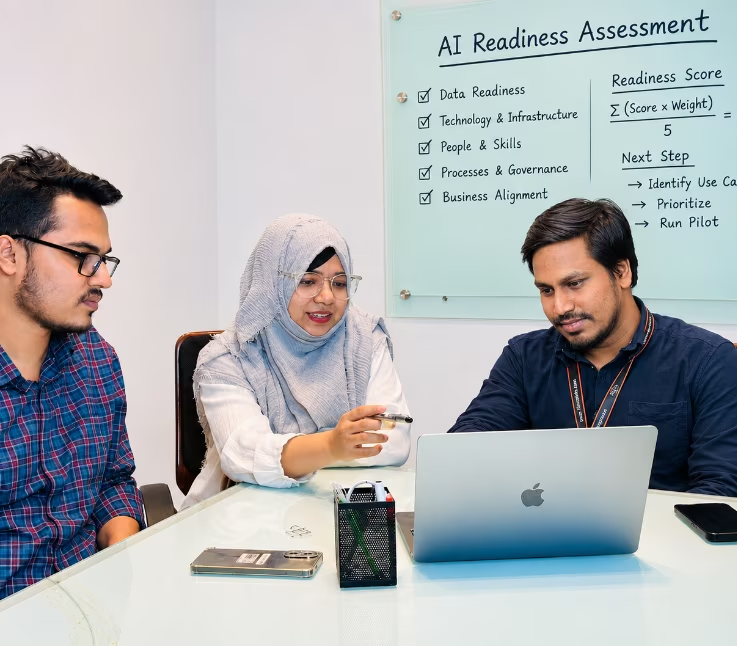
An AI readiness assessment is a structured evaluation of an organization’s preparedness to adopt, implement, and scale artificial intelligence (AI). It examines business strategy, data quality, technology infrastructure, workforce capabilities, AI governance, and operational processes to identify capability gaps, reduce implementation risks, and develop an effective AI adoption strategy.
For example, a company planning to implement AI-powered customer service can use an assessment to determine whether its CRM data, existing systems, and employees are ready for conversational AI.
The assessment provides a clear picture of your organization’s AI implementation readiness and helps prioritize high-value AI use cases based on business objectives, technical feasibility, and expected return on investment (ROI).
Is Your Business Ready for AI or Risking Costly Mistakes?
Investing in AI without proper preparation can lead to wasted budgets, failed implementations, and operational disruptions. As a business owner or CEO, the challenge isn’t just adopting AI. It’s ensuring your investment solves real business problems and delivers measurable ROI.
From my perspective, an AI readiness assessment helps businesses avoid these costly mistakes by identifying gaps, evaluating opportunities, and building a clear path toward successful AI adoption.
Here’s why it matters for your business:
- Avoid Wasted AI Investments: Identify high-value AI use cases that align with your business objectives instead of spending on tools that don’t solve real problems.
- Identify Hidden Technology Gaps: Assess data quality, existing infrastructure, and system integration capabilities before they cause costly implementation delays.
- Reduce Financial and Operational Risks: Evaluate implementation costs, technical feasibility, security concerns, and potential risks before committing your budget.
- Prepare Your Workforce for AI: Identify employee skill gaps, training needs, and workflow challenges to prevent resistance and productivity loss.
- Maximize AI ROI and Scalability: Prioritize AI opportunities with measurable business value and develop a realistic roadmap for scaling successful solutions.
AI success isn’t about how much you invest in technology. It’s about investing in the right opportunities at the right time. An AI readiness assessment helps you make those decisions with greater confidence.
This is also reflected in how our CEO views AI readiness and its role in business transformation.
“The biggest risk in AI transformation isn’t choosing the wrong technology. It’s solving the wrong problem with the right technology. I believe AI readiness is about knowing where to invest, what to fix first, and which opportunities can create measurable value. My vision is to help businesses turn AI from an expensive experiment into a lasting competitive advantage.”

6 Business Gaps That Could Derail Your AI Investment
An AI readiness assessment evaluates six key dimensions to determine how prepared your organization is for AI adoption. These include:
- Operation
- Business strategy
- Data
- Technology
- Workforce
- Governance
Each dimension addresses a different part of AI implementation readiness. Together, they help you identify capability gaps, assess potential risks, and build a practical AI adoption strategy.
Here’s what you should evaluate in each area.
1. Business Strategy and Leadership Readiness
AI adoption should start with clear business goals and strong leadership support. Without these, companies may invest in AI solutions that fail to address their actual needs.
This dimension evaluates how well your AI implementation strategy aligns with business objectives. It also examines leadership commitment, investment priorities, and accountability.
Key areas to assess:
- Business alignment: Are your AI initiatives connected to goals such as cost reduction, revenue growth, or customer satisfaction?
- Leadership commitment: Do executives support AI adoption and provide the necessary resources?
- Budget allocation: Have you planned for AI development, implementation, training, and maintenance costs?
- AI use case prioritization: Do you have a process for selecting AI projects based on business impact and expected ROI?
- Performance measurement: Have you established clear KPIs to evaluate AI success?
Example: A SaaS company wants to improve customer retention. Its leadership should first evaluate whether AI-powered churn prediction can address this goal. A business impact assessment can help estimate its potential value before investment.
2. Data Readiness and Governance
Reliable data is essential for successful AI implementation. Poor data quality can affect the accuracy of machine learning models, generative AI applications, and predictive analytics.
This dimension evaluates whether your organization has the right data to support its planned AI use cases. It also examines how that data is collected, stored, accessed, and managed.
Key areas to assess:
- Data quality: Is your data accurate, complete, consistent, and up to date?
- Data accessibility: Can authorized systems and employees access the required information?
- Data integration: Can your CRM, ERP, and other business applications exchange relevant data?
- Data governance: Are data ownership, access permissions, and retention policies clearly defined?
- Data availability: Do you have enough relevant information for your intended AI applications?
Example: An e-commerce company plans to introduce AI-powered product recommendations. However, its customer behavior and purchase history are stored in separate systems. An AI readiness assessment can identify these data gaps before implementation.
3. Technology and Infrastructure Readiness
Your existing technology infrastructure determines how easily AI solutions can be deployed and scaled. Outdated systems, limited computing resources, and integration challenges can slow down AI adoption.
This dimension measures infrastructure readiness and technical feasibility for your planned AI initiatives.
Key areas to assess:
- Computing capabilities: Do you have sufficient cloud resources, storage, and processing power?
- System compatibility: Can AI solutions work with your existing software and business applications?
- API integration: Can your systems connect with AI platforms through APIs and other integration tools?
- Scalability: Can your infrastructure support more users, data, and AI workloads over time?
- Monitoring capabilities: Can your IT team track system performance, reliability, and operating costs?
Example: A technology company wants to add a generative AI assistant to its SaaS platform. Before development, it should assess API compatibility, cloud infrastructure, security controls, and the expected cost of using large language models (LLMs).
4. Workforce and Organizational Readiness
AI adoption changes how employees work and make decisions. Without proper training and organizational support, even effective AI solutions may remain underused.
This dimension evaluates workforce readiness, employee AI skills, and organizational readiness for AI-driven changes.
Key areas to assess:
- AI literacy: Do employees understand how AI tools work and where their limitations lie?
- Technical expertise: Does your organization have access to AI engineers, data scientists, or other required specialists?
- Employee training: Are there practical training programs for AI-powered workflows?
- Change management: Is there a clear plan to help employees adapt to new technologies?
- Organizational culture: Are employees encouraged to learn, experiment, and provide feedback?
Example: A BPO company introduces an AI-powered quality assurance platform. Its agents and supervisors need training to interpret AI evaluations and identify inaccurate results. This preparation can improve employee confidence and support AI adoption.
5. AI Governance, Security, and Compliance Readiness
AI adoption can introduce risks involving data privacy, inaccurate outputs, unauthorized access, and regulatory compliance. These risks become more important when AI handles sensitive information or supports critical business decisions.
This dimension evaluates whether your organization has the policies and controls needed for responsible AI implementation. Strong AI governance during transformation is especially important as AI moves into everyday business decisions.
Key areas to assess:
- AI governance: Are there clear policies for developing, deploying, and using AI systems?
- Data security: Are sensitive customer, employee, and business records protected?
- Regulatory compliance: Do your AI applications meet relevant legal and industry requirements?
- Model reliability: Are AI outputs tested for accuracy, bias, and potential errors?
- Human oversight: Can employees review and override important AI-generated decisions?
- Risk management: Is there a process for identifying and responding to AI-related risks?
Example: A financial institution wants to use machine learning for loan assessments. Before deployment, it should evaluate data privacy, model fairness, explainability, and human oversight. Frameworks such as the NIST AI Risk Management Framework can help structure this process.
6. Operational and Process Readiness
AI technology delivers value when it improves real business operations. However, unclear workflows and inconsistent processes can make AI integration difficult.
This dimension evaluates whether your existing operations are suitable for intelligent automation and enterprise workflows and AI-powered processes.
Key areas to assess:
- Process documentation: Are your important business workflows clearly defined?
- Process standardization: Do employees follow consistent procedures across departments?
- Automation opportunities: Have you identified repetitive tasks that AI could improve?
- Workflow integration: Can AI solutions connect with existing operational systems?
- Human-AI collaboration: Are responsibilities clearly divided between employees and AI systems?
- Operational KPIs: Can you measure improvements in processing time, accuracy, and efficiency?
Example: An insurance company wants to automate claims processing using agentic AI. Before implementation, it should evaluate its existing approval workflows, document handling procedures, and exception management processes. This helps identify which tasks can be automated safely.
Free AI Assessment
Is Your Business Truly Ready for AI?
Identify readiness gaps, uncover high-value AI opportunities, and plan your next move with confidence.
Assess Your AI ReadinessAI Readiness Assessment Checklist for Businesses
Before investing in AI, you need to understand whether your organization has the right strategy, data, technology, people, and processes to support it.
An AI readiness assessment checklist for enterprises helps you evaluate these capabilities, identify critical gaps, and prepare for successful AI adoption.
I recommend using this checklist with your leadership, IT, operations, and business teams. Review each statement based on your current capabilities, not future plans.
This checklist provides an initial understanding of your enterprise AI readiness. Use the findings to guide a detailed AI readiness assessment and develop a practical AI implementation strategy.
How to Calculate Your AI Readiness Score Before Investing?
Before committing your budget to AI, you need to understand how prepared your business is and which gaps could affect your investment.
An AI readiness score helps you measure your current capabilities on a scale of 0–100, identify weaknesses, and decide whether to move forward with AI implementation.
A weighted scoring model helps businesses calculate their overall AI readiness by evaluating each dimension according to its importance to their AI implementation goals.
I recommend using a weighted scoring model based on the six key dimensions of AI readiness. This provides a structured way to evaluate your organization’s AI implementation readiness. Here’s a simple three-step approach.
Step 1: Rate Your Business Across 6 Key Areas
Score each AI readiness dimension from 1 (Not Ready) to 5 (Fully Ready) based on your current business capabilities.
| AI Readiness Dimension | Weight |
|---|---|
| Business Strategy and Leadership | 20% |
| Data Readiness and Governance | 20% |
| Technology and Infrastructure | 15% |
| Workforce and Organizational Readiness | 15% |
| AI Governance, Security, and Compliance | 15% |
| Operational and Process Readiness | 15% |
| Total | 100% |
These weights are illustrative and can be adjusted based on your business priorities.
Step 2: Calculate Your Overall AI Readiness Score
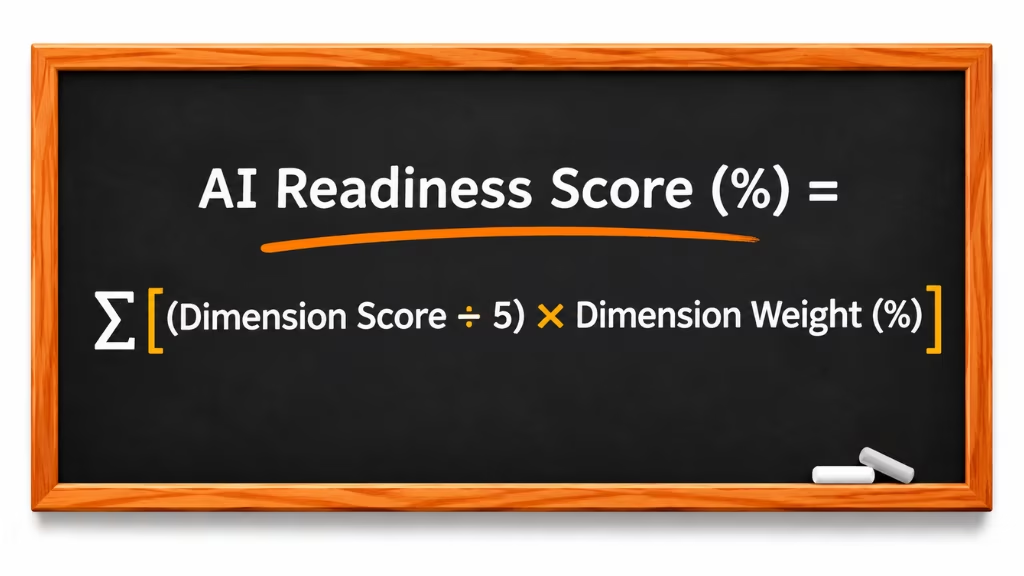
Multiply each dimension’s rating by its assigned weight. Then, divide the result by the maximum rating of 5 to convert it into a percentage.
Use this formula:
AI Readiness Score (%) = Σ [(Dimension Score ÷ 5) × Dimension Weight (%)]
For example, consider a mid-sized SaaS company with these assessment results:
| AI Readiness Dimension | Score (1–5) | Weight | Weighted Score |
|---|---|---|---|
| Business Strategy | 4 | 20% | 16 |
| Data Readiness | 3 | 20% | 12 |
| Technology Readiness | 4 | 15% | 12 |
| Workforce Readiness | 3 | 15% | 9 |
| AI Governance | 2 | 15% | 6 |
| Operational Readiness | 4 | 15% | 12 |
| Total | 100% | 67/100 |
The company’s overall AI readiness score is 67 out of 100.
This suggests it has a reasonable foundation for selected AI initiatives. However, it should improve data governance before implementing applications that handle sensitive information.
Step 3: Interpret Your AI Readiness Score
Use the following score ranges to understand your organization’s readiness level.
| AI Readiness Score | Readiness Level | Recommended Action |
|---|---|---|
| 0–39 | Low Readiness | Address major gaps in strategy, data, and infrastructure |
| 40–59 | Developing Readiness | Strengthen workforce skills, technology, and governance |
| 60–79 | Moderate Readiness | Start suitable AI pilot projects and improve weak areas |
| 80–100 | High Readiness | Scale validated AI solutions and monitor performance |
These score ranges are suggested assessment guidelines, not universally accepted industry benchmarks.
A high score does not guarantee successful AI implementation. You should also evaluate the technical feasibility, risks, and data requirements of each planned AI use case.
Remember: Your AI readiness score is a decision-making tool, not a certification. The real value comes from understanding your weaknesses and taking the right steps toward successful AI adoption.
How to Assess Your Business Before Investing in AI
Conducting an AI readiness assessment helps you understand how prepared your business is for AI adoption. It identifies gaps in your existing capabilities and shows what needs improvement before implementation.
I recommend following a structured AI readiness assessment framework to evaluate your business strategy, data, technology, workforce, and governance. This approach helps you make informed decisions and select AI opportunities that deliver measurable value.
Here are five practical steps to assess AI readiness in your organization.
Step 1: Define Business Goals and AI Objectives
Start by identifying the business problems you want AI to solve. Focus on challenges such as high operating costs, slow workflows, customer churn, or low productivity.
Discuss these challenges with department heads and key stakeholders. Then, set measurable AI objectives based on your business priorities.
For example, a BPO company may want to reduce the time agents spend preparing call summaries. It could set a target to reduce manual documentation time by 30% through AI-powered automation.
You should also assign ownership, establish KPIs, and determine your available budget. This ensures your AI adoption strategy supports real business needs.
Expected outcome: Clear business objectives, measurable KPIs, and defined priorities for AI investment.
Step 2: Assess Data, Technology, and Infrastructure
Next, evaluate whether your existing data and technology can support your planned AI initiatives.
Start with data readiness. Examine data quality, accessibility, consistency, and availability. Then, assess your cloud infrastructure, databases, computing resources, and storage capacity.
You should also review AI integration capabilities. Check whether your CRM, ERP, and other business systems can connect with AI applications through APIs.
For example, a SaaS company planning to introduce a generative AI assistant should examine its internal knowledge base, API compatibility, and security controls. It should also estimate the operating costs of using large language models (LLMs).
This assessment helps you identify technical limitations before development begins.
Expected outcome: A clear understanding of your data readiness, infrastructure readiness, and technical gaps.
Step 3: Evaluate Workforce, Processes, and Governance
AI implementation requires more than suitable technology. Your employees, workflows, and internal policies must also support the changes.
Begin by assessing workforce readiness and organizational readiness. Identify employee skill gaps, training requirements, and potential resistance to AI adoption.
Next, review your existing business processes. Look for repetitive activities, unclear responsibilities, and workflows that could benefit from intelligent automation.
You should also evaluate AI governance, data security, privacy policies, and regulatory compliance. Identify which AI-generated decisions require human review.
For example, a financial services company planning AI-powered document processing should evaluate employee skills and existing approval procedures. It must also establish appropriate security controls for sensitive financial data.
Expected outcome: A documented assessment of workforce capabilities, operational limitations, and AI governance requirements.
Step 4: Calculate AI Readiness Scores and Identify Gaps
Once you have gathered the necessary information, measure your organization’s readiness using a consistent scoring method.
Use an AI readiness scoring framework to evaluate the six core dimensions. Assign each dimension a score from 1 to 5 based on documented evidence. You can also apply different weights based on your business priorities.
Compare the results with the requirements of your planned AI applications. This helps you identify capability gaps and determine which improvements deserve immediate attention.
For example, your company may score 4/5 in technology readiness but only 2/5 in data governance. This suggests your technical infrastructure is relatively strong, but your data policies need improvement.
Prioritize gaps based on their potential impact on implementation, security, and business performance.
Expected outcome: An AI readiness scorecard, identified capability gaps, and a prioritized improvement plan.
Step 5: Identify and Prioritize AI Use Cases
The final step is determining where AI can create the most business value.
Start by identifying potential applications across customer service, sales, software development, HR, and back-office operations. Then, conduct an AI opportunity assessment to evaluate each use case.
Consider its expected business impact, technical feasibility, data requirements, implementation costs, and potential risks. A cost-benefit analysis can help estimate AI ROI and support better investment decisions.
For example, a BPO company may identify AI call summarization, conversational AI, and agentic AI workflow automation as potential opportunities.
I would recommend comparing these options through AI use case scoring. If call summarization offers strong business value with fewer integration challenges, it may be the most practical starting point.
Choose a suitable use case for an AI pilot project or proof of concept (PoC) before committing to wider implementation.
Expected outcome: A prioritized list of high-value AI use cases and a clear starting point for your AI transformation roadmap.
How to Score AI Use Cases Before Investing Your Budget
A simple scoring model can help you compare potential AI investments. Rate each factor from 1 to 5. For risk suitability, a higher score means lower risk.
Priority Score = (Business Value × 40%) + (Technical Feasibility × 30%) + (Risk Suitability × 30%)
For example, a BPO company might compare these opportunities:
| AI Use Case | Business Value | Feasibility | Risk Suitability | Priority Score |
|---|---|---|---|---|
| AI Call Summarization | 5 | 5 | 4 | 4.7/5 |
| AI-Powered Quality Assurance | 5 | 4 | 4 | 4.4/5 |
| Autonomous Customer Support | 5 | 2 | 2 | 3.2/5 |
Note: These scores are illustrative. Actual priorities depend on your organization’s readiness assessment results.
In this example, AI call summarization is the strongest starting point. It offers high potential value with fewer implementation challenges.
Before investing, validate your preferred use case through an AI pilot project or proof of concept (PoC). Measure its performance against clear business KPIs.
Remember, a high priority score does not override serious security or compliance risks.
High-Value AI Use Cases for Business Transformation
Once you complete an AI readiness assessment, the next step is identifying where AI can create the most business value. Different departments have different challenges. The right AI solution should address those challenges and deliver measurable improvements.
I recommend focusing on AI use cases that match your business goals, data readiness, and technical capabilities. Here are six high-value AI opportunities worth considering for your AI transformation roadmap.
1. AI-Powered Customer Service and Conversational AI
Customer service is one of the most practical areas for AI adoption. Businesses can use conversational AI, natural language processing (NLP), and large language models (LLMs) to automate routine customer interactions.

AI chatbots and voice agents can answer common questions, track orders, schedule appointments, and provide 24/7 support. AI-powered customer experience solutions in practice show how these capabilities can work alongside human support teams. AI-powered agent assistance can also suggest responses and summarize conversations for human agents.
Example: An e-commerce company receives hundreds of daily inquiries about orders, refunds, and deliveries. An AI chatbot connected to its CRM can handle routine questions. Human agents can then focus on complex customer issues.
Business value: Faster response times, lower support costs, improved agent productivity, and better customer experiences.
2. AI-Driven BPO and Back-Office Automation
BPO companies and enterprises often spend significant time on repetitive administrative tasks. Intelligent automation, machine learning, and intelligent document processing (IDP) can reduce this manual workload.

AI can extract information from invoices, process documents, classify emails, update records, and support quality monitoring. These applications build on established business process automation methods. It can also help automate workflows across finance, customer support, and other back-office operations.
Example: A financial services company manually processes hundreds of supplier invoices. An AI-powered document processing system can extract invoice details and validate them against existing records. Employees only need to review exceptions and approve payments.
Business value: Reduced processing time, fewer manual errors, lower operational costs, and improved efficiency.
3. AI-Powered Software Development and Quality Assurance
Software and SaaS companies can use generative AI and machine learning to improve software development and testing processes.

AI coding assistants can help developers generate code, identify bugs, and create technical documentation. AI-powered quality assurance tools can generate test cases, analyze defects, and support regression testing.
However, developers should still review AI-generated code and validate test results before deployment.
Example: A SaaS company struggles with lengthy software testing cycles. AI-assisted testing tools can help its QA team generate test cases and identify high-risk application areas. This allows engineers to focus on critical defects and improve testing efficiency.
Business value: Shorter development cycles, faster testing, improved code quality, and reduced repetitive work.
4. AI for Sales, Marketing, and CRM Automation
Sales and marketing teams can use predictive analytics, machine learning, and generative AI to improve customer engagement and sales performance.
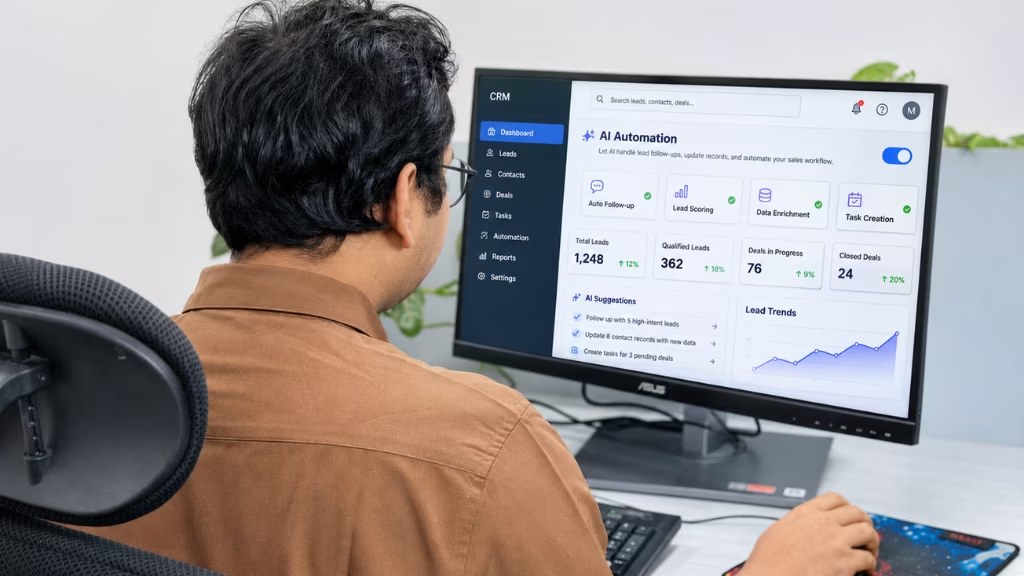
AI can score leads, segment customers, forecast sales, personalize marketing campaigns, and automate CRM updates. For B2B teams, AI-driven sales outreach offers another example of using data to prioritize and personalize customer engagement. It can also analyze customer behavior to identify potential sales opportunities.
Example: A B2B technology company receives leads from several marketing channels. Its sales team struggles to identify the most promising prospects. An AI-powered lead scoring system can analyze customer interactions and historical conversion data to rank leads.
Sales representatives can then focus on prospects with stronger conversion potential.
Business value: Better lead prioritization, improved sales productivity, more relevant marketing, and higher conversion potential.
5. AI for HR and Employee Productivity
HR departments can use AI-powered assistants, natural language processing, and intelligent automation to simplify administrative tasks and improve employee support.

AI can answer employee questions, organize HR documents, assist with onboarding, and recommend training resources. It can also support workforce planning by analyzing staffing needs and employee data.
Sensitive employment decisions should remain subject to appropriate human oversight.
Example: A multinational company receives frequent employee questions about leave policies, payroll, and benefits. An AI-powered HR assistant connected to its approved knowledge base can answer routine inquiries. HR professionals can then focus on complex employee matters.
Business value: Less administrative work, faster employee support, improved HR efficiency, and better access to internal information.
6. Generative AI and Agentic AI for Enterprise Operations
Generative AI and agentic AI can help enterprises manage complex information and automate multi-step business workflows.
Generative AI uses large language models (LLMs) to create content, summarize documents, and answer questions. Agentic AI goes further by using approved tools to perform tasks and coordinate actions across business systems.
For example, AI agents can retrieve internal information, create support tickets, update CRM records, and prepare reports. These actions require suitable permissions, security controls, and human oversight.
Example: A large enterprise stores business information across multiple departments and platforms. An AI knowledge assistant can help employees find information from approved sources. An AI agent can then use that information to prepare service requests or initiate approved workflows.
Business value: Faster information access, reduced manual coordination, improved operational efficiency, and more scalable business processes.
What’s Holding Back Your AI Transformation?
Overcome readiness gaps and move toward smarter operations.
Accelerate Your AI JourneyIs Your Business Facing These Common AI Adoption Challenges?
Yes, and you might not realize it until your AI investment starts going wrong.
Don’t try to solve every problem at once!
A business invests in AI expecting faster operations and lower costs. But implementation tells a different story. Customer data is scattered, existing systems cannot connect, and employees struggle with the new tools. What seemed like a promising investment quickly becomes a costly challenge.
I believe many of these problems can be avoided with a proper AI readiness assessment. It helps businesses identify potential barriers early and prepare for successful AI adoption.
Here are six common challenges and practical ways to address them:
| AI Adoption Challenges | Business Impact | How to Overcome Them |
|---|---|---|
| Poor Data Quality and Disconnected Systems | Unreliable AI results and inefficient operations | Improve data quality, establish data governance, and integrate essential systems. |
| Outdated Technology and Integration Issues | Higher implementation costs and project delays | Assess infrastructure readiness, upgrade critical systems, and improve API connectivity. |
| Employee Skill Gaps and Resistance | Low AI adoption and limited productivity gains | Provide practical AI training, involve employees early, and establish clear responsibilities. |
| Unclear AI Strategy and Priorities | Wasted budgets and poor AI ROI | Align AI initiatives with business goals and prioritize high-value use cases. |
| Security, Privacy, and Governance Risks | Data exposure, compliance issues, and reputational damage | Strengthen security controls, establish AI governance, and ensure human oversight. |
| Difficulty Scaling AI Solutions | Rising operating costs and inconsistent performance | Validate pilot results, assess scalability, and expand based on measurable ROI. |
Focus on fixing the gaps that could cost your business the most. You don’t need to solve every challenge before adopting AI, but you do need to address the ones that could put your investment at risk.
What’s Next After Your AI Readiness Assessment?
Completing an AI readiness assessment is only the beginning. The next challenge is turning your findings into a practical AI implementation strategy.
Once you’ve identified readiness gaps and prioritized AI use cases, the next step is building a practical implementation plan. Understanding the broader AI digital transformation process can help you connect these findings with your business strategy, technology investments, and long-term goals.
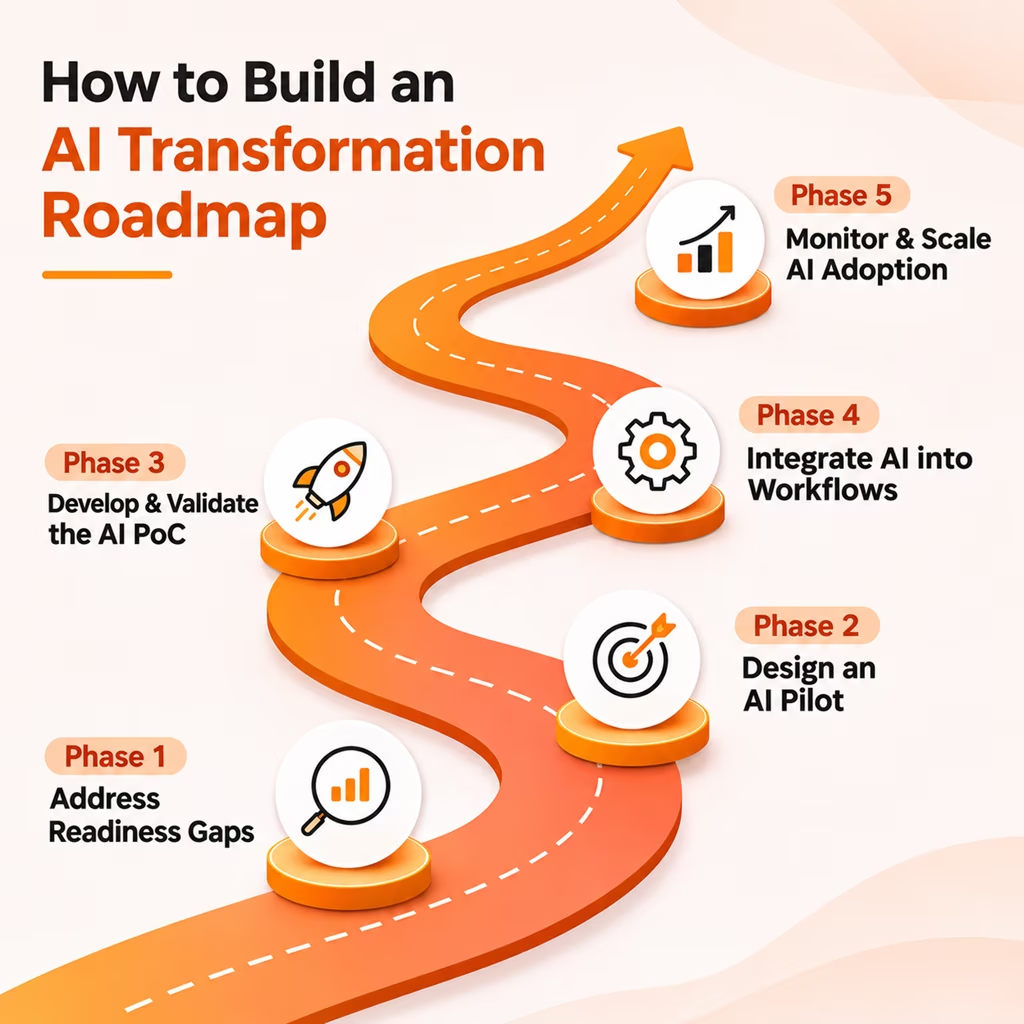
I recommend following these five phases to turn your assessment results into measurable business outcomes.
Phase 1: Address Critical Readiness Gaps
Start by addressing the weaknesses identified in your AI readiness assessment that could put your investment at risk. Focus on improving data quality, technology infrastructure, employee skills, and AI governance. Prioritize the gaps that directly affect your planned AI initiatives rather than trying to fix everything at once.
Phase 2: Select and Design a High-Value AI Pilot
Identify an AI opportunity that solves a pressing business problem and offers measurable value. Compare potential AI use cases based on implementation costs, technical feasibility, business impact, and expected ROI. Select a manageable pilot project with a clear budget, timeline, and performance goals before making a larger investment.
Phase 3: Develop and Validate the AI Proof of Concept
Before committing to full implementation, validate your selected AI solution through a proof of concept (PoC). Test its accuracy, performance, security, and compatibility with existing systems. Use real business scenarios to determine whether the solution can deliver the expected results without introducing unnecessary costs or operational risks.
Phase 4: Integrate AI into Existing Business Workflows
Once your AI solution demonstrates promising results, integrate it into your existing business workflows. Connect it with essential systems such as CRM, ERP, and internal databases. Prepare employees through practical training, establish clear responsibilities, and implement appropriate security controls to minimize disruptions during deployment.
Phase 5: Monitor Performance and Scale AI Adoption
Track how AI affects your operating costs, employee productivity, customer satisfaction, and overall business performance. Compare actual results against your initial KPIs and investment expectations. If the solution delivers consistent value, gradually expand it across other teams or departments while monitoring costs, performance, and scalability.
Use these findings to improve your AI adoption strategy and identify future opportunities.
Which AI Readiness Framework Is Right for Your Business?
Choosing the right AI readiness assessment framework helps you evaluate your business capabilities, identify gaps, and prepare for successful AI adoption. However, the best framework depends on your business size, industry, goals, and current AI maturity.
I recommend considering these factors before selecting a framework:
- Business Goals: Choose a framework that aligns with your AI adoption strategy and business objectives.
- AI Maturity: Ensure it matches your current AI adoption stage and implementation readiness.
- Assessment Coverage: Check whether it evaluates strategy, data, technology, workforce, governance, and operations.
- Industry Requirements: Consider security, compliance, and responsible AI standards such as NIST AI RMF and ISO/IEC 42001.
- Readiness Scoring: Look for clear scoring methods to measure capabilities and identify gaps.
- AI Use Case Prioritization: Ensure it supports use case selection based on business value, feasibility, and expected ROI.
- Actionable Recommendations: Choose a framework that identifies weaknesses and suggests practical improvements.
- Scalability: Ensure it supports future AI projects and your long-term AI transformation roadmap.
Select a framework that helps you understand your AI readiness, prioritize improvements, and turn assessment results into practical business decisions.
When Should Businesses Work with an AI Technology Partner?
An AI readiness assessment may reveal opportunities your internal team cannot handle alone. You might have clear AI goals but lack the technical skills, infrastructure, or resources needed for implementation.
A 2026 study by Precisely and Drexel University found that 87% of leaders believe their organizations are AI-ready. Yet 43% identify data readiness as their biggest obstacle. This highlights the gap between AI ambitions and actual implementation capabilities.
This is where an experienced AI technology partner can help. Riseup Labs’ AI transformation case study also illustrates how adoption can evolve into broader operational change. The right partner can assess your capabilities, identify high-value AI use cases, and turn your AI adoption strategy into practical solutions.
I believe businesses should consider external AI expertise when implementation challenges begin to exceed their internal capabilities.
Signs Your Business Needs External AI Expertise
Not every organization needs an external AI partner. However, some challenges are difficult to resolve without specialized knowledge and experience.
Here are some signs that your business may need support:
- Limited AI expertise: Your team lacks experience with machine learning, generative AI, large language models (LLMs), or agentic AI.
- Poor data and infrastructure readiness: Your existing data, cloud systems, or applications cannot support planned AI solutions.
- Difficulty selecting AI use cases: You have several AI opportunities but struggle with AI use case prioritization and technical feasibility.
- Failed or stalled AI pilots: Your proof of concept (PoC) works in testing but cannot move into production.
- Complex AI integration: Your AI applications need to connect with existing CRM, ERP, or legacy systems.
- Security and compliance concerns: Your organization needs stronger AI governance, data protection, and responsible AI practices.
- Limited implementation resources: Your internal team cannot manage AI development, employee training, and ongoing maintenance.
For example, a mid-sized BPO company may want to introduce conversational AI and intelligent automation. However, its internal team may lack the skills to integrate these solutions with existing customer service systems.
An AI technology partner can help address these gaps without requiring the company to build an entire AI engineering team.
What to Look for in an AI Technology Partner
Choosing the right partner requires more than checking technical expertise. You need a team that understands your business challenges and can demonstrate how AI will create measurable value.
I recommend evaluating potential partners based on these factors:
- AI engineering expertise: Experience with machine learning, generative AI, LLMs, conversational AI, and intelligent automation.
- Business understanding: Ability to connect AI solutions with your operational challenges and strategic objectives.
- AI readiness assessment capabilities: A structured approach to evaluating data readiness, infrastructure, workforce capabilities, and governance.
- AI use case evaluation: Experience identifying and prioritizing AI projects based on business impact, feasibility, and expected ROI.
- System integration experience: Ability to connect AI applications with existing enterprise software, APIs, and cloud platforms.
- Security and AI governance: Clear practices for data privacy, model reliability, compliance, and human oversight.
- Proven implementation results: Relevant case studies, measurable outcomes, and experience scaling AI beyond pilot projects.
- Long-term technical support: Ability to monitor, maintain, and improve AI solutions after deployment.
Before choosing a partner, ask how they measure success. A reliable partner should explain the expected business outcomes, implementation requirements, potential risks, and ongoing costs.
Your business may be ready for AI. But are you investing in the right opportunities?
Found Gaps in Your AI Readiness?
Let’s figure out what to fix first and how to move forward.
Final Thoughts
AI adoption isn’t just about choosing the latest technology. It’s about knowing whether your business is ready to use it effectively.
An AI readiness assessment helps you understand your current capabilities, identify critical gaps, and select AI opportunities that align with your business goals. It also provides clear direction to reduce risk, improve AI ROI, and build a practical AI transformation roadmap.
From my perspective, businesses shouldn’t rush to implement AI everywhere. Start by solving one meaningful problem. Evaluate your readiness, prioritize high-value AI use cases, and test your approach before scaling.
Remember, successful AI transformation isn’t measured by how many AI tools you adopt. It’s measured by the real business value they create.
Frequently Asked Questions
Here are answers to common questions about AI readiness assessment, implementation costs, organizational requirements, and preparing your business for successful AI adoption.
1. How long does an AI readiness assessment typically take?
An AI readiness assessment typically takes 2 to 6 weeks, depending on your organization’s size, technical complexity, and assessment scope. Small businesses may complete a basic assessment within a few days. Large enterprises may need 6 to 12 weeks or longer to evaluate multiple departments, data systems, and governance requirements.
2. Who should be involved in an organization’s AI readiness assessment?
An AI readiness assessment should involve business leaders, IT teams, data specialists, operations managers, HR representatives, and security experts. Each team evaluates a different part of AI implementation readiness. Executive leadership should also participate to align AI initiatives with business goals, budgets, and long-term strategy.
3. What information and resources are needed to conduct an AI readiness assessment?
You need business objectives, technology inventories, data quality reports, workflow documentation, employee skill assessments, and security policies. You should also review existing CRM, ERP, cloud infrastructure, and AI tools. These resources help identify capability gaps and evaluate your organization’s readiness for AI implementation.
4. How often should a business reassess its AI readiness?
Businesses should consider reassessing their AI readiness every 6 to 12 months. You may need more frequent reviews when introducing new AI systems, changing infrastructure, or expanding into new markets. Regular assessments help you track improvements, identify emerging risks, and keep your AI adoption strategy aligned with business needs.
5. Can a business adopt AI if its data infrastructure is not fully mature?
Yes. You can start AI adoption without having a fully mature data infrastructure. The requirements depend on your chosen AI use case. For example, an AI chatbot may only need an accurate knowledge base. However, predictive analytics may require reliable historical data. Start with manageable AI applications while improving your data readiness.
6. What are the biggest signs that a business is not ready for AI adoption?
Common warning signs include poor data quality, outdated technology, unclear AI objectives, limited employee skills, and weak AI governance. A lack of leadership support or measurable KPIs can also indicate low AI readiness. These gaps do not mean you must avoid AI. They show what needs improvement before implementation.
7. Should businesses conduct an AI readiness assessment before investing in generative AI?
Yes. An AI readiness assessment helps businesses evaluate their data, infrastructure, security, and workforce capabilities before investing in generative AI. It also helps identify suitable applications for large language models (LLMs). This reduces implementation risks and supports better decisions about AI integration, costs, and expected business value.
8. What is the difference between an AI readiness assessment and an AI audit?
An AI readiness assessment evaluates whether your organization is prepared to adopt or scale AI. It examines strategy, data, technology, workforce, and governance. An AI audit reviews existing AI systems to assess performance, security, reliability, and compliance. In simple terms, readiness assessment focuses on preparation, while AI auditing focuses on evaluating existing systems.
9. How much does an AI readiness assessment cost?
The cost of an AI readiness assessment depends on your business size, assessment scope, and technical requirements. A basic internal assessment may involve only staff time and existing resources. A comprehensive enterprise assessment may require external consultants, technical reviews, and workshops. Request a scope-based estimate to understand the expected investment.
10. Can an AI technology partner help businesses improve their AI readiness?
Yes. An experienced AI technology partner can assess your current capabilities, identify technical gaps, and recommend suitable AI use cases. They can also support data preparation, AI integration, pilot development, and implementation planning. This helps businesses build a practical AI transformation roadmap and prepare for scalable AI adoption.
This page was last edited on 13 November 2026, at 6:19 pm
Start a conversation with our team to solve complex challenges and move forward with confidence.