Quick Answer:
Large language models are shaping the future by automating knowledge work, improving decision-making, and powering smarter tools across business, healthcare, finance, coding, and customer service. Their impact will grow through real-time data access, multimodal capabilities, specialized models, lower costs, and deeper workflow integration—while accuracy, bias, and safety remain key challenges.
Large language models are not just chatbots anymore. They write code, answer customer questions, and help doctors check medical notes. Understanding how large language models shape the future means looking at where they came from, what they can do now, and where they are headed next.
This article is a full guide to the future of large language models: the trends driving them forward, the limits still holding them back, and the top platforms leading the field today.
How LLMs Got Here
Language AI is older than most people think. Back in 1950, IBM researchers built a system that translated Russian into English. It was simple, but it was a start.
For decades after that, researchers tried other methods. They built rule-based systems. They tested word maps called “ontologies.” None of these worked very well.
Then neural networks changed the game. First came word embeddings. Then came recurrent neural networks. Then came LSTM models. Each step made language AI a little smarter. The real breakthrough came with the transformer architecture. This led to models like BERT and GPT-3. These models could write text that sounded human. GPT-4 pushed this even further with better reasoning and nuance.
Interest in this technology exploded after ChatGPT launched in 2022. Millions of regular people, not just engineers, started using AI every day. That is a big reason why so many people now ask how large language models shape the future of work and everyday life.
What Large Language Models Can Do Today
Before we look ahead, let’s look at what these models already do well. As base models, LLMs power many tasks at once.
They translate between languages. They summarize long documents. They answer questions fast. They write new text from a simple prompt. They sort documents by topic. They recommend content based on context. They read sentiment in customer feedback. They model language patterns. They pull out key phrases from messy text. They catch spelling mistakes. They fix grammar errors.
These skills add up to real-world tools. LLMs rewrite content to make it clearer. They power chatbots and virtual assistants. They write working code and SQL queries. They help marketing teams write better ad copy and spot emotional tone in customer messages. Each of these uses adds another piece to the bigger picture. Large language model use is spreading into nearly every office job that involves words, numbers, or data.
Future Trends of Large Language Models
The next sections cover eight key future trends of LLMs. Together, they show how large language models shape the future of business, science, and daily life.
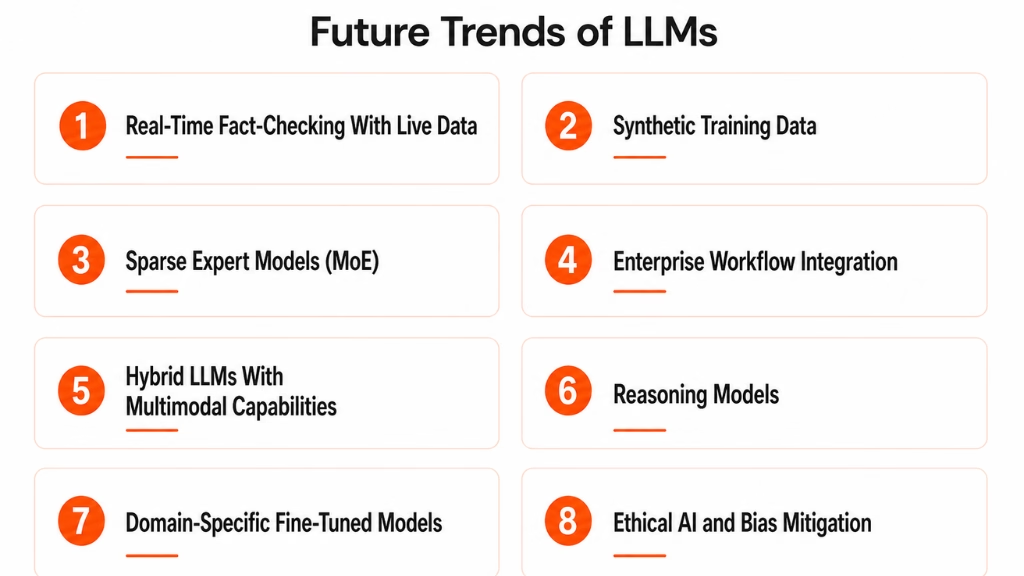
1. Real-Time Fact-Checking With Live Data
Older models only knew what they learned during training. Newer models can search the web mid-conversation. They pull in fresh facts and add citations to their answers. This does not fix every error, though. A model can still misread a source or cite it incorrectly.
Microsoft Copilot shows this trend well. It now runs on GPT-5.4, thinking with live internet access. It offers two modes: “Quick Response” for simple tasks and “Think Deeper” for harder ones.
Microsoft also built a “Researcher” agent. It uses GPT to write a first draft, then has Claude check that draft for accuracy. This combo improved results by 13.8% on the DRACO deep-research benchmark compared to single-model systems, according to GeekWire
ChatGPT and Perplexity also search the web for current events. Both add source links to their answers.
2. Synthetic Training Data
Models used to need huge piles of human-labeled text. Now, some models create their own training data instead. Google ran an experiment where a model wrote its own questions, answered them, and then trained on those answers.
The results were strong. Math scores on the GSM8K benchmark jumped from 74.2% to 82.1%. Reading comprehension scores on DROP rose from 78.2% to 83.0%. These numbers come from the research paper “Large Language Models Can Self-Improve.”
OpenAI, Anthropic, and Google all use this method now. It cuts labeling costs. But it also creates a new risk: a model can repeat and grow its own mistakes if no one checks the data.
This matters because old scaling tricks may be running out of room. A March 2026 survey found that 76% of AI researchers think gains from adding more compute and data have slowed down. Big labs are reporting smaller and smaller returns despite spending more money.
That finding points to a new path forward. Future gains may come from smarter architecture, not just bigger models.
3. Sparse Expert Models (Mixture of Experts)
Most models try to use their full network for every task. Mixture of Experts (MoE) models work differently. They only turn on a small, relevant part of the network for each input. This saves a lot of computing power.
Meta’s Llama 4 Scout is a good example. It has 109 billion total parameters, but only 17 billion are active at once. It can still handle a 10-million-token context window on a single H100 GPU.
Mistral’s Devstral 2 is built just for coding tasks. It has 123 billion parameters and a 256K-token context window. It scores 72.2% on the SWE-bench Verified test, which makes it the top open-weight coding model right now. A smaller version, Devstral Small 2, has only 24 billion parameters and runs on regular consumer computers.
DeepSeek’s new V4 model (still in preview) goes even bigger. It uses a 1-trillion-parameter MoE design, about 50% larger than its earlier V3 model’s 671 billion parameters. It also adds video and image support, plus a feature called “Thinking in Tool-Use” that lets it reason while using outside tools.
4. Enterprise Workflow Integration
LLMs used to live in a separate chat window. Now they live inside the tools people already use at work.
Salesforce Agentforce (once called Einstein Copilot) answers customer questions right inside the CRM system. It pulls from a company’s own data through something called the Einstein Trust Layer.
Microsoft 365 Copilot works inside Word, Excel, PowerPoint, and Outlook. It drafts documents, reads spreadsheets, builds slides, and sums up long email threads. It does this by pulling company data through Microsoft Graph.
Microsoft’s Researcher agent is notable for another reason. It mixes GPT and Claude inside one product. TechCrunch called this the first confirmed case of two rival AI companies’ models working together inside a single enterprise tool.
Anthropic has its own enterprise push too. Claude for Enterprise keeps each team’s memory separate. Claude Opus 4.6 added “agent teams,” which let several Claude agents split a big task into smaller pieces and work on them at the same time. The same update added a Claude panel right inside PowerPoint, so people can build slides without leaving the app.
5. Hybrid LLMs With Multimodal Capabilities
Multimodal just means a model can handle more than text. It can also read images, audio, and video. This used to be rare. Now it is normal for top-tier models.
GPT-5.5 handles text and images well. It is strong at agentic coding and long, multi-step tasks. It costs $5 per million input tokens and $30 per million output tokens.
Gemini 2.5 Pro goes further. It handles text, audio, images, video, and even full code repositories, all inside a 1-million-token window. Pricing starts at $1.25 per million input tokens and $10 per million output tokens.
Meta’s Llama 4 Scout and Maverick use a method called “early fusion.” This means the model learns text and images together from the start, instead of bolting them together later. These models were trained in 200 languages. They also got extra fine-tuning in 12 languages, including Arabic, Spanish, German, and Hindi.
Multimodal AI models are now standard across the top tier. The real challenge left is consistency. Models still struggle with rare image types, low-quality photos, and tasks that mix visual and text reasoning together.
6. Reasoning Models
Reasoning models think through a problem step by step instead of guessing the answer right away. This skill matters for two reasons. First, it helps AI agents plan and adjust tasks on their own. Second, it makes AI answers easier to check and trust.
Claude Opus 4.7 uses something called “adaptive thinking.” The model decides on its own how much thinking a task needs. No one has to switch modes by hand. On a visual test from XBOW, Opus 4.7 scored 98.5%, up from just 54.5% for the prior model.
Claude Sonnet 4.6 brings the same adaptive thinking to a lower price: $3 per million input tokens and $15 per million output tokens. It comes close to Opus on coding tests (79.6% vs. 80.8% on SWE-bench Verified) and computer-use tests (72.5% vs. 72.7% on OSWorld-Verified).
A bigger gap still shows up on harder, more abstract reasoning tests like ARC-AGI-2.
7. Domain-Specific Fine-Tuned Models
General models work well for most tasks. But some fields need a model trained just for them.
In coding, GitHub Copilot had reached 20 million developers by July 2025. That is a 400% jump from the year before. About 90% of Fortune 100 companies use it/
In finance, BloombergGPT is a 50-billion-parameter model. It was trained on 363 billion tokens of Bloomberg’s own financial data. It beats similar-sized general models on tasks like sentiment analysis and named entity recognition.
In healthcare, Google’s Med-PaLM 2 scored over 85% on USMLE-style medical exam questions. That made it the first LLM to reach expert-level performance on this test. It now powers Google Cloud’s MedLM family of tools.
In law, ChatLAW is an open-source model trained only on Chinese legal documents.
8. Ethical AI and Bias Mitigation
As models get more powerful, safety testing matters more too.
In mid-2025, Anthropic and OpenAI tested each other’s public models. They checked for sycophancy (telling users what they want to hear), whistleblowing behavior, and self-preservation instincts. They found sycophancy in every model tested. In some cases, models agreed with harmful ideas from users who seemed to have delusional beliefs. This led Anthropic to build a new testing method called the “Bloom” framework to catch this behavior going forward.
Anthropic also released a model called Claude Mythos Preview under a project named Glasswing. Only a small group of trusted organizations can use it. Its only job is to find and fix security holes in major operating systems and browsers. Anthropic has said it has no plans to release this model to the public.
Google DeepMind published a paper called “The Ethics of Advanced AI Assistants.” It was the first deep look at the ethical risks of AI agents, covering manipulation, privacy, and fairness. DeepMind also ran more than 350 red-team safety tests and created a new risk category just for harmful manipulation, putting it on the same level as cyberattacks.
Limits of Large Language Models
No honest look at how large language models shape the future can skip their problems. Here are the five biggest ones.
Hallucinations
Models sometimes generate answers that sound true but are not. The Vectara Hallucination Leaderboard is the most-used test for this problem. On its original test set, Google’s Gemini models rank at the top. Gemini Flash models hallucinate less than 1% of the time. OpenAI’s GPT models land between 0.8% and 2.0%.
In late 2025, Vectara released a much harder test. It grew from 1,000 articles to 7,700 articles, with documents up to 32,000 tokens long, covering law, medicine, finance, and tech.
The results were surprising. Models built for heavy reasoning often hallucinate more on this harder test than smaller, faster models. Most “thinking” models scored above 10% on this new test. Lighter Gemini Flash models still scored low.
No single test gives a perfect hallucination score. A good check uses at least two different tests and names the exact model version used. The good news: hallucination rates have dropped a lot over time, from about 21% in 2021 to under 5% for top models today. Still, important tasks need a human to check the work.
Bias
Models can pick up and repeat unfair patterns from their training data. Common examples include gender bias in job suggestions, racial bias in resume screening, age bias in health advice, and income bias in education content. This research comes from a study on arXiv about cognitive bias in LLMs.
Toxicity
Even with safety filters, models can still produce harmful or offensive text. There is a trade-off here. Strict filters block more bad content, but they also block more harmless requests by mistake. Loose filters let more harmful content slip through. This trade-off was studied by researchers at UCLA and UC Berkeley in the OR-Bench paper.
Context Window Limits
Every model has a memory limit, called a context window. This is the total number of words or tokens it can “see” at once. Go over that limit, and the model either forgets older parts of the chat or refuses the task.
Llama 4 Scout currently has the largest proven context window: 10 million tokens, or about 7.5 million words, according to Hugging Face.That is enough to load a full codebase or legal archive without breaking it into pieces.
Gemini 2.5 Pro offers 1,048,576 tokens. It keeps 100% recall up to 530,000 tokens, and 99.7% recall at the full 1 million mark.
Claude Sonnet 4.6 gives users a 1-million-token window at standard pricing, with no special setup needed, according to Anthropic’s release notes.
GPT-5.5 also offers a 1-million-token window at the API level, according to OpenAI.
A bigger window does not always mean better results. Recall tends to drop in the middle of very long chats. Cost also rises with input length. So the real question is not which model has the biggest window. It is the model that stays accurate at the length you actually need.
Static Knowledge Cutoff
Every model has a “knowledge cutoff” date. It only knows what existed in its training data up to that point. This creates problems: outdated facts, missed recent news, and weaker answers in fast-moving fields like tech, finance, and medicine.
The current fix is web search. ChatGPT, Claude, and Perplexity all offer it. But search does not erase hallucinations completely. A model can still misread or misuse what it finds online.
The Economics Behind the Future of Large Language Models
Part of how large language models shape the future comes down to cost, not just skill. Running these models used to be very expensive. In 2020, scoring a large batch of product reviews with GPT-2 cost about $10,000. Today, GPT-4 can do the same job for about $3,000.
Falling costs have pulled in serious money. LLM developers raised about $11.6 billion in funding in 2023 alone. OpenAI alone pulled in roughly $13 billion in funding around that time.
That early funding wave looks small next to today’s numbers. OpenAI closed a $122 billion private funding round in March 2026, at a valuation of $852 billion. That is one of the largest private funding rounds in history.
The wider LLM market is growing fast too, though estimates vary by research firm. Roots Analysis values the market at $11.63 billion in 2026, growing to $823.93 billion by 2040, a 35.57% yearly growth rate.
Precedence Research puts the 2026 figure lower, at $10.57 billion, growing to $149.89 billion by 2035.
Fortune Business Insights looks only at the enterprise segment, sizing it at $5.91 billion in 2026, growing to $48.25 billion by 2034.
These numbers differ because each firm counts the market differently. But every source agrees on one thing: the market is growing fast.
User numbers back this up. ChatGPT hit 900 million weekly active users by February 2026. That is more than double the 400 million users it had a year earlier.
By June 2026, the ChatGPT app passed 1 billion monthly active users. That made it the fastest app in history to hit that mark, based on Reuters reporting.
On the business side, OpenAI reported more than 9 million paying business users, a fourfold jump in under six months. About 92% of Fortune 500 companies now use ChatGPT in some form.
Major LLM Platforms Shaping the Future
A few top platforms show where LLM development is heading next.
GPT-5.5
GPT-5.5 is OpenAI’s current flagship model, released on April 23, 2026. It lets developers set how much “thinking” a task needs, so simple questions don’t waste computing power. It excels at agentic coding and long, multi-step tasks. It costs $5 per million input tokens and $30 per million output tokens, the highest price among the models on this list.
Claude Opus 4.7 and Claude Sonnet 4.6
Claude Opus 4.7 and Claude Sonnet 4.6 are Anthropic’s two main models right now. Opus 4.7 is the flagship. It is stronger at hard, multi-step reasoning and long coding tasks. Sonnet 4.6 gets close to Opus-level results at one-fifth the price. Both models use adaptive thinking, meaning they decide on their own how much to “think” before answering. Anthropic’s memory system is also notably careful: Claude starts fresh each session and only pulls up past context when a tool call asks for it. This way, users always know when memory is active.
Gemini 2.5 Pro
Gemini 2.5 Pro is Google’s top model. It handles text, audio, images, and video together inside a 1-million-token window. A special mode called Deep Think gives the model extra time to think on hard problems, available to paid Google AI Ultra users. Pricing starts at $1.25 per million input tokens and $10 per million output tokens through Vertex AI.
Llama 4 Scout
Llama 4 Scout is Meta’s open-weight model. It uses the Mixture of Experts design described earlier. It can run on a single Nvidia H100 GPU. This makes its huge 10-million-token window usable without a full data center. It is free to use under Meta’s Llama 4 Community License, which makes it a strong pick for teams that want full control over where their data lives.
DeepSeek V4
DeepSeek V4 is still in preview. It uses a 1-trillion-parameter Mixture of Experts design, about 50% bigger than its earlier V3 model. It supports text, image, and video, and includes the “Thinking in Tool-Use” feature mentioned earlier. Pricing starts at about $0.27 per million input tokens, roughly 18 times cheaper than GPT-5.5. That said, U.S. export rules on advanced chips still limit how much computing power Chinese AI labs can access for training.
Real-World Impact
The impact of LLMs is not just theory anymore. It shows up in daily business numbers.
In finance, 60% of Bank of America’s clients now use LLM-based tools for things like investment and retirement planning.
Across all industries, about 67% of companies worldwide, roughly 201 million businesses, now use generative AI tools built on large language models.
Looking ahead, three trends stand out most. First, content will get more personalized, shaped by each person’s behavior and interests. Second, chat assistants will get better at holding context across long conversations. Third, more industries like healthcare, finance, and law will get models built just for their specific needs.
What This All Means
Put all these trends together: smarter architecture, falling costs, bigger memory windows, multimodal skills, and stronger safety testing. That is the real answer to how large language models shape the future.
This technology is no longer a side feature bolted onto search engines. It is becoming standard infrastructure for how people work, write, and make decisions. The biggest open questions are not about whether LLMs will keep improving. They will.
The real questions are which technical bets pay off first, how fast hallucination and bias problems shrink, and how evenly these benefits reach different industries and countries as adoption grows.
Frequently Asked Questions
What is a large language model?
A large language model is an AI system trained to understand and generate human-like text. It uses deep learning and neural networks with many layers and a huge number of parameters. This lets it learn complex patterns in language.
Why did large language models become so popular?
Interest grew fast after ChatGPT launched in 2022. For the first time, regular people without coding skills could use a powerful AI model just by typing normal questions.
What is the biggest weakness of large language models today?
Hallucination is still the top concern. Models can produce answers that sound confident and correct but are actually false. This is why critical tasks still need a human to double-check the output.
What is Mixture of Experts, and why does it matter?
Mixture of Experts is a model design that only activates a small part of the network for each task, instead of using the whole thing every time. This saves computing power and lets companies build bigger, more capable models without massive cost increases.
Will large language models replace human jobs?
LLMs are changing how many jobs work, especially tasks involving writing, coding, and customer support. Most experts see this as a shift in how work gets done rather than a full replacement, since human judgment is still needed to catch errors and bias.
How can businesses choose the right LLM for their needs?
The right choice depends on the task. Coding-heavy teams may prefer a strong reasoning model. Document-heavy teams may need a large context window. Cost-sensitive teams may prefer an open-weight model that runs on their own hardware.
This page was last edited on 18 June 2026, at 12:34 pm

Start a conversation with our team to solve complex challenges and move forward with confidence.