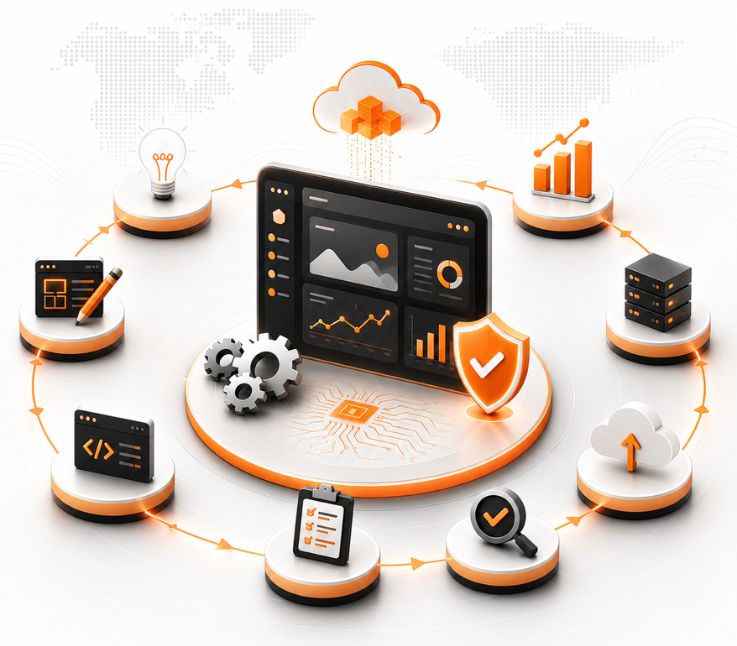
Quick Answer: Product engineering services guide organizations through designing, developing, testing, deploying, and maintaining digital products, ensuring quality, compliance, and innovation at each lifecycle stage. These services reduce risk, accelerate delivery, and align teams for business success.
Missed product launches, rising costs, and failed vendor relationships frustrate many tech leaders. Even with an experienced team, unclear roles and hidden risks can delay critical software releases.
These challenges matter more today. Digital transformation, tough regulations, and rapid innovation pressure make technical delivery and partner choice business-critical. A single mistake can set your roadmap back months or more.
This practical guide shares proven processes, frameworks, risk controls, and an actionable vendor checklist. Use it to understand, compare, and choose product engineering services with confidence.
What Does Product Engineering Services Guide Mean?
A product engineering services guide explains the complete, structured process for building, launching, supporting, and evolving software products. It connects business, technical, and delivery needs with proven solutions.
Product Engineering Services
| Context | Meaning |
| Business | Full-cycle support from idea to upgrade, focused on value and compliance |
| Technical | Design, development, QA, deployment, and lifelong modernization |
| Direct client | End-to-end product realization, managed by expert teams |
| Partner/agency | Overflow delivery, white-label build, or capability augmentation |
| Staff augmentation | Skilled resources embedded within in-house teams for product delivery |
| AI, QA, Cloud, Legacy | Integration of advanced tech, quality, scalable infrastructure, and modernization |
Industry frameworks align with this definition, highlighting full lifecycle, cross-disciplinary team, and built-in compliance. Product engineering services match growing expectations for connected digital experiences and regulatory demands.
Why Product Engineering Services Matter Nowadays
Product engineering services tackle the growing risks and pressures across modern product teams. They matter most when hitting a release date, managing complexity, or keeping up with change is critical.
Teams in regulated industries, fast-moving startups, and enterprises facing modernization all face:
- Project delays: Slipped launches can mean lost revenue
- Technical debt: Fast fixes create long-term headaches
- Cost overruns: Rework and inefficient teams raise expenses
- Compliance risks: Quality or regulatory errors can result in fines
- Poor fit: The wrong vendor or model risks failed outcomes
| Risk Type | Business Impact |
| Delay | Missed revenue, market share loss |
| Quality drop | Customer churn, frequent fixes |
| Compliance gap | Rework, legal penalties |
| Vendor misfit | Wasted budget, team stress |
Every product owner, innovation lead, or agency partner can face these risks—making rigorous product engineering services essential.
What Problems Are Buyers Really Trying to Solve?

Different buyers seek product engineering for different reasons, but the core pains are clear.
| Buyer Type | Main Pain | Associated Risk | Desired Outcome |
| CTO/Product Lead | Launch delays, tech debt | Missed funding, lost users | Reliable, quick launch |
| Agency Partner | Overflow, limited expertise | Client churn, reputation hit | Flexible, high-quality delivery |
| Staff Aug Manager | Skill gaps, onboarding drag | Ramp-up delays, quality dip | Rapid, seamless team extension |
| Procurement | Poor vendor fit, cost surprises | Rework, lost investment | Transparency, cost control |
Buyers want certainty. They seek partners or processes that reduce delay, assure compliance, prevent cost surprises, and fit into their team or tech stack without disruption.
In-House, Outsourcing, Staff Augmentation, or Full Product Engineering?
Choosing the right delivery model affects risk, quality, and speed. Here’s how each option compares:
| Approach | Pros | Cons | Best for |
| In-House | Full control, domain insight | Costly, limited scale or tech breadth | Ongoing, core IP projects |
| Outsourcing | Lower cost, external expertise | Less control, comms risk | MVPs, non-core enhancements |
| Staff Augmentation | Flexible capacity, fills skill gaps | Onboarding, variable team fit | Short-term, specific skills |
| Full Prod Eng. | De-risked, structured, cross-functional | Vetting required, can be higher total cost | High-stakes, complex products |
Example scenario:
A regulated fintech firm used in-house teams but faced delays. Moving to a structured product engineering partner improved delivery and compliance.
Product Engineering Risk Control Framework
This section introduces a practical framework that helps reduce the most common failures in product launches—delay, poor quality, and compliance gaps.
Risk Control Matrix
| Risk Area | Typical Failure | Mitigation Action | Buyer Proof Needed |
| Launch Delay | Missed deadlines | Stage gating, reporting | Delivery schedule sample |
| Quality Issues | Frequent post-launch bugs | Embedded QA per sprint | QA test coverage, defect logs |
| Compliance | Missed standards/core reqs | Checklist at all stages | Compliance/signoff summary |
| Handover Gap | Poor support, unclear docs | Documented handover, support | Support process sample |
Product Engineering Risk Matrix—What to Watch and How to Act
The risk matrix highlights where most projects fail—requirements, quality, compliance, or handover. Mitigating early makes the difference between launch and rework.
A strong framework maps risks by stage:
- Idea validation: Missed goals if requirements incomplete
- Build: Bugs and security gaps if QA not parallel
- Deploy: Delays if integration steps unclear
- Support: Rework needed if documentation poor
Mitigate these with defined roles, stage gates, continuous QA, and transparent communication.
End-to-End Team Integration—Who Owns What and When
Cross-disciplinary integration reduces handoff failures. Successful teams define roles clearly through architects, UX, development, QA, DevOps, and compliance leads. Each owns their part at the right stage.
For example, DevOps leads own deployment and CI/CD. QA specialists embed with developers from day one. Communication check-ins and escalation steps keep progress and catch issues early.
QA & Compliance Assurance at Every Stage
Quality and compliance cannot wait for the end. The risks of insufficient testing remain significant. According to the 2026 Quality Transformation Report from Tricentis, 60% of organizations deploy untested code, while one in five reports losing more than $1 million annually because of poor software quality.
Leading teams set role-based quality checks for every lifecycle stage. This includes automated and manual testing, code peer review, and compliance audits.
A checklist can track progress:
- Requirements: Approved documentation
- Build: Automated test pass rates
- Pre-launch: Compliance signoff, performance metrics
- Post-launch: Support readiness, incident response measures
Failure to embed QA and compliance early often leads to expensive rework.
Delivery Model Adaptability (End-to-End, Pod, Staff Aug)
Not every project needs the same model. The best frameworks adapt delivery for scope, risk, and team capacity:
| Model | When to Use | Risk Tradeoffs |
| End-to-End Delivery | Complex, high-stakes builds | High assurance, higher upfront cost |
| Pod/Team Augmentation | Overflow, parallel initiatives | Faster, but integration risk |
| Staff Augmentation | Niche skills, short-term needs | Flexible, but onboard/fit is vital |
Riseup Labs applies different models based on each client’s needs, offering structure and transparency at every handoff.
Service-Specific Technical Considerations in Product Engineering
Modern product engineering spans technical, process, and compliance detail across all stages. Each stage and role matters.
Product Engineering Process (Step-by-Step)
- Ideation and concept validation: Document goals, user journeys, business needs.
- Design and prototyping: UX/UI, wireframes, clickable prototypes, feedback loops.
- Development and integration: Coding, functional integration, API and cloud setup.
- QA and testing: Automated/manual tests, security scans, performance verification.
- Deployment and launch: CI/CD pipelines, cloud deployment, rollback planning.
- Scaling and support: Ongoing updates, bug fixes, change management, compliance reviews.
Best practices include parallel QA, documentation at every step, DevOps-driven automation, and client handover or knowledge transfer upon launch.
Technical teams typically cover architecture, front and backend, QA, cloud/DevOps, security, and compliance.
Common Mistakes to Avoid in Product Engineering Projects
- Selecting untested or low-cost vendors over proven expertise
- Skipping detailed scoping and planning up front
- Delaying or limiting QA and compliance checks
- Allowing communication gaps between teams or vendors
- Underestimating the need for strong handover and support
Buyers should check for these risks in any planned engagement.
How to Choose the Right Product Engineering Vendor or Partner
Evaluating the right partner is critical. Use this checklist and table for due diligence:
Vendor Evaluation Checklist
- Proven full-cycle delivery experience
- Cross-functional team (dev, QA, DevOps, compliance)
- Transparent communication and reporting process
- Embedded QA and compliance steps
- References or portfolio mapped to scenarios like yours
- Post-launch support and upgrade readiness
- Pricing and scope transparency
| Criterion | Why It Matters | Buyer Question | Proof Needed |
| Service expertise | Avoids delivery failure | Has the provider built end-to-end? | Portfolio, process map |
| QA/Compliance | Reduces rework, prevents penalty | How is QA/compliance handled? | Test plan, checklist |
| Communication | Prevents drift/missed updates | How will we track and report? | Reporting samples |
| Fit for industry | Speeds learning, reduces risk | Done similar work for my sector? | Client list/examples |
| Delivery model | Ensures scope, risk fit | Which model suits my needs? | Model explanation |
| Support | Ensures product value lasts | How is post-launch handled? | Support plan/SLAs |
Red flags include vague experience, lack of QA detail, hidden costs, or unclear communication models.
Cost, Timeline, and Scope Factors in Product Engineering

Accurate planning depends on understanding what drives both cost and schedule.
| Factor | Cost Impact | Timeline Impact |
| Project scope | Bigger features mean more required effort | More features = longer project |
| Complexity | Advanced tech (AI/cloud) often adds cost | Complex integrations may increase development time |
| Team size/expertise | Senior or niche skills cost more | Experienced teams can deliver faster |
| Compliance/QA needs | Industry standards increase cost, time | Added review cycles extend timeline |
| Integrations | Third-party APIs/hardware add variables | Integration delays can slow progress |
| Feedback loops | Many revisions add cost and duration | Longer review phases stretch delivery end date |
| Support/maintenance | Longer-term value, ongoing cost | Can impact post-launch roadmap timing |
Many providers will offer ranges, but these factors help buyers budget and plan RFPs more realistically.
Real-World Use Cases and Scenarios
Buyers often ask: Does this model fit my challenge? Here are common application scenarios:
- Startup MVP Launch: Fast build needed. Risk: Missed market entry.
- Partner Agency Overflow: Overflow work risks client retention. Solution: White-label or managed pod delivery.
- Staff Augmentation: Scale for a complex upgrade. Challenge: Onboarding niche roles quickly.
- Project Rescue: Previous vendor failed QA. Solution: Structured process recovery.
- Compliance-Critical: Healthcare or fintech app needs regulatory audit pass.
- Continuous Scaling: SaaS product needs frequent updates to retain users.
Success comes when the approach and delivery model fit true buyer pain.
How to Measure Success in Product Engineering Projects
| Metric | What It Shows |
| Launch timeline | Speed to market |
| Defect/bug rate | Product quality |
| User retention | Engagement and market fit |
| Sprint/project velocity | Delivery team effectiveness |
| QA pass percentage | Test rigor and reliability |
| Compliance incidents | Regulatory readiness |
| Support ticket volume | Post-launch stability |
Use these to set expectations and measure vendors or internal teams.
When Riseup Labs May Be a Good Fit
- Structured, transparent processes for complex product delivery
- Cross-functional teams blending dev, QA, cloud, and compliance
- Flexible models for end-to-end builds, agency overflow, or staff augmentation
- Expertise in regulated, scalable, or innovation-focused projects
- Clear communication and reporting standards
Clients should review delivery processes, technical depth, and support models to confirm fit.
Final Takeaway & Next Steps
Product engineering services, when managed with structured frameworks and risk controls, solve the most pressing problems—delays, poor quality, and compliance misses.
Use the risk framework and vendor evaluation tool in this guide to protect your roadmap and business.
For tailored guidance, consider requesting a delivery framework consultation with Riseup Labs. Review your current challenges and map them to a model that fits.
FAQs: Product Engineering Services
What are product engineering services?
Product engineering services cover the entire process of designing, developing, testing, launching, and improving digital products with a focus on quality, compliance, and business alignment.
How do product engineering services reduce business risk?
They use proven frameworks, build in QA and compliance from the start, and require clear communication. This helps avoid delays, rework, and regulatory mistakes.
How is product engineering different from traditional development?
Product engineering manages the full product lifecycle with innovation, continuous support, and compliance. Traditional development often ends at launch.
What are the typical stages of product engineering?
Ideation, design, development, QA/testing, deployment, scaling, and support are the main stages.
How is QA managed in product engineering?
QA is embedded throughout. Automated and manual testing happens at each step, not only at the end. Compliance checks are also integrated early.
How do I choose the right product engineering provider?
Check for full-cycle experience, cross-functional team, embedded QA/compliance, references, strong communication, and post-launch support.
What common mistakes should I avoid?
Avoid vendors with no proof, skipping QA, unclear scope, weak communication, or no post-launch plan.
Which industries benefit most from product engineering?
Any sector where digital products, compliance, or fast iteration matter—like finance, healthcare, SaaS, eCommerce, and industry modernization.
Can I combine staff augmentation with product engineering?
Yes, many teams mix staff augmentation with structured product engineering processes for fast scaling or niche needs.
What impacts cost and timeline most?
Scope, complexity, tech choices, QA needs, integrations, and the feedback schedule all shape total cost and schedule.
How do modern frameworks like agile or scrum fit?
Product engineering teams use agile or scrum to deliver constant value, handle change well, and involve stakeholders throughout.
What proof should I expect from a credible provider?
Request process maps, case studies, quality metrics, compliance checklists, and references from similar industries.
This page was last edited on 24 July 2026, at 6:32 pm

Start a conversation with our team to solve complex challenges and move forward with confidence.