
- AI Digital Transformation
- Role of AI in Digital Transformation
- When AI Digital Transformation Required?
- Where Transformation Can Create Value?
- Benefits and Challenges
- How to Assess AI Transformation Readiness
- How to Manage AI Governance
- Strategy & Implementation Roadmap
- Technologies and Data Architecture
- How to Measure Transformation ROI
- Why Riseup Labs?
- Final Thoughts
- FAQs
Your design team is using Claude design. Devs integrated Claude code for co-working. Finance also has an AI co-pilot. Someone even built a dashboard that looks like a spaceship. Yet the board keeps asking one question: What has AI actually earned us?
That’s where AI digital transformation gets serious. It means fixing costly workflows, connecting disconnected systems, and turning promising experiments into measurable business outcomes.
Before subscribing to another new AI tool, understand the real transformation beyond a shiny subscription. Let’s start with the difference.
What Is AI Digital Transformation?
AI digital transformation is the strategic integration of artificial intelligence into business operations to improve workflows, decision-making, customer experiences, and measurable outcomes. It connects AI with your people, processes, data, and existing systems to change how work gets done.
For Example, an online retailer drowning in customer messages asking, “Where’s my order?” Many AI chatbots can answer repetitive questions much faster.
But what if AI could also check order status, identify delays, initiate approved actions, and alert employees when something needs human attention?
Now you’re changing the entire customer service workflow, not simply answering messages faster with AI.
That’s the real purpose of AI digital transformation: building the system that helps decide better and execute faster.
AI Transformation vs. Digital Transformation
I used to think we had already transformed almost everything with AI at Riseup Labs.
After all, we’re an AI-native global technology company. Our designers use AI to explore ideas and create designs. Our developers work with different AI models to build products. Even our QA engineers are using Claude to speed up qa testing planning, script creation, and analysis.
Honestly, I thought we could confidently check the box marked “AI transformation.”
Then our CEO challenged my thinking with a simple observation:
“We could put AI in the hands of every designer, developer, and engineer at Riseup Labs. But if our clients still wait just as long, our teams face the same bottlenecks, and delivery costs remain unchanged, what have we really transformed? I want AI to change how we deliver value, not just how we complete tasks.”

That made me pause.
We were clearly adopting AI across teams. But using AI everywhere doesn’t automatically mean you’ve transformed your business.
Definitely, digital transformation improves individual tasks. But AI transformation redesigns workflows, connects systems, and changes how an organization delivers value.
The difference isn’t how many AI tools your team uses. It’s what those tools help your business accomplish.
Digital transformation and AI transformation are connected. But they solve different business challenges depending on their capabilities.
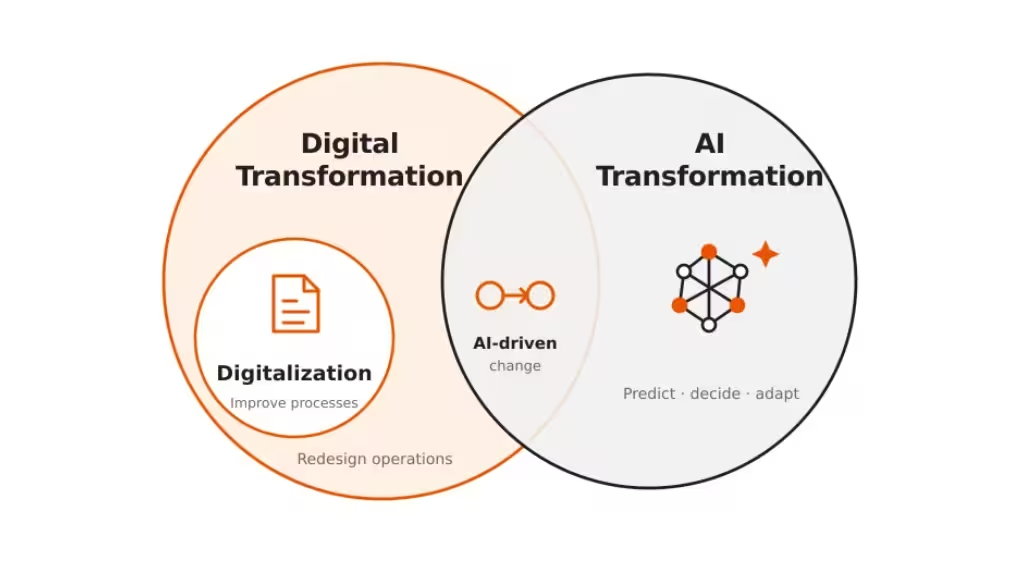
Digitalization improves how individuals or teams do their work. Digital transformation changes how the business operates. And AI transformation uses intelligence to improve decisions, automate complex workflows, and create new capabilities.
Here’s how they differ:
| Terms | Key Characteristics |
| Digital Transformation | Core Focus: Redesigning business operations, customer experiences, and business models through technology. System Nature: Connects data, applications, and departments through integrated digital platforms. Human Role: Employees adapt to new processes, technologies, and cross-functional ways of working. Example: Connecting sales, inventory, finance, and customer service through a unified platform. |
| AI Transformation | Core Focus: Using artificial intelligence to improve decisions, predict outcomes, and redesign business workflows. System Nature: Integrates machine learning, generative AI, and intelligent automation with existing business systems. Human Role: Employees collaborate with AI, oversee important decisions, handle exceptions, and manage risks. Example: Predict inventory demand, automatically identify supply chain disruptions, and recommend corrective actions. |
5 Common Myths & Realities About AI Digital Transformation
AI promises big results. But with tight budgets, skeptical teams, and uncertain ROI, how do you separate opportunity from hype?
Here are five myths worth questioning:
- Myth: AI can fix everything.
Reality: Automating a broken workflow only makes the mess faster. - Myth: AI transformation is expensive.
Reality: Start with focused projects and scale when results justify investment. - Myth: You need perfect, large, and complex data.
Reality: Start with reliable, relevant data and improve gradually. - Myth: AI replaces everyone.
Reality: Roles evolve, but human judgment and oversight remain essential, even more important. - Myth: AI transformation is a one-time project.
Reality: Continuous monitoring, improvement, and governance drive lasting value.
The Role of AI in Digital Transformation
Assume that your company has finally connected its sales, inventory, finance, and customer support systems. Data flows smoothly. Decisions are data-driven. Dashboards look impressive.
Yet when a customer asks why their order is delayed, your team still spends 20 minutes finding the answer.
That’s where AI changes the game.
Traditional digital transformation connects systems and improves processes. AI takes it further by turning business data into predictions, recommendations, and intelligent actions.
Here’s what AI brings to digital transformation:
- Smarter decisions: Analyze complex data, identify patterns, and make informed recommendations.
- Predictive intelligence: Anticipate demand, equipment failures, and potential business risks.
- Intelligent automation: Reduce repetitive work and automate complex workflows with human oversight.
- Better experiences: Personalize customer interactions and help employees resolve problems faster.
- Faster innovation: Support product development, software engineering, and QA testing.
But here’s the interesting part.
According to McKinsey’s 2026 State of AI report, 80% of respondents reported improved individual productivity from AI, yet only 37% reported that AI contributed to their organization’s operating profit (EBIT).
Did you get the message clearly? “Using AI is relatively easy. Turning it into measurable business value is much harder.“
That’s where Riseup Labs comes in with a talented team that assesses and measures outcomes before transforming a business.
Free AI Assessment
Ready to Make AI Work for Your Business?
Discover AI opportunities to reduce costs, improve efficiency, and drive measurable business growth.
Get Your Free AssessmentReal AI transformation requires connected systems, reliable data, perfect workflows, and clear business objectives.
Before simply feeling the pressure, I would like to ask: does your business actually need AI transformation?
When Does a Business Need AI Digital Transformation?
You should not transform with AI just because your competitors do. Before AI transformation, you must check your business’s AI readiness. AI can deliver measurable improvements and outcomes only when you are ready to absorb it.
Signs Your Business Is Ready for AI Transformation
At Riseup Labs, we have begun our AI transformation; our talents should not waste their valuable time on repetitive manual tasks. If these situations sound familiar, it might be time to explore AI transformation:
- Employees waste hours on repetitive, manual tasks.
- Customer expectations are growing faster than your team’s capacity.
- Valuable business data sits unused across disconnected systems.
- Slow decisions and inaccurate forecasts create costly mistakes.
- Your team has clear business goals and accessible data to support AI.
When AI Transformation Is Not the Right Solution
Here’s something AI vendors don’t always emphasize: Not every business problem needs AI.
You may need to reconsider when:
- Simple automation can solve the problem more efficiently.
- Existing workflows are poorly designed or undocumented.
- Critical data is unreliable, inaccessible, or unsuitable.
- You lack clear objectives, ownership, or a way to measure success.
After all, adding AI to an inefficient process won’t guarantee success. Because, the cost of AI implementation might not meet your expectations due to your weak existing workflow.
But when you implement AI in your business at the right stage of digital transformation, backed by reliable data and clear objectives, you will create measurable value.
Where Can AI Digital Transformation Create Measurable Value?

AI can’t deliver measurable value by showing an impressive demo. It delivers most value when it solves costly business problems. Let’s explore when AI can improve performance and deliver measurable results for your business.
1. Customer and Employee Experience
When customers wait for answers and employees search multiple systems for information, everyone loses. AI assistants can personalize interactions, resolve routine inquiries, and support employees. Measure success through response times, customer satisfaction, and employee productivity. You can check out how Riseup Labs achieved 96% CSAT with 24/7 voice support.
2. Intelligent Document Processing and Back-Office Operations
Invoices, contracts, and claims rarely arrive neatly organized. AI can extract information, detect errors, and route documents for approval without endless copy-pasting. Businesses can track processing time, operational costs, accuracy, and manual workload reductions.
3. IT Modernization, Engineering, and Software Delivery
Legacy systems, slow releases, and recurring software bugs drain engineering resources. AI helps developers understand complex codebases, generate tests, and troubleshoot issues faster. Track development time, deployment frequency, defect rates, and system reliability to measure improvements.
4. Predictive Operations, Analytics, and Computer Vision
Why wait for equipment to fail before taking action? AI analyzes historical and real-time data to predict maintenance needs, forecast demand, and detect visual defects. Measure improvements through reduced downtime, forecasting accuracy, and production quality.
These are just a few common scenarios I have mentioned here. But your use case will completely depend on your business requirements and use cases. If you really want to implement AI transformation for your business, let’s look at some main opportunities and challenges behind it.
Benefits and Challenges of AI Digital Transformation
AI digital transformation promises faster operations, smarter decisions, and better customer experiences. Sounds great, right? But turning those promises into measurable results isn’t always easy.
According to a recent Gartner survey, only 22% of organizations had successfully scaled AI across multiple business units or adopted an AI-first approach.
The challenge isn’t simply adopting AI. It’s integrating it into business operations and achieving sustainable results.
Here’s what businesses can gain and what might stand in their way.
| Key Business Benefits | Common Challenges and Limitations |
| Higher Productivity: Faster workflows and fewer manual tasks. | Process Complexity: Outdated or inefficient workflows. |
| Smarter Decisions: Better insights and predictions. | Data Quality: Incomplete or unreliable information. |
| Better Customer Experience: Faster, personalized support. | AI Accuracy: Errors, bias, and trust issues. |
| Cost Efficiency: Reduced operational expenses. | Implementation Costs: Integration and ongoing maintenance. |
| Faster Innovation: Accelerated development and delivery. | Skill Gaps: Limited expertise and employee resistance. |
| Business Scalability: Handling more work with fewer resources. | Security and Governance: Privacy, compliance, and oversight risks. |
The real challenge isn’t recognizing AI’s potential. It’s making your business ready to capture it. Before moving forward, let’s assess whether your organization has the right foundations for successful AI digital transformation.
How to Assess Your Organization’s AI Transformation Readiness
If your business processes, data, people, and systems are not prepared yet, then it won’t be effective. Because there’s a big difference between being ready to experiment with AI and being ready to run it across an enterprise.
Six Key Dimensions of AI Readiness
Depending on the different types of business models, dimensions for measuring AI readiness would be different. But the core points will be the same for every business. Here I have added 6 key dimensions of AI readiness assessment:
| Readiness Dimension | What You Should Assess |
| 1. Business Strategy | Clear objectives, prioritized AI use cases, and leadership commitment. |
| 2. Data Readiness | Data quality, accessibility, security, and availability for AI applications. |
| 3. Technology Infrastructure | Existing systems, integration capabilities, scalability, and technical resources. |
| 4. People and Culture | Employee skills, AI awareness, training, and willingness to embrace change. |
| 5. Governance and Security | Privacy safeguards, risk management, human oversight, and accountability. |
| 6. Operational Readiness | Workflow ownership, implementation capacity, measurable KPIs, and ongoing monitoring. |
Remember: Your readiness score isn’t a competition. It’s a way to identify what needs attention before you invest more time and money.
AI Readiness Scorecard and Decision Criteria
The AI readiness score will depend on the 6 dimensions of AI readiness. If you have understood those 6 dimensions, it will be very easy to self-assess your company’s AI readiness.
Rate each dimension from 1 to 5, based on your organization’s current capabilities. Then add your scores across all six dimensions. Your total will range from 6 to 30.
| Total Score | Readiness Level | Recommended Action |
| 6–14 | Low | Strengthen essential foundations first. |
| 15–22 | Moderate | Start a controlled AI pilot and address gaps. |
| 23–30 | High | Validate results and prepare for responsible scaling. |
Important Note: Don’t rely on the total score alone.
For example, a business scoring 26/30 may still face serious risks if its governance and security controls are weak. Treat this as a practical planning guide, not a certification or guarantee of success.
How to Manage AI Governance, Security, and Risk
Nowadays, managing AI governance is one of the most important tasks for humans. If an AI system makes an incorrect decision that affects hundreds of customers before anyone notices.
Who takes responsibility? Who stops it? And how do you prevent it from happening again?
That’s why AI governance, security, and risk management must be part of your transformation strategy from the beginning.
Applying NIST’s Govern, Map, Measure, and Manage Functions
The NIST AI Risk Management Framework provides four interconnected functions for managing AI risks.
| NIST Function | What Your Business Should Do |
| Govern | Establish AI policies, accountability, responsibilities, and risk management processes. |
| Map | Identify AI use cases, affected stakeholders, data dependencies, and potential risks. |
| Measure | Evaluate AI accuracy, reliability, bias, security, and potential impacts. |
| Manage | Prioritize risks, implement safeguards, monitor outcomes, and improve controls. |
These 4 functions are not a checklist you complete once and forget. They work together continuously throughout the system lifecycle. That’s why you need to keep them going by monitoring.
Human Oversight, Incident Response, and Monitoring
Sometimes, the biggest AI risk isn’t a security breach. It’s an unexpected bill nobody saw coming.
Recently, Amazon reportedly spent $1.8 million on a failed AI project using Claude Sonnet. The project exceeded its budget by 860%, and the overspending went unnoticed for five months.
If that can happen at Amazon, imagine the risks for businesses with fewer resources. That’s why every organization needs three safeguards:
- Human Oversight: Assign clear responsibilities, approval limits, and spending controls.
- Continuous Monitoring: Track AI performance, costs, security threats, and unusual activities.
- Incident Response: Establish procedures to detect problems, stop harmful actions, and recover quickly.
AI can operate independently, but accountability cannot. Strong AI governance protects your business from unnecessary risks while helping ensure your AI implementations deliver real value.
AI Digital Transformation Strategy and Implementation Roadmap
When your company is ready for AI or digital transformation, don’t implement it randomly. A successful AI transformation strategy starts with real business problems, not technology. You need clear goals, the right people, reliable data, and a practical implementation plan.
Here’s a simplified three-stage AI implementation roadmap to help you understand the journey.
Stage 1: Assess, Prioritize, and Plan
Before investing in AI, take a step back and look at how your business operates today. Which processes consume the most time? Where are employees struggling? And which problems could AI realistically solve?
The answers will help you focus on opportunities that matter instead of chasing every exciting AI trend. First, start with:
- Assess readiness: Review your business goals, data, infrastructure, skills, and security.
- Prioritize opportunities: Identify high-impact use cases with measurable business value.
- Plan implementation: Set budgets, success metrics, responsibilities, and realistic timelines.
In this stage, your goal is to understand where AI can create value and what it will take to get there.
Stage 2: Prove Value and Redesign Workflows
Now it’s time to put your ideas to the test. You don’t need to start by automating everything. Start by prioritizing what was defined in Stage 1.
Choose a promising use case and see how AI performs in a controlled environment. Then:
- Build a pilot: Start with a manageable use case and clear success criteria.
- Measure results: Compare performance, costs, accuracy, and efficiency against your baseline.
- Redesign workflows: Define how AI and employees will work together.
In this stage, your goal is to prove that AI solves a real business problem before committing to larger investments.
Stage 3: Integrate, Scale, and Continuously Improve
A successful pilot lights the spark. But turning that spark into business-wide impact is a different challenge. The real challenge begins when AI needs to work across departments and interact with your existing systems.
You need reliable integrations, trained employees, consistent governance, and continuous performance monitoring. Now your goal will be to turn isolated AI successes into sustainable, organization-wide business value by doing:
- Integrate systems: Connect AI with your existing applications, databases, and workflows.
- Scale gradually: Expand successful solutions across teams while maintaining security and governance.
- Optimize continuously: Monitor performance, collect feedback, and improve outcomes.
Important: This is a high-level overview, not a complete enterprise AI transformation roadmap. The actual strategy involves deeper technical assessments, data architecture, change management, governance, and ongoing optimization. Its scope depends on your organization’s complexity and business objectives.
Another of the biggest decisions along that journey is choosing the right technologies. You need to figure out how they’ll work with the systems you already have.
Core Technologies and Data Architecture for Enterprise AI Transformation
Before writing this section of the article, I discussed enterprise AI architecture with Md. Rafiquzzaman, Director of Technology at Riseup Labs.
That conversation brought me back to a simple question: What happens after AI generates a response or action?
After all, a powerful AI model means little if it cannot access the right business data or work with your existing systems.
Let’s explore the technologies, integrations, and architectural decisions that make enterprise AI transformation practical.
Integrating AI With Existing Business Systems
Suppose a manufacturing company is using AI on their software to predict equipment failures. The AI successfully identifies a machine that needs maintenance. Great!
But there’s a problem.
The AI isn’t connected to the company’s maintenance system. Nobody receives an alert, no new task is created, and the machine eventually breaks down.
Even though the AI made the right prediction. The business still suffered the loss. That’s why enterprise AI needs a connected technology architecture, not just intelligent models.
Here are four essential components:
- Data Infrastructure: Prepare reliable, accessible data from business applications and databases.
- System Integration: Connect AI with ERP, CRM, and other existing systems through secure APIs and MCPs.
- AI Models and Automation: Use LLMs, machine learning, and automated workflows to support business decisions and actions.
- Security and Monitoring: Manage access permissions, protect sensitive data, and continuously track system performance.
Overall, make AI a part of your daily operations so its insights translate into measurable business outcomes.
Build vs. Buy vs. Partner: Choosing the Right Approach
Now comes another important decision. Should you build your own AI solution, buy an existing product, or hire an AI development partner?
Each approach has advantages. So the right choice depends on your business goals, available resources, and technical requirements. Here is a clear difference between them:
| Approach | Best For | Key Consideration |
| Build | Unique workflows and proprietary AI capabilities | Greater control, but higher development and maintenance demands |
| Buy | Standard business needs and faster deployment | Faster implementation, but limited customization |
| Partner | Complex AI solutions and enterprise integrations | Specialized expertise, but requires clear collaboration and ownership |
Remember that you don’t always have to choose just one. For example, your business could use an existing AI model while partnering with an engineering team to customize it.
Free AI Training
Is Your Team Ready for AI?
Help your team understand AI, discover opportunities, and prepare for transformation.
Get Free AI TrainingMy takeaway: You don’t need to build everything from scratch to achieve successful AI transformation. You need the right combination of technology, expertise, and business strategy. However, connecting AI with business-critical systems also introduces security and operational risks.
How to Measure AI Digital Transformation ROI
Measuring real ROI from the AI transformation is not only about the solution performing perfectly. You need to think of it as actually printing money for your business or not.
To measure AI digital transformation ROI, start by establishing a baseline. Record your current costs, processing times, error rates, and business performance before implementing AI. So that you can compare the results after AI transformation deployment.
Next, account for the full investment, including AI tools, infrastructure, integration, employee training, security, and ongoing maintenance. That will help you to calculate your returns using this simple formula.
ROI Formula:
Here, net gain means total financial benefits minus total costs. Financial benefits may include additional profit and verified cost savings.
Example:
If your company spends $100,000 (Total Investment Cost) to deploy an AI customer support agent, and that agent saves you $150,000 in labor and overhead over the year (Net Financial Gain):
So, the final ROI is 50%. However, ROI isn’t the only measure of success. Track outcomes across seven KPI categories:
| KPI Category | Key Metrics to Track |
| Financial | Revenue growth, cost savings |
| Operational | Processing time, productivity |
| Customer | Satisfaction, retention |
| Employee | Time saved, satisfaction |
| Quality | Accuracy, error rates |
| Security & Risk | Incidents, compliance |
| Adoption | Active users, workflow adoption |
Real-World AI Digital Transformation Case Studies
AI transformation strategies sound promising on paper. But what happens when businesses actually put them into practice?
Let’s explore how Riseup Labs and three real-world organizations across different industries have turned AI into meaningful business improvements.
An AI Transformation Case Study by Riseup Labs
At Riseup Labs, we began by building an AI-first culture, then redesigned workflows across engineering, QA, marketing, and operations. We also developed Riseup Labs Mission Control to connect agents, knowledge, and systems. Our AI transformation case study shows how individual AI adoption evolved into a company-wide operating model.
Cross-Industry Examples and Key Lessons
Other organizations are seeing measurable results, too. Here are three examples worth learning from:
- IKEA (Retail): Its AI chatbot, Billie, resolved approximately 3.2 million customer interactions, generating nearly €13 million in savings between 2021 and 2023. Meanwhile, 8,500 employees were reskilled for higher-value roles.
- DBS Bank (Finance): In 2025, DBS deployed over 2,000 AI models across 430+ use cases, reporting approximately SGD 1 billion in economic value from its data analytics and AI initiatives.
- Great Ormond Street Hospital (Healthcare): A clinical trial of AI-powered documentation reported 23.5% more direct patient interaction time and 8.2% shorter appointments.
I think these examples share one important lesson: successful transformation starts with a business problem and delivers measurable outcomes.
Want to explore more? Check out our collection of real-world digital transformation examples across industries.
Why Choose Riseup Labs as Your AI Digital Transformation Partner?
AI projects can consume budgets and investment before they deliver business value. Riseup Labs helps you identify worthwhile opportunities, connect AI with existing systems, and scale successful workflows safely. With our AI digital transformation services, you get a practical roadmap, clear accountability, and measurable business outcomes.
Here are a few reasons why you should not miss the opportunity for a FREE Assessment:
Business-First Discovery and Outcome Measurement
Before recommending AI, we take time to understand your business challenges, existing workflows, and operational costs. Then our team identifies opportunities, prioritizes them by business value and feasibility, and establishes measurable success criteria.
Your benefit: Invest in AI opportunities backed by evidence, not assumptions.
Engineering Expertise From Existing Systems to Production AI
You shouldn’t have to replace your entire technology infrastructure to benefit from AI. Our engineering teams can integrate AI with your existing applications. It will help to modernize legacy systems, and develop customized AI agents and automation solutions. From initial development to deployment, we help you build reliable and scalable solutions
Transparent Delivery, Risk Controls, and Collaboration
We understand: nobody wants an expensive AI project that turns into a black box. You don’t need to worry about it. We emphasize clear project scopes, defined responsibilities, regular collaboration, and measurable milestones.
Security, human oversight, and performance monitoring remain part of the implementation process. This helps your business maintain control, reduce risks, and make informed decisions throughout the AI transformation journey.
Final Thoughts
AI digital transformation isn’t about how your business uses many AI tools. It’s about what business outcomes you achieve from a centralized, connected AI ecosystem.
You can start with a problem worth solving with AI. Check your AI readiness. Test a small solution, measure its impact, and scale what works. Keep your people involved and your risks under control.
You don’t need to transform your entire business overnight. You need a clear strategy, reliable numbers, and the confidence to make the next move.
And if you’re still wondering where to start, that’s exactly what an AI transformation assessment can help you discover.
Let’s Identify Your Highest-Value AI Opportunities
Discuss your business challenges with our AI experts.
Get Free AI AssessmentFAQs
How is AI Transformation Different From Using Generative AI Tools?
Using Gen AI tools like ChatGPT or Claude is the early stage of AI adoption. It can’t work across teams, CRMs, ERPs, etc. AI transformation changes how a business operates. AI transformation goes further by connecting AI to business systems, improving workflows, and delivering measurable results across departments.
Which Business Processes Should Use AI First?
You can start with repetitive, time-consuming tasks that have reliable data. Customer support, document processing, reporting, and data entry are common examples that you can automate using AI. Also, consider choosing processes that are easy to automate, have manageable risks, and offer clear business benefits.
What Factors Determine AI Transformation Costs?
AI transformation costs depend on project size, complexity, data readiness, and integration needs. Key expenses include AI tools, development, infrastructure, security, employee training, and maintenance. Larger projects involving multiple business systems generally require higher investments.
How Long Does an Enterprise AI Transformation Take?
Enterprise AI transformation can take several months to multiple years. But a small AI pilot may take weeks or months. The overall timeline depends on company size, data quality, system complexity, and employee readiness.
How Can Businesses Scale AI Pilots While Managing Security and Governance?
Businesses can scale AI safely by using clear policies, access controls, human oversight, and continuous monitoring. Test each AI solution before expanding it. Follow established frameworks like the NIST AI Risk Management Framework to identify risks, protect data, and maintain accountability.
This page was last edited on 2 November 2026, at 6:12 pm
Start a conversation with our team to solve complex challenges and move forward with confidence.