
Yes, AI transformation is a problem of governance because its success depends on how enterprises manage AI risks, accountability, and decisions. Strong governance prevents failures, builds trust, and helps organizations scale AI responsibly.
AI adoption is moving fast. But for many businesses, the results aren’t keeping up with the investment.
One department uses AI to automate customer support. Another relies on it for business decisions. Meanwhile, employees experiment with AI tools without approval. Soon, sensitive data is exposed, decisions become inconsistent, and no one knows who’s responsible.
Sound familiar?
You’re not alone. According to McKinsey’s 2026 State of AI report, 88% of organizations use AI, but only 7% have fully scaled it across their operations.
So, what’s holding them back?
The problem often goes beyond technology. Without clear AI governance, even promising AI initiatives can create security risks, compliance issues, and operational confusion.
This guide explains why AI transformation is a problem of governance, who should take ownership, and which frameworks matter. You’ll also discover seven practical steps to build responsible, scalable AI operations.
What AI Transformation Means in an Enterprise?
AI transformation in an enterprise is the strategic integration of artificial intelligence (AI) into business operations, workflows, and decision-making. It uses machine learning (ML), generative AI, and intelligent automation to improve efficiency, reduce costs, enhance customer experiences, and drive measurable business growth.
Unlike basic AI adoption, enterprise AI transformation involves more than deploying individual tools. It requires modernizing legacy systems, integrating AI with existing business processes, and establishing strong data governance.
Successful transformation also requires AI governance, clear accountability, human oversight, and regulatory compliance. These safeguards help enterprises manage AI risks, protect sensitive data, and scale AI responsibly across departments.
AI adoption vs. AI transformation vs. AI governance
Although these terms are closely related, they serve different purposes.
| Aspects | AI Adoption | AI Transformation | AI Governance |
|---|---|---|---|
| Primary focus | Introducing AI tools | Redesigning business operations | Managing AI responsibly |
| Main objective | Improve individual tasks | Create organization-wide value | Ensure accountability, safety, and control |
| Typical activities | Deploying chatbots and AI assistants | Integrating AI across systems and workflows | Establishing policies, risk controls, and oversight |
| Key stakeholders | Individual teams and IT departments | Business leaders, CIOs, and CTOs | CAIOs, CROs, CISOs, legal teams, and business owners |
| Success measures | Usage and task efficiency | ROI, productivity, and business outcomes | Risk reduction, compliance, reliability, and auditability |
Consider an enterprise that introduces an AI-powered quality assurance tool.
Using AI to review customer conversations represents adoption. Connecting those insights with coaching, workforce management, and service improvement represents transformation.
Establishing evaluation standards, access controls, human review procedures, and audit trails represents governance.
AI adoption introduces capabilities. AI transformation changes operations. AI governance ensures those changes remain accountable and sustainable.
Why AI Transformation Fails without AI Governance
Many enterprises invest in artificial intelligence but struggle to scale it beyond pilot projects. The challenge often comes from an AI governance maturity gap. Organizations adopt AI tools without clear ownership, data policies, or risk controls.
This explains why AI transformation is a problem of governance, not just technology. Without proper oversight, even advanced AI systems can create security risks, unreliable decisions, and operational inefficiencies.
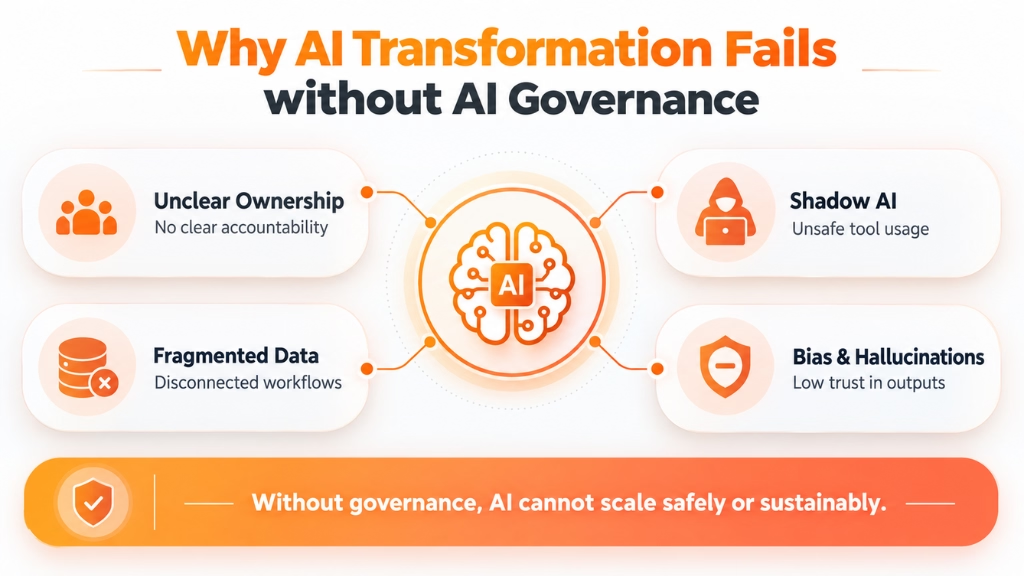
Here are four major governance failures that prevent successful enterprise AI transformation.
1. Unclear Ownership Creates an Accountability Vacuum
Who takes responsibility when an AI system makes a wrong decision?
In many organizations, nobody has a clear answer. IT teams manage the technology. Business teams use AI-generated recommendations. Risk teams monitor compliance. However, responsibility for AI outcomes often remains undefined.
This creates an accountability vacuum. Problems take longer to resolve. Employees may not know when to override AI decisions or escalate incidents.
For example, consider an AI-powered recruitment system that unfairly rejects qualified candidates. Who investigates the algorithmic bias? Who approves corrective action?
How to address it: Establish an AI decision rights framework. Assign clear responsibilities to the Chief AI Officer (CAIO), Chief Risk Officer (CRO), and relevant business owners. An AI Governance Board can oversee high-risk decisions. Use ISO/IEC 42001 and the NIST AI Risk Management Framework to guide accountability, risk assessments, and escalation procedures.
2. Shadow AI Exposes Sensitive Business Data
Employees often use unapproved generative AI (GenAI) tools to summarize reports, analyze customer information, or complete routine tasks. This practice is known as shadow AI.
These tools may include unsanctioned SaaS applications, external Large Language Models (LLMs), and third-party APIs.
Suppose a BPO employee uploads customer call transcripts to an unapproved AI platform. Those transcripts may contain personal information, account details, or confidential business data.
Without proper controls, the organization may lose visibility into how that information is processed, stored, or shared. This creates data privacy, security, and regulatory compliance risks.
How to address it: Create an approved AI tool inventory. Apply role-based access controls, data classification, and third-party risk management (TPRM). Involve the Chief Information Security Officer (CISO) and Data Protection Officer (DPO) in reviewing sensitive use cases. Maintain audit trails and data lineage records to support applicable GDPR, CCPA, and CPRA requirements.
3. Fragmented Data and Workflows Prevent AI Scaling
AI transformation becomes difficult when departments use disconnected systems, inconsistent data, and separate automation tools.
For example, a customer experience (CX) team may deploy AI voice agents for lead qualification. However, the agents cannot automatically update the company’s CRM. Sales representatives must manually transfer customer information.
This creates operational friction and limits productivity.
Fragmented workflows also make it difficult to maintain consistent governance across enterprise software, BPO operations, and customer service channels.
How to address it: Establish enterprise-wide data governance standards. Connect AI applications through secure APIs and standardized integrations. Use data provenance and lineage tracking to maintain information quality. Apply COBIT and ITIL 4 practices to align AI-enabled workflows with enterprise IT governance and service management.
A shared MLOps architecture can also support model versioning, deployment standards, and continuous monitoring as AI adoption expands.
4. Algorithmic Bias and Hallucinations Reduce Trust
AI systems can produce inaccurate, misleading, or discriminatory results. These risks become more serious when organizations rely on AI for customer interactions or business-critical decisions.
For example, an AI customer service agent might invent a refund policy. An AI recruitment model might favor certain applicants because of biased training data.
Generative AI systems can also produce hallucinations. Model drift and degradation may reduce performance over time.
Without regular evaluation, these problems can remain undetected. They can damage customer trust and expose businesses to financial or regulatory risks.
How to address it: Introduce algorithmic audits, bias testing, and continuous AI monitoring. Use human-in-the-loop (HITL) supervision for sensitive decisions. Establish output validation, model performance thresholds, and clear escalation pathways.
The OECD AI Principles and NIST AI RMF provide useful guidance for building trustworthy AI systems. Enterprises should also maintain audit trails and review workflows to detect errors and improve reliability.
Who Should Be Accountable for AI Governance in an Enterprise?
AI governance is a shared responsibility, but every AI system needs a clear owner. The board and executive leadership oversee AI strategy and risk. The Chief AI Officer (CAIO) coordinates governance policies. Business leaders remain accountable for AI-driven decisions and outcomes.
Without clear ownership, enterprises face an accountability vacuum. This is why AI transformation is a problem of governance, not just technology.
Here is how enterprises should divide AI governance responsibilities:
| Role | Key Responsibilities |
|---|---|
| Board and CEO | Set AI strategy, risk appetite, and accountability standards. |
| Chief AI Officer (CAIO) | Lead AI governance, policies, and responsible AI adoption. |
| Chief Risk Officer (CRO) | Assess AI risks, algorithmic bias, and compliance exposure. |
| CISO and DPO | Oversee cybersecurity, data privacy, and third-party AI risks. |
| CIO and CTO | Manage AI infrastructure, integrations, and model monitoring. |
| Business and CX Leaders | Own AI performance, operational decisions, and business outcomes. |
| AI Governance Committee | Review high-risk AI use cases and oversee governance compliance. |
For example, when a BPO company deploys AI voice agents, the CX director owns service quality. The CISO manages security risks. Human-in-the-loop (HITL) supervisors review sensitive decisions and handle escalations.
Enterprises should establish an AI decision rights framework with defined ownership, approval processes, and escalation pathways. ISO/IEC 42001 and NIST AI RMF 1.0 provide guidance for assigning responsibilities and managing AI risks.
This approach strengthens accountability and supports safe, scalable enterprise AI transformation.
Which AI Governance Frameworks Should Enterprises Follow?
Enterprises need clear standards to manage AI risks, protect sensitive data, and maintain accountability. However, no single framework covers every governance challenge.
Organizations should combine international AI standards, risk management frameworks, and applicable regulations. The right approach depends on their industry, AI use cases, and regulatory obligations.
Here are the key frameworks that support responsible AI transformation and enterprise-wide AI governance.
ISO/IEC 42001: Establishing an AI Management System
ISO/IEC 42001:2023 is an international standard for establishing an Artificial Intelligence Management System (AIMS). It helps enterprises create structured AI policies, assign responsibilities, assess risks, and improve governance processes.
The standard covers AI risk assessments, accountability, impact evaluation, internal audits, and continuous improvement.
For example, a BPO company can use ISO/IEC 42001 to define AI ownership, document operational controls, and establish review procedures for AI-powered customer service.
Best for: Enterprises seeking a formal, auditable AI governance management system.
NIST AI RMF 1.0: Managing AI Risks Throughout the Lifecycle
The NIST AI Risk Management Framework (AI RMF 1.0) provides voluntary guidance for identifying and managing AI risks throughout the AI lifecycle.
It includes four core functions:
- Govern: Establish AI policies, accountability, and risk management responsibilities.
- Map: Identify AI use cases, operational contexts, and potential risks.
- Measure: Evaluate model accuracy, algorithmic bias, security, and reliability.
- Manage: Prioritize risks, apply controls, and continuously monitor AI performance.
For example, an enterprise deploying generative AI (GenAI) can use NIST AI RMF to assess hallucination risks, establish human-in-the-loop (HITL) reviews, and monitor model degradation.
Best for: Organizations building a practical, risk-based AI governance strategy.
EU AI Act: Understanding Risk-Based AI Regulation
The EU AI Act establishes legally binding requirements for AI systems within its scope. It uses a risk-based approach to regulate AI applications and protect fundamental rights.
It addresses prohibited AI practices, high-risk AI systems, and transparency obligations for certain AI applications.
For example, an enterprise using AI for recruitment or employee evaluation may face high-risk requirements. These can include risk management, data governance, technical documentation, and human oversight.
The Act applies in phases. Following the July 2026 AI Omnibus amendments, key high-risk requirements apply from December 2, 2027, or August 2, 2028, depending on the system category. Other obligations already apply.
Best for: Enterprises developing, providing, or deploying AI systems covered by EU regulations.
OECD AI Principles: Supporting Trustworthy AI
The OECD AI Principles provide international guidance for developing and using trustworthy artificial intelligence. They emphasize human rights, fairness, transparency, security, and accountability.
These principles help organizations address algorithmic discrimination, harmful AI outputs, and ethical concerns.
For example, a customer experience (CX) company can apply them to improve transparency in AI interactions. It can also establish fair treatment standards and human escalation options.
Unlike binding regulations, the OECD principles serve as voluntary guidance for responsible AI adoption.
Best for: Enterprises developing ethical AI policies and building customer trust across international markets.
GDPR, CCPA/CPRA, COBIT, and ITIL 4
AI governance also requires established data privacy, IT governance, and service management practices.
These frameworks and regulations address different operational needs:
- GDPR: Protects personal data under EU privacy law. It establishes requirements for lawful processing, data protection, and certain automated decisions.
- CCPA/CPRA: Establishes California consumer privacy rights and obligations for covered businesses.
- COBIT: Supports enterprise IT governance, risk management, performance measurement, and accountability.
- ITIL 4: Provides IT service management practices for incident handling, change management, and continual service improvement.
For example, a BPO provider can use GDPR-aligned privacy controls to protect customer information. COBIT can support IT governance, while ITIL 4 can guide incident management for AI-powered service workflows.
Best for: Enterprises integrating AI governance with existing privacy, cybersecurity, IT operations, and compliance programs.
How to Build an Effective AI Governance Framework (7 Practical Steps)
Building an effective AI governance framework requires more than creating policies. Enterprises must turn governance principles into daily operational practices.
A structured approach helps organizations reduce AI risks, maintain accountability, and scale automation responsibly. Frameworks such as ISO/IEC 42001 and NIST AI RMF 1.0 provide useful guidance for this process.
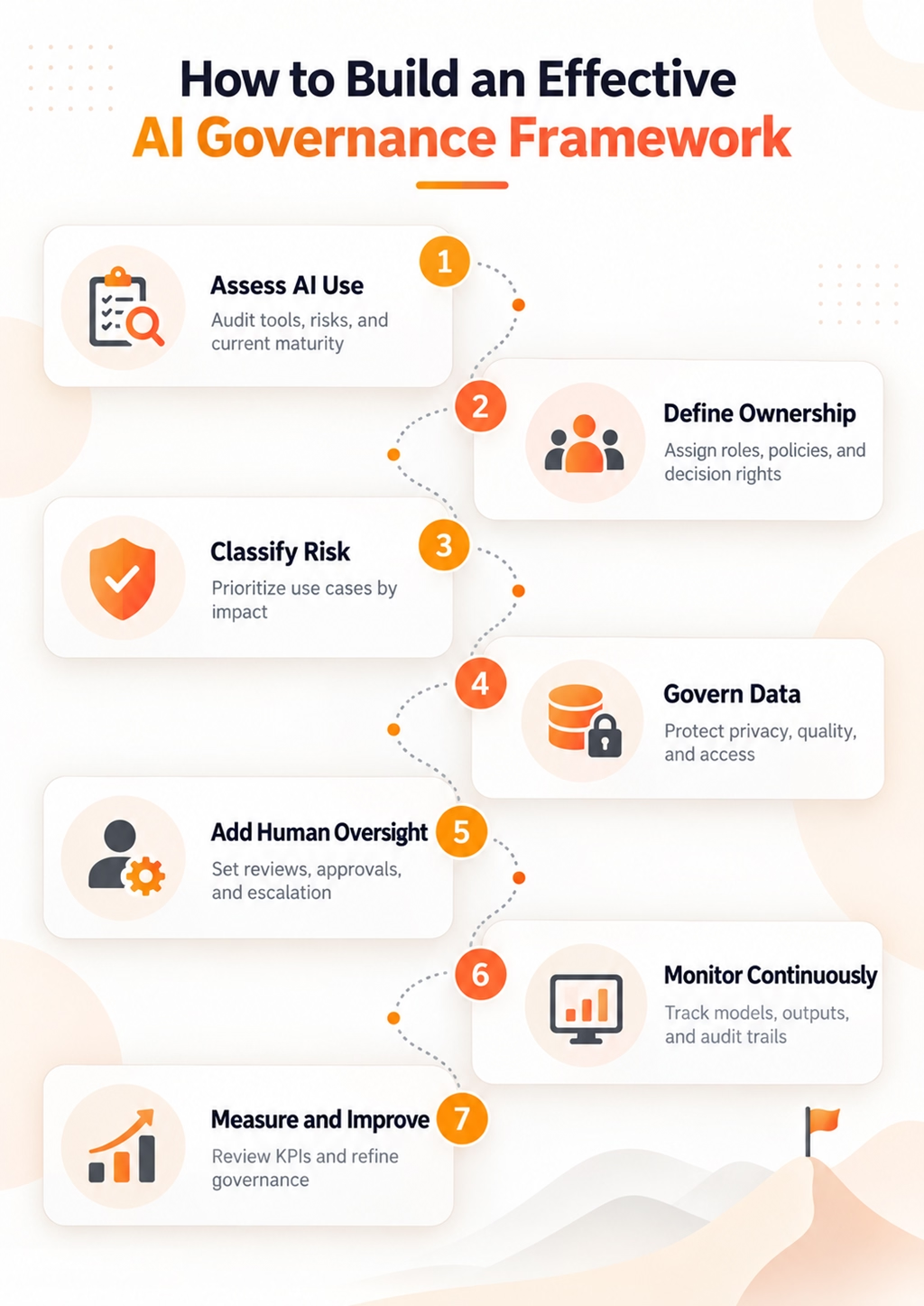
Here are seven practical steps to build AI governance across enterprise operations.
Step 1. Assess AI Governance Maturity and Identify Existing AI Use
Start by identifying where and how AI is currently used across your organization. Review approved AI platforms, employee tools, third-party APIs, and existing automation workflows.
Look for shadow AI, security gaps, and unclear ownership. Assess your current AI governance maturity against established standards such as ISO/IEC 42001.
For example, a BPO company may discover that different teams use unapproved generative AI tools to analyze customer conversations.
Action: Create a centralized AI inventory. Record each system’s purpose, owner, data access, and associated risks. This helps identify governance gaps before expanding AI adoption.
Step 2. Define AI Ownership, Policies, and Decision Rights
Every AI system needs clear ownership and accountability. Otherwise, enterprises may struggle to manage errors, security incidents, and automated decisions.
Establish an AI Governance Board with representatives from IT, legal, security, risk, and operations. Assign responsibilities to the Chief AI Officer (CAIO), Chief Risk Officer (CRO), CISO, and relevant business leaders.
Action: Develop an AI decision rights framework. Define who approves AI deployment, monitors performance, handles incidents, and authorizes corrective actions. Document these responsibilities through a RACI matrix.
Step 3. Classify AI Use Cases by Risk and Business Impact
Not every AI application carries the same level of risk. An internal AI writing assistant requires different controls from an autonomous agent handling financial transactions.
Assess each use case based on data sensitivity, decision-making authority, potential harm, and business impact.
Use the NIST AI RMF to guide risk assessments. Consider the EU AI Act’s risk classifications when the regulation applies.
Action: Create internal low-, medium-, and high-risk categories. Require additional testing, approval, and human oversight for high-impact applications. These internal categories should remain separate from legal classifications.
Step 4. Establish Data Governance and Privacy Controls
AI systems need accurate, secure, and properly managed data. Poor data quality can produce unreliable results. Weak privacy controls may expose sensitive business or customer information.
Establish policies for data collection, classification, storage, retention, and access. Apply relevant GDPR, CCPA, and CPRA requirements.
For example, a customer experience (CX) platform should restrict access to customer recordings and personally identifiable information (PII).
Action: Implement role-based access control (RBAC), encryption, data masking, and data lineage tracking. Review third-party AI vendors through a Third-Party Risk Management (TPRM) process.
Step 5. Embed Human Oversight Into AI Workflows
AI automation should not remove human accountability from sensitive business decisions.
Establish human-in-the-loop (HITL) controls for high-risk activities. Define when AI can act independently and when human approval is required.
For example, an AI voice agent may answer routine customer questions. However, payment disputes or sensitive account changes may require a human supervisor.
Action: Set approval thresholds, escalation pathways, and override permissions. Ensure human reviewers can understand, challenge, and correct AI-generated decisions.
Step 6. Implement Continuous AI Monitoring and Audit Trails
AI governance must continue after deployment. AI models can experience performance degradation, model drift, hallucinations, and unexpected behavior.
Use MLOps and AI monitoring processes to track model accuracy, security events, output quality, and policy violations.
For agentic AI systems, monitor tool usage, autonomous actions, and permission boundaries.
Action: Maintain audit trails, model version histories, and decision logs. Establish automated alerts and regular algorithmic audits. Investigate failures and update controls when risks change.
Step 7. Measure Business Value and Improve Governance Continuously
Effective governance should reduce risks without preventing innovation. Enterprises must measure both AI performance and governance effectiveness.
Track key performance indicators (KPIs) such as:
- AI risk assessment coverage: Percentage of AI systems evaluated for potential risks.
- Policy compliance rate: Percentage of reviewed AI systems meeting required controls.
- AI incident frequency: Number of confirmed security, privacy, or operational incidents.
- Model accuracy and reliability: Performance against established evaluation standards.
- Business ROI: Cost savings, productivity improvements, and measurable operational value.
For example, a BPO provider can compare AI-assisted quality assurance results against human evaluations. It can also track review time, scoring consistency, and customer satisfaction.
Action: Review governance KPIs regularly. Use the findings to update policies, improve AI workflows, and strengthen operational controls.
Why Agentic AI Makes Enterprise Governance More Complex
Unlike traditional AI, agentic AI can make decisions, access systems, and execute tasks with limited human involvement. This increases efficiency but creates new governance risks.
For example, an autonomous AI agent can verify a refund request, update customer records, and process a transaction without human approval.
Here are the major governance challenges:
- Unclear Accountability: Autonomous agents can make incorrect decisions without direct oversight. Clear AI ownership, decision rights, and escalation pathways are essential.
- Security and Privacy Risks: AI agents access sensitive data, internal systems, and third-party APIs. Excessive permissions and unauthorized access increase data privacy risks.
- Unreliable Decisions: Hallucinations, algorithmic bias, and model drift can produce incorrect actions. Regular testing and continuous AI monitoring help maintain reliability.
- Limited Transparency: Multi-step AI workflows can make errors difficult to trace. Audit trails, execution logs, and model lineage tracking improve accountability.
- Lack of Human Oversight: Autonomous actions in BPO and customer experience (CX) operations can create costly mistakes. Human-in-the-loop (HITL) controls help manage high-risk decisions.
- Regulatory Compliance Challenges: Agentic AI may trigger obligations under GDPR, CCPA/CPRA, or the EU AI Act. Risk assessments and documented controls help organizations address applicable requirements.
To address these risks, enterprises should establish clear AI governance policies, limit agent permissions, and implement human approval checkpoints. ISO/IEC 42001 and NIST AI RMF 1.0 provide guidance for responsible AI governance.
How AI Governance Works Across Software, BPO, and CX Operations
AI governance varies across business functions. Software companies prioritize secure development. BPO providers focus on data protection and accountability. Customer experience (CX) teams need reliable automation and consistent service quality.
Here is how enterprises can apply AI governance across these operations.
AI Governance in Enterprise Software Development
Generative AI (GenAI) and AI coding assistants improve development speed but can introduce security vulnerabilities, inaccurate code, and data privacy risks.
Enterprises should integrate AI governance into the Software Development Life Cycle (SDLC). Secure coding standards, human code reviews, model validation, and MLOps monitoring help maintain software quality.
For example, AI-generated code should pass security testing before production deployment.
AI Governance in BPO and Outsourced Workflows
BPO companies use AI for call transcription, automated quality assurance, and workflow automation. However, handling sensitive client information creates security and compliance risks.
Effective governance requires third-party risk management (TPRM), role-based access controls, audit trails, and human-in-the-loop (HITL) reviews.
For example, BPO providers should validate AI-generated quality scores against human evaluations to ensure consistent service standards.
AI Governance in Customer Experience Automation
CX teams use AI voice agents, chatbots, and conversational AI to automate customer interactions. However, hallucinations and incorrect responses can damage customer trust.
Enterprises should establish clear rules for governing autonomous CX agents. These include response validation, human escalation procedures, and continuous AI monitoring.
For example, an AI voice agent can handle routine inquiries but should escalate sensitive payment disputes to authorized employees.
How to Choose the Right Technology Partner for Governed AI Transformation
Choosing the right AI technology partner is not just about advanced features or automation capabilities. Enterprises need a partner that supports security, accountability, regulatory compliance, and long-term scalability.
Since AI transformation is a problem of governance, businesses should evaluate how well a technology partner manages AI risks and maintains control over automated workflows.
Here are the key factors to consider:
- AI Governance and Compliance: Look for alignment with ISO/IEC 42001 and NIST AI RMF 1.0. Ask how the provider supports risk assessments, audit trails, and applicable regulatory requirements.
- Data Security and Privacy: Evaluate encryption, role-based access controls, data retention policies, and GDPR or CCPA/CPRA compliance measures. Confirm how sensitive information is processed and protected.
- Transparency and Accountability: Choose a partner that provides clear AI decision logs, model monitoring, and defined escalation pathways. These features help teams investigate errors and maintain accountability.
- Human Oversight and Control: Ensure the platform supports human-in-the-loop (HITL) reviews, approval checkpoints, and manual overrides for sensitive or high-risk decisions.
- Integration and Scalability: Check compatibility with existing CRM, ERP, BPO, and customer experience (CX) systems. Secure APIs and flexible integrations help reduce operational friction during enterprise AI scaling.
- Continuous Monitoring and Support: Look for model performance tracking, hallucination detection, quality evaluation, and incident management capabilities. Ask how the provider handles model updates and performance degradation.
- Vendor Reliability and Support: Review service-level agreements (SLAs), incident response procedures, and third-party risk management (TPRM) practices. Confirm how the partner handles AI failures and security incidents.
Before selecting a partner, run a pilot using a real business workflow. Test not only automation accuracy but also security controls, human intervention, and auditability.
Build a Future-Ready Enterprise with Responsible AI Transformation
Successful AI transformation requires more than advanced technology. Enterprises need clear accountability, strong data governance, human oversight, and continuous risk management to scale AI responsibly.
Frameworks like ISO/IEC 42001 and NIST AI RMF 1.0 help businesses establish these controls while supporting innovation.
At Riseup Labs, our AI Digital Transformation approach recognizes the importance of aligning AI solutions with business goals, operational workflows, and responsible governance practices.
Start with high-value AI use cases. Define ownership, assess risks, and measure performance before expanding automation across departments.
Sustainable AI transformation begins when innovation and governance work together to deliver measurable business value.
Final Thoughts
AI transformation is not just about adopting advanced technologies. It is about building a system where innovation, accountability, and risk management work together.
AI transformation is a problem of governance because even the most powerful AI systems cannot deliver sustainable value without clear ownership, secure data, human oversight, and continuous monitoring.
As generative AI and agentic AI become part of everyday business operations, strong governance will become even more important. Enterprises must address security risks, regulatory compliance, and operational challenges before scaling AI across departments.
The key is to treat AI governance as a business enabler, not a barrier to innovation. Start with clear policies, assign responsibilities, and measure outcomes. This approach helps organizations build trustworthy AI systems and achieve long-term business value.
Ultimately, successful AI transformation is not defined by how much AI an enterprise adopts, but by how responsibly and effectively it puts AI to work.
Frequently Asked Questions (FAQs)
1. Why is AI transformation a problem of governance rather than technology?
AI transformation is a problem of governance because technology alone cannot ensure accountability, data security, or responsible decision-making. Enterprises need clear AI policies, risk management frameworks, and human oversight to scale AI successfully. Without proper governance, even advanced AI systems can create operational and compliance risks.
2. What is the difference between AI governance and AI management?
AI governance defines the policies, responsibilities, and risk controls for responsible AI use. AI management focuses on implementing those policies through daily operations, performance monitoring, and continuous improvement. Governance establishes the rules, while management ensures they are followed.
3. What are the biggest AI governance challenges for enterprises?
The biggest AI governance challenges include unclear ownership, shadow AI, data privacy risks, algorithmic bias, AI hallucinations, and regulatory compliance. Enterprises also face difficulties with model drift, fragmented workflows, and limited transparency. Strong governance helps address these risks through clear accountability and continuous monitoring.
4. Why does agentic AI require stronger governance?
Agentic AI requires stronger governance because autonomous agents can make decisions, access sensitive data, and execute actions with limited human involvement. This increases security, privacy, and operational risks. Enterprises need access controls, audit trails, human-in-the-loop (HITL) oversight, and clear escalation procedures.
5. How can businesses govern AI in BPO and customer experience operations?
Businesses can govern AI in BPO and customer experience (CX) operations through data protection policies, automated quality assurance, and human oversight. Role-based access controls, customizable QA scorecards, and conversation monitoring help maintain service quality. Clear escalation procedures also support responsible AI-powered customer interactions.
6. How can organizations measure AI governance effectiveness?
Organizations can measure AI governance effectiveness through key performance indicators (KPIs) such as policy compliance rates, AI risk assessment coverage, model accuracy, security incidents, and audit findings. They should also track business outcomes like productivity, cost savings, and customer satisfaction to evaluate governance performance.
7. Can strong AI governance accelerate digital transformation?
Yes. Strong AI governance can accelerate digital transformation by reducing risks, improving decision-making, and building trust in AI systems. Clear policies, defined responsibilities, and standardized controls help enterprises deploy AI solutions more efficiently. This supports responsible AI adoption, operational scalability, and sustainable business growth.
This page was last edited on 19 October 2026, at 9:59 am

Start a conversation with our team to solve complex challenges and move forward with confidence.