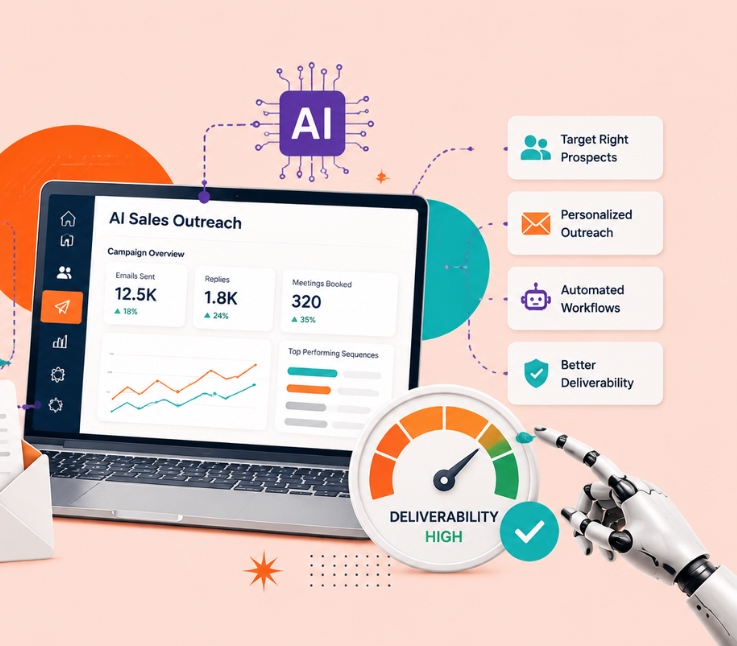
The noise around AI in B2B sales has reached a point where it’s genuinely difficult to separate what’s working from what’s being marketed. Every tool claims to write better emails, find better leads, and close more deals.
Most of that is overstatement. But beneath the hype, there are real shifts in how outreach is built, targeted, and measured, and some of them matter significantly for teams trying to generate pipeline.
This piece looks at what AI is actually changing, where it still falls short, and what any serious outbound program needs to get right regardless of which tools it uses.
What AI Actually Changes in B2B Sales Outreach
Most discussions about AI in sales focus on output emails written faster, lists built quicker, responses generated automatically. The more interesting question is whether the output is better, not just faster.
Replacing guesswork with pattern recognition
The most practical AI contribution to outreach isn’t message generation. It’s signal detection.
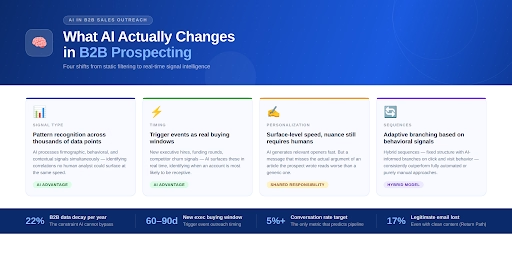
AI systems can process thousands of firmographic, behavioral, and contextual data points simultaneously and identify patterns that would take a human analyst weeks to surface. Which types of companies respond to which message angles? At what stage of company growth does a prospect become receptive to a specific offer? Which combination of job title, industry, and recent activity correlates with a short sales cycle? These are questions that manual analysis can answer eventually, but AI can answer faster and at a scale that changes how prospecting lists get built.
Personalization at scale and where it still breaks down
The pitch for AI-assisted personalization is straightforward: write one-to-one messages for thousands of contacts simultaneously, each one tailored to the recipient’s context.
The reality is more complicated. AI personalization works well at the surface level — referencing a recent job change, a company funding round, a published article. It struggles with nuance. A message that mentions someone’s recent blog post in a way that misses the actual argument, or that references a company milestone without understanding its strategic significance, reads as worse than a well-written generic message. The error is visible to the recipient and the damage to credibility is immediate.
AI-Driven Prospecting: Signals, Triggers, and the ICP Problem
Traditional ICP filtering is static. Job title plus company size plus industry produces a list, and that list ages out within weeks. AI changes the speed and sophistication with which prospects are identified, but only if the underlying signals are right.
Dynamic ICP signals vs. static filters
AI-powered prospecting tools ingest data from dozens of sources: job posting patterns, technology adoption signals, LinkedIn activity, news mentions, funding databases, review platforms. The combination of these signals builds a profile of a company’s current state, not just its firmographic category.
A company posting five engineering roles, having recently adopted a new CRM, and showing a spike in G2 activity around enterprise software is different from a company that matches the same firmographic profile but shows none of those behaviors. Static filtering can’t see that difference. AI-assisted prospecting can, and the quality of the resulting list reflects it.
Trigger events as buying windows
Not all signals are equal. The ones that indicate an active buying window outperform firmographic matches by a significant margin.
A new VP of Sales starting at a target account will likely evaluate their tech stack within the first 60 to 90 days. A company announcing geographic expansion needs operational infrastructure it may not currently have. A competitor’s product receiving consistent negative reviews on Capterra creates an opening that won’t stay open long. AI tools that surface these signals in real time allow sales teams to reach the right account at the right moment, which is a fundamentally different capability than finding an account that might be ready someday.
Sequence Design in the AI Era
The mechanics of a cold outreach sequence haven’t changed because of AI. The number of touches, the spacing between them, the channel mix — those fundamentals are driven by buyer behavior, not tooling. What AI changes is how sequences adapt to individual responses within a campaign.
The difference between scheduled and adaptive sequences
| Sequence type | How it works | Strength | Limitation |
| Time-based | Messages fire on a fixed calendar | Simple to build and manage | No response to engagement signals |
| Behavior-triggered | Next step determined by what the prospect did | More relevant touchpoints | Requires reliable tracking data |
| AI-adaptive | Sequence branches based on predicted next-best-action | Responds to intent signals in near-real-time | Black box — hard to audit or learn from |
| Hybrid | Fixed structure with behavioral branches at key points | Balances control and responsiveness | Requires careful initial design |
Most teams benefit most from the hybrid approach: a defined structure that branches based on specific engagement signals (clicked a pricing link, visited the website twice this week, opened without clicking three times). Pure AI-adaptive sequences can optimize for clicks or opens without optimizing for conversations, which is the only metric that predicts pipeline.
Message generation and the limits of automation
AI can produce a reasonable first draft of a cold email faster than any human writer. That’s genuinely useful for testing new angles, scaling message variations, and avoiding blank-page paralysis.
What it doesn’t do is guarantee relevance. An AI-generated opener that mentions a prospect’s company expanding into EMEA lands well if the expansion is true and recent. If the data is stale by three weeks, it lands as a clear signal of automation and immediately reduces trust. The principle holds across every element of AI-assisted message writing: the output is only as good as the data feeding it.
Deliverability: The Problem AI Cannot Solve Alone
A common assumption in discussions about AI-powered outreach is that smarter targeting automatically means better deliverability. It doesn’t. The two problems are related but distinct, and confusing them leads to well-targeted campaigns that never reach the inbox.
Why better targeting doesn’t equal better inbox placement
Gmail, Outlook, and Yahoo route messages based on the sender’s domain reputation, not the quality of the targeting decisions that produced the list.
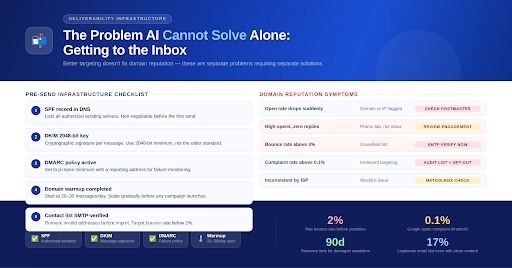
A domain sending from a fresh setup, without completed warmup, without properly configured SPF, DKIM, and DMARC records, and without historical engagement signals will go to spam regardless of how well the recipient was selected. The same is true for domains that have accumulated bounce rates above 2% or spam complaint rates above 0.1%. AI prospecting can put the right name on the list. It cannot repair the domain’s standing with ISPs.
Testing deliverability before campaigns go live
One of the most consistently underused practices in outbound is testing whether messages actually reach the inbox before a campaign starts sending to real prospects.
Before any sequence goes live, running a deliverability check identifies problems with domain authentication, IP reputation, and content filtering that would otherwise only surface as mysteriously flat results weeks into the campaign. A tool like Snov.io allows teams to test inbox placement across major providers before the first prospect ever receives a message — which is a faster diagnostic than watching campaign metrics fall and working backward to find the cause. According to research from Return Path, 17% of legitimate email never reaches the inbox even when the content is clean. Knowing your starting position before launch changes how the campaign gets set up.
What AI Doesn’t Change: The Fundamentals That Still Decide Outcomes
No technology layer removes the underlying requirements for effective outreach. AI accelerates and enhances; it doesn’t replace judgment.
Conversation rate still depends on human decisions
The metric that predicts pipeline in cold outreach isn’t open rate or reply rate — it’s conversation rate, the percentage of contacts that turn into genuine two-way exchanges.
Conversation rate depends on factors AI can influence at the margins but cannot control:
- Whether the ICP was defined with real customer insight or assumption
- Whether the message angle resonates with an actual problem the prospect has right now
- Whether the timing aligns with a moment when the prospect is receptive
- Whether the follow-up sequence adds value or just adds noise
- Whether the from name and domain inspire enough trust for the message to be read at all
Each of these is a judgment call that belongs to a human with real knowledge of the buyer and the market. AI tooling supports these decisions; it doesn’t make them.
Data quality is still the constraint that limits everything
AI systems are pattern-matching engines operating on whatever data they’re given. Better data produces better patterns. Stale, incomplete, or inaccurate data produces confident-sounding recommendations that lead in the wrong direction.
Contact data in B2B decays at roughly 22% per year. A list enriched in January looks materially different in July. AI prospecting tools that pull from a single data source, or from a source that isn’t refreshed regularly, will surface patterns that fit historical reality but not current reality. The teams getting the most from AI-assisted outreach are also the ones maintaining the strictest standards around data freshness — running verification passes before imports, auditing their lists quarterly, and treating enrichment as an ongoing process rather than a one-time step.
Conclusion
AI is a genuine improvement to B2B outreach in several specific areas: signal detection, ICP refinement, sequence branching, and message variation testing. It doesn’t solve deliverability, it doesn’t replace human judgment on messaging, and it doesn’t compensate for bad data. The teams generating consistent pipeline from AI-enhanced outreach are using it to amplify what was already working, not to substitute for the fundamentals that were missing.
Frequently Asked Questions
Does AI improve cold email deliverability?
Not directly. AI can improve targeting precision and help personalize messages at scale, but deliverability is determined by domain reputation, authentication records (SPF, DKIM, DMARC), sending volume history, and bounce rates. A well-targeted campaign sent from a domain with no warmup and missing authentication will still land in spam. AI handles the “who and what” of outreach. Deliverability is an infrastructure problem that requires its own setup — including domain warmup, list verification, and monitoring tools — regardless of how sophisticated the AI layer is.
What B2B outreach tasks does AI handle best?
AI performs best at pattern recognition across large datasets — identifying which prospect profiles correlate with fast sales cycles, surfacing trigger events that indicate active buying windows, generating message variations for A/B testing at scale, and branching sequences based on behavioral signals. It handles volume and consistency better than any manual process. Where it underperforms is in tasks requiring genuine contextual judgment: reading whether a message angle resonates with a specific buyer’s real situation, deciding when to stop following up, and interpreting ambiguous responses that require a nuanced reply.
How accurate is AI-generated personalization in cold email?
It depends heavily on data quality and recency. AI personalization performs well when the signal it’s acting on is accurate and fresh — a recent funding round, a confirmed job title change, a specific article the prospect published. It fails when the underlying data is stale, incomplete, or sourced from a single provider without cross-verification. A message that confidently references outdated context about a prospect reads worse than a well-written generic message. Most experienced outbound teams use AI-generated drafts as starting points for human review rather than sending them without any editorial pass.
What is conversation rate and why does it matter more than open rate?
Conversation rate is the percentage of contacted prospects who respond with genuine interest and initiate a real two-way exchange. It’s the only outreach metric with a direct correlation to pipeline generation. Open rates measure whether a subject line worked. Reply rates measure whether someone responded at all. Conversation rate measures whether the response moved the relationship forward. A campaign with a 40% open rate and a 0.5% conversation rate is failing where it counts. Since Apple’s Mail Privacy Protection began inflating open rates for iOS users, conversation rate has become even more important as a reliable leading indicator of outreach effectiveness.
How often should B2B contact data be refreshed when using AI prospecting tools?
At minimum, lists should be verified before any new campaign is launched. For teams running ongoing outbound at volume, a quarterly audit of active segments is a practical baseline — removing hard bounces, checking for role changes, and re-verifying SMTP on contacts that haven’t been emailed in 60 or more days. B2B contact data decays at roughly 22% per year, which means a list built in January is materially different by July. AI prospecting tools that pull from a single data source without regular refresh produce signals that fit historical reality, not current reality. Waterfall enrichment across multiple providers consistently achieves higher match rates and fresher data than any single-source approach.
Can small sales teams benefit from AI outreach tools without large budgets?
Yes, but the benefit scales with how disciplined the underlying process is. The highest-value AI application for a small team isn’t message generation — it’s trigger event monitoring. Knowing when a target account just hired a new VP, raised funding, or posted a relevant job opening allows a two-person team to prioritize outreach at the exact moment it’s most likely to land, without sending volume at scale. That kind of signal-based prioritization produces better results from fewer touches, which is precisely the constraint a small team is working within. The infrastructure requirements (domain warmup, authentication, list verification) are the same regardless of team size and should be set up before any AI-assisted outreach begins.
What is the biggest mistake companies make when implementing AI in B2B outreach?
Treating AI as a substitute for a clear strategy rather than an accelerant of one. Teams that don’t have a defined ICP, a tested message angle, or a process for managing list quality don’t fix those problems by adding an AI layer — they scale the confusion faster. The companies that get the most from AI-assisted outreach already have a functioning outbound motion: they know which segments respond, which message angles open conversations, and what a qualified reply looks like. AI helps them do more of what’s working. For teams still figuring out those fundamentals, AI tooling adds complexity without improving the underlying results
This page was last edited on 12 August 2026, at 1:48 pm

Start a conversation with our team to solve complex challenges and move forward with confidence.