Agentic AI is an advanced form of artificial intelligence that allows systems to independently analyze situations, make decisions, and complete tasks toward specific goals. Unlike traditional AI that only responds to instructions, Agentic AI can plan, reason, and act autonomously.
For years, artificial intelligence has helped humans find information, generate content, and automate repetitive tasks. But the next phase of AI is changing the way machines operate — from simply responding to instructions to independently making decisions and taking action.
This new era is powered by Agentic AI.
Unlike traditional AI systems that wait for human prompts, Agentic AI systems can understand goals, analyze situations, create plans, and execute tasks with minimal human involvement. They can adapt to changing conditions, use available tools, and work through complex problems to achieve desired outcomes.
Imagine an AI system that does not just answer a customer query but resolves the issue, updates records, and follows up automatically. Or an AI assistant that can analyze data, create a strategy, and complete business workflows without step-by-step instructions.
This shift from reactive AI to proactive intelligence is transforming industries, from healthcare and finance to software development and customer service.
In this guide, we will explore what Agentic AI is, how it works, its key capabilities, real-world applications, benefits, challenges, and why it is becoming one of the most important developments in the future of artificial intelligence.
What Is Agentic AI?
Agentic AI is a new generation of artificial intelligence that can do more than answer questions. It can think through problems, make decisions, and take action to achieve a specific goal.
Traditional AI waits for instructions. Agentic AI works toward outcomes.
For example, a chatbot can tell a customer their account balance. But an Agentic AI system can analyze the customer’s situation, compare available options, recommend the best solution, and complete the required steps through connected systems.
It works by combining technologies like large language models (LLMs), reasoning, planning, and tool integrations to handle complex tasks with less human involvement.
In simple terms, generative AI creates content, while Agentic AI completes tasks. This ability to plan and act is making Agentic AI a powerful solution for industries like customer service, healthcare, software development, and business automation.
How Does Agentic AI Work?
Agentic AI operates through a continuous perception-to-action cycle that enables autonomous decision-making and learning. While frameworks vary, most agentic systems follow the same foundational process of perceiving their environment, reasoning over data, setting goals, making decisions, executing tasks, and adapting through feedback.
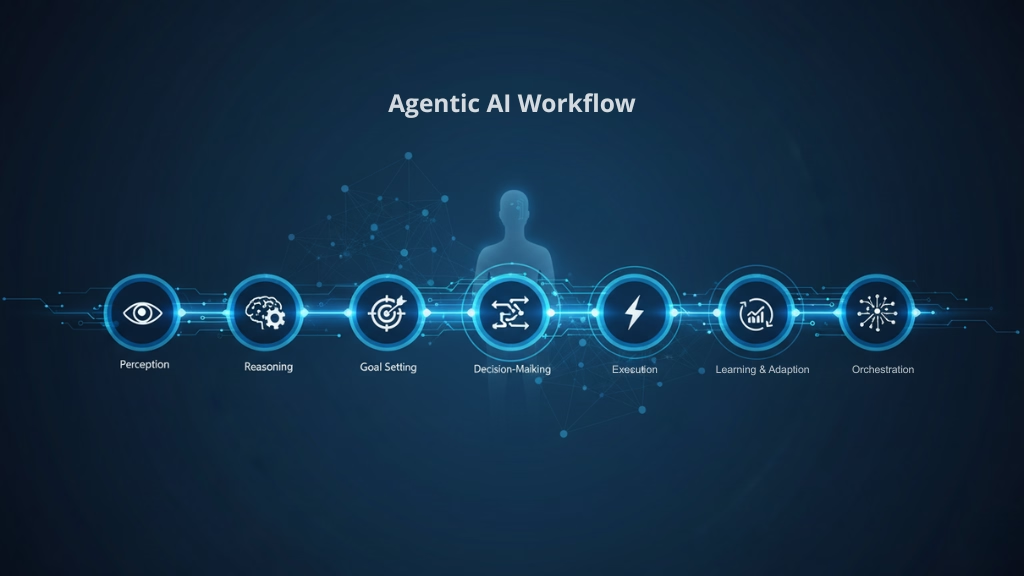
1. Perception
Agentic AI begins by collecting information from its environment using sensors, APIs, databases, or user interactions. This ensures it works with the most current and relevant data. For example, a digital operations agent might monitor CRM updates, web analytics, or external signals before deciding what to do next.
2. Reasoning
Once data is collected, the AI analyzes and interprets it to extract meaning. Using natural language processing (NLP), computer vision, or data analytics, it detects patterns, understands intent, and contextualizes information. This reasoning capability helps the system evaluate conditions and identify potential actions.
3. Goal Setting
The agent then defines objectives either from predefined instructions or dynamically inferred goals. Through planning algorithms, decision trees, or reinforcement learning, it determines what it wants to achieve and how to get there. This stage bridges raw information with purposeful behavior.
4. Decision-Making
Here, the AI evaluates possible actions and selects the optimal one. It considers factors such as efficiency, success probability, and available resources. Decision-making may use probabilistic reasoning, utility functions, or model-based reinforcement learning to balance trade-offs between competing outcomes.
5. Execution
After choosing a plan, the AI acts to carry it out. It may:
- Send commands to APIs or software systems.
- Generate or modify data.
- Communicate results to users or other agents.
Execution is where the AI’s “intentions” become measurable actions within its environment.
6. Learning and Adaptation
Once an action is executed, the AI assesses the result. Feedback, whether success or failure is fed into its learning loop. Using reinforcement or self-supervised learning, the system refines its strategies, improving performance over time and adapting to new scenarios.
7. Orchestration
Modern agentic systems rarely act alone. AI orchestration coordinates multiple agents and tools, managing workflows, monitoring resource usage, and maintaining system memory. Orchestration platforms ensure that dozens or even thousands of agents can collaborate productively, each contributing to a shared task or goal.
Key Characteristics of Agentic AI Systems
What makes Agentic AI different from traditional AI is its ability to understand goals, make decisions, adapt to changes, and take actions with less human involvement.
Instead of only generating responses, Agentic AI systems can analyze situations, plan next steps, and work toward achieving specific outcomes.
1. Proactive Instead Of Reactive
Traditional AI systems usually wait for a prompt or instruction before responding.
Agentic AI takes a more proactive approach. It can monitor situations, identify changes, and decide when action is needed based on its goals.
For example, an AI system managing a supply chain can detect potential delays and suggest alternative solutions before the issue impacts operations.
2. Adaptable To Changing Situations
Agentic AI systems are designed to adjust their behavior as new information becomes available.
Rather than relying only on fixed rules, they can learn from feedback, analyze previous outcomes, and improve their decisions over time.
This adaptability allows Agentic AI to handle changing environments where the best solution may not always be predictable.
3. Context-Aware And Collaborative
Agentic AI can understand the broader context behind a task instead of focusing only on individual instructions.
It can work with humans, other AI agents, and connected software tools to complete complex workflows more efficiently.
For example, in a business environment, multiple AI agents can collaborate on tasks like analyzing data, managing customer interactions, and automating internal processes while keeping shared goals in mind.
4. Continuous Learning And Improvement
A major advantage of Agentic AI is its ability to improve through feedback.
These systems can evaluate the results of their actions, identify successful approaches, and adjust future decisions accordingly.
Over time, continuous learning helps Agentic AI become more accurate, efficient, and better aligned with user goals.
Key Technologies Behind Agentic AI
Agentic AI works when five layers fit together: a language “brain” for reasoning, planners for choosing actions over time, durable memory and knowledge, orchestration to coordinate roles, and safe tool interfaces to act in the world. The quality of the composition matters more than any single part.
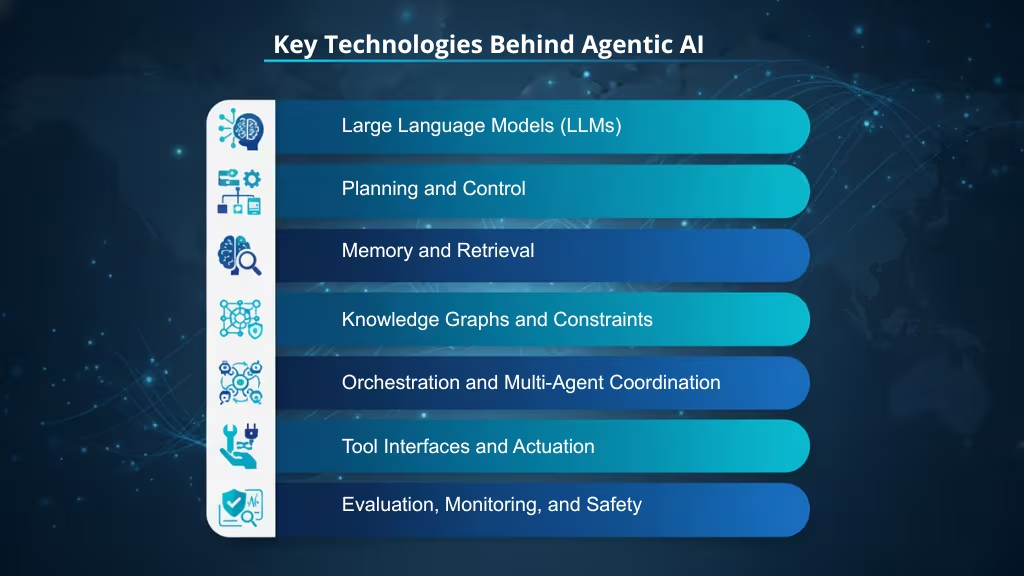
Agentic AI is not powered by a single technology. It combines multiple AI capabilities that allow systems to understand goals, make decisions, use tools, and complete tasks independently.
The main technologies behind Agentic AI include:
1. Large Language Models (LLMs)
Large Language Models (LLMs) act as the reasoning engine behind Agentic AI systems.
They help AI agents understand user goals, analyze information, communicate naturally, and create plans to complete tasks.
Unlike traditional AI models that only provide responses, LLM-powered agents can break complex goals into smaller steps and decide what actions are needed next.
For example, an AI assistant can understand a request like “prepare a sales report” and determine the steps required, such as collecting data, analyzing trends, and generating a summary.
2. Planning And Decision-Making
Agentic AI relies on planning capabilities to complete complex tasks that require multiple steps.
Instead of responding immediately, AI agents can evaluate different options, create a strategy, and adjust their approach based on new information.
This ability allows them to handle workflows such as:
- Managing business processes
- Analyzing data
- Automating customer support tasks
- Completing software development activities
Planning helps Agentic AI move from simple automation to goal-oriented problem solving.
3. Memory And Knowledge Retrieval
Memory allows Agentic AI systems to maintain context, remember previous interactions, and access relevant information when needed.
By using technologies like retrieval-augmented generation (RAG), AI agents can connect with external knowledge sources such as:
- Business documents
- Databases
- Company knowledge bases
- Customer records
This helps agents provide more accurate responses and make better decisions based on available information.
4. Tool Integration And Action Capabilities
One of the biggest differences between traditional AI and Agentic AI is the ability to take action.
Through APIs, software integrations, and external tools, AI agents can interact with business systems and complete real tasks.
For example, an Agentic AI system can:
- Update customer records
- Schedule appointments
- Analyze reports
- Process requests
- Trigger automated workflows
These integrations allow AI to move beyond generating answers and become an active assistant.
5. Multi-Agent Collaboration
Complex tasks often require multiple specialized AI agents working together.
A multi-agent system allows different AI agents to handle specific responsibilities, such as:
- Research
- Data analysis
- Planning
- Quality checking
- Execution
These agents can collaborate and share information to complete larger workflows more efficiently.
6. Safety, Monitoring, And Human Oversight
As AI systems become more autonomous, safety and control become essential.
Agentic AI requires monitoring systems and safeguards to ensure actions are accurate, secure, and aligned with business goals.
Important safety measures include:
- Permission controls
- Human approval for sensitive actions
- Performance monitoring
- Error detection
These safeguards help businesses use Agentic AI responsibly while reducing risks.
The Future Of Agentic AI Systems
Agentic AI combines reasoning, planning, memory, and action capabilities to create systems that can work toward goals instead of simply responding to commands.
By bringing these technologies together, businesses can build AI solutions that automate complex workflows, improve efficiency, and support better decision-making across industries.
Agentic AI vs Other Forms of AI
Agentic AI differs from other types of artificial intelligence in how it operates, learns, and interacts with its environment. Unlike generative or rule-based systems that rely on user prompts or fixed workflows, agentic AI can independently plan and execute multi-step actions to reach specific goals.
1. Agentic AI vs. Generative AI
| Aspect | Generative AI | Agentic AI |
|---|---|---|
| Purpose | Produces content (text, images, code) based on user prompts. | Achieves objectives through reasoning, planning, and action. |
| Core Function | Pattern recognition and creation. | Goal-oriented decision-making and execution. |
| User Role | Provides instructions and context. | Defines goals; AI autonomously decides how to fulfill them. |
| Example | ChatGPT generates an article or image. | An AI agent that drafts, edits, and publishes content autonomously after validation. |
Generative AI is reactive; it responds when prompted.
Agentic AI is proactive; it acts on its own initiative to deliver outcomes.
2. Agentic AI vs. Traditional Automation / RPA
| Aspect | Traditional Automation (RPA) | Agentic AI |
|---|---|---|
| Operation | Follows fixed rules and scripts. | Adapts to new data, exceptions, and changing environments. |
| Flexibility | Limited requires manual reprogramming for new conditions. | High learns and adjusts behavior automatically. |
| Scope | Handles repetitive, predictable tasks. | Manages dynamic, complex, multi-step workflows. |
| Intelligence Level | No reasoning or contextual understanding. | Context-aware, reasoning-driven execution. |
While RPA automates actions, Agentic AI automates decisions, understanding why, when, and how to act.
3. Agentic AI vs. Standard AI Agents
| Aspect | Standard AI Agent | Agentic AI System |
|---|---|---|
| Goal Orientation | Executes pre-set instructions. | Defines and pursues goals autonomously. |
| Learning Ability | Static minimal adaptation over time. | Continuously improves through reinforcement and feedback. |
| Coordination | Operates independently. | Collaborates with other agents through orchestration. |
| Decision-Making | Limited to defined scenarios. | Handles open-ended, ambiguous problems dynamically. |
Standard AI agents are narrow tools designed for one-off tasks.
Agentic AI represents the evolution of that concept: a network of intelligent agents capable of reasoning, collaborating, and adapting in real time.
Applications And Use Cases Of Agentic AI
Agentic AI is being adopted across industries where businesses need smarter automation, faster decisions, and the ability to handle complex workflows.
Unlike traditional AI systems that only provide responses, Agentic AI can analyze situations, plan actions, use tools, and complete tasks with minimal human involvement.
1. Enterprise Automation And Operations
Businesses are using Agentic AI to automate complex operations and improve efficiency across different departments.
AI agents can:
- Monitor business processes and identify issues
- Automate repetitive workflows
- Support decision-making with real-time insights
- Coordinate tasks across multiple systems
For example, an AI agent can monitor supply chain operations, detect potential delays, and recommend or execute solutions to reduce disruptions.
2. Customer Service And Experience
Agentic AI is taking customer support beyond traditional chatbots by enabling AI systems to understand customer needs and complete tasks.
AI agents can:
- Analyze customer requests using context and history
- Access CRM and support systems
- Resolve issues and complete actions automatically
- Personalize customer interactions
For example, a telecom AI agent can identify a network issue, check customer details, and guide the resolution process without requiring a human agent for every step.
3. Supply Chain Optimization
Agentic AI helps businesses create more responsive and efficient supply chains by analyzing data and adapting to changing conditions.
AI agents can:
- Predict potential disruptions
- Optimize inventory and logistics decisions
- Coordinate tasks across suppliers and distribution networks
For example, AI agents can analyze weather, inventory, and transportation data to help businesses adjust delivery plans in real time.
4. Software Development And Engineering
Agentic AI is transforming software development by helping teams automate different stages of the development process.
AI agents can:
- Generate and review code
- Identify bugs and suggest improvements
- Run tests and analyze results
- Assist with documentation and deployment workflows
For example, a development AI agent can help create a feature, test the implementation, and provide feedback before release.
5. Research And Knowledge Discovery
Agentic AI is also helping researchers analyze large amounts of information and accelerate discovery.
AI agents can:
- Collect and analyze data
- Generate research insights
- Run simulations
- Support complex problem-solving
For example, in pharmaceutical research, AI agents can analyze scientific data, identify potential compounds, and assist researchers in exploring new treatments.
From automating business operations to accelerating research, Agentic AI is helping organizations move from simple automation toward intelligent systems that can reason, adapt, and take action.
Benefits of Agentic AI
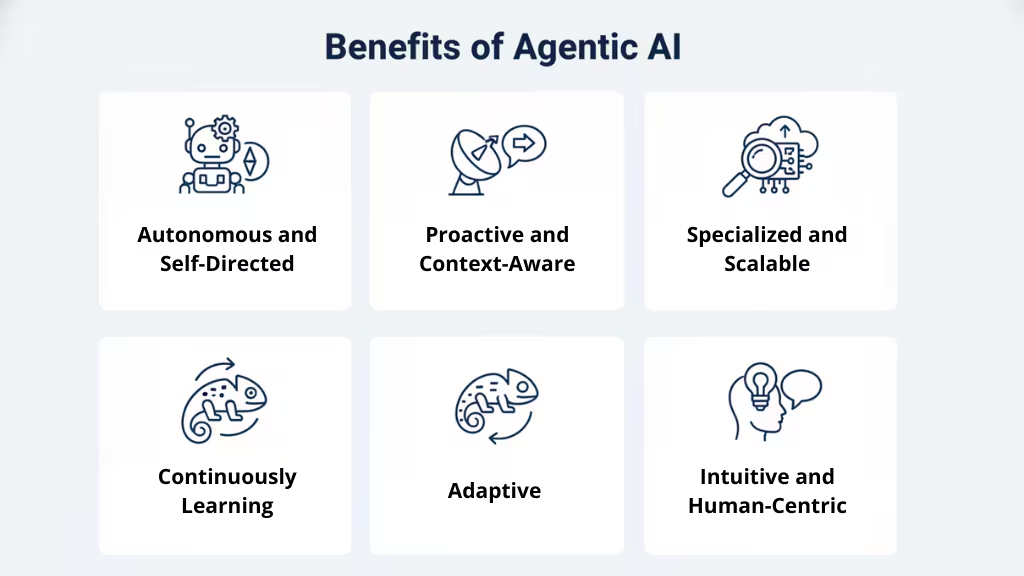
Agentic AI offers a major step forward from traditional and generative systems by introducing genuine autonomy, adaptability, and intuition. These systems don’t just respond to commands; they act independently, learn from experience, and collaborate naturally with humans and other agents to achieve long-term goals.
1. Autonomous Task Execution
One of the biggest benefits of Agentic AI is its ability to complete tasks with minimal human supervision.
AI agents can manage multi-step workflows, track progress, and make decisions based on available information. This allows businesses to automate complex processes while reducing the need for constant manual involvement.
For example, an enterprise AI agent can analyze reports, update workflows, and alert team members only when human approval is required.
2. Proactive Problem Solving
Traditional AI usually waits for a user request before responding. Agentic AI can take a more proactive approach by identifying opportunities, detecting issues, and acting when needed.
By connecting with tools, APIs, and real-time data sources, AI agents can gather information, evaluate situations, and complete tasks before problems become larger.
3. Improved Scalability
Agentic AI allows businesses to handle increasing workloads without adding the same level of manual effort.
Organizations can create specialized AI agents for different tasks, such as customer support, data analysis, research, or workflow automation. Multiple agents can also work together to manage larger and more complex operations.
4. Continuous Learning And Improvement
Agentic AI systems can learn from feedback and previous outcomes to improve their performance over time.
By analyzing results and adjusting their approach, AI agents become more accurate, efficient, and better aligned with business goals.
This continuous improvement helps organizations build AI systems that become more valuable with ongoing use.
5. Better Human-AI Collaboration
Agentic AI is designed to support people, not replace them.
By handling repetitive tasks and providing intelligent recommendations, AI agents allow employees to focus on areas that require creativity, strategy, and human judgment.
This creates a more efficient partnership between humans and AI.
6. More Natural User Experiences
Agentic AI makes advanced technology easier to use through natural language interactions.
Instead of learning complex software systems, users can communicate with AI assistants through simple conversations. This makes AI tools more accessible and allows teams to complete tasks faster.
Overall, Agentic AI helps businesses move from basic automation to intelligent operations by enabling systems that can understand goals, make decisions, and take meaningful actions independently.
Challenges and Ethical Considerations
While Agentic AI offers transformative potential, it also introduces new technical, operational, and ethical challenges. As AI systems gain autonomy, ensuring they act responsibly, transparently, and safely becomes a critical priority for developers, enterprises, and regulators.
1. Governance, Transparency, and Accountability
The rise of autonomous decision-making raises the question: who is responsible when AI acts on its own?
- Governance frameworks must define clear accountability, especially when agents make independent choices that impact finances, customers, or society.
- Transparency in how AI reasons and acts is essential for trust. Organizations need explainable models and traceable decision logs.
- Auditability should be built in: every autonomous action must be reviewable to ensure compliance and ethical oversight.
Challenge example: When an AI agent independently adjusts a company’s pricing strategy, who owns the outcome: the engineer, the manager, or the AI provider?
2. Bias, Reliability, and Control
Even the most advanced systems can reflect or amplify biases in their training data.
- Bias propagation: If an agent’s learning data is skewed, its autonomous actions may reinforce unfair or inaccurate outcomes.
- Reliability: Agents must perform consistently across unpredictable conditions, which requires continuous testing and validation.
- Control mechanisms: Human-in-the-loop safeguards are essential to prevent harmful or unintended actions.
Example: A recruitment AI agent autonomously screening candidates must be monitored to avoid bias and ensure compliance with employment laws.
3. Security and Misuse Risks
As Agentic AI gains access to systems, APIs, and data pipelines, security becomes a critical concern.
- Unauthorized actions: A compromised agent could manipulate or leak sensitive data.
- Emergent behavior: Multi-agent systems can exhibit unpredictable or collusive dynamics if not properly constrained.
- Adversarial manipulation: Attackers might trick agents into executing harmful or fraudulent actions.
Robust authentication, sandboxed execution, and continuous monitoring are required to maintain control.
4. The “Agent-Washing” Problem
The growing hype around Agentic AI has led to mislabeling and overstatement of capabilities, a trend known as agent-washing.
- Many products marketed as “agentic” are simply enhanced chatbots or workflow automations.
- Misuse of the term confuses buyers and undermines legitimate research and development.
- True agentic systems must demonstrate autonomy, adaptability, and reasoning, not just scripted automation.
5. Regulatory and Ethical Complexity
Global regulations around AI autonomy are still developing. Organizations deploying agentic systems must navigate:
- Legal ambiguity regarding liability and compliance.
- Ethical dilemmas around autonomy versus human control.
- Cultural expectations about machine responsibility and transparency.
The Future Of Agentic AI
Agentic AI is changing the future of artificial intelligence by moving systems from simple responses to autonomous decision-making and task execution.
As AI capabilities continue to improve, these systems are expected to transform businesses, workflows, and the way humans interact with technology
1. Wider Enterprise Adoption
Businesses are increasingly exploring Agentic AI for automation, customer service, software development, and operations.
As AI models become more powerful and easier to integrate, AI agents will become a key part of enterprise systems, helping organizations automate tasks and improve decision-making.
2. Growth Of Multi-Agent Systems
The future of Agentic AI will involve multiple specialized agents working together.
Instead of one AI handling every task, different agents will manage specific responsibilities such as research, analysis, planning, and execution. This will allow businesses to automate more complex workflows efficiently.
3. Human And AI Collaboration
Agentic AI will change how people work by handling repetitive tasks and supporting complex decision-making.
Rather than replacing humans, AI agents will help teams focus on creativity, strategy, and higher-value work.
4. Focus On Safety And Governance
As AI systems become more autonomous, businesses will need stronger safeguards around security, transparency, and accountability.
Future Agentic AI development will focus on creating systems that are reliable, explainable, and aligned with human goals.
Agentic AI represents a major shift in artificial intelligence. By combining reasoning, planning, and action, it will help businesses build smarter systems that work alongside humans to solve complex problems.
Conclusion
Agentic AI marks a fundamental turning point in the evolution of artificial intelligence from passive automation to autonomous decision-making. It represents a class of systems capable of perceiving their environment, reasoning about objectives, and executing multi-step actions independently. Unlike traditional or generative AI, which relies on human prompts, agentic systems pursue goals, adapt to change, and improve through experience.
Agentic AI’s value lies not only in efficiency and automation, but in its potential to create self-optimizing digital ecosystems where humans and machines collaborate fluidly. However, realizing that vision demands strong governance, ethical frameworks, and oversight to ensure transparency, accountability, and control.
In short, Agentic AI isn’t just the next buzzword; it’s the architectural blueprint for the next generation of intelligent systems. The organizations and researchers who learn to balance its autonomy with responsibility will define the future of AI-driven innovation.
FAQs
What is Agentic AI in simple terms?
Agentic AI is artificial intelligence that can make its own decisions and take action toward goals without constant human guidance.
How does Agentic AI differ from Generative AI?
Generative AI creates content when prompted, while Agentic AI acts autonomously, planning, reasoning, and executing multi-step tasks.
What makes an AI system agentic?
It combines autonomy, adaptability, and proactive goal pursuit, supported by reasoning and learning capabilities.
Is Agentic AI used in business today?
Yes. It’s already being applied in operations, customer service, logistics, and software development through orchestrated AI agents.
What are the risks of Agentic AI?
The main risks include a lack of transparency, biased decision-making, and security vulnerabilities if autonomy isn’t properly governed.
How does Agentic AI learn from its environment?
It uses reinforcement and self-supervised learning to evaluate outcomes, learn from feedback, and adapt future behavior.
What industries will Agentic AI impact most?
Industries like manufacturing, logistics, finance, and healthcare are expected to see major transformations due to autonomous decision systems.
Can Agentic AI operate without humans?
Not entirely, while it can act autonomously, humans remain responsible for oversight, goal-setting, and governance.
This page was last edited on 3 September 2026, at 6:31 pm

Start a conversation with our team to solve complex challenges and move forward with confidence.