The best Labelbox alternatives for AI data labeling in 2026 are SuperAnnotate for enterprise and multimodal needs, Label Studio for open-source projects, CVAT for vision annotation, Dataloop for workflow automation, Scale AI for managed AI data services, and Riseup Labs for companies that want to fully outsource labeling operations.
AI data labeling needs have changed for many teams. Costs are rising, and strict compliance makes picking the right tool more important than ever. Teams want platforms that match their budget, workflow, and scale.
Labelbox is popular, but it comes with limits and costs that don’t fit every project. I have seen strong teams outgrow their tools fast, running into workflow or integration gaps. That leads to frustration and wasted time.
This guide helps you cut through the noise. Compare up-to-date alternatives to Labelbox, see clear feature and price breakdowns, and learn how to choose the right solution for your team.
Why Consider Alternatives to Labelbox for AI Data Labeling?
Labelbox has strong features, but many teams seek options with lower costs, better fit, or improved compliance. Most often, companies want tailored solutions that meet strict business and industry needs.
In my experience, teams look beyond Labelbox for these reasons:
- High or unclear pricing and hidden costs
- Missing features for auto-labeling, multimodal data, or advanced workflows
- Security and compliance limitations (SOC2, HIPAA, GDPR)
- Lack of deep integration or flexibility for custom processes
- Feedback from peers about slow support or steep learning curves
Beyond these points, feedback on forums like Reddit often focuses on pain with onboarding, feature gaps, or project scaling. A better approach is to match the tool directly to your team’s core needs, instead of defaulting to the market leader.
Labelbox Competitors and Service Alternatives Compared: Features, Pricing, and Benefits
Not every Labelbox alternative is the same type of solution. Some products directly replace Labelbox’s annotation software, while others provide trained teams that perform annotation, quality assurance, and project management for you.
Riseup Labs belongs in the managed-service category. It is best suited to companies that want to outsource labeling operations rather than purchase a self-service annotation platform.
Managed and Outsourced Data Labeling Providers
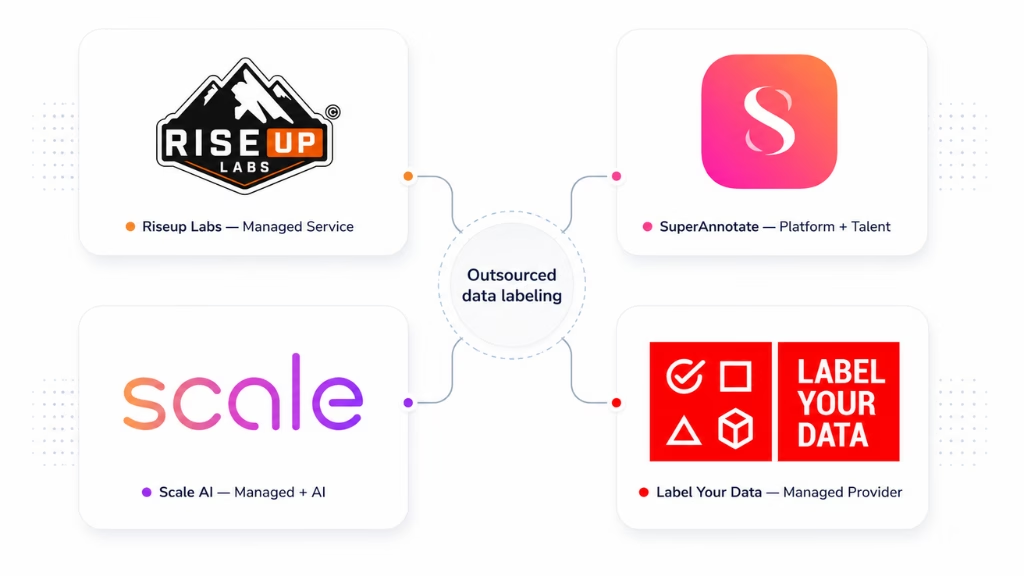
Managed providers handle annotation execution, workforce management, quality control, and delivery. They are often a better fit for large datasets, short deadlines, specialized labeling requirements, or companies that do not want to recruit and supervise annotators internally.
| Provider | Solution Type | Supported Data | Quality and Delivery Model | Best For |
|---|---|---|---|---|
| Riseup Labs | Managed data annotation service | Image, video, text, and audio | Dedicated teams, automation-assisted workflows, multilevel QA, project management, and 24/7 operational support | Companies that want to outsource annotation execution, workforce management, and QA |
| SuperAnnotate | Annotation platform plus managed talent network | Multimodal data | Combines annotation software with access to managed specialists | Enterprises wanting both a platform and an external workforce |
| Scale AI | Enterprise data platform and managed data services | Multimodal and generative-AI data | Combines automation, subject-matter experts, and managed workflows | Complex, regulated, or high-volume AI programs |
| Label Your Data | Managed annotation provider | Computer vision, NLP, audio, and other project-specific data | Dedicated annotation teams with security-focused workflows | Healthcare, financial, retail, and multilingual projects |
SuperAnnotate is a hybrid option because it offers both annotation software and a professionally managed talent network. Scale AI similarly combines software, automation, and expert human input rather than operating as a simple annotation tool.
Enterprise and Workflow-Driven Annotation Platforms
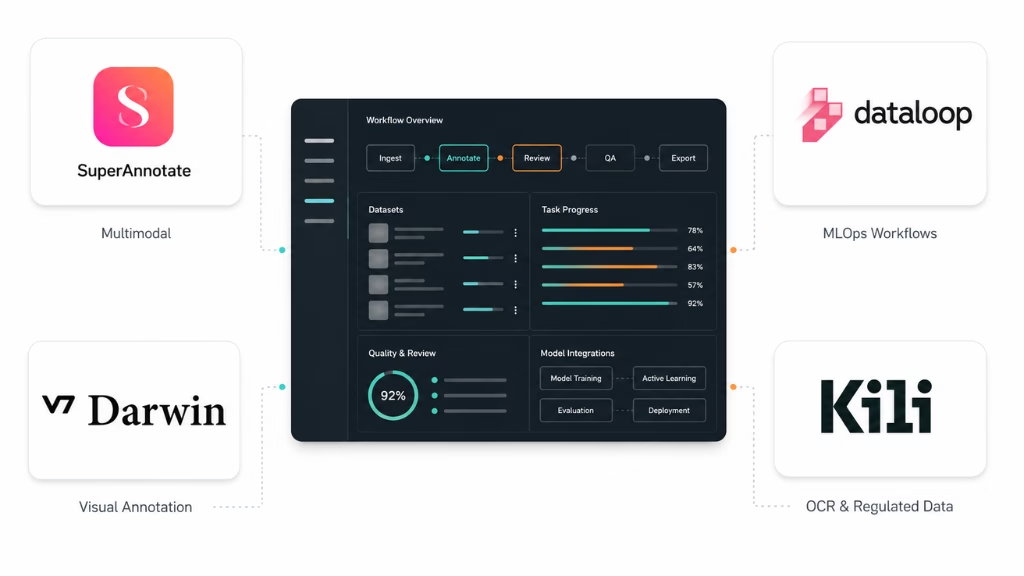
Enterprise annotation platforms provide software for configuring projects, assigning tasks, automating parts of the labeling process, reviewing output, managing dataset versions, and integrating annotation into machine-learning pipelines.
| Platform | Automation | Workflow and QA | Primary Fit |
|---|---|---|---|
| SuperAnnotate | High | Versioning, review workflows, vendor and workforce management | Multimodal enterprise projects requiring software and optional managed labor |
| Dataloop | Advanced | Configurable pipelines, human-in-the-loop workflows, audit trails, APIs | Large enterprises and integrated MLOps workflows |
| V7 Darwin | High | Collaborative visual annotation, automation, dataset management | Computer vision, video, medical imaging, and 3D workflows |
| Kili Technology | High | Configurable ontologies, pre-annotation, review stages, role-based workflows | Multimodal, OCR, document, and regulated-data projects |
Dataloop emphasizes workflow orchestration, integrations, human feedback, and enterprise security controls. Kili supports image, video, text, PDF, geospatial, and OCR annotation with configurable quality workflows. V7 Darwin is particularly relevant to visual, video, medical-imaging, and 3D annotation use cases.
Open-Source and Budget-Friendly Alternatives
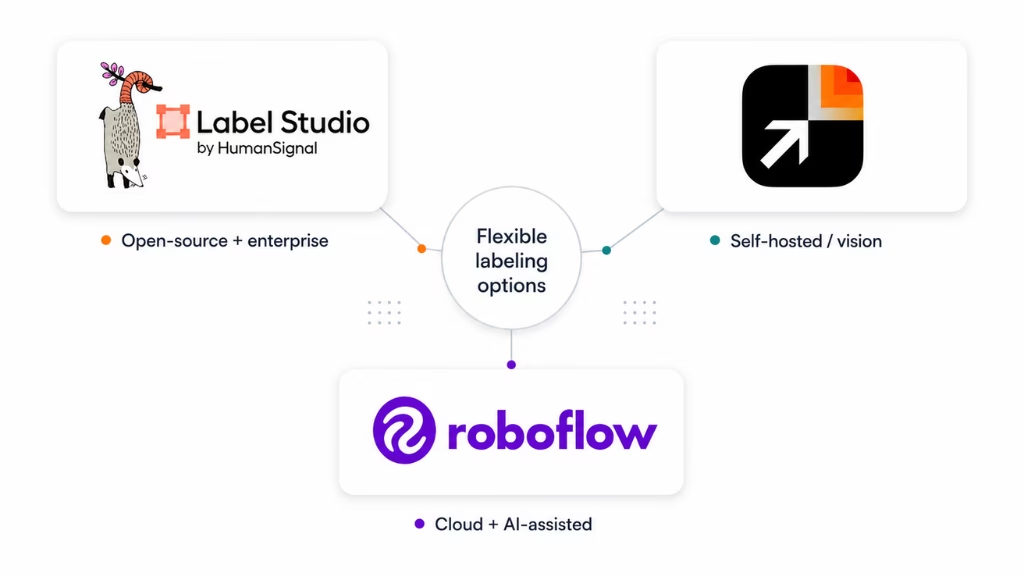
Open-source tools can reduce software licensing costs and provide greater hosting control. However, teams remain responsible for deployment, infrastructure, security configuration, maintenance, annotation labor, and quality management.
| Platform | Product Type | Setup Difficulty | Supported Data | Key Consideration |
|---|---|---|---|---|
| Label Studio | Open-source platform with paid enterprise options | Moderate | Image, video, audio, text, time series, and multimodal tasks | Highly customizable but may require technical configuration |
| CVAT | Open-source, cloud, and enterprise visual-annotation platform | Moderate | Image, video, and 3D data | Strong computer-vision workflows; self-hosting requires infrastructure management |
| Roboflow | Commercial cloud computer-vision platform with free and paid plans | Easy | Primarily image and visual data | AI-assisted labeling and integrated computer-vision workflows |
Roboflow should not be called open source. It fits this section because it has an accessible cloud-based entry option, while Label Studio and CVAT provide true self-hosted open-source editions.
Feature-by-Feature Software Comparison for 2026
This table compares products that provide annotation software. Riseup Labs is deliberately excluded because it is a managed service provider rather than a standalone annotation platform.
| Platform | Product Type | Main Annotation Types | Automation | Collaboration | Pricing Approach |
|---|---|---|---|---|---|
| SuperAnnotate | Platform plus optional managed workforce | Image, video, text, audio, and multimodal | High | Yes | Paid/custom |
| Label Studio | Open source plus enterprise edition | Multimodal and configurable | Customizable | Yes | Free self-hosted/paid enterprise |
| CVAT | Open source plus cloud and enterprise editions | Image, video, and 3D | AI-assisted | Yes | Free self-hosted/paid cloud |
| Dataloop | Enterprise AI data platform | Multimodal | High | Yes | Custom quote |
| Scale AI | Data engine plus managed services | Multimodal and LLM data | High | Enterprise workflows | Self-service and enterprise pricing |
| V7 Darwin | Visual-data platform | Image, video, medical, and 3D | High | Yes | Trial/custom |
| Roboflow | Cloud computer-vision platform | Primarily vision data | Medium to high | Yes | Free and paid plans |
| Kili Technology | Enterprise annotation platform | Image, video, text, PDF, OCR, and geospatial | High | Yes | Custom quote |
Using product types instead of star ratings or dollar signs makes this comparison less misleading. Pricing and plan features change frequently, while ratings from G2 and GitHub are not directly comparable—GitHub stars are a community-popularity signal, not a customer-review score. Current product capabilities are described on the respective official platform pages.
Where Riseup Labs Fits in the Buying Decision
Choose Riseup Labs when you need:
- A trained annotation workforce rather than another software license
- Image, video, text, or audio annotation delivered as a service
- Workforce recruitment, training, scheduling, and supervision handled externally
- Multilevel QA and project-management support
- Capacity for a large or time-sensitive annotation project
- A service team that can work within project-specific tools and guidelines
Choose a self-service platform such as Label Studio, CVAT, Dataloop, V7, or Kili when your organization wants to operate the annotation workflow internally and needs direct control over users, interfaces, datasets, integrations, and automation.
A company may also combine both approaches: use an annotation platform as the technical workspace and hire a provider such as Riseup Labs to supply and manage the annotation team.
Common Evaluation Themes
Avoid presenting uncited comments as direct user quotations. Instead, summarize recurring buying considerations:
Managed providers
- Reduce the need to recruit and supervise annotators
- Include quality control and project management
- Usually require a custom quote
- Offer less direct day-to-day workforce control than an internal team
Enterprise platforms
- Provide stronger automation, analytics, permissions, and integrations
- Help internal and external teams work in one environment
- Can become expensive as usage, storage, seats, or advanced features increase
Open-source tools
- Provide hosting and customization control
- Reduce initial licensing expenses
- Require internal DevOps, security, maintenance, and annotation-management resources
Claims such as “cut review time in half” or exact accuracy improvements should only appear when linked to a named, verifiable case study.
What Should You Evaluate When Choosing a Labelbox Alternative?
Start by deciding whether you need software, annotation labor, or both. Then compare:
- Supported data types, including image, text, video, audio, documents, or 3D data
- Automation and model-assisted labeling
- Quality-assurance and consensus-review workflows
- Role-based access and distributed-team collaboration
- APIs, SDKs, cloud storage, and MLOps integrations
- Hosting and data-residency options
- Applicable security standards and contractual safeguards
- Migration, onboarding, and technical support
- Annotation workforce availability
- Total cost, including infrastructure, labor, management, storage, and maintenance
Do not treat SOC 2, ISO certification, GDPR obligations, and HIPAA requirements as interchangeable. Ask vendors for current documentation and confirm that the proposed service, hosting environment, and contract cover your particular project.
Cost, Pricing Transparency, and ROI
Managed services, enterprise platforms, and open-source tools have fundamentally different cost structures.
| Provider or Platform | Pricing Model | Free Software Tier | Main Costs to Consider |
|---|---|---|---|
| Riseup Labs | Custom project or volume-based quote | No | Annotation labor, QA, project management, volume, complexity, and turnaround time |
| Label Your Data | Custom project quote | No | Workforce, task complexity, language, domain expertise, and volume |
| SuperAnnotate | Platform subscription plus optional managed services | Contact vendor | Software, seats, storage, usage, and managed talent |
| Label Studio | Open-source and paid enterprise editions | Yes | Hosting, engineering, security, maintenance, and enterprise features |
| CVAT | Free self-hosted plus paid cloud and enterprise options | Yes | Infrastructure, storage, support, collaboration, and automation |
| Dataloop | Enterprise subscription | Trial or vendor-dependent | Usage, integrations, storage, seats, and support |
| Scale AI | Self-service usage plus enterprise contracts | Limited self-service entry | Labeling units, expert labor, data management, and enterprise services |
| V7 Darwin | Subscription or custom agreement | Trial | Seats, automation, data volume, and enterprise requirements |
| Roboflow | Free and paid cloud plans | Yes | Projects, storage, users, AI features, deployment, and labeling services |
| Kili Technology | Enterprise subscription or custom agreement | Vendor-dependent | Seats, deployment, security, workflow, and support |
Riseup Labs should be compared on cost per completed and quality-checked project, not simply against the monthly software prices of Labelbox or other platforms. Its quote may include labor, supervision, QA, and delivery operations that would otherwise be separate internal expenses.
For startups and research teams with internal technical capacity, self-hosted tools may offer the lowest entry cost. For enterprises, the better-value option depends on whether internal workforce management or outsourced delivery produces the lower total cost and operational risk.
Security, Compliance, and Data Privacy in Annotation Platforms
Security and compliance drive many platform choices, especially in healthcare, finance, or government AI.
Below is a compliance matrix for top platforms (2026):
| Platform | SOC 2 | HIPAA | GDPR | ISO Certified | Data Ownership |
|---|---|---|---|---|---|
| SuperAnnotate | Yes | Yes | Yes | Yes | Customer controls |
| Scale AI | Yes | Yes | Yes | Yes | Managed |
| Label Studio | Varies* | Depends on host | Varies* | N/A | Customer/self-hosted |
| CVAT | N/A | N/A | N/A | N/A | Self-hosted, open-source |
| Dataloop | Yes | Yes | Yes | Yes | Customer controls |
| V7 | Yes | No | Yes | Yes | Customer controls |
| Kili Technology | Yes | No | Yes | Yes | Customer controls |
*Open-source solutions (Label Studio, CVAT) rely on your own hosting for compliance. For regulated industries, managed providers often ensure full certifications with strict audit/logging and export controls.
If your team is in healthcare or finance, pick verified providers and ensure all exports and storage stay compliant.
Use Case Mapping: Which Platform is Best for Your Team’s Needs?
Picking the right tool comes down to your team size, domain, and technical requirements. Here’s a quick-use map:
| Use Case | Recommended Option | Best Fit |
|---|---|---|
| Managed/Outsourced Data Annotation | Riseup Labs, Scale AI, SuperAnnotate | External annotation teams, quality assurance, project management, and scalable delivery |
| Startup/Research | Label Studio, CVAT, Roboflow | Affordable experimentation, prototypes, and internally managed projects |
| Healthcare/Regulated Data | SuperAnnotate, Scale AI, Kili Technology, V7 | Enterprise security, controlled workflows, medical data, and specialized review requirements |
| Large Enterprise/Automation | Dataloop, Kili Technology, V7, SuperAnnotate | Workflow automation, integrations, analytics, and large distributed teams |
| Model and LLM R&D | SuperAnnotate, Scale AI, Dataloop, Kili Technology | LLM evaluation, human feedback, multimodal annotation, and model-assisted workflows |
| Computer Vision | CVAT, V7, Roboflow | Image, video, medical imaging, object detection, segmentation, and tracking |
| Audio and Text/NLP | Label Studio, Kili Technology, SuperAnnotate, Dataloop | Text classification, NLP, audio segmentation, transcription, and multimodal projects |
| Distributed/Remote Teams | Dataloop, Kili Technology, V7, SuperAnnotate | Collaborative annotation, assignments, review stages, and team management |
| High-Volume Annotation Delivery | Riseup Labs, Scale AI, SuperAnnotate | Ongoing projects requiring managed workers, multilevel QA, and rapid capacity scaling |
In my experience, open-source tools like Label Studio match research speed and flexibility. For healthcare and regulated AI, managed services like SuperAnnotate and Scale AI take away compliance risks. Large teams or organizations needing lots of collaboration and automation do better with platforms like Dataloop or V7.
What Mistakes to Avoid When Switching from Labelbox?
Moving from Labelbox can introduce risks if not handled carefully. I have seen the following pitfalls cause delays and frustration:
- Missing checks when exporting or importing labels/datasets
- Lack of training for new team members leads to confusion
- Overlooking compliance needs during migration, risking audit issues
- Not mapping old workflows to new platform capabilities
To avoid these:
- Carefully export data in a format all key fields and metadata are preserved
- Test import on a small dataset first
- Schedule onboarding or support calls, especially with managed or enterprise platforms
- Involve IT/security to review compliance at every step
- Assign user roles and access before granting broad permissions
Addressing these early reduces downtime and protects data accuracy during migration.
About Riseup Labs’ Role in AI Data Labeling
Riseup Labs supports organizations in AI data labeling and annotation through expert-led managed service offerings. Our team helps with project consultation, migration from platforms like Labelbox, and compliance assessments for regulated data. If your team needs tailored labeling solutions, workflows, or onboarding support, contact Riseup Labs for a free assessment.
Conclusion
Picking the best alternative to Labelbox matters for your project’s success and bottom line. The right choice depends on your data types, budget, compliance risks, and technical capacity.
In my experience, matching platform strengths to your true use case always delivers the best results. Managed solutions work for regulated, high-stakes projects. Open-source and mid-market tools win on flexibility and cost.
If your team is starting migration or needs clear ROI, Riseup Labs can guide you through platform selection, onboarding, and workflow setup. Next, review product demos and trials or contact our team for expert help.
AI data workflows will keep evolving. The teams that choose well will adapt faster. Working with experts who understand your domain ensures your machine learning efforts stay future-proof.
Frequently Asked Questions (FAQ) About Labelbox Alternatives for AI Data Labeling
What are the best alternatives to Labelbox for AI data labeling in 2026?
SuperAnnotate, Label Studio, CVAT, Dataloop, and Scale AI are top alternatives, each excelling in different use cases.
Are there open-source options that can replace Labelbox?
Yes. Label Studio and CVAT are robust open-source data labeling platforms suitable for many projects.
How does Label Studio compare to Labelbox for enterprise annotation?
Label Studio offers flexibility and self-hosting, but enterprise features may require paid plans, unlike Labelbox’s managed environment.
Which platform offers the most transparent labeling pricing?
Dataloop and Kili Technology provide detailed, up-front pricing calculators, while open-source tools like CVAT and Label Studio have no license fees.
What features should I look for in a data labeling tool?
Key features include multimodal support, auto-labeling, strong collaboration, integrations, security certifications, and transparent pricing.
How do managed services differ from open-source/self-serve tools?
Managed services handle the labeling process for you, ensuring accuracy and compliance, while open-source and self-serve platforms require your team to set up and manage projects.
Best platform for medical or regulatory use cases?
SuperAnnotate and Scale AI both deliver high compliance and specialized workflows for medical and healthcare data labeling.
What are the pros and cons of free vs. paid annotation tools?
Free tools save money but require more setup. Paid tools provide faster support, advanced features, and compliance guarantees.
How can I migrate workflows from Labelbox?
Export your projects from Labelbox, review data types, test imports to the new platform, and train your team before full migration.
Which solutions work best for large distributed teams?
Dataloop, Kili Technology, and V7 all support large-scale collaboration and access for distributed teams.
This page was last edited on 4 August 2026, at 3:02 pm

Start a conversation with our team to solve complex challenges and move forward with confidence.