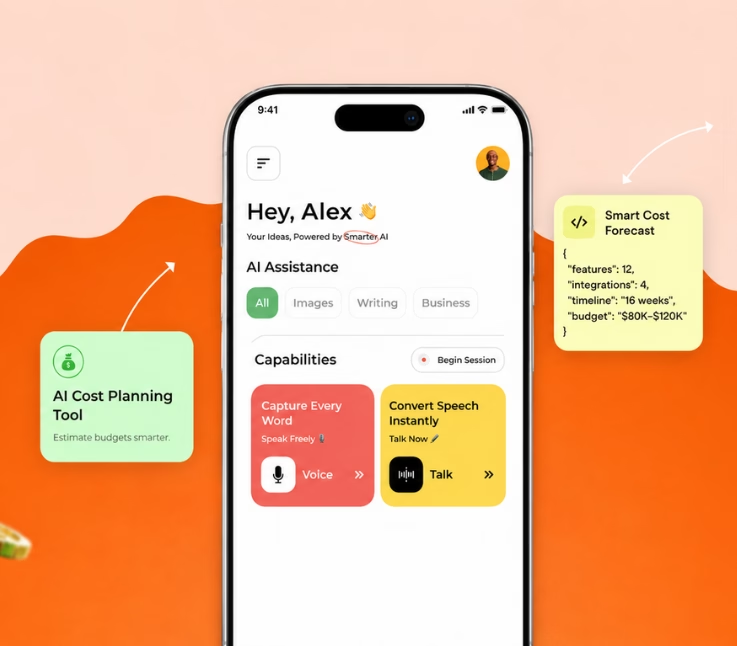
AI app development typically costs $10,000–$80,000 for a basic app, $50,000–$200,000 for a mid-level solution, and $150,000–$1 million+ for an enterprise system. The final cost depends on features, data, integrations, security, and AI complexity.
Ask five companies about AI app development cost, and you’ll get five different answers. One site says a few thousand dollars. Another jumps straight to half a million. Both answers can be true. It just depends on what you’re building.
This guide walks through the real cost to build an AI app in 2026. You’ll see what drives the price up, what it costs by app type, industry, and size, the hidden costs nobody warns you about, and a simple way to estimate your own budget.
How Much does an AI App Cost?
Before we go deep, here’s the short version. Your AI app development budget depends mostly on how you build the app, not just what it does.
| Build approach | Typical cost | Best for |
|---|---|---|
| No-code AI app builder (subscription) | $15–$100/month | Prototypes, MVPs, internal tools |
| Prototype or demo app | Free–$1,000 | Testing an idea before you invest more |
| Basic/entry-level AI app | $10,000–$80,000 | Simple chatbots, one-feature tools |
| Mid-level AI application | $50,000–$200,000 | Custom assistants, dashboards, recommendation engines |
| Advanced/enterprise AI system | $150,000–$1,000,000+ | Multi-model platforms, regulated industries, large-scale automation |
That’s a wide range, but it’s not a mistake. An AI app can genuinely cost anywhere from a monthly subscription fee to a seven-figure enterprise build. The number that matters is the one tied to your exact project, not the headline figure a vendor gives you on a sales call.
What’s actually included in AI app development cost?
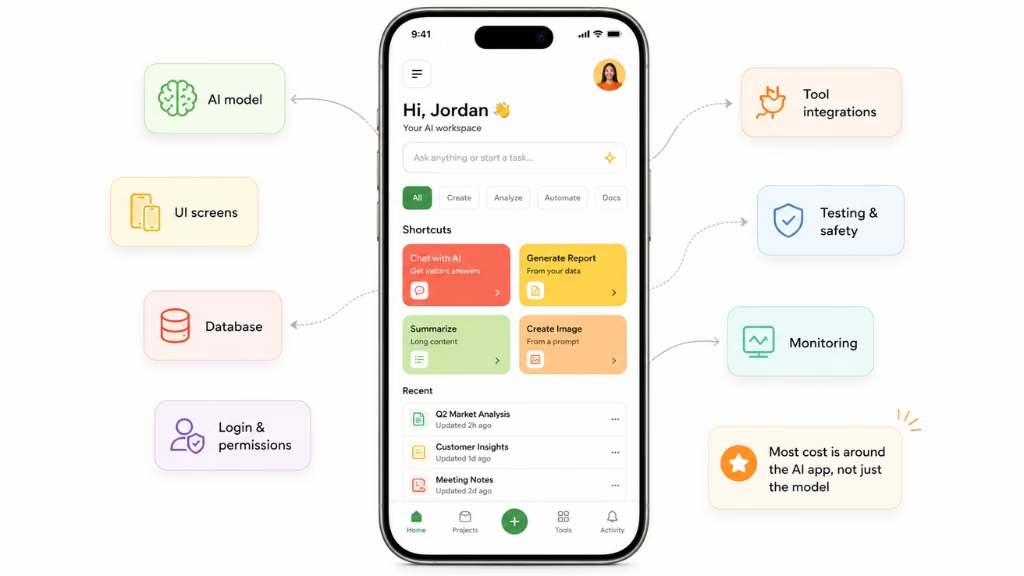
Here’s something most people get wrong at the start: the AI model itself is usually the cheapest part of the project.
When someone quotes you an AI software development pricing number, that price rarely covers just “the AI.” Most of the cost goes into everything around the AI: the app screens users see, the database that stores information, login and permissions, connections to your other tools, testing to make sure the AI gives safe and correct answers, and watching how the app performs after launch.
This is also why AI apps usually cost more than regular apps. A normal app follows fixed rules. A user clicks a button, the same thing happens every time, and the result is easy to predict.
An AI app is different. Its output can change based on the input, so your team has to test whether each answer is accurate, safe, and useful. That extra checking takes real time and real money.
AI app development cost breakdown by complexity
Most projects fall into one of three size categories. Think of it like building a house: a small starter home, a mid-size family house, and a custom mansion all use the same basic materials, but the scale changes everything.
| Complexity level | What it includes | Estimated cost |
|---|---|---|
| Basic solution | One AI model, simple screen, few or no integrations, proof-of-concept or MVP | $10,000 – $80,000 |
| Mid-level solution | Several AI features, your own business data, connections to databases or APIs, better design | $50,000 – $200,000 |
| Large-scale/enterprise solution | Many AI models working together, real-time processing at scale, strong security, connects to many systems | $150,000 – $1,000,000+ |
A basic proof-of-concept, like a chatbot that answers simple questions, might take a few weeks to build. It can often run on free or low-cost public data.
An enterprise system, like a bank’s fraud detection tool or a multilingual customer assistant that serves millions of users, is a different job entirely. These projects often take six months to two years and need a full team of specialists, not just one developer.
According to McKinsey’s State of AI research, 78% of organizations now use AI in at least one business function, up from 55% in 2023. More companies building AI apps means more demand for AI talent and tools, which is one reason prices move around so much right now.
Custom AI application cost by solution type
The custom AI application cost also changes a lot based on what kind of AI you need. Here’s a realistic range for each common type:
| AI solution type | Common use cases | Estimated cost |
|---|---|---|
| Chatbots & virtual assistants | Customer support, FAQ automation, appointment scheduling | $15,000 – $100,000 |
| Recommendation systems | Product suggestions, content personalization | $40,000 – $180,000 |
| Generative AI applications | Writing tools, code generation, AI copilots, image or content creation | $60,000 – $300,000+ |
| Fraud detection | Spotting suspicious transactions in real time | $80,000 – $250,000+ |
| Computer vision / image recognition | Medical scans, quality checks, facial recognition | $50,000 – $300,000+ |
| Predictive maintenance | Warning teams before machines break down | $100,000 – $500,000+ |
Chatbots sit at the low end because many can be built on existing frameworks with light customization. Predictive maintenance sits at the high end because it usually needs sensors, live data feeds, and specialized models trained on your specific equipment.
It’s also worth knowing that the cost of generative AI app development behaves differently over time than more traditional AI. A traditional model, like one that predicts which customers might cancel a subscription, is mostly a one-time build cost. Once it’s trained, it runs fairly cheaply.
A generative AI tool, like a chatbot or writing assistant powered by a large language model, keeps costing money every time someone uses it. Every question a user asks burns tokens, and tokens cost money. So the more popular your generative AI app becomes, the more it costs to run, not less.
AI mobile app development cost
If your AI app needs to live on a phone, plan for extra cost on top of the AI itself. Building for iOS and Android (or using a cross-platform tool like React Native or Flutter) adds mobile-specific design work, app store reviews, offline handling, push notifications, and extra testing across different phone models.
In practice, AI mobile app development costs usually run about 20-40% higher than a similar web-only app. Part of this comes from testing on multiple devices. Part of it comes from making AI responses feel fast on a phone’s slower, sometimes spotty internet connection, which often means caching answers or trimming how much data gets sent back and forth.
A simple AI feature added to an existing mobile app, like a chatbot button in a shopping app, might cost $20,000 to $60,000. A mobile app built around AI from day one, using things like voice input or live camera-based image recognition, can run well into six figures.
AI chatbot development cost
Chatbots are usually where people start, so they deserve their own closer look. AI chatbot development cost depends mostly on how smart the bot needs to be.
- Simple, scripted bots that follow a set decision tree can cost as little as $2,000 to $15,000 through an agency, or come bundled into a monthly SaaS plan.
- Basic AI-powered FAQ bots, using one AI model and one knowledge source, usually run $15,000 to $60,000.
- Context-aware bots that remember earlier parts of a conversation, support multiple languages, and connect to a CRM or help desk typically cost $30,000 to $120,000.
- Enterprise conversational AI, with long-term memory, complex handoff rules to human agents, and deep system connections, can pass $150,000.
Building the bot is only half the cost. Running it costs money too. A small support bot handling around 1,000 questions a day might use about $200 to $300 a month in AI API fees alone, separate from hosting and upkeep.
AI app development costs by industry
The same type of app can cost very different amounts depending on the industry. This mostly comes down to rules, risk, and how much the data connects to other systems.
| Industry | Why do costs run higher | Estimated cost |
|---|---|---|
| Healthcare | Patient data rules (HIPAA/GDPR), medical records systems, clinical testing | $150,000 – $1,200,000+ |
| Finance & fintech | Fraud checks, identity verification, strict audits | $100,000 – $800,000+ |
| Manufacturing | Sensor and machine data, real-time alerts | $100,000 – $800,000+ |
| Retail & e-commerce | Personalization at scale, inventory data, heavy traffic | $40,000 – $500,000+ |
| Automotive | Real-time navigation, safety-critical systems | $200,000 – $5,000,000+ |
| Education | Personalized lessons, automated grading, tutoring | $40,000 – $800,000 |
Healthcare and finance sit at the top almost every time. These industries mix strict rules with high stakes. An AI tool that reads X-rays or scores someone’s credit risk can’t afford to be “mostly right.” It has to be tested far more carefully than, say, a retail app that recommends sneakers.
Factors affecting AI development cost
Now let’s zoom out. These are the specific choices and conditions that push the price up or down the most.
1. App scope and complexity
This is the single biggest factor. A basic chatbot only needs one AI connection and a simple screen. A full business app needs user roles, dashboards, approval steps, admin tools, and handling for unusual situations. Each of those adds more work, and more work means more cost.
2. Data readiness
AI is only as good as the data behind it. If your data is already clean and organized, the build moves faster and costs less. If it’s scattered across spreadsheets, PDFs, and separate tools, someone has to clean it up first. That means removing duplicates, fixing errors, adding labels, and setting rules for who can see what.
Data work alone can eat up 15% to 40% of the total budget. For specialized data, like labeling thousands of medical images by hand, this step alone can cost well into six figures.
3. Model choice and API or token usage
You have three main paths here. Using an existing AI model through an API, like connecting to OpenAI, Claude, or Gemini, keeps your starting cost low, but you pay an ongoing bill based on how much text goes in and out.
Fine-tuning an existing model, meaning you adjust it with your own data, costs more than an API but far less than starting from zero. Training a brand-new model from scratch is the most expensive option by far and usually only makes sense for large tech companies with deep pockets and specialized teams.
4. Infrastructure and hosting
You can run your AI on the cloud, on your own servers (on-premise), or a mix of both. Cloud is cheaper to start with because you rent what you need and scale up or down.
On-premise costs more upfront, since you’re buying hardware, but it gives you full control over your data, which matters a lot in industries like healthcare or banking. Cloud GPU costs can run from a few hundred dollars a month for a small project to tens of thousands for heavy training jobs.
5. Integrations with existing systems
Most AI apps don’t work alone. They need to talk to your CRM, your email tool, your database, or your internal software. Each new connection takes setup time, and the cost climbs further if the AI needs to write information back into those systems, not just read from them.
6. Security, permissions, and compliance
Once an app touches real customer or business data, security stops being optional. You’ll need role-based access (so only the right people see the right records), audit logs, encryption, and rules for handling personal information.
Regulated industries add extra steps, like legal reviews and compliance documentation, before the app can go live.
7. Testing, evaluation, and monitoring
AI apps need normal software testing, plus a second layer just for AI. That means checking for made-up answers (called hallucinations), testing unusual questions, and making sure results stay accurate over time.
After launch, someone still needs to watch usage, cost, and failure rates so small problems don’t turn into big ones.
8. Team size, expertise, and location
Labor is usually the biggest line item in any AI project. Specialized AI roles cost more than general software roles, and where your team is based makes a big difference:
| Role | US rate (per hour) | Eastern Europe rate (per hour) |
|---|---|---|
| Data scientist | $80 – $150 | $40 – $70 |
| AI/ML engineer | $90 – $160 | $45 – $75 |
| AI software developer | $70 – $130 | $35 – $65 |
| Project manager | $60 – $120 | $30 – $55 |
| QA engineer | $40 – $80 | $20 – $45 |
| UX/UI designer | $50 – $100 | $25 – $50 |
Hiring an offshore or nearshore team instead of a fully in-house US team can lower total labor costs by roughly 30% to 50%. The trade-off is usually less day-to-day, in-person control.
9. Ongoing maintenance
The cost doesn’t stop when the app launches. AI models get updated, pricing changes, data goes out of date, and users find edge cases nobody planned for. Most teams budget 15% to 25% of the original build cost per year just to keep things running smoothly.
Three ways to build an AI app: Cost Comparison
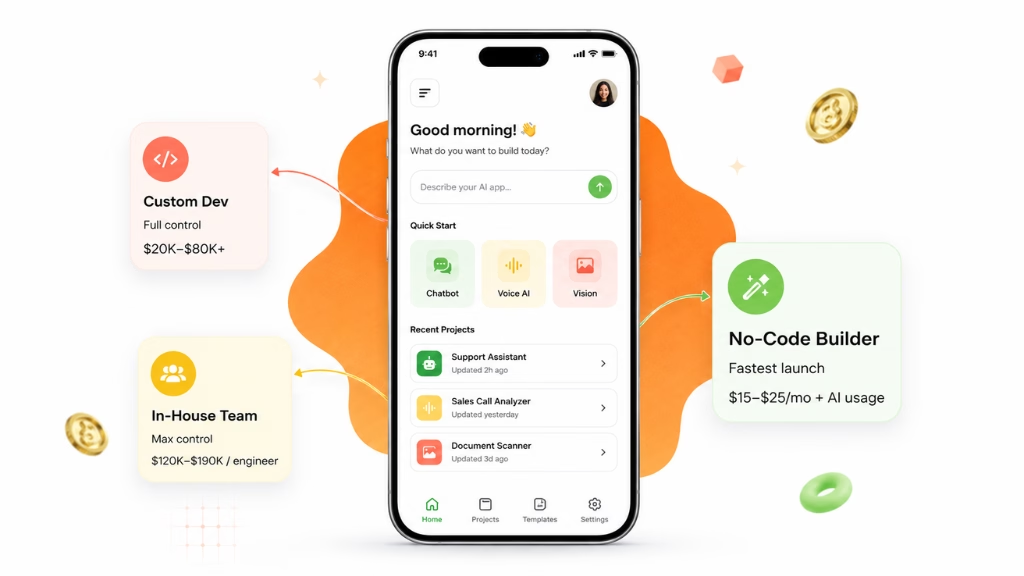
Not every AI app needs custom code from day one. There are really three paths to choose from:
Custom development (in-house or agency)
You get full control and full customization, but you also pay for every piece: the interface, the database, permissions, hosting, and integrations. Agencies often charge $20,000 to $80,000 for a small custom AI app, and $100,000 or more for anything larger.
In-house engineering team
This is the most expensive path in the short term. A single specialized engineer in the US can cost $120,000 to $190,000 a year. A full team of three to five people can pass $500,000 a year once you add overhead like benefits and management.
No-code AI app builders
Tools built for business apps bundle the database, permissions, workflows, hosting, and AI setup into one flat monthly price, often starting around $15 to $25 a month, plus whatever you spend on AI usage. This is by far the fastest and cheapest way to get something working in front of real users, though it gives you less flexibility than fully custom code.
If you’re building a simple internal tool or testing an idea, a no-code builder can turn weeks of developer work into an afternoon of setup. If your app needs deep custom logic, a proprietary model, or heavy compliance work, custom development still makes more sense.
Hidden costs of AI app development
The first working version of an app almost never shows the true, ongoing cost. These are the expenses that tend to show up later, once real users start using the app:
- Data cleanup and labeling. Teams often assume their existing records are ready for AI. They rarely are.
- AI usage growth. Real users ask longer, messier questions than a test run ever showed you.
- Permissions and access control. It’s easy to demo AI on shared data. It’s much harder to control exactly who can see or change what, at scale.
- Integration upkeep. APIs change over time, sync jobs break, and someone has to fix the connections.
- AI-specific testing. Checking for made-up answers and bad edge cases isn’t covered by regular software testing.
- Monitoring. Tracking cost per task, failed responses, and slow answers needs its own tools and time.
- Model and provider changes. AI pricing and model behavior shift often, which means re-testing and rewriting prompts.
- Model drift. Accuracy can quietly get worse over months as user behavior and real-world data shift, so models need retraining.
- Vendor lock-in. Relying too heavily on one AI provider makes it costly to switch later if their prices jump or performance drops.
How to estimate your AI app development cost
Here’s a simple way to build your own number instead of guessing.
- Define what the app needs to do. Is it answering questions, summarizing documents, updating records, or triggering workflows? This step alone keeps you from comparing a simple prototype to a full production system, which is where most cost surprises start.
- Break the build into layers. List out the product design, the core app (frontend, backend, database, login), the AI layer (models, prompts, search), data cleanup, integrations, security, testing, and launch, and estimate each one separately.
- Estimate AI usage on its own. A useful formula is: monthly AI cost = active users × sessions per user × AI calls per session × average tokens used × price per token. Then add extras like file uploads or image generation.
- Build three scenarios. Work out a low estimate (clean data, few users), an expected estimate (normal use), and a high estimate (messy data, heavy use, more integrations).
- Add a maintenance buffer. Set aside 15% to 25% of your build cost per year for updates and fixes.
- Recalculate once you’re live. Your first guess will never be perfect. Once real users show up, track cost per user and cost per task, then adjust.
Put simply, the full picture looks like this:
Total AI app cost = build cost + AI usage cost + infrastructure cost + security and testing cost + maintenance cost
Ways to reduce AI app development cost
- Start with an MVP. Build the smallest useful version first, then grow it based on real feedback instead of guesses.
- Use pre-trained, open-source models. Fine-tuning an existing model, instead of training a new one from scratch, saves both time and money.
- Choose cloud infrastructure over on-premise hardware, at least early on. You avoid a big upfront cost and can scale usage up or down as needed.
- Consider outsourcing or nearshoring parts of the build. It can cut labor costs by 30% to 50% without a real drop in quality, especially for well-defined MVP work.
- Try a no-code AI app builder for simpler internal tools or lighter customer-facing apps that don’t need heavy customization.
- Clean your data early. Better data upfront means fewer retraining cycles and fewer surprises later.
FAQs
How much does it cost to build an AI app?
Most AI apps land somewhere between $10,000 for a basic prototype and $500,000-plus for an enterprise system. Most custom business AI apps fall between $50,000 and $250,000. No-code builders can bring the starting cost down to a monthly subscription.
What’s the biggest factor in AI app development cost?
App scope and complexity usually matter most, followed closely by how ready your data is. A simple tool with clean data is far cheaper to build than a complex app that first needs its data cleaned and organized.
Is generative AI more expensive than traditional AI?
Usually, yes, over time. Traditional AI, like a model that predicts customer churn, tends to be mostly an upfront cost. Generative AI apps run on ongoing, usage-based compute, so the cost keeps growing as more people use the app.
How much does an AI chatbot cost specifically?
Simple, scripted bots can cost as little as $2,000 to $15,000. Context-aware bots with integrations and multi-language support usually run $30,000 to $120,000. Full enterprise conversational AI can pass $150,000.
Do I need a large team to build an AI app?
Not always. A basic MVP can be built by a small team, or even one developer, using existing APIs and no-code tools. Larger, regulated, or enterprise systems usually need a full team of data scientists, ML engineers, developers, and QA specialists.
How much should I budget for maintenance after launch?
A common rule is 15% to 25% of your original build cost per year. This covers prompt updates, model changes, data refreshes, monitoring, and bug fixes. Apps with heavy usage or sensitive data often need more.
Can I build an AI app on a limited budget?
Yes. Start with a proof of concept, use pre-trained models instead of custom-built ones, and consider a no-code AI app builder. All three keep your starting cost low while still letting you test the idea with real users.
How long does AI app development take?
Timelines usually track with cost. A proof of concept can take a few weeks. A simple AI MVP takes about 2 to 3 months. A mid-level app takes 3 to 6 months. A full enterprise system can take 6 to 12 months or longer.
This page was last edited on 14 July 2026, at 12:47 pm

Start a conversation with our team to solve complex challenges and move forward with confidence.