
- What Is Conversational AI?
- How Does Conversational AI Work?
- Types of Conversational AI
- Conversational AI Architecture Explained
- Core Capabilities of a Strong Conversational AI System
- Conversational AI vs. Generative AI
- How to Build Conversational AI
- Benefits of Conversational AI
- Challenges and Considerations
- What are Popular Real-World Industry Uses of Conversational AI?
- What are the Best Practices for Implementing Conversational AI in Your Business?
- The Future of Conversational AI
- Conversational AI Platforms and What to Look for in Them
- Examples of Leading Conversational AI Platforms
The way people interact with technology is changing.
Users no longer want to navigate complicated menus, fill out endless forms, or wait hours for support responses. They expect technology to understand their questions, remember context, and provide instant solutions.
This is where conversational AI is transforming digital experiences.
Conversational AI enables machines to understand, process, and respond to human language through text and voice. It powers chatbots, virtual assistants, voice applications, and AI agents that can communicate naturally with users.
From customer support and banking assistants to healthcare platforms and enterprise automation, conversational AI is helping businesses deliver faster, more personalized, and more efficient experiences.
According to Gartner, by 2029, agentic AI could autonomously resolve 80% of common customer service issues without human intervention, showing how quickly AI-powered interactions are evolving.
In this guide, we will explore:
- Future trends and business opportunities
- What conversational AI is
- How conversational AI works
- Types of conversational AI systems
- Key capabilities and benefits
- Real-world use cases
- Development process
What Is Conversational AI?
Conversational AI is a branch of artificial intelligence that enables computers to communicate with humans using natural language.
Unlike traditional software interfaces that rely on buttons, menus, and fixed commands, conversational AI allows users to interact through normal conversations.
For example, instead of searching through an app to track an order, a customer can simply ask:
“Where is my package?”
The AI understands the request, retrieves the necessary information, and provides a relevant response.
Conversational AI combines technologies such as:
- Natural Language Processing (NLP)
- Machine Learning (ML)
- Natural Language Understanding (NLU)
- Natural Language Generation (NLG)
- Speech Recognition
- Large Language Models (LLMs)
Together, these technologies allow AI systems to understand intent, maintain context, and generate meaningful responses.
As conversational AI continues to evolve, businesses are moving beyond basic chatbots toward intelligent AI assistants that can support users, automate workflows, and handle complex interactions. Solutions like RISA by Riseup Labs represent this next generation of conversational AI, combining intelligent assistance with automation capabilities to help businesses create more efficient and personalized digital experiences.
How Does Conversational AI Work?
Conversational AI combines natural language processing (NLP) and machine learning (ML) with traditional chatbot logic to create systems that can understand and respond to human conversations.
Unlike traditional chatbots that rely on predefined scripts, conversational AI can analyze user input, understand meaning, maintain context, and improve responses through learning.
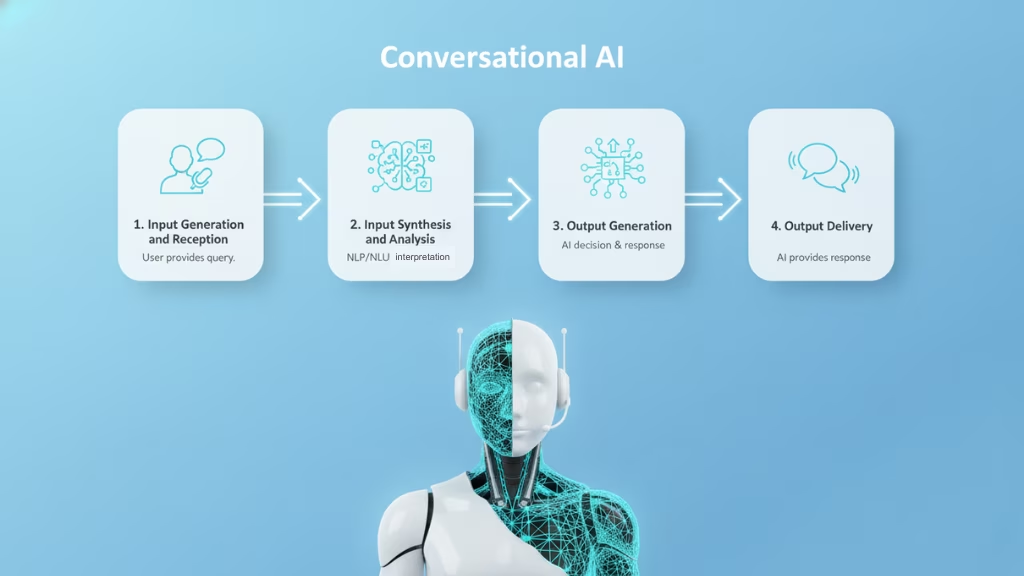
1. Input Generation And Reception
The process begins when a user sends a message or speaks to the AI system.
For text-based interactions, the system directly processes the input. For voice interactions, speech recognition technology converts spoken words into text that the AI can understand.
2. Input Analysis And Understanding
Once the input is received, Natural Language Understanding (NLU) analyzes the user’s message to identify intent and important information.
For example, when a user asks:
“Can you help me reschedule my appointment?”
The AI identifies:
- User intent: Reschedule appointment
- Required action: Modify existing booking
NLU uses machine learning models and language processing techniques to understand different ways users can express the same request.
3. Response Generation
After understanding the user’s intent, the system generates an appropriate response.
The response may come from:
- Predefined workflows
- Connected knowledge sources
- Machine learning models
- Large language models
Advanced conversational AI systems can create more natural and context-aware responses instead of relying only on fixed answers.
4. Output Delivery
The final response is delivered through the selected communication channel, such as:
- Website chat
- Mobile application
- Messaging platform
- Voice assistant
For voice interactions, text-to-speech (TTS) converts the generated response into natural-sounding speech.
This entire process happens within seconds, allowing conversational AI systems to provide faster and more natural interactions. Unlike basic chatbots, these systems can continue improving through user interactions, feedback, and updated training data.
Types Of Conversational AI
Conversational AI systems can be categorized based on the technology used to understand user input and generate responses. The three main types are pattern-matching chatbots, algorithmic chatbots, and NLP/ML-based chatbots.
Each type differs in intelligence, flexibility, development complexity, and use cases.
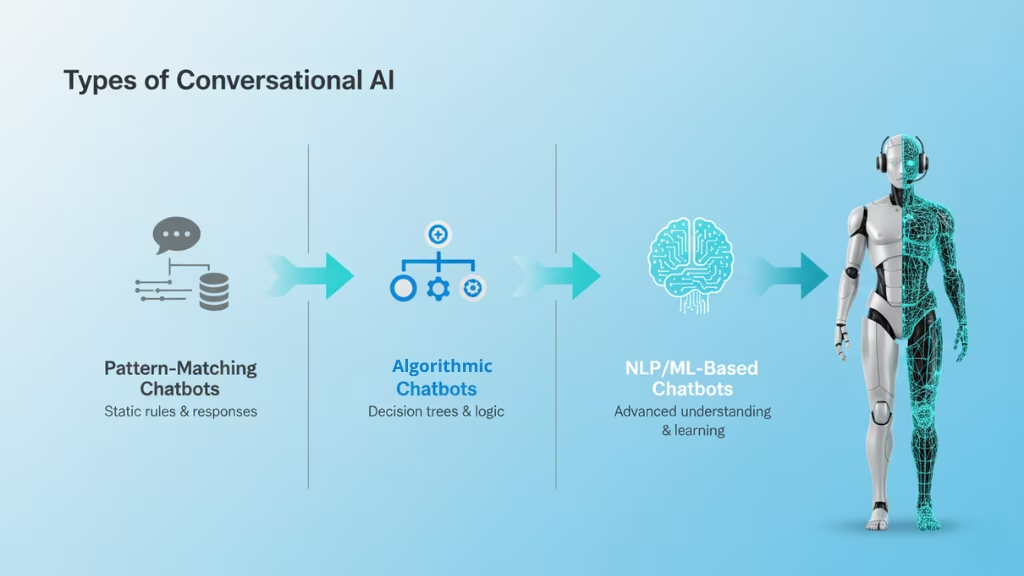
1. Pattern-Matching Chatbots
Pattern-matching chatbots are the simplest form of conversational AI. They work by matching user input with predefined patterns stored in a database and returning a fixed response.
These systems follow a basic question-and-answer approach. When a user’s message matches a known pattern, the chatbot provides the corresponding response.
For example:
User:
“What are your business hours?”
Bot:
“Our support team is available from 9 AM to 6 PM.”
Best For:
- Frequently asked questions
- Basic customer support
- Simple information retrieval
- Guided workflows
Limitations:
Pattern-matching chatbots cannot truly understand user intent or context. They may struggle when users phrase questions differently from the predefined patterns.
For example, a bot trained to understand:
“Check my order status”
may fail to respond correctly to:
“Where is my package?”
unless that variation is already included.
2. Algorithmic Chatbots
Algorithmic chatbots use predefined rules, workflows, and decision-making logic to guide conversations.
Unlike pattern-matching bots, these systems can handle more structured interactions by following a sequence of conditions and responses.
For example, a product recommendation chatbot may ask users:
- What type of product are you looking for?
- What is your budget?
- What features are important to you?
Based on the answers, it applies predefined rules to recommend suitable options.
Best For:
- Appointment scheduling
- Product recommendations
- Basic troubleshooting
- Guided customer journeys
Limitations:
Algorithmic chatbots are more flexible than simple rule-matching bots, but they still depend on predefined workflows. They cannot fully understand complex language, emotions, or unexpected user requests.
3. NLP And ML-Based Chatbots
NLP and ML-based chatbots represent the most advanced type of conversational AI.
These systems use Natural Language Processing (NLP) and Machine Learning (ML) to understand user intent, analyze context, and generate more natural responses.
Instead of only matching keywords, they interpret the meaning behind a user’s message.
For example:
User:
“I forgot my password and can’t access my account.”
The AI understands that the user needs account recovery assistance, even if the exact phrase “reset password” was not used.
Key Capabilities:
- Understand complex queries
- Maintain conversation context
- Learn from interactions
- Personalize responses
- Handle multi-turn conversations
Best For:
- Enterprise customer support
- AI assistants
- Voice applications
- Business automation
- Complex customer interactions
Limitations:
NLP/ML-based systems require more investment, quality training data, and ongoing optimization compared to simpler chatbot solutions.
Comparison Of Conversational AI Types
| Feature | Pattern-Matching Chatbots | Algorithmic Chatbots | NLP/ML-Based Chatbots |
|---|---|---|---|
| Technology | Predefined patterns and responses | Rules and decision workflows | NLP and machine learning models |
| Understanding | Limited keyword matching | Structured logic-based understanding | Context and intent understanding |
| Learning Ability | No learning | Manual updates | Improves through data and feedback |
| Flexibility | Low | Medium | High |
| Best Use Cases | FAQs and simple requests | Guided processes and workflows | Enterprise automation and complex conversations |
| Development Cost | Low | Moderate | Higher |
Choosing The Right Type Of Conversational AI
The right conversational AI approach depends on your business goals, complexity, budget, and scalability requirements.
For simple and repetitive tasks, pattern-matching or algorithmic chatbots may be enough.
However, businesses that need personalized experiences, complex workflows, and scalable automation should consider NLP and ML-based conversational AI solutions.
While advanced systems require more resources initially, their ability to understand context, learn from interactions, and improve over time makes them a stronger long-term investment.
Conversational AI Architecture Explained
Conversational AI architecture is the framework that connects different AI components to understand user input, manage conversations, generate responses, and continuously improve performance.
A complete conversational AI system usually includes several layers:
1. User Interface Layer (Input And Output)
The user interface layer is where conversations begin and end.
It includes platforms where users interact with AI, such as:
- Websites
- Mobile applications
- Messaging platforms
- Voice assistants
For voice-based systems, speech recognition converts spoken language into text, while text-to-speech (TTS) converts AI responses back into natural speech.
2. Natural Language Processing (NLP) Engine
The NLP engine is the core component responsible for understanding human language.
It processes user input by analyzing:
- Words
- Sentence structure
- Intent
- Context
- Important entities
Natural Language Understanding (NLU), a part of NLP, helps identify what users want and extracts important information from conversations.
3. Dialogue Management Layer
The dialogue management layer controls how conversations progress.
It helps the AI:
- Remember previous interactions
- Maintain context
- Decide the next response
- Handle follow-up questions
This allows conversations to feel more natural instead of isolated question-and-answer exchanges.
4. Business Logic And Integration Layer
This layer connects conversational AI with external systems and business applications.
Through APIs and integrations, AI systems can access information from:
- CRM platforms
- Databases
- Enterprise software
- Knowledge bases
For example, a customer support AI can check order details, update information, or process requests in real time.
5. Response Generation Layer
After understanding the user’s request, the response generation layer creates the final answer.
Responses may come from:
- Predefined messages
- Business rules
- Knowledge sources
- Generative AI models
This layer ensures responses are accurate, relevant, and aligned with the conversation context.
6. Data, Analytics, And Learning Layer
This layer helps conversational AI improve over time.
It collects interaction data and monitors performance through metrics such as:
- User satisfaction
- Response accuracy
- Common queries
- Failed interactions
The insights help teams optimize conversations and improve AI performance.
7. Security And Compliance Layer
Security is essential because conversational AI often handles sensitive information.
This layer manages:
- Data protection
- Authentication
- Encryption
- Privacy requirements
- Compliance standards
Regulations such as GDPR and CCPA help ensure user data is handled responsibly.
A well-designed conversational AI architecture allows businesses to build systems that are scalable, secure, and capable of delivering reliable human-like interactions.
Core Capabilities of a Strong Conversational AI System
A strong conversational AI system combines multiple intelligent capabilities to make interactions natural, relevant, and effective. These capabilities work together to ensure that the AI not only understands what users say but also responds appropriately in real-world contexts.
1. Natural Language Understanding (NLU)
NLU allows the AI to interpret meaning, emotion, and intent from user input.
It goes beyond word recognition, understanding why a user asks a question and what action they expect.
For example, it can distinguish between “Book me a flight” and “Show me my flight details,” even though both contain similar words.
2. Context Awareness and Memory
Contextual intelligence enables the AI to remember previous exchanges within a conversation and use that knowledge in follow-up responses. This continuity makes interactions feel more human, as the AI can track topics, recall details, and respond naturally across multiple turns.
3. Personalization and Adaptation
Advanced systems adjust their tone, phrasing, or recommendations based on user behavior or preferences. For example, a shopping assistant might recall past purchases or preferred product types to make relevant suggestions. Personalization builds trust and improves engagement over time.
4. Multilingual and Multimodal Communication
Modern conversational AIs can understand and respond in multiple languages, accents, and dialects. They also combine text, voice, and visual elements to create multimodal experiences, like showing a product image while describing it verbally. This capability makes them accessible and effective across diverse audiences and platforms.
5. Integration with Backend Systems
To deliver meaningful answers, conversational AI must connect with data sources and applications such as CRMs, ERPs, calendars, and APIs.
For instance, when a customer asks, “What’s the status of my order?” the AI retrieves the information from backend systems in real time.
6. Continuous Learning and Improvement
Strong conversational AI doesn’t stay static it improves through constant data analysis and retraining.
With every conversation, it refines its ability to predict intent, recognize patterns, and enhance accuracy.
Together, these capabilities create an ecosystem where AI can communicate effectively, respond intelligently, and evolve continuously bridging the gap between human language and machine understanding.
Conversational AI vs. Generative AI
Conversational AI and Generative AI are closely related but serve different purposes in how machines communicate. Conversational AI focuses on understanding and managing dialogue, while Generative AI focuses on creating new and original content, such as text, images, or code.
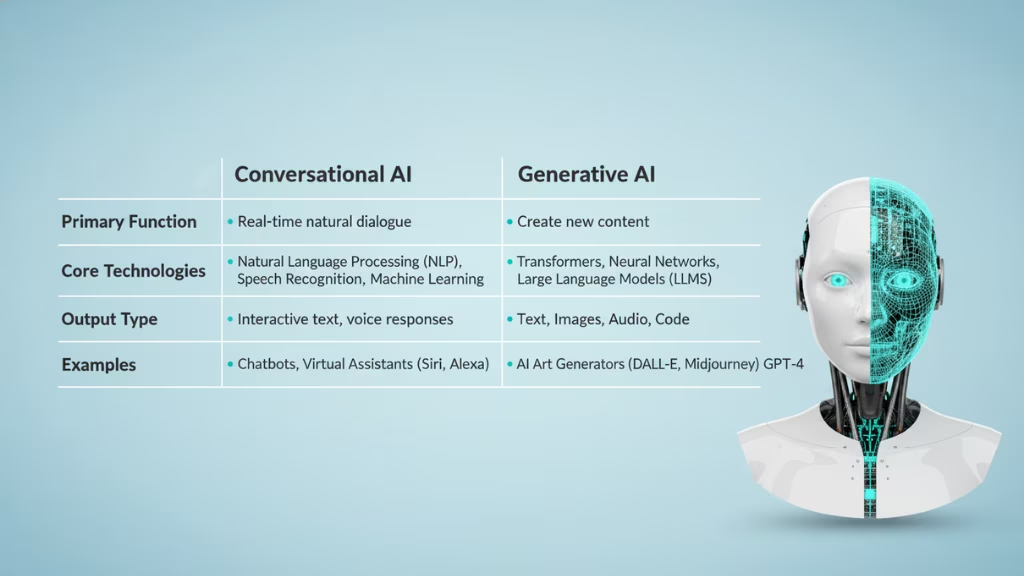
1. Core Differences in Purpose
Conversational AI systems are built for interaction. Their main goal is to sustain logical, task-oriented conversations, like helping a user reset a password or find a product. Generative AI systems, such as GPT-4 or Gemini, are built for creation. They generate new language, images, or even audio by learning from massive datasets.
2. How They Work Together
Today’s most advanced conversational systems combine both approaches.
Conversational AI handles the interaction flow, interpreting user intent, managing context, and maintaining conversation continuity. Generative AI adds depth by producing flexible, human-like responses that are not limited to scripted options.
For instance, when a customer asks a chatbot for product advice, conversational AI determines what they’re asking, and generative AI helps craft a personalized, natural reply.
3. Benefits of Integration
Bringing these technologies together enhances realism, scalability, and usefulness.
- Dynamic Dialogue: Conversations become less repetitive and more adaptable.
- Personalized Responses: AI tailors answers to each user’s tone, query, and history.
- Expanded Knowledge: With LLM integration, the AI can reference vast sources of information instantly.
This hybrid approach is powering next-generation assistants capable of understanding emotion, context, and complex requests far beyond simple rule-based chatbots.
4. Future Outlook
As conversational and generative AI continue to merge, future systems will act as autonomous conversational agents able not only to talk but to think, reason, and act on behalf of users. This shift marks a move from reactive tools to proactive digital companions capable of managing tasks, solving problems, and learning continuously.
How to Build Conversational AI
Building a successful conversational AI system requires more than simply adding a chatbot to a website. It involves designing meaningful conversations, training the AI with relevant data, integrating it with business systems, and continuously improving its performance.
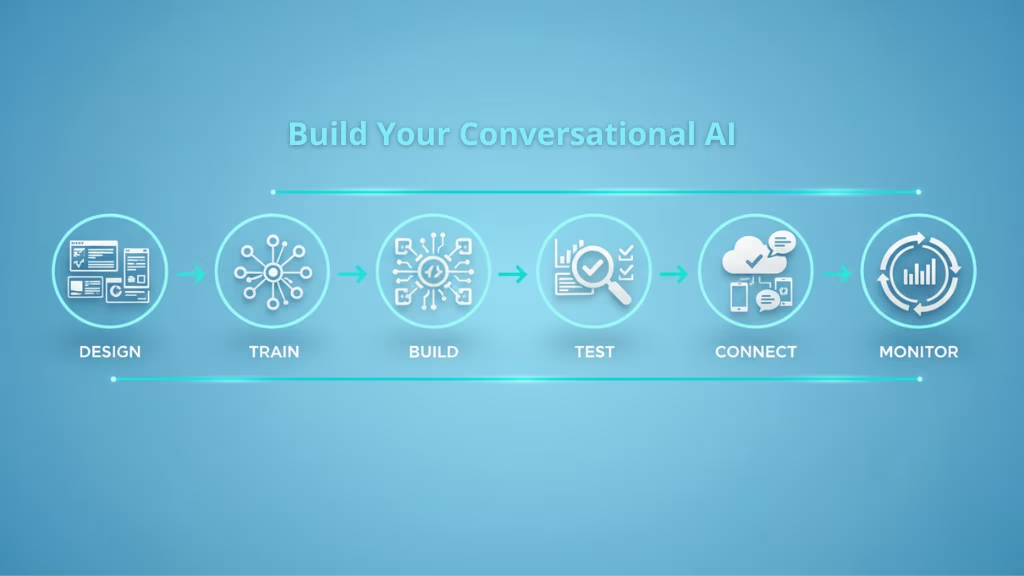
1. Design The Conversation Experience
The design phase defines the purpose, users, and functionality of the conversational AI system.
Teams identify:
- The target audience
- Main use cases
- Conversation flows
- User intents
- AI tone and communication style
This stage also determines where the AI will operate, such as websites, mobile apps, messaging platforms, or voice interfaces.
A strong design ensures conversations feel natural, consistent, and aligned with business goals.
2. Train The AI Model
Training helps the AI understand user questions, recognize intent, and generate relevant responses.
The system is trained using:
- Conversation examples
- Business knowledge
- Customer queries
- Domain-specific data
Technologies like Natural Language Processing (NLP), Natural Language Understanding (NLU), and Machine Learning (ML) help the AI interpret different ways users communicate.
High-quality training data is essential for improving accuracy and handling different user scenarios.
3. Build And Integrate The System
During development, engineers connect the AI model with the required applications and business tools.
This includes:
- Creating conversation workflows
- Connecting APIs
- Integrating databases
- Linking CRM, support, or enterprise systems
These integrations allow conversational AI to perform useful actions, such as retrieving customer information, scheduling appointments, or processing requests.
4. Test Performance And Accuracy
Before deployment, conversational AI systems need thorough testing to ensure reliable performance.
Testing evaluates:
- Response accuracy
- Intent recognition
- Conversation flow
- Error handling
- Performance under high user demand
Feedback from testing helps improve the AI’s responses and resolve potential issues before users interact with the system.
5. Deploy Across User Channels
After testing, the AI is connected to the platforms where users interact with it.
Common deployment channels include:
- Websites
- Mobile applications
- Messaging platforms
- Voice assistants
A scalable architecture ensures users receive consistent experiences across different platforms.
6. Monitor And Improve Continuously
Launching conversational AI is only the beginning. Continuous monitoring helps businesses improve performance over time.
Teams analyze:
- User feedback
- Conversation success rates
- Common questions
- Failed interactions
The AI can then be updated with new data, improved workflows, and better responses to maintain accuracy and effectiveness.
Benefits of Conversational AI
Conversational AI delivers value by making communication between humans and machines faster, more efficient, and more personal. It enables organizations to automate interactions while maintaining a natural, human-like experience for users.
1. 24/7 Availability
Unlike human agents, conversational AI systems never need breaks or sleep. They’re available at all hours, across time zones, ensuring that customers, employees, or students can always get help.
Sintra AI applies this always-on model through 12 role-specific AI employees that support customer service, sales, marketing, and other recurring business tasks around the clock.
This constant accessibility improves service continuity and supports global operations.
2. Faster and More Accurate Responses
By instantly understanding queries and retrieving information from connected databases, conversational AI dramatically reduces wait times.
It can handle routine tasks like booking appointments, checking orders, or providing FAQs freeing human agents to focus on complex issues that require empathy or judgment.
3. Cost Reduction and Scalability
Deploying conversational AI reduces the need for large support teams while maintaining high-quality service.
A single AI agent can manage thousands of conversations simultaneously, lowering operational costs and scaling easily during peak demand without hiring additional staff.
4. Personalized and Consistent Interactions
Through data integration and context retention, conversational AI tailors responses to individual users.
It can remember previous interactions, recognize repeat customers, and adjust tone or recommendations accordingly.
This personalization leads to stronger relationships and better customer experiences.
5. Multilingual and Cross-Channel Communication
Modern conversational AI supports multiple languages, dialects, and communication channels from web chat to mobile apps to voice assistants.
This flexibility ensures inclusivity and allows organizations to serve users in their preferred format and language.
6. Data Insights and Process Improvement
Every conversation provides valuable data. Conversational AI can analyze patterns in user behavior, identify recurring issues, and highlight opportunities for process optimization or product improvement.
These insights help organizations make better decisions backed by real-time feedback.
7. Enhanced Employee Productivity
Internally, conversational AI automates repetitive administrative tasks such as IT requests, HR queries, or data lookups, allowing employees to focus on high-value activities.
This results in improved efficiency and reduced burnout across departments.
In short, conversational AI enhances both user and business outcomes. It improves responsiveness, reduces costs, and creates experiences that feel more human, even when powered by machines.
Challenges and Considerations
While conversational AI offers major advantages, it also comes with challenges that developers and organizations must address to ensure reliability, fairness, and trust. From language complexity to data privacy, these considerations shape how effectively AI systems perform in real-world situations.
1. Language Ambiguity and Complexity
Human language is filled with nuances, slang, and cultural variations that make it difficult for AI to interpret accurately.
A single phrase can have multiple meanings depending on tone or context for example, “That’s just great” could be positive or sarcastic.
Training models to recognize these subtleties requires large, diverse datasets and continuous tuning.
2. Data Privacy and Security Risks
Conversational AI often processes sensitive personal data names, addresses, financial details, or medical information. Without strong security protocols and encryption, this data could be vulnerable to breaches or misuse.
Organizations must comply with privacy regulations such as GDPR or CCPA and ensure that all interactions are securely stored and anonymized where possible.
3. Bias in AI Models
AI systems learn from the data they’re trained on. If that data reflects biased social, cultural, or linguistic the AI can unintentionally reproduce them in its responses.
For example, an assistant might favor certain accents, gendered terms, or cultural expressions.
Ethical model training, regular audits, and diverse datasets are essential to reduce these risks.
4. Scalability and Maintenance
As conversational AI systems grow in complexity and handle more users, maintaining consistency and performance becomes challenging. They require frequent retraining, infrastructure updates, and integration with new tools and APIs to stay current. Without continuous monitoring, performance can degrade over time.
5. Limited Understanding of Emotions and Context
Even the most advanced systems still struggle to detect tone, sarcasm, or emotion. This can lead to robotic or insensitive responses during emotional interactions, such as customer complaints or medical discussions. Adding emotional intelligence remains a frontier area for improvement.
6. High Development and Training Costs
Building and training conversational AI systems requires skilled teams, large data volumes, and computational resources. While pre-trained models have reduced these barriers, fine-tuning and integrating them into enterprise workflows can still be resource-intensive.
7. Compliance and Ethical Oversight
Regulatory frameworks for AI are still evolving. Ensuring compliance with emerging standards such as AI transparency, user consent, and explainability is crucial for long-term trust and adoption. Organizations must establish clear guidelines for responsible AI use.
Managing these challenges requires a balance of strong data governance, ethical design, and continuous model improvement. When done right, these safeguards make conversational AI systems more trustworthy, inclusive, and effective.
What are Popular Real-World Industry Uses of Conversational AI?
Conversational AI is widely used in customer service, marketing, HR, retail, banking, social media, and more. It automates routine requests, personalizes support, and routes complex issues to humans when needed.
Customer service
AI assistants handle FAQs, refunds, troubleshooting, bookings, and proactive status updates. They cut wait times, improve first-contact resolution, and escalate edge cases to live agents. Tight CRM integration lets bots use history to tailor answers 24/7, at peak scale.
Marketing and sales
Chat flows qualify leads, collect zero/first-party data, and personalize offers. Teams analyze conversation sentiment and topic trends to refine campaigns and product messaging.
HR and internal processes
Virtual assistants answer policy FAQs, guide onboarding, triage IT tickets, and prioritize requests.
Employees get faster self-service; operations gain clean, searchable case data.
Retail and ecommerce
Shoppers find products, compare options, track orders, change/cancel, and initiate returns all in chat.
Back-end links improve inventory visibility; tailored prompts reduce cart abandonment.
Banking and financial services
Secure assistants help with balances, bills, lost cards, and fraud alerts, plus guided financial FAQs. Identity checks and audit trails support compliance and trust.
Social media
Bots reply in comments/DMs, recommend content/products, and summarize campaign performance.
Conversation analytics reveal audience interests and creative that converts.
Multipurpose and emerging
LLM-powered agents (e.g., ChatGPT/Gemini) create content, translate, retrieve knowledge, and reason through tasks. Adoption is growing in education, insurance, travel, and IoT, enabling voice-first, hands-free control across connected devices.
What are the Best Practices for Implementing Conversational AI in Your Business?
Successful implementations start with a focused use case, clean data, and measurable goals then scale with testing, training, and strong governance. Choose platforms that are secure, extensible, and easy to maintain.
Pick a high-impact use case
Start where AI can measurably reduce friction (e.g., order status, password resets, appointment booking). Define the problem, audience, and success criteria.
Match application type to goals
Decide between FAQ bots, task bots, agent-assist copilots, or voice IVR. Align channels (web, app, WhatsApp, voice) with user behavior.
Set clear KPIs
Track containment rate, resolution rate, CSAT, average handle time, deflection, and fallback frequency. Review weekly during ramp-up.
Ensure clean, unbiased data
Curate representative utterances, intents, and entities. Remove PII where not needed. Balance examples across languages, dialects, and user profiles.
Treat training as continuous
Retrain on real transcripts, add new intents, and refine prompts/policies regularly. Close the loop on low-confidence and escalated cases.
Test rigorously before scale
Run intent confusion tests, adversarial phrasing, edge-case flows, latency/load tests, and accessibility checks (screen readers, voice).
Align people and processes
Prepare support, legal, security, and brand teams. Define escalation paths, agent handoff rules, and update cadences.
Choose scalable, secure platforms
Require SSO, role-based access, encryption, audit logs, and compliance (e.g., GDPR/CCPA). Verify API depth for CRM/ERP/knowledge integration.
Plan for post-launch operations
Stand up monitoring dashboards, incident playbooks, and content governance. Schedule periodic UX reviews and red-teaming for safety/bias.
Document and communicate
Maintain playbooks for conversation design, prompt conventions, and release notes so teams can iterate confidently.
The Future of Conversational AI
Conversational AI is evolving from simple chatbots into intelligent, context-aware digital companions capable of understanding emotion, predicting intent, and managing complex tasks. The next generation of AI will be proactive, multimodal, and seamlessly integrated into everyday life.
1. From Reactive to Proactive AI
Today’s conversational systems primarily respond to user queries, but future models will anticipate needs before they’re expressed. For example, an AI assistant might suggest meeting reminders, reordering supplies, or summarizing unread messages automatically. This shift toward proactive assistance will make AI feel less like a tool and more like a collaborative partner.
2. Integration with Generative and Multimodal AI
The convergence of conversational AI and generative AI will redefine digital communication. Future systems will process text, voice, images, and even video simultaneously creating richer, more natural conversations. Imagine describing a product verbally while the AI displays visual options or summarizing a meeting transcript in both written and spoken form. This multimodal capability is already emerging in models like GPT-4, Gemini, and Claude.
3. Emotionally Intelligent and Empathetic AI
Next-generation conversational systems will move closer to understanding human emotions. By combining sentiment analysis, affective computing, and real-time tone recognition, AI can adjust its responses to match the user’s emotional state. For example, an AI mental health assistant might detect stress in a user’s voice and reply more gently or suggest a calming exercise. These developments will make interactions more authentic and human-centered.
4. Ethical, Transparent, and Regulated AI
As conversational AI becomes embedded in daily life, ethical design and governance will be critical. Future systems will need to clearly disclose when users are interacting with AI, how their data is used, and where it’s stored. Regulatory frameworks such as the EU AI Act and global standards from organizations like ISO will shape responsible AI deployment. The goal: ensure AI is explainable, fair, and transparent across industries.
5. Domain-Specific and Personalized AI Agents
In the near future, individuals and organizations will have their own AI agents customized for specific purposes. A personal AI assistant might manage one’s schedule and emails, while a business AI could handle procurement or HR queries. Through federated learning, these agents will learn from user behavior without compromising data privacy.
6. Voice-First and Ambient Computing Experiences
Conversational AI will soon extend beyond screens into the physical environment embedded in cars, wearables, homes, and workplaces. This ambient computing will enable continuous, hands-free interaction, allowing people to communicate naturally with devices anywhere. For instance, you might speak to your home AI to adjust lighting, start a call, or order groceries all through a single system that understands context.
7. Collaboration Between Humans and AI
The future is not AI replacing humans but AI augmenting human abilities. Conversational systems will handle repetitive, data-heavy tasks, while humans focus on empathy, strategy, and creativity. Hybrid teams of humans and AI agents will redefine productivity, education, and service delivery across industries.
Conversational AI is moving toward a future where technology becomes invisible woven seamlessly into daily life through intuitive, emotionally aware, and ethically guided systems.
Its ultimate goal isn’t just to talk like humans but to understand and support them in ways that feel genuinely intelligent and empathetic.
Conversational AI Platforms and What to Look for in Them
Conversational AI platforms provide the essential tools, models, and infrastructure for building, training, and managing intelligent chatbots, virtual agents, and voice assistants. Choosing the right platform determines not only how quickly you can build but also how effectively your AI can scale, integrate, and perform in real-world environments. Key Features to Look for in a Platform:
Ease of Implementation
A user-friendly interface and drag-and-drop conversation builder reduce technical barriers. Look for pre-built templates for industries like retail, healthcare, and finance to speed up deployment. Low-code or no-code options make prototyping and updates faster.
Natural Language Processing (NLP) and Understanding (NLU)
These are the engines that make the bot intelligent. Robust NLP and NLU models help recognize intent, extract entities, and maintain context even in complex dialogues. Advanced systems use deep learning and large language models (LLMs) to handle ambiguity and deliver nuanced responses.
Multichannel and Multimodal Integration
Ensure the platform supports deployment across multiple channels web, mobile, messaging apps (e.g., WhatsApp, Messenger), and voice assistants. Multimodal platforms that combine voice, text, and visuals enhance accessibility and engagement.
Scalability and Performance
The platform should handle high volumes of concurrent interactions without degradation. Cloud-native or hybrid deployment options help maintain performance during peak loads.
Customization and Personalization
Choose systems that allow tailored workflows, integration with APIs, and adaptive dialogue flows. Personalization features, such as remembering user history or preferences, make interactions more human-like.
Analytics and Reporting
Comprehensive dashboards should track metrics like intent accuracy, user satisfaction, drop-off points, and CSAT (Customer Satisfaction Scores). These insights help refine responses and improve the system over time.
Security, Compliance, and Responsible AI
Security is non-negotiable. Platforms should comply with GDPR, CCPA, and ISO/IEC standards. They must support encryption, authentication, access control, and transparent data handling. Look for features or documentation on ethical AI practices, bias detection, explainability, and human oversight.
Support and Ecosystem
Enterprise-grade support, detailed documentation, and active developer communities can greatly accelerate adoption. Some vendors also offer training and certification programs for in-house teams.
Examples of Leading Conversational AI Platforms
According to leading industry research, some of the most recognized platforms include:
Amazon Lex – Uses the same deep learning technologies as Alexa; great for voice-enabled experiences.
IBM watsonx.ai – Cloud-based, generative AI-powered platform ideal for customer engagement and sentiment analysis.
Kore.ai – Enterprise-grade automation platform for large organizations; strong in workflow integration.
Microsoft Bot Framework – Flexible SDK for creating bots that integrate across Teams, Skype, and web apps.
Rasa – Open-source framework for fully customizable, self-hosted chatbot development.
Each platform differs in language capabilities, ecosystem, and ease of scaling so it’s best to pilot before full adoption.
The Human Future of Conversational AI
Conversational AI has evolved from rule-based chatbots into intelligent, adaptive systems that understand, learn, and respond to humans with increasing fluency. It’s no longer a novelty or a customer support add-on; it’s a cornerstone technology redefining how we communicate, work, and experience the digital world.
At its core, conversational AI uses natural language processing (NLP), machine learning (ML), and deep learning to bridge the gap between human language and machine logic. Through these layers of intelligence, it listens, interprets, and responds in ways that feel natural while continuously learning from every exchange.
Over time, this technology has matured into something far more powerful than simple Q&A bots. It now powers banking assistants, healthcare advisors, educational tutors, HR copilots, and enterprise automation agents, delivering convenience, personalization, and efficiency at a global scale.
Yet, as conversational AI becomes more embedded in our lives, it’s also raising new challenges. Issues such as bias, data privacy, emotional awareness, and ethical governance demand thoughtful attention. To move forward responsibly, organizations must balance innovation with transparency, fairness, and user trust.
Frequently Asked Questions (FAQ)
Below are some of the most common questions users and organizations ask about conversational AI optimized for both SEO and Answer Engine discovery.
What is conversational AI?
Conversational AI is a type of artificial intelligence that enables computers to understand, process, and respond to human language naturally. It powers chatbots, virtual assistants, and voice-based systems through technologies like natural language processing (NLP) and machine learning (ML).
How does conversational AI work?
Conversational AI processes input through multiple stages:
Speech or text recognition
Language understanding (NLP/NLU)
Dialogue management to decide the next response
Response generation through natural language generation (NLG)
Continuous learning via data and feedback loops
What are the main types of conversational AI?
There are three main types:
Pattern-Matching Bots: Use predefined templates and simple rules.
Algorithmic Bots: Follow logical operations or decision trees.
NLP/ML Bots: Use deep learning and NLP to understand context, intent, and nuance.
What’s the difference between conversational AI and chatbots?
All chatbots use conversation, but not all are powered by AI.
Traditional chatbots follow rule-based scripts.
Conversational AI uses NLP and ML to understand meaning, context, and emotion, making interactions more natural and adaptive.
What are the benefits of using conversational AI?
24/7 availability and faster response times
Cost savings through automation
Personalized and consistent customer experiences
Multilingual and omnichannel support
Valuable data insights from user interactions
Which industries use conversational AI the most?
Conversational AI is widely used across industries, including:
Customer service (e.g., telecom, ecommerce)
Banking and finance (fraud alerts, balance checks)
Healthcare (symptom triage, scheduling)
Retail (personalized recommendations, returns)
Education and HR (onboarding, tutoring, internal support)
How do businesses build conversational AI?
The development process follows six steps:
Design → Train → Build → Test → Connect → Monitor.
This ensures accuracy, relevance, and continuous improvement. Most organizations use specialized AI platforms like IBM watsonx.ai, Amazon Lex, or Rasa to accelerate deployment.
What are conversational AI platforms, and which ones are popular?
Conversational AI platforms provide tools and infrastructure to design, train, deploy, and manage chatbots. Popular options include:
Amazon Lex – Voice-driven automation
IBM watsonx.ai – Generative and enterprise-grade AI
Kore.ai – Enterprise workflow automation
Microsoft Bot Framework – Multichannel integration
Rasa – Open-source and highly customizable framework
What challenges does conversational AI face?
Misunderstanding complex or ambiguous language
Managing user privacy and data security
Bias in AI training data
Maintaining emotional sensitivity in responses
Balancing automation with human oversight
What’s next for conversational AI?
The future lies in multimodal, generative, and emotionally intelligent AI. Next-generation systems will combine voice, text, and visual understanding to create more natural, human-like experiences. These AI companions will anticipate needs, detect emotions, and assist users proactively marking a shift from reactive chatbots to true digital partners.
This page was last edited on 3 September 2026, at 3:55 pm

Start a conversation with our team to solve complex challenges and move forward with confidence.