
Quick Answer:
To succeed with enterprise automation, document the right processes, define clear KPIs, choose scalable tools, run structured pilots, invest in team readiness, prioritize security, and commit to continuous optimization across the organization.
Many large organizations jump into automation with high expectations—streamlined processes, lower costs, agility. Yet, in practice, most automation projects stall before they deliver real impact. Sometimes, teams automate the wrong processes, fail with stakeholder buy-in, or layer technology onto broken workflows. Others rush into complex toolsets without a solid foundation, leading to project abandonment or limited ROI.
This isn’t just an operational headache. As global competitors invest in automation and digital transformation, companies that lag behind risk higher costs, slower innovation, and loss of market share. According to a 2022 Deloitte report, 74% of organizations are pursuing process automation to remain competitive. But only 26% report a significant impact across the enterprise.
So, how can you confidently succeed with enterprise automation? The answer lies in a practical, step-driven approach—one that blends strategy, process, technology, and people. In this article, you’ll learn exactly how to chart a successful automation journey: understanding its types, building the right foundation, measuring outcomes, tackling common roadblocks, and scaling automation across your organization. Whether you’re just starting or ready to mature your efforts, you’ll find detailed playbooks, insightful examples, and strategies proven by practitioners who have seen what works—and what fails—in the field.
What is Enterprise Automation?
Enterprise automation is the coordinated deployment of technology to automate complex business processes across departments and functions within large organizations. It goes far beyond basic task automation, integrating business process automation (BPA), robotic process automation (RPA), and intelligent automation (IA) to create seamless, end-to-end systems.
Key Points:
- Enterprise automation links workflows and data between systems, slashing manual effort.
- The field has rapidly evolved, moving from simple scripting to sophisticated AI-driven orchestration.
- For many enterprises, automation is no longer an add-on—it’s the backbone of scalable digital transformation.
| Term | Definition |
| Enterprise Automation | Coordinated automation spanning multiple processes & systems |
| BPA | Streamlines complete workflows |
| RPA | Automates structured, task-level work with software bots |
| IA | Leverages AI/ML for smarter, adaptive automation |
| Integration | Connects otherwise disparate systems to ensure flow and context |
When automation is designed and governed at scale, it does more than save money. It drives productivity, reduces errors, accelerates response to market changes, and creates consistency for customers and staff alike. Top organizations treat automation as a foundational lever for innovation.
Types of Enterprise Automation: From Task Bots to Hyperautomation
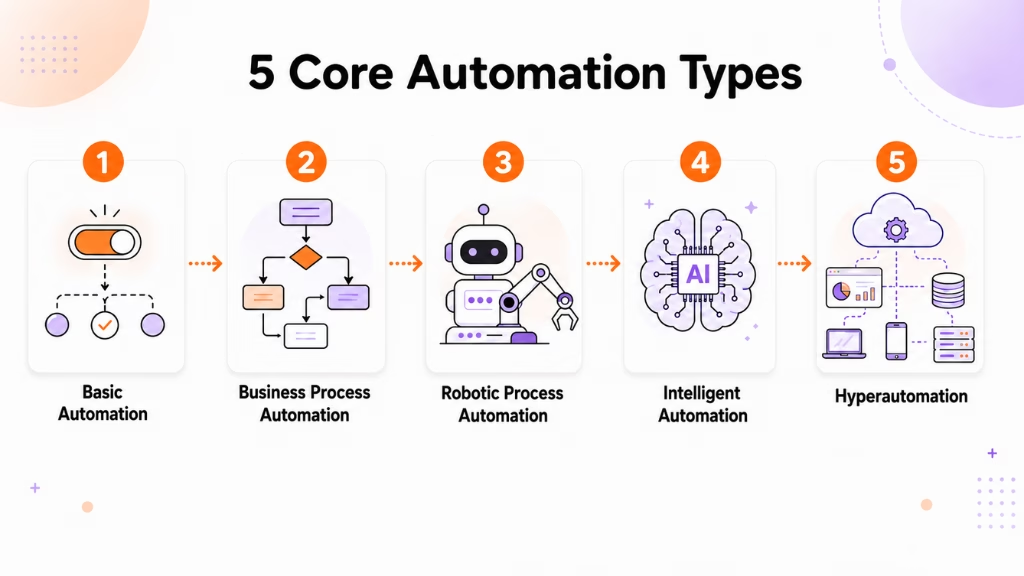
Enterprise automation comes in several overlapping flavors, each suited to different business scenarios.
| Type | Scope | Typical Use Cases |
| Basic Automation | Single, repetitive tasks | Data entry, basic file transfers |
| Business Process Automation (BPA) | Department or cross-functional | Order workflows, compliance checks |
| Robotic Process Automation (RPA) | Rule-based, structured processes | Invoice handling, HR onboarding |
| Intelligent Automation (IA) | Unstructured & decision-rich work | Document reviews, chatbots |
| Hyperautomation | Enterprise-wide, multi-tech | End-to-end transformation, dynamic scaling |
What matters most here:
- Basic task automation is often where companies start, but real value comes from tackling entire processes (BPA) and layering intelligence (IA) where judgment or unstructured data are involved.
- Hyperautomation is the orchestrated application of many tools—AI, RPA, analytics, and more—to automate nearly everything possible, at speed.
Industry Applications:
- In finance, RPA bots have revolutionized invoice processing for speed and accuracy.
- Healthcare organizations rely on BPA to smooth out everything from patient intake to compliance.
- Manufacturers use IA to monitor equipment and predict maintenance needs before breakdowns occur.
The Step-by-Step Playbook: How to Succeed with Enterprise Automation
There’s no shortcut to sustainable automation, but following a structured, experience-tested playbook increases your odds of success dramatically.
- Assess and Map Current Processes
- Use process discovery or mining tools to visualize real workflows.
- Focus on high-volume, error-prone, or repetitive tasks as initial candidates.
- A detailed process map surfaces hidden bottlenecks and quick wins.
- Define Goals, KPIs & Success Metrics
- Align each automation initiative with strategic business outcomes (cost, speed, compliance, customer experience).
- Choose measurable KPIs—cycle time, error rates, productivity, or user satisfaction.
- Set “before and after” benchmarks to demonstrate value.
- Select the Right Tools & Technology
- Don’t chase hype—choose solutions (RPA, BPA, IA, integrations) based on real needs.
- Assess candidate platforms for compatibility, usability, security features, vendor support, and scalability.
- Prioritize fit over flashiness.
- Pilot, Iterate, and Scale
- Launch a low-risk, high-visibility pilot (something impactful but manageable).
- Gather user feedback, refine processes, and measure results.
- Use lessons learned to draft deployment frameworks, then expand carefully.
- Empower Teams with Upskilling & Change Management
- Proactive communication reduces resistance and builds support.
- Upskill existing staff, establish a Center of Excellence (COE), and deploy champions within business units.
- Change management, more than tech, typically determines real success.
- Lock Down Data Governance, Security & Compliance
- Develop clear protocols: who owns the data, who accesses it, and how it’s protected.
- Build compliance from the start (think GDPR, SOX, HIPAA) with proper audit trails.
- Periodically stress-test controls to adapt to evolving risks.
- Commit to Continuous Improvement
- Track post-launch metrics and gather stakeholder feedback on real-world performance.
- Use “lessons learned” reviews and automation maturity models to discover new opportunities.
- Foster an innovation culture where improvements come from everywhere—not just IT.
Many organizations skip formal process mapping or skimp on change management. From experience, these steps are where the biggest automation ROI is either won or lost.
How Do You Measure Success in Enterprise Automation?
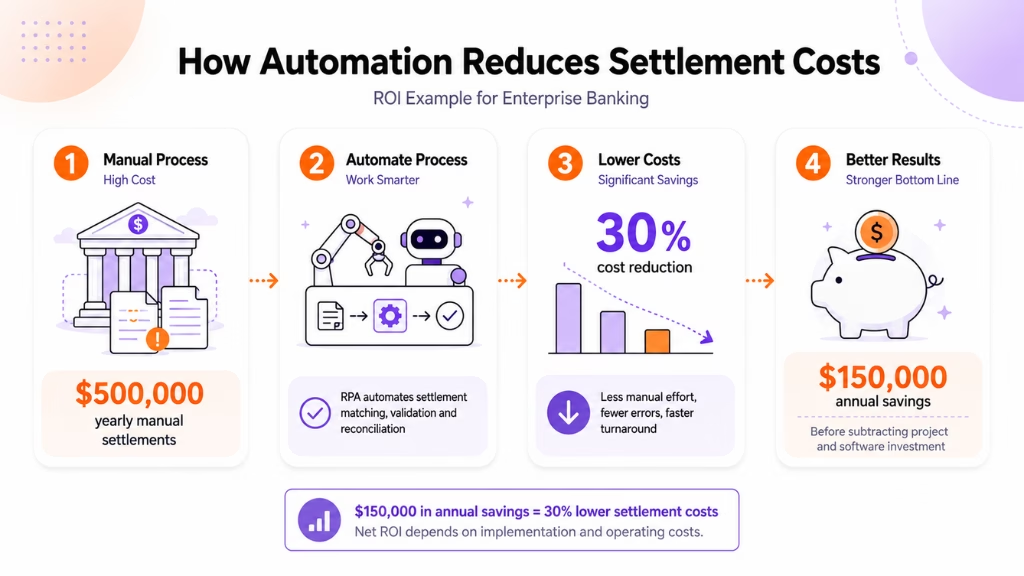
You can’t improve what you can’t measure. A successful automation program ties financial and operational metrics directly to transformation efforts.
Successful enterprise automation shows up in reduced costs and cycle times, fewer errors, higher productivity, and quantifiable business agility.
| Metric | Description | How to Measure |
| Cost Savings | Reduced labor or operational spend | Actual vs. projected cost reduction |
| Time Savings | Shorter time to complete processes | Average turnaround |
| Error Reduction | Fewer mistakes or rework | Error rate before/after |
| Productivity Gain | More output per hour/FTE | Output metrics |
| Process Adoption Rate | Share of processes now automated | Count automated vs. total candidates |
| User Satisfaction | Employee/stakeholder perceptions | Surveys, voluntary usage stats |
| Business Agility | Speed to adapt processes | Time to update workflows/processes |
Sample ROI Example:
A bank spends $500,000 yearly on manual settlements. Automation trims those costs by 30%. That’s $150,000 in annual savings, against which you subtract project and software investment.
What matters most isn’t just initial savings. Strong automation teams also track how quickly and flexibly the business can launch new automations, adapt to changing rules, and sustain improvement as complexity grows.
Avoiding Pitfalls: Common Challenges in Enterprise Automation
Even the best tools and brightest talent can run into costly roadblocks. Here’s what to watch for:
- Change Resistance
Many employees—and even some managers—fear automation means job cuts or painful change. The better approach is to involve users early, communicate transparently, and invest in upskilling. - Integration Complexity
Siloed systems and technical debt create real headaches. I’ve seen better results when teams start with integration-friendly tools and isolate pilots until core roadblocks are solved. - Data Quality and Security
Dirty or inconsistent data kills automation effectiveness. Clean up data before automating, mandate governance, and don’t cut corners on platform security. - Proving Value
Automation investment skeptics abound. Quick, visible wins with solid ROI metrics are essential to maintain (and expand) stakeholder support. - Industry-Specific Hurdles
Highly regulated industries (finance, healthcare) introduce compliance challenges. Engage legal experts from the outset and use platforms with auditable traces.
| Challenge | Prevention Strategy |
| Change resistance | Early, visible wins & team upskilling |
| Integration complexity | Start small, use modular APIs, address silos |
| Data quality/security | Pre-automation cleanup & robust protocols |
| Proving value | Define & share concrete KPIs and ROI |
| Compliance hurdles | Involve regulatory experts, enforce auditability |
One mistake I often see: treating automation as an IT-only project. In reality, sustained buy-in and cross-team collaboration make or break automation success.
Enterprise Automation in Action: Real-World Success Stories
- Finance:
High-volume invoice processing caused significant bottlenecks. Deploying RPA bots allowed real-time invoice validation and posting, slashing processing time by 60% and reducing errors by 80%. Finance staff shifted to analysis and strategic reporting. - Healthcare:
Slow, manual patient onboarding led to incomplete data and delays. BPA streamlined patient info capture, cutting onboarding time by 40% and improving data quality. - Manufacturing:
Maintenance used to depend on periodic checks and intuition. By feeding sensor data into an IA system, manufacturers reduced unplanned downtime by 25% and trimmed maintenance costs significantly. - Legal:
Legal teams faced overwhelming contract review backlogs. Introducing AI-powered clause review doubled throughput and lowered compliance risk.
These aren’t outliers—they illustrate what’s possible when sound automation strategy meets consistent execution.
Scaling and Maturing Your Automation Program
To move past isolated pilots and short-term gains, organizations must formalize and expand their automation approach.
| Stage | Description | Key Actions |
| Ad hoc | Scattered, informal automations | Clarify vision, identify leaders |
| Defined | Programs with clear governance | Establish COE, standardize tools |
| Managed | Integrated, cross-team deployments | Track outcomes, focus on scaling |
| Optimized | Continuous improvement, data-driven advances | Leverage advanced analytics/AI |
Center of Excellence (COE):
A central COE (or virtual leadership team) maintains strategy, standards, training, and reusable assets. Practical steps include:
- Assigning clear leadership and cross-team roles
- Documenting playbooks and best practices
- Facilitating enterprise-wide collaboration and upskilling
- Regular review of KPIs, sharing wins and lessons learned
Scaling Insights:
- Avoid “pilot purgatory” by pushing successful pilots into templated deployment frameworks.
- Use advanced workflow intelligence, predictive analytics, and keep up with trends like generative AI or autonomous agents to keep your automation edge.
- Most beginners assume scaling means more bots. The better approach is to scale process governance, knowledge sharing, and measurement.
Frequently Asked Questions About Succeeding with Enterprise Automation
What first steps help ensure enterprise automation success?
Document your workflows, prioritize automation candidates, define clear KPIs, run targeted pilots, invest in upskilling, and build cross-functional governance.
What are the most critical metrics for measuring automation impact?
Look at ROI, cost and time savings, error reductions, adoption rates, and user satisfaction—always comparing pre- and post-automation data.
Which processes should be automated first in a large organization?
Focus on high-volume, rule-based tasks that are manual, prone to errors, and tied to business priorities. Start where success will be highly visible.
What are the major challenges during enterprise automation?
Common issues include resistance to change, integrating with legacy systems, poor data quality, unclear success metrics, and compliance barriers.
How do you pick the right automation technology?
Match technology to specific process needs, integration complexity, user readiness, security requirements, and long-term cost of ownership.
Why does change management matter in automation projects?
Because cultural buy-in and skill development determine adoption and lasting impact more than almost any technical factor.
What makes an automation initiative truly successful?
Success is indicated by positive ROI, wide adoption, improved process metrics, and high satisfaction among users and stakeholders.
Make Enterprise Automation Work for You
Enterprise automation should empower—not overwhelm—your teams and business. The most impactful programs result from clear process mapping, smart tool selection, persistent measurement, and a relentless focus on people. Start small, learn fast, and expand with a Center of Excellence guiding your efforts. Download our enterprise automation readiness checklist, assess your automation landscape, or connect with an expert for tailored support. Real transformation starts with your first, well-executed step.
Key Takeaways
- Structured playbooks form the backbone of enterprise automation success.
- The mix of technology, process insight, and people determines your results.
- Set and track KPIs rigorously—automation is only as valuable as its measured outcomes.
- Early attention to change management, integration, and data sets you up for fewer missteps.
- Mature your approach over time, establishing a Center of Excellence and adapting as both technology and business needs evolve.
This page was last edited on 16 June 2026, at 12:42 pm

Start a conversation with our team to solve complex challenges and move forward with confidence.