Emerging lifestyle trends like AI-assisted living, digital nomadism, and hyper-personalization are expected to reshape app development in 2027. Explore 10 key trends, nine major user pain points, and practical solutions for businesses.
What makes someone download an app today and delete it a week later? Often, it’s not a lack of features. It’s confusing navigation, endless notifications, hidden costs, and the frustration of switching between apps just to complete one task.
Here’s the interesting part. According to Sensor Tower’s State of Mobile 2026 report, consumers spent $167 billion on in-app purchases in 2025. Clearly, people are willing to pay for digital experiences. But only when those experiences deliver real value.
Meanwhile, AI-assisted living, digital nomadism, and hyper-personalization are changing what users expect from modern apps.
So, how can businesses keep up without building another app that users abandon?
This guide explores 10 emerging lifestyle trends and pain points for app development, along with practical solutions, technical challenges, and opportunities to build AI-powered applications that users genuinely need.
10 Emerging Lifestyle Trends Shaping App Development
People are changing how they work, learn, manage their health, and use digital services. These changes are creating new opportunities for businesses. However, they also introduce challenges related to user experience, privacy, and technology.
Understanding these emerging lifestyle trends and pain points for app development helps businesses identify what users actually need. It also helps developers build applications that solve everyday problems and encourage long-term engagement.
Here are 10 key trends shaping lifestyle app development in 2027.
1. Digital Nomadism Is Driving Demand for Location-Independent Apps
Remote workers, freelancers, and digital nomads need applications that work wherever they go. They often manage projects, communicate with clients, and access business information across different locations and time zones.
However, poor connectivity and disconnected tools can interrupt their work. This creates demand for location-independent apps with reliable access and seamless synchronization.
Key app development opportunities include:
- Cloud-based productivity apps with offline functionality.
- AI scheduling assistants with automatic time-zone adjustments.
- Unified dashboards for project management and team communication.
- Secure access to customer data and business applications.
Development insight: Businesses can use Flutter or React Native for cross-platform development. Serverless infrastructure can support scalable remote access. Offline-first architecture helps users continue working during network interruptions.
2. Biohacking and Longevity Tracking are Transforming Wellness Apps
People increasingly use technology to monitor sleep, physical activity, nutrition, and long-term health. This has accelerated interest in biohacking and longevity tracking applications.
Users want more than basic fitness statistics. They want understandable insights into their daily habits and wellness goals.
For example, a wellness app can analyze sleep duration and activity patterns. It can then suggest personalized routines based on those measurements.
Key app development opportunities include:
- Wearable integration for continuous wellness monitoring.
- AI-powered recommendations based on individual health goals.
- Personalized dashboards for sleep, fitness, and nutrition tracking.
- Predictive analytics for identifying changes in wellness patterns.
Development insight: On-device machine learning and Edge AI can process selected health data locally. Federated learning may support model improvement without centralizing raw user data. Developers should also use data-minimization pipelines and secure consent management to reduce data privacy anxiety.
Wellness insights should not be presented as medical diagnoses without appropriate clinical validation.
3. Spatial Computing Is Creating Immersive App Experiences
Spatial computing combines digital content with physical environments. Technologies such as augmented reality (AR), virtual reality (VR), and mixed reality (MR) are creating new ways to interact with applications.
For example, an online furniture store can let customers preview products inside their homes. A manufacturing company can use immersive simulations to train employees.
These experiences can make complex information easier to understand.
Key app development opportunities include:
- AR shopping apps with virtual product previews.
- Immersive training platforms for enterprise employees.
- Interactive real estate and interior design applications.
- Spatial user interfaces for healthcare, education, and field services.
Development insight: Developers should prioritize accurate spatial tracking, intuitive navigation, and cross-platform performance optimization. Hardware limitations also matter. Complex 3D experiences can increase battery drain and device processing requirements.
Businesses should validate whether immersive functionality improves real user tasks before investing in advanced spatial features.
4. The Silver Economy Is Increasing Demand for Age-Inclusive Applications
The silver economy focuses on products and services for older consumers. Interest in active aging is also increasing demand for accessible digital applications.
According to the World Health Organization, one in six people worldwide will be aged 60 or older by 2030.
Older adults may use apps to manage appointments, monitor wellness, access financial services, and communicate with family members. However, complicated navigation and small interface elements can create onboarding friction.
Key app development opportunities include:
- Healthcare apps with appointment and medication reminders.
- Voice-enabled applications with simplified navigation.
- Financial management tools with accessible interfaces.
- Remote assistance platforms for older adults and caregivers.
Development insight: Accessibility should guide the entire user experience. Developers should use readable text, clear instructions, larger touch targets, and straightforward onboarding. Human-in-the-loop (HITL) systems can provide support when automated assistance is insufficient.
Age-inclusive design should support independence rather than assume every older user has the same abilities or needs.
5. Hyper-Personalization is Redefining User Expectations

Users increasingly expect applications to provide relevant experiences based on their preferences, behavior, and current needs.
Hyper-personalization uses AI, behavioral analytics, and contextual information to adapt content and functionality for individual users.
For example, an e-commerce app can recommend products based on shopping preferences. A customer support app can recognize a returning customer’s unresolved issue and suggest an appropriate next step.
Key app development opportunities include:
- AI-first app personalization and recommendation engines.
- Adaptive interfaces based on user preferences.
- Personalized shopping, learning, and entertainment experiences.
- Proactive customer support workflows.
Development insight: Intent recognition and sentiment analysis algorithms can help apps understand user needs. Predictive churn mitigation can identify patterns linked to disengagement.
However, excessive tracking can create data privacy anxiety. Businesses should prioritize consent, transparent personalization, and responsible data collection.
6. Micro-Learning Is Accelerating Mobile-First Education
Busy professionals often struggle to fit long training sessions into their daily schedules. Micro-learning addresses this problem through short, focused lessons.
These lessons may include quick videos, interactive exercises, quizzes, or practical simulations.
For example, a contact center agent could complete a five-minute training module on handling customer complaints. An SDR could practice responding to sales objections before making outbound calls.
Key app development opportunities include:
- Mobile learning apps with short, interactive lessons.
- AI-powered quizzes and personalized learning paths.
- Gamified employee training and skill development.
- Corporate learning platforms with progress tracking.
Development insight: AI can recommend lessons based on performance and knowledge gaps. Low-code/no-code platforms may help teams validate simple learning applications quickly. More complex products can use a composable architecture to connect learning modules, assessments, and analytics.
Developers should also support offline lessons and simple navigation to reduce cognitive overload.
7. Sustainable Living Is Encouraging Carbon Footprint Tracking Apps
Consumers and businesses are becoming more conscious of their environmental impact. They want practical ways to track energy consumption, reduce waste, and make sustainable choices.
This creates opportunities for carbon footprint tracking applications. These apps can estimate emissions from transportation, household energy use, and everyday purchases.
Key app development opportunities include:
- Carbon footprint calculators with personalized insights.
- Smart energy monitoring through Internet of Things (IoT) devices.
- Sustainable shopping and transportation recommendations.
- Gamified challenges for reducing environmental impact.
Development insight: Developers can integrate environmental data APIs and IoT systems to improve tracking. AI can identify consumption patterns and recommend more sustainable habits. Carbon calculations should use transparent methods and reliable emissions factors.
8. The Creator Economy Is Expanding Digital Monetization Opportunities
Creators, educators, influencers, and independent professionals increasingly earn revenue through digital content. However, managing multiple platforms for payments, subscriptions, content distribution, and customer communication can become complicated.
This ecosystem fragmentation creates demand for unified creator economy applications.
For example, an online instructor could manage paid courses, memberships, and student support through a single platform.
Key app development opportunities include:
- Creator platforms with integrated payments and subscriptions.
- AI-assisted content creation and publishing tools.
- Community management and audience engagement applications.
- Analytics dashboards for revenue and subscriber performance.
Development insight: Businesses can use third-party API integrations and composable architecture to connect payments, content management, and analytics. Hybrid app monetization models can combine memberships, paid content, and transaction-based revenue.
Omnichannel automation can also bring customer messages from multiple platforms into one workflow.
9. Digital Wellbeing Is Increasing Demand for Distraction-Free Apps
People spend considerable time managing notifications, messages, and digital services. Constant interruptions can increase cognitive overload and digital fatigue.
Digital wellbeing focuses on helping users build healthier technology habits. This encourages applications that prioritize meaningful interactions over unnecessary screen time.
For example, a productivity app could group low-priority notifications into a daily summary. Users would receive immediate alerts only for important tasks.
Key app development opportunities include:
- Focus and productivity apps with distraction controls.
- Intelligent notification filtering and scheduling.
- Screen time monitoring and habit management tools.
- Minimalist applications with simplified user interfaces.
Development insight: Developers can use on-device machine learning to classify notifications while limiting unnecessary data transfers. User-controlled preferences are essential for digital fatigue and notification management.
Businesses should measure task completion and user satisfaction alongside engagement. Longer screen time does not always indicate a better experience.
10. AI-Assisted Living Is Creating Demand for Agentic Applications
People increasingly want applications that do more than display information. They want digital assistants that can complete tasks, coordinate services, and reduce manual work.
AI-assisted living uses artificial intelligence to simplify daily activities. Agentic applications extend this capability through autonomous or semi-autonomous workflows.
For example, an AI personal assistant could review a user’s calendar, identify scheduling conflicts, and suggest meeting changes. With permission, it could also update connected applications.
Key app development opportunities include:
- AI personal assistants for scheduling and task management.
- Agentic workflows for customer service and business operations.
- Voice-enabled applications with conversational AI.
- Smart home and connected lifestyle management platforms.
Development insight: AI-native architecture can connect large language models (LLMs), business APIs, and workflow automation tools. Intent recognition helps applications understand user requests. Intelligent query routing directs tasks to the appropriate AI agent or service.
Human-in-the-loop systems should review sensitive actions. Zero-trust security frameworks can restrict access to connected services. Continuous post-launch maintenance is also necessary to monitor AI accuracy, costs, and performance.
Why Are Emerging Lifestyle Trends Creating New App Development Opportunities?
Emerging lifestyle trends are creating new app development opportunities by changing consumer expectations and revealing unmet market needs. Businesses can capitalize on these changes by building personalized, connected, and AI-powered applications that solve real problems.
Here are five major ways these trends are creating new opportunities:
- Growing Demand for Lifestyle Apps: Digital nomadism, biohacking, and the silver economy create opportunities for remote-work, wellness, and age-inclusive applications.
- AI-Powered Personalization: AI-native architecture and agentic workflows enable personalized recommendations, intelligent automation, and better user experiences.
- Connected Digital Ecosystems: Businesses can reduce app fatigue and ecosystem fragmentation through unified platforms and seamless third-party integrations.
- Advanced App Development Technologies: Spatial computing, Edge AI, and cross-platform frameworks enable immersive, responsive, and scalable mobile applications.
- Better Retention and Revenue Opportunities: Frictionless onboarding, predictive churn mitigation, and flexible monetization models help businesses improve engagement and long-term revenue.
The biggest opportunity is to build applications that solve real user problems, deliver lasting value, and adapt to changing lifestyles.
10 Major User Pain Points That Modern App Development Must Solve
Modern applications promise convenience, but poor user experiences often create more problems than they solve. Complicated interfaces, privacy concerns, and disconnected services can frustrate users and increase app abandonment.
Businesses must understand these pain points to build applications that improve usability, customer satisfaction, and long-term retention.
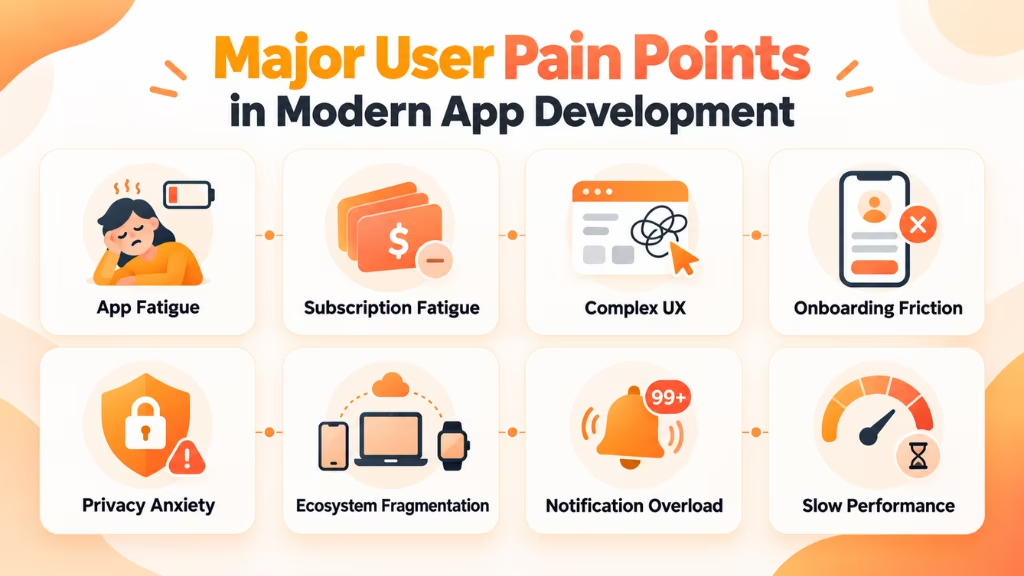
Here are nine common app development pain points and practical ways to address them.
1. App Fatigue and Too Many Disconnected Applications
Users often rely on separate applications for communication, payments, scheduling, and daily tasks. Switching between these tools takes time and creates frustration. This is known as app fatigue.
For example, a remote worker may use multiple apps to manage projects, meetings, and client communication. A disconnected experience makes simple tasks unnecessarily difficult.
How to solve it: Build unified applications that combine related functions. Use composable architecture and omnichannel automation to connect essential workflows. Focus on core user needs instead of adding unnecessary features.
2. Subscription Fatigue and Unclear Pricing Value
Many users pay for multiple apps but struggle to understand the value of each subscription. Hidden charges, confusing pricing tiers, and limited free features can increase subscription fatigue.
This problem is especially relevant to wellness, productivity, and creator economy apps that rely on recurring payments.
How to solve it: Offer transparent pricing and flexible payment options. Consider hybrid app monetization models such as freemium access, subscriptions, and pay-per-use services. Clearly explain what users receive from each plan.
3. Cognitive Overload From Complex App Interfaces
Applications with crowded dashboards, excessive features, and complicated navigation can overwhelm users. This creates cognitive overload and makes everyday tasks harder to complete.
For example, a customer support agent should not need to navigate five different screens to find a customer’s previous conversation.
How to solve it: Use minimalist interface design and clear navigation. Apply progressive disclosure to show advanced features only when needed. AI-first app personalization can also highlight relevant functions based on user preferences.
Measure task completion rates to identify confusing workflows.
4. Onboarding Friction and Poor First-Time User Experience
Users expect to understand an application quickly. Long registration forms, unnecessary permissions, and complicated setup processes create onboarding friction.
A poor first-time experience may cause users to leave before discovering the application’s value.
How to solve it: Design frictionless user onboarding UX with simple registration and guided setup. Use contextual tutorials and optional AI assistants to explain essential features.
Track onboarding completion rates and time to first value. These measurements help developers identify where new users abandon the process.
5. Data Privacy Anxiety and Lack of User Trust
Wellness, financial, and lifestyle apps often collect sensitive personal information. Users may worry about how businesses store, process, and share this data.
These concerns create data privacy anxiety, especially in applications that use AI personalization and behavioral tracking.
How to solve it: Follow privacy-by-design principles and use data-minimization pipelines. Apply encryption, consent management, and zero-trust mobile security frameworks.
Edge AI and on-device machine learning can keep selected data processing on users’ devices. Federated learning may also reduce the need to centralize raw personal data.
Clearly explain data usage and give users control over their information.
6. Ecosystem Fragmentation Across Digital Services
Users often manage information across different platforms that cannot communicate effectively. This ecosystem fragmentation creates duplicate work and inconsistent experiences.
For example, a business may use separate CRM, helpdesk, and communication systems. Employees must repeatedly switch platforms to access complete customer information.
How to solve it: Develop connected digital ecosystems through secure APIs and centralized data access. Use scalable mobile application architecture to support integrations and data synchronization.
Businesses can also modernize legacy mobile applications to improve compatibility with existing digital services.
7. Notification Overload and Digital Distractions
Frequent alerts, promotional messages, and unnecessary reminders interrupt users throughout the day. This notification overload contributes to digital fatigue and reduced engagement.
For example, a productivity app that sends constant updates may distract users instead of helping them complete tasks.
How to solve it: Introduce intelligent notification filtering and customizable alert preferences. Use AI-based intent recognition to identify relevant notifications.
Allow users to set quiet hours and choose notification priorities. Effective digital fatigue and notification management help create a more focused experience.
8. Hardware Limitations, Battery Drain, and Slow Performance
Not every user owns a high-performance smartphone. Resource-intensive applications can cause slow loading, excessive battery consumption, and poor responsiveness.
These issues are particularly important for spatial computing, AI-powered wellness tracking, and real-time applications.
How to solve it: Optimize application size, memory consumption, and background processing. Use Edge AI when local processing offers measurable benefits.
Developers should also evaluate Edge AI inference latency and cross-platform performance optimization. Frameworks such as Flutter and React Native can support shared development, but performance must be tested on actual devices.
Continuous post-launch maintenance helps identify crashes, performance problems, and battery-related issues.
9. Interoperability Deficits and Poor Third-Party Integrations
Applications lose value when they cannot exchange information with other essential systems. These interoperability deficits create disconnected workflows and additional manual work.
For example, a sales application may fail to synchronize customer updates with a CRM. This can lead to outdated records and missed follow-ups.
How to solve it: Use standardized APIs and reliable integration frameworks. Design a composable architecture that supports third-party services and future integrations.
10. Lack of Personalization and Context-Aware Experiences
Users increasingly expect applications to understand their preferences, behaviors, and changing needs. Generic recommendations and irrelevant features can reduce engagement and increase app abandonment.
For example, a productivity app that provides the same suggestions to every user may fail to support different working habits.
How to solve it: Use AI-first app personalization, behavioral analytics, and context-aware recommendations to deliver relevant experiences. Apply privacy-by-design principles to protect user data and maintain trust.
What Technical Challenges Do Businesses Face When Developing Lifestyle Apps?
Developing a lifestyle app requires more than an attractive interface and useful features. Businesses must ensure smooth performance, strong security, and reliable integrations across different devices. AI-powered features also introduce challenges related to data processing, accuracy, and infrastructure costs.
Here are the major technical challenges businesses should address during lifestyle app development.
- Scalability and Architecture: Growing user demands can affect app performance. Cloud-native solutions, serverless infrastructure, and composable architecture help businesses build scalable applications.
- AI Integration and Performance: AI-powered personalization and agentic workflows require significant processing resources. Edge AI and on-device machine learning can reduce cloud dependency and improve response times for suitable tasks.
- Data Security and Privacy: Sensitive user information creates security and compliance risks. Zero-trust security frameworks, encryption, and data-minimization pipelines help protect personal data.
- Cross-Platform Compatibility: Different devices and operating systems create performance challenges. Flutter and React Native support shared development, while device testing helps reduce crashes, battery drain, and compatibility issues.
- Third-Party Integrations: Connecting payment gateways, wearables, CRM systems, and legacy software can cause interoperability problems. API-first development and standardized data formats improve system connectivity.
- Development Costs and Time-to-Market: Complex features can increase development costs and delay launches. Rapid MVP validation and low-code/no-code platforms help businesses test ideas before making larger investments.
- Post-Launch Maintenance and Retention: Bugs, outdated features, and poor performance can increase app churn. Continuous monitoring, predictive churn mitigation, and user feedback analysis help maintain application quality.
Why Choose an AI-Native Technology Partner for Lifestyle App Development?
Understanding emerging lifestyle trends and pain points for app development is only the first step. Turning these insights into successful applications requires expertise in software engineering, AI integration, user experience, and security.
An AI-native technology partner helps businesses build intelligent, scalable applications that meet changing user expectations and solve real problems.
Here’s how the right technology partner can add value:
- AI-Powered App Development: Integrates AI-native architecture, hyper-personalization, and agentic workflows to deliver intelligent features and automate repetitive tasks.
- Scalable and Cross-Platform Solutions: Uses cloud-native infrastructure, Flutter, and React Native to build flexible applications with consistent experiences across supported devices.
- Security and Data Privacy: Implements zero-trust security, encryption, and data-minimization practices to protect sensitive information and strengthen user trust.
- Seamless System Integrations: Connects CRM, payment gateways, wearable devices, and third-party services through secure APIs to reduce ecosystem fragmentation.
- AI-Driven Customer Experience: Combines omnichannel automation, intelligent query routing, and human-in-the-loop support to improve customer interactions and service efficiency.
- Faster Development and Continuous Improvement: Supports MVP validation, agile development, performance monitoring, and post-launch maintenance to reduce development risks and improve retention.
Ready to Build an App That Solves Real User Problems?
Emerging lifestyle trends create exciting opportunities, but turning them into successful applications requires the right development approach. The key is to understand user pain points, prioritize essential features, and build experiences that deliver lasting value.
Whether you’re launching a new product or improving an existing one, working with an experienced technology partner can help you make informed development decisions.
At Riseup Labs, our mobile app development services help businesses transform their ideas into secure, scalable, and user-friendly applications. We focus on practical solutions that address real user needs and support long-term business goals.
Have an app idea inspired by changing lifestyle trends? Let’s explore how to turn it into a meaningful digital experience.
Final Thoughts
The emerging lifestyle trends and pain points for app development show how quickly user expectations are changing. People want smarter, faster, and more personalized applications that simplify their daily lives.
From digital nomadism and AI-assisted living to hyper-personalization and digital wellbeing, these trends create exciting opportunities for businesses. However, challenges like app fatigue, privacy concerns, and poor user experiences cannot be ignored.
Successful app development starts with solving real user problems, not simply adding more features. Businesses should focus on user-centered design, AI-native architecture, seamless integrations, and scalable technology to build applications that deliver lasting value.
As digital lifestyles continue to evolve, businesses that understand these changes and adapt early will be better positioned to improve customer experiences, increase retention, and unlock new growth opportunities.
Frequently Asked Questions
What Are Emerging Lifestyle Trends in App Development?
Emerging lifestyle trends in app development are changes in consumer behavior, technology adoption, and everyday habits that influence mobile app design. Key trends in 2026 include digital nomadism, biohacking, spatial computing, hyper-personalization, sustainable living, digital wellbeing, and AI-assisted living.
How Do Emerging Lifestyle Trends Create New App Development Opportunities?
Emerging lifestyle trends reveal unmet user needs and new market demands. Businesses can address these opportunities by developing personalized, accessible, connected, and AI-powered applications. Successful products solve specific problems, improve convenience, and provide measurable value to users.
Which Lifestyle Apps Have the Strongest Growth Opportunities?
AI personal assistants, wellness and longevity tracking platforms, age-inclusive healthcare apps, micro-learning solutions, and creator monetization platforms are promising development categories. However, their commercial potential depends on market demand, customer acquisition costs, retention, and competitive differentiation.
How Can AI Solve Common Mobile App User Pain Points?
AI can reduce mobile app friction through personalized recommendations, conversational interfaces, intelligent search, automated workflows, and contextual assistance. It can also help users navigate complex features and complete repetitive tasks faster. Effective implementations require reliable data, appropriate permissions, and human oversight.
How Can Businesses Reduce App Fatigue and Improve Retention?
Businesses can reduce app fatigue by simplifying interfaces, combining related workflows, integrating third-party services, and removing unnecessary notifications. To improve retention, they should provide value early, personalize useful features, optimize onboarding, and continuously evaluate user feedback and behavior.
What Technologies Are Best for Building Scalable Lifestyle Apps?
Scalable lifestyle apps commonly use cloud-native infrastructure, modular software architecture, REST or GraphQL APIs, and cross-platform frameworks such as Flutter or React Native. AI-native products may also use LLMs, RAG, edge AI, and agentic workflows. The ideal technology stack depends on the application’s requirements, security needs, and expected usage.
How Much Does It Cost to Develop an AI-Powered Lifestyle App?
The cost of an AI-powered lifestyle app depends on its complexity, features, integrations, design, and ongoing infrastructure requirements.
According to Clutch’s October 2026 app development pricing guide, most mobile app development projects reviewed on its platform fall between $10,000 and $49,999.
This page was last edited on 20 October 2026, at 3:39 pm

Start a conversation with our team to solve complex challenges and move forward with confidence.