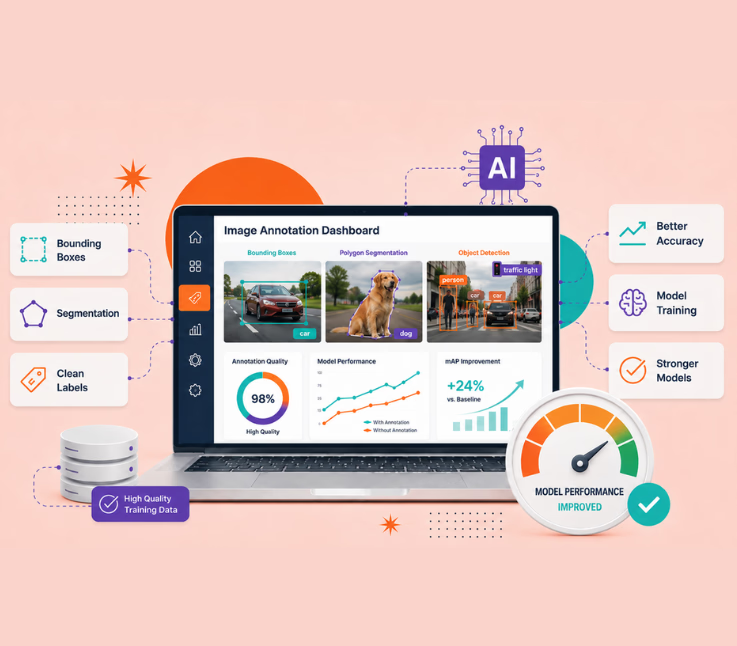
Image annotation improves machine learning models by turning raw images into structured, labeled training data. Accurate annotations help models recognize objects, patterns, and features more precisely, improving prediction accuracy, reducing errors, and helping AI systems perform reliably on new real-world data.
An AI model can process millions of images and still fail if it learns from poorly labeled data. Missed objects, inconsistent annotations, or unclear labeling rules can quickly turn into inaccurate predictions once the model reaches production.
That is why image annotation matters so much.
Understanding how image annotation improves machine learning models starts with one simple idea: models learn what humans teach them to recognize. Accurate bounding boxes, segmentation masks, classifications, and other labels give algorithms the context they need to understand visual data correctly.
High-quality annotation can improve model accuracy, reduce bias, strengthen generalization, and make computer vision systems more reliable in real-world conditions. Automation can accelerate the process, but human review and clear quality standards remain essential.
In this guide, you will learn how image annotation supports machine learning, the key annotation techniques and workflows, the best tools for 2026, common quality challenges, and practical ways to build better-performing models from visual data.
How Image Annotation Improves Machine Learning Models
Image annotation improves machine learning models by giving algorithms accurate, structured examples of what they need to recognize. High-quality labels help models understand objects, features, and visual patterns more precisely, resulting in stronger predictions and better real-world performance.
High-quality image annotation helps models:
- Improve prediction accuracy by providing precise training examples
- Reduce false detections caused by missing or inconsistent labels
- Generalize better to new and unseen images
- Support complex vision tasks such as detection, segmentation, and classification
- Reduce annotation errors and label drift through consistent QA
- Perform more reliably in production with cleaner training data
The performance impact can be significant. In one documented healthcare annotation project, model accuracy increased from 80.1% to 92.4% after improvements to the training dataset and annotation process. CloudFactory also reports that active learning improves model accuracy and generalization by prioritizing the most informative samples, while its AI Consensus Scoring approach provides automated quality checks to identify potential annotation errors. These findings show why combining high-quality annotation, consensus QA, and active-learning automation can lead to substantial improvements in model performance.
In practice, the strongest results come from combining skilled annotators, clear guidelines, automated pre-labeling, active learning, and layered quality assurance. This gives machine learning models a cleaner and more reliable foundation for learning.
What Are the Main Types and Techniques of Image Annotation?
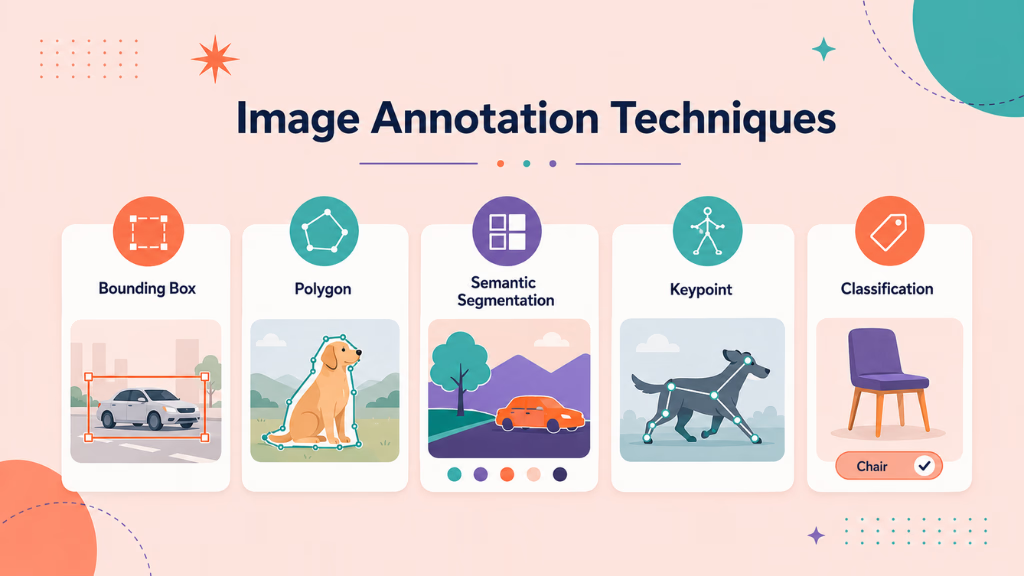
Choosing the right annotation technique is essential for your model’s goal. Here is a guide to the main methods, their best uses, and trade-offs.
| Technique | Best Use Case | Pros | Cons |
| Bounding Box | Object detection | Fast, simple | Misses shape detail |
| Polygon | Irregular object shapes | Very accurate, flexible | Slower, more complex |
| Semantic Segmentation | Scene understanding, counting | Full-pixel accuracy | Labor-intensive |
| Instance Segmentation | Object separation | Per-object detail | Complex, costly |
| Keypoint | Pose, facial landmarks | Detailed, captures variation | High setup time |
| Classification | Image-level categorization | Fast, easy | No object location data |
Bounding Boxes
Bounding box annotation draws rectangles around objects. It is the fastest way to create training data for object detection models.
In my POV, bounding boxes are best for straightforward detection jobs—like vehicles in traffic footage. The mistake I see often is using bounding boxes where more accurate shape data is needed.
Polygon Annotation
Polygon annotation outlines objects with points to capture their exact shape. Use it for irregular items like animals, plant leaves, or fashion.
Polygons are more accurate, but also require more time and skill to annotate. This is where many teams struggle when scaling up.
Semantic and Instance Segmentation
Semantic segmentation assigns a class to every pixel in the image, while instance segmentation does this at the object instance level.
I have seen segmentation pay off in medical imaging and robotics, where fine-grained details are critical. The real issue is scaling due to its labor cost.
Keypoints
Keypoint annotation marks positions like human joints or facial landmarks. This is common in gesture recognition or biometrics.
Last year when our dev team tackled a sports analytics project, using keypoints made movement tracking much more reliable.
Classification Labels
Image-level classification assigns a single or multi-class label to each image.
A better approach is starting with classification for high-volume, low-complexity tasks, then moving to object-level annotation as model goals shift.
What Is the Modern Workflow for High-Quality Image Annotation Projects?
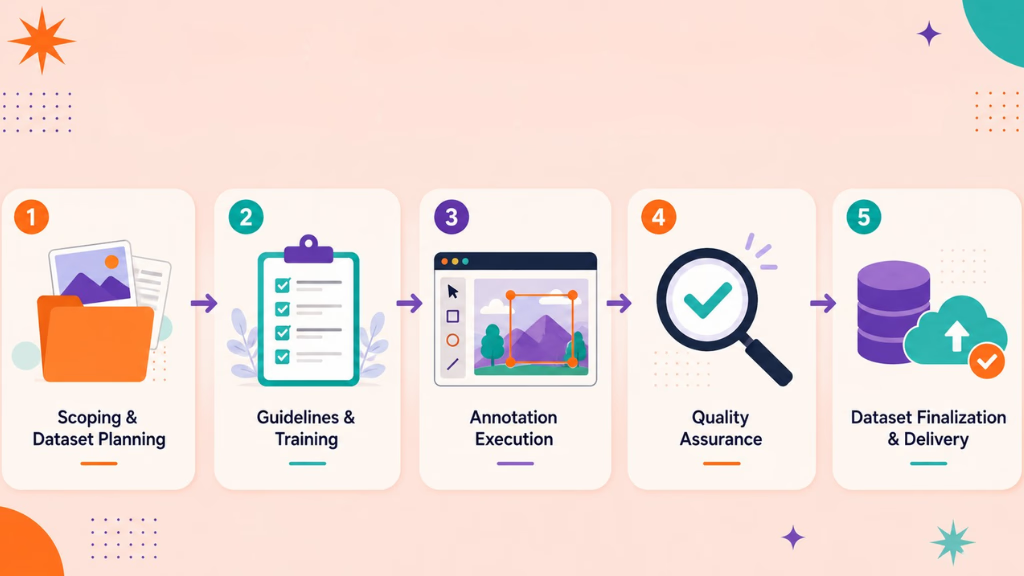
A successful annotation project relies on a well-planned workflow. The modern 2026 workflow uses automation, layered QA, and clear guidelines to deliver quality at scale.
Here’s a high-level view of the recommended image annotation workflow:
- Scope and plan the dataset.
- Create detailed annotation guidelines and train your team.
- Execute annotation using both human and automated methods.
- Run thorough quality assurance checks and corrections.
- Finalize and deliver your annotated dataset.
Step 1 – Scoping & Dataset Planning
Careful planning prevents waste and confusion. Many teams skip this and pay dearly later.
Key steps:
- Define the model task (classification, detection, segmentation).
- Assess diversity needs (lighting, object variations, backgrounds).
- Set clear goals, metrics, and success measures.
Step 2 – Annotation Guidelines & Training
Annotators need detailed, easy-to-follow instructions. In my experience, unclear guidelines force annotators to guess, making data less useful.
Include:
- Task instructions with clear definitions and samples.
- Training or onboarding for all annotators.
- Documentation for edge cases and ambiguous situations.
Step 3 – Annotation Execution (Manual & Automated)
Annotation can be manual, automated, or a mix. Automation now supplements over 50% of labeling workflows.
- Assign batches and track progress.
- Integrate automation through pre-labeling or active learning (AI suggests, humans validate).
- Expand automation as quality and model confidence grows.
Step 4 – Quality Assurance & Corrections
Strong QA prevents costly errors from entering your models. I have seen up to 20% accuracy loss when QA is skipped or rushed.
Implement:
- Peer review and consensus checks.
- Spot audits of labeled data.
- Automated QA tools to flag likely errors or inconsistencies (look for tools with hybrid QA in 2026).
Step 5 – Dataset Finalization & Delivery
Finalize by preparing the dataset for use in the model’s pipeline.
- Normalize formats for your ML stack.
- Document all classes, labels, and edge cases for audit and reuse.
- Version and archive data with clear records, ensuring compliance for regulated industries.
How Do Workforce Models Impact Annotation Quality and Cost?
Who does the annotation—your team, a vendor, or a crowd—changes cost, speed, and quality. Picking the right workforce model depends on your project’s needs and risks.
Here is a 2026 snapshot comparing options:
| Model | Security | Cost | Quality | Scalability | Best For |
| In-House | High | High | Consistent | Limited | IP-sensitive, long-term projects |
| Outsourced | Medium | Moderate | Variable | High | Large, repeatable tasks |
| Crowdsourced | Low | Low | Inconsistent | Unlimited | Early-stage, rapid data expansion |
| Hybrid | Medium | Variable | High | Flexible | Complex, regulated, or risky datasets |
A mistake I see often is chasing low cost without checking for security or data privacy. In my POV, hybrid and human-in-the-loop models—now more common in 2026—are best for projects needing both scale and QA.
Which Annotation Tools and Platforms Lead the Market in 2026?
Choosing the right annotation solution matters. The leading options in 2026 combine automation, strong quality assurance, scalable workflows, and integration flexibility.
| Platform/Provider | Automation | QA Tools | Cloud/On-Prem | Industry Focus |
|---|---|---|---|---|
| Riseup Labs | Automation-Assisted | Multi-Level QA | Managed Service | Enterprise AI/ML |
| CVAT | Yes | Moderate | Both | Open-source, research |
| Labelbox | Advanced | Strong | Cloud | Enterprise, healthcare |
| SuperAnnotate | Advanced | Advanced | Both | AV, medicine, robotics |
| VGG Image Annotator | Basic | Basic | Open-source | Academic |
| Scale AI | Advanced | Advanced | Cloud | Commercial, insurance |
Riseup Labs is a strong option for teams that prefer managed image and data annotation rather than running the entire operation internally. It combines trained human annotators, automation-assisted workflows, and multi-level quality assurance while supporting image, video, text, and audio datasets.
For self-service platforms, Labelbox and SuperAnnotate are strong choices for automation and QA, while CVAT remains useful for teams that prioritize open-source flexibility. The right choice depends on your project scale, security requirements, integrations, and whether you need a platform or a managed annotation partner.
What Are the Most Impactful Industry Use Cases for Image Annotation?
Image annotation powers critical AI across sectors. Below are mini-case studies from top industries in 2026.
Healthcare: Annotated medical scans raised diagnostic ML accuracy by 17% over previous datasets (Nature ML, 2026). Annotation must follow strict privacy and documentation rules.
Autonomous Vehicles: Fine-grained segmentation and keypoints for pedestrians lowered false detection by 19% in one AV deployment project (SuperAnnotate, 2026).
Precision Agriculture: Crop and weed labeling improved yield prediction models for farming clients, speeding field assessment by 28% (CloudFactory, 2026).
Retail Analytics: Pose detection and shelf labeling drove a measurable uptick in planogram compliance, saving hours per store per week.
In my experience, each sector needs different tools and annotation types. Compliance and ethics are real concerns, especially in regulated industries.
What Are the Common Challenges and Best Practices in Image Annotation?
Most projects hit issues with quality, cost, or scale. Avoiding common pitfalls ensures smoother workflows and better ML performance.
Typical challenges:
- Inconsistent labeling or drift across batches
- Annotation bias, especially with unrepresentative datasets
- Workforce turnover and retraining pain
- Cost overruns from rework or unclear guidelines
- Scale bottlenecks in high-volume projects
Best practices for managing these include:
- Run pilot projects before full-scale rollout
- Use consensus QA for all important datasets
- Document every guideline and update often
- Augment human work with automated error detection
- Review workforce models every six months for fit
How Riseup Labs Solves Complex Annotation Workflows
When organizations need project support, Riseup Labs fills the gaps in workflow design, quality assurance, and tool integration. I have worked with teams who used Riseup Labs to build hybrid annotation models, access subject-matter experts, and close compliance gaps.
Riseup Labs focuses on:
- Designing workflows that prevent mission drift
- Integrating the latest annotation tools and automation
- Scaling with both in-house and trusted outsourced teams
- Building QA strategies for regulated industries
For projects with tight deadlines or unique compliance needs, engaging a partner like Riseup Labs gives your team confidence and control.
Conclusion
Investing in image annotation is the surest way to improve machine learning model accuracy and reliability. Every business that relies on visual data must treat annotation as a key part of its AI strategy.
The real value comes from combining expert-led processes, clear guidelines, and smart automation. A single error or poorly chosen workflow can undermine months of development work. In my experience, the teams that revisit their annotation approach yearly stay ahead.
Looking forward, annotation workflows will keep evolving—with generative AI, stricter compliance, and flexible hybrid models coming to the forefront. For organizations aiming to unlock the full power of computer vision, working with partners who understand both the tech and the pitfalls will make all the difference.
The best next step is to review your current annotation process and engage data partners who bring experience, proven tools, and a focus on quality—like Riseup Labs.
FAQs
What is image annotation in machine learning?
Image annotation is labeling images with metadata so ML algorithms can recognize and learn from visual elements during training.
How does image annotation improve model accuracy?
Annotation provides labeled examples that help models detect objects, reduce errors, and generalize better to new data.
What are the main types of image annotation?
Main types include bounding boxes, polygons, semantic segmentation, instance segmentation, keypoints, and classification labels.
Which annotation techniques are best for object detection and segmentation?
Bounding boxes work for object detection. Semantic and instance segmentation are best for detailed object separation and scene analysis.
How do you ensure annotation quality and consistency?
Adopt clear annotation guidelines, quality assurance steps like consensus review, and use automation tools for error detection.
Can image annotation be automated?
Yes. Automation through AI and pre-labeling speeds up annotation but should always include human quality checks.
What challenges do projects face in large-scale annotation?
Scaling causes inconsistent labeling, high costs, and QA issues if guidelines or workforce management are weak.
How do annotation costs and workforce models differ?
In-house models offer control but cost more. Outsourced and crowdsourced options scale better but may risk security and quality.
What are common use cases for image annotation in industry?
Uses include healthcare diagnostics, autonomous vehicles, retail analytics, agriculture, insurance, and robotics.
Which annotation platforms are leading in 2026?
Labelbox, SuperAnnotate, CVAT, and Scale AI are top annotation platforms as of 2026 due to automation and advanced QA features.
This page was last edited on 24 August 2026, at 6:28 pm

Start a conversation with our team to solve complex challenges and move forward with confidence.