

Nearshore outsourcing of digital transformation is rapidly redefining how businesses achieve tech modernization, efficiency, and global competitiveness.
Many US and European organizations face pressures to keep up with relentless technological change, but struggle with talent shortages, rising costs, and slow project cycles at home.
As a result, nearshore outsourcing in LATAM (Latin America) is gaining momentum—offering proximity, access to skilled STEM talent, cost savings, and regulatory alignment through agreements like USMCA.
This executive playbook arms you with the answers, frameworks, country-by-country analysis, and practical tools to confidently lead digital transformation through LATAM partnerships, from early strategy to successful execution.
What Is Nearshore Outsourcing of Digital Transformation?
Nearshore outsourcing of digital transformation is the practice of engaging external technology partners in nearby regions (such as Latin America) to execute or accelerate major digital change initiatives.
Digital transformation involves reimagining business processes, customer experiences, and operational models through technology—covering initiatives like AI integration, automation, cloud migration, and software modernization. Unlike onshore (hiring domestically) or offshore (distant, often different continents), nearshore outsourcing leverages partners in countries that are geographically close, with similar time zones and cultural overlap.
Examples of nearshored digital transformation services include:
- Cloud migration and application modernization
- AI and machine learning solutions
- Robotic Process Automation (RPA)
- Business analytics and data platforms
A typical engagement starts with jointly defining goals and requirements, then leveraging skilled nearshore teams for faster, cost-effective delivery and ongoing support.
What Are the Key Benefits and Drivers of Nearshore Digital Transformation?
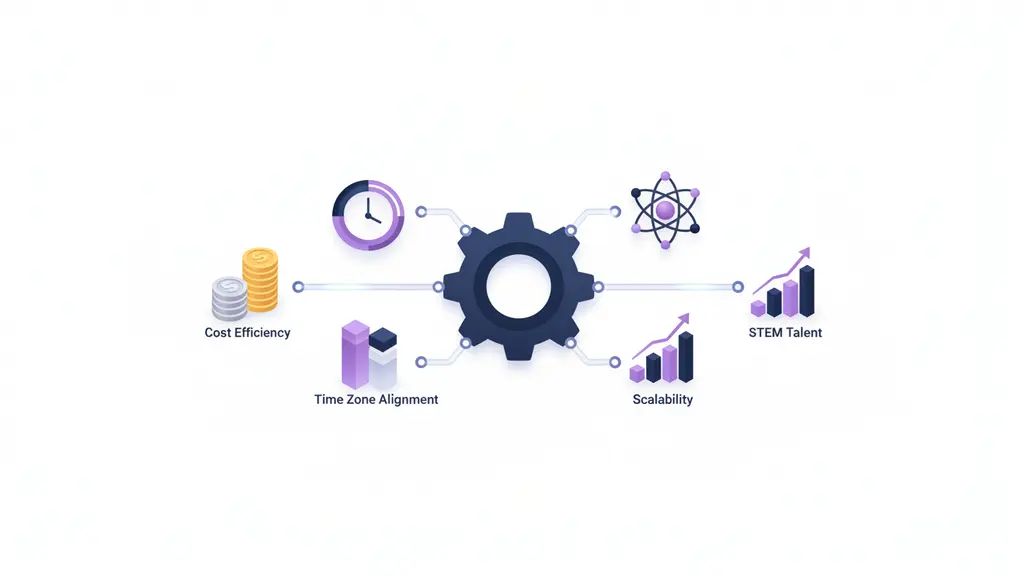
Nearshore outsourcing enables businesses to modernize faster, control costs, and access specialized talent—delivering better ROI and reducing operational risk.
Key reasons organizations choose nearshore digital transformation include:
- Cost Efficiency: Significantly lower labor and overhead costs than US/EU rates, with minimal compromise on quality.
- Time Zone Alignment: Real-time collaboration across similar working hours—especially strong between the US and LATAM.
- Access to STEM Talent: Deep engineering pools in Mexico, Colombia, Brazil, and beyond, supported by strong university systems.
- Scalability: Flexibly ramp teams up or down as needs evolve, without long-term employment overhead.
- Communication & Cultural Compatibility: Higher fluency in English and business culture than offshore regions in Asia or Eastern Europe.
- Faster Speed-to-Market: Accelerated project cycles thanks to agile methodologies and real-time communication.
- Risk Reduction & Compliance: Familiar legal frameworks (e.g., USMCA) and strong data/IP protection standards.
Common outcomes from nearshore IT modernization:
- Reduced project delivery times
- Lower total cost of ownership
- Improved agility for innovation
- Greater resilience via 24/7 support models
Nearshore vs Offshore vs Onshore: Complete Comparative Analysis
Choosing between nearshore, offshore, and onshore outsourcing models depends on cost, time zone, legal, and operational priorities.
The table below summarizes key differences:
| Criterion | Nearshore | Offshore | Onshore |
| Geography | Adjacent region (e.g., LATAM to US) | Distant region (e.g., Asia) | Domestic |
| Time Zone Overlap | High | Low–Moderate | Full |
| Cost | Moderate savings | Highest savings | Highest cost |
| Cultural Affinity | Moderate–High | Low–Moderate | Highest |
| Talent Pool | Strong, STEM-focused | Broad, variable | Local only |
| Legal/IP Clarity | Strong (USMCA, similar regs) | Sometimes complex | Strongest |
| Use Cases | Growth, transformation, innovation | Cost-driven, simple/volume work | Sensitive, confidential projects |
Sample Scenarios:
- Nearshore: Best for innovation, real-time collaboration, regulated industries, and projects where IP security is critical.
- Offshore: Ideal for cost efficiency on high-volume, low-complexity development.
- Onshore: Necessary for highly confidential or compliance-driven work.
Which Latin American Countries Lead in Nearshore Digital Transformation?

Mexico, Colombia, Costa Rica, and Brazil are the most prominent LATAM hubs for nearshore outsourcing; each offers distinct strengths in talent, tech capacity, and sector expertise.
Below is a comparative overview:
| Country | Key Strengths | Workforce Size (IT/Tech) | Cost Benchmark | English Proficiency | Notable Sectors |
| Mexico | Proximity to US, USMCA, tech parks | Largest LATAM IT workforce | Competitive | Moderate–High | Automotive, fintech, SaaS |
| Colombia | R&D, fintech innovation | Rapidly growing | Moderate | High (urban areas) | Fintech, banking, logistics |
| Costa Rica | Security, AI, education | Smaller, highly skilled | Moderate–High | Highest in LATAM | Healthcare, AI, cybersecurity |
| Brazil | Scale, software engineering depth | One of world’s largest | Variable | Moderate | SaaS, e-commerce, financial |
| Argentina | Agile, blockchain, developer culture | Deep dev pool | Low–Moderate | High | Media, blockchain, software |
Mexico stands out for proximity and regulatory alignment with the US (thanks to USMCA).
Colombia has a thriving fintech and R&D sector.
Costa Rica is noted for robust cybersecurity talent and AI focus.
Brazil offers massive scale, whereas Argentina shines in developer skill and innovation.
What Technologies and Tools Drive Nearshore Digital Transformation Projects?
Effective nearshore digital transformation relies on modern cloud platforms, AI frameworks, agile toolsets, and robust collaboration software.
Key technology categories and toolsets include:
- Cloud Platforms: AWS, Microsoft Azure, Google Cloud Platform (GCP) for scalable computing, storage, and modern app development.
- Automation & AI: Robotic Process Automation (RPA) tools (e.g., UiPath), machine learning frameworks, natural language processing.
- DevOps: Tools like Jenkins, GitHub, Docker for continuous integration/delivery.
- Project Management & Collaboration: Jira (project tracking), Slack (messaging), Miro (virtual whiteboarding), Zoom (video conferencing).
- Cybersecurity: Next-gen firewalls, SIEM (Security Information and Event Management) solutions, and encrypted communication layers.
- IP Protection: Secure code repos, multi-factor authentication, and contractual frameworks.
Checklist: Must-Have Tools for Smooth Nearshore Collaboration
- Version control (Git, Bitbucket)
- Agile boards (Jira, Trello)
- Video calls/screensharing (Zoom, Google Meet)
- Real-time messaging (Slack, MS Teams)
- Knowledge sharing (Confluence, SharePoint)
- Virtual whiteboarding (Miro, MURAL)
- Secure file sharing (Box, OneDrive)
These platforms and practices ensure productivity, transparency, and security across borders.
How Strong Is LATAM Nearshore Tech Talent? Education, Skills, and Availability
LATAM’s nearshore talent pool is recognized for its strong engineering education, practical skills, and scalable resource pipelines.
Recent data from Statista and the Coursera Global Skills Report spotlight key findings:
- Engineering Graduates: Mexico, Brazil, and Colombia produce over 350,000 tech and engineering graduates annually combined.
- Top Tech Clusters: Guadalajara (Mexico), Bogotá (Colombia), San José (Costa Rica) are regional innovation hubs.
- English Proficiency: Costa Rica and Argentina lead in English skills, with broad intermediate-to-advanced fluency across major cities.
- Continuous Upskilling: University partnerships and online learning (Coursera, Platzi) drive up-to-date STEM curricula.
- Certifications: Many LATAM professionals hold AWS, Azure, Google Cloud, and AI-related certifications.
Expert Insight: “We consistently find that LATAM engineering teams rival US and EU peers in technical and communication skills, especially for cloud and AI projects.” — Director, Global Tech Consultancy
How to Launch a Nearshore Digital Transformation Project: Step-by-Step Framework

Launching a successful nearshore digital transformation project follows a systematic, phased approach to minimize risk and maximize value.
6-Step Framework:
- Define Business Goals & Project Scope
Clarify transformation objectives, timeline, KPIs, and success metrics. - Select Target Country & Shortlist Partners
Consider regulatory fit, talent, cost, and language. Research partner track records. - Due Diligence on Partners
Evaluate portfolios, client references, compliance credentials, and technology stack alignment. - Negotiate Contracts (SLA, IP, KPIs)
Define deliverables, service levels, intellectual property terms, security standards, and pricing. - Establish Communication Protocols
Set up project management tools, reporting cadences, escalation paths, and feedback cycles. - Kickoff & Phased Delivery
Start with a pilot or phased roll-out, continuously monitor progress, and adjust based on iterative feedback.
Downloadable project launch checklist recommended for practical implementation.
How to Manage Risk: Security, Compliance, and Governance in Nearshore Outsourcing
Strong governance, compliance, and data security frameworks are essential to mitigate risk in nearshore digital transformation projects.
Key risk areas and mitigation tactics:
| Risk Area | Mitigation Strategies |
| Legal Differences | Leverage USMCA-compliant contracts, define jurisdiction, use NDAs |
| Data Security | Enforce ISO/IEC 27001 standards, require security certifications |
| IP Protection | Use IP clauses, secure code repos, audit rights |
| Compliance | Align with GDPR-like LATAM regulations, verify data residency |
| Project Drift | Implement Agile/Scrum, regular stakeholder reviews |
| Incident Response | Predefine escalation paths and SLAs for rapid resolution |
Regular cross-border reviews, robust audit processes, and clear documentation underpin strong governance—especially for regulated sectors like finance and healthcare.
Case Studies: Real-World Successes in Nearshore Digital Transformation
Across industries, nearshore partnerships have delivered measurable value, accelerating digital innovation and reducing costs for businesses of all sizes.
| Sector | Country | Project / Outcome | Key Benefits |
| Banking | Mexico | Core banking platform migration | 30% faster delivery, 25% lower cost |
| Manufacturing | Colombia | IoT/automation rollout | Improved process efficiency |
| Fintech | Costa Rica | AI fraud detection deployment | Enhanced security & rapid launch |
| SaaS | Argentina | Cloud-native product build | Increased agility, scalable team |
Expert Voices from the Field:
“We’ve consistently seen nearshore LATAM teams outperform expectations on both technical delivery and collaboration. Time zone compatibility drives real-time problem-solving.” — Senior VP, North America IT Services
These successes underline the practical ROI and innovation boost achieved through strategic nearshore engagement.
How to Choose a Nearshore Digital Transformation Partner: Selection Framework & Table
Evaluating and selecting the right nearshore partner is based on a framework of technical, operational, and cultural criteria to ensure optimal outcomes.
The ‘6 Pillars’ of Nearshore Partner Selection:
- Technical Skills & Experience
Relevant technology stack, digital strategy expertise. - Verified Track Record
Case studies, market reputation, client references. - Compliance & Certifications
Security standards (ISO/IEC 27001), cloud/AI certifications. - Cultural Fit & Communication
English proficiency, aligned values, collaboration style. - Scalability & Resource Flexibility
Ability to adjust teams as project evolves. - Governance & Transparency
Clear reporting, escalation, and performance tracking.
| Pillar | What to Check |
| Technical Depth | Proven work in desired tech stack |
| Experience | Portfolio, client testimonials, awards |
| Compliance | ISO/IEC, GDPR, USMCA-compliant processes |
| Cultural Fit | Interview team, test communication, check fluency |
| Scalability | Team ramp-up/down experience |
| References | Speak with past/current clients |
What’s Next? The Future of Nearshore Digital Transformation (Trends & Sustainability)
The future of nearshore digital transformation in LATAM will be shaped by sustainable technology practices, emerging markets, new talent flows, and ongoing regulatory evolution.
Key trends to watch:
- Green & Sustainable Outsourcing: Growing demand for low-carbon, energy-efficient digital operations; vendors now offer “green coding” and sustainable cloud.
- Expansion Beyond Mexico: Fast-growing tech ecosystems in Argentina, Chile, Uruguay, and Peru entering the nearshore landscape.
- AI & Automation Impact: Upskilling and reskilling LATAM talent to lead in AI, process automation, and machine learning—critical for staying competitive.
- Government Policy Shifts: Further harmonization under USMCA; evolving data localization and cybersecurity laws.
- Remote & Hybrid Work Models: Pandemic-accelerated changes now standard, enabling optimal cross-border team structures.
Organizations adopting forward-thinking strategies—focused on sustainability, continuous learning, and regulatory alignment—will reap long-term transformation value.
FAQs: Nearshore Outsourcing of Digital Transformation
What is nearshore outsourcing of digital transformation?
Nearshore outsourcing of digital transformation means partnering with technology providers in nearby countries (like Mexico or Colombia) to deliver digital initiatives efficiently. This typically covers projects such as cloud migration, automation, or AI integration.
Why choose nearshore over offshore for digital transformation projects?
Nearshore offers real-time communication, cultural compatibility, and legal/regulatory alignment (e.g., USMCA), resulting in greater project speed, lower risk, and improved collaboration compared to offshore models.
What are the main cost factors in nearshore digital transformation?
Costs reflect labor rates (lower than US/EU), project complexity, required expertise, and the chosen LATAM country. Total cost of ownership is typically reduced through shorter project cycles and lower ramp-up costs.
Which Latin American countries are best for nearshore technology outsourcing?
Mexico, Colombia, Costa Rica, Brazil, and Argentina are top choices, each offering unique strengths in talent, sector focus, and cost structure.
How does time zone alignment benefit nearshore digital transformation teams?
Similar working hours mean faster feedback, real-time meetings, and accelerated decision-making—critical for agile digital projects.
What compliance and security risks are associated with nearshore outsourcing?
Main risks include data privacy, IP protection, and differing legal frameworks. These can be managed through certified partners, contractual controls, and ongoing audits aligned to regulations like USMCA.
How do I evaluate and choose a nearshore partner for digital transformation?
Assess potential partners on technical skill, relevant experience, compliance credentials, scalability, cultural fit, and client references using a structured selection framework.
What technologies and tools drive success in nearshore digital projects?
Cloud platforms (AWS, Azure), project management tools (Jira, Slack), DevOps automation, cybersecurity solutions, and AI frameworks are central to effective collaboration and delivery.
What is the role of government policy (e.g., USMCA) in nearshore talent flows?
Government agreements like USMCA facilitate smoother cross-border trade, standardize IP protection, and provide legal clarity for technology exports and collaborative work.
What real-world examples illustrate successful nearshore digital transformation?
Case studies across banking, fintech, manufacturing, and SaaS industries highlight faster delivery, reduced costs, and greater innovation through strategic nearshore partnerships.
Conclusion
Nearshore outsourcing of digital transformation offers a proven path for US and international companies to drive rapid modernization, access top technology talent, and achieve measurable business outcomes—while managing cost and risk.
This guide mapped the “why, where, and how” for success in LATAM, providing actionable frameworks, regional insights, and partner selection strategies.
Key Takeaways
- Nearshore outsourcing in LATAM accelerates digital transformation with a blend of cost savings, talent access, and operational agility.
- Mexico, Colombia, Costa Rica, Brazil, and Argentina are leading countries, each suited to different project and industry needs.
- Success hinges on structured partner selection, transparent governance, and leveraging cutting-edge tools for collaboration and security.
- Future-proof strategies require focus on sustainability, continuous talent development, and regulatory compliance.
- A step-by-step framework minimizes risk and ensures measurable ROI for digital projects.
This page was last edited on 25 February 2026, at 3:14 pm

Start a conversation with our team to solve complex challenges and move forward with confidence.