The best IT outsourcing companies combine strong technical expertise, flexible delivery models, security, and proven global experience. Leading options include Riseup Labs, Accenture, TCS, Capgemini, N-iX, Globant, BairesDev, Fujitsu, Thoughtworks, and Svitla Systems.
Choosing among the best IT outsourcing companies is harder than it looks.
Most providers now offer some combination of software development, cloud, AI, managed services, and dedicated teams. Some compete on scale. Others on cost, engineering depth, or time-zone alignment.
That makes long service lists surprisingly unhelpful.
The more useful question is:
What kind of outsourcing problem is each company actually good at solving?
My shortlist includes Riseup Labs, Accenture, Tata Consultancy Services (TCS), Capgemini, N-iX, Globant, BairesDev, Fujitsu, Thoughtworks, and Svitla Systems.
I’ve placed Riseup Labs first because it offers a useful middle ground: broader technical and delivery capability than a conventional software agency, but without the scale and consulting overhead that often come with firms such as Accenture or TCS.
That does not make it the best choice for every project.
It means its strengths fit a different kind of outsourcing need—and that is the distinction this comparison focuses on.
Which Are the Best IT Outsourcing Companies in 2026?
The best IT outsourcing companies in 2026 include Riseup Labs, Accenture, TCS, Capgemini, N-iX, Globant, BairesDev, Fujitsu, Thoughtworks, and Svitla Systems. The right company depends on whether you need flexible software development, enterprise transformation, nearshore engineering, AI development, product engineering, or large-scale managed IT services.
| Company | Region | Best For |
|---|---|---|
| Riseup Labs | South Asia / Global | Flexible end-to-end IT outsourcing |
| Accenture | Western Europe / Global | Enterprise transformation |
| TCS | South Asia / Global | Large-scale IT delivery |
| Capgemini | Western Europe / Global | Consulting-led transformation |
| N-iX | Eastern Europe / Global | Software engineering and dedicated teams |
| Globant | Latin America / Global | AI-led digital engineering |
| BairesDev | Latin America / North America | Nearshore development |
| Fujitsu | Japan / Asia-Pacific | Enterprise IT and managed services |
| Thoughtworks | Global | Digital products and engineering consulting |
| Svitla Systems | Eastern Europe / Global | Flexible distributed engineering |
The right choice depends less on company size and more on whether its delivery model, technical strengths, and level of support match your project.
What Is IT Outsourcing?
IT outsourcing is the practice of hiring an external technology company or specialist team to perform work that could otherwise be handled internally.
Businesses commonly outsource:
- Custom software development
- mobile app development
- AI and machine learning
- cloud services
- DevOps
- QA and testing
- cybersecurity
- IT support
- Data engineering
- Enterprise applications
- Infrastructure management
- Managed IT services
The traditional view of IT outsourcing was mostly about cheaper development.
That is only part of the picture now.
Businesses also outsource because specialist engineers are difficult to recruit, because a capability may only be needed temporarily, or because maintaining every technical function internally does not make economic sense.
The more useful question today is not:
“Where can I find cheaper developers?”
It is:
“Which capabilities should we keep internally, and which could an outside technology partner deliver better or faster?”
That shift matters because it changes how you evaluate IT outsourcing companies.
The lowest hourly rate is not necessarily the best deal. The largest engineering team is not necessarily the best team. And the company offering the longest service list is not necessarily the one most capable of delivering your particular project.
How Did We Select the Best IT Outsourcing Companies?
I compared these IT outsourcing companies using six factors: technical capability, relevant delivery experience, engagement flexibility, global reach, security and operational maturity, and buyer fit.
I ignored generic claims such as “innovative,” “world-class,” and “customer-centric.”
Almost every technology company says some version of them.
Evidence is more useful.
That means looking for:
- Comparable projects
- Genuine technical depth
- Long-term customer relationships
- International delivery capability
- Flexible engagement models
- Security and quality maturity
- Ability to support projects after launch
- Clear situations where the company is a good fit and where it is not
I also looked for trade-offs.
A ranking where every company is described as equally brilliant for every type of project is not much of a ranking.
1. Riseup Labs — Best for Flexible End-to-End IT Outsourcing
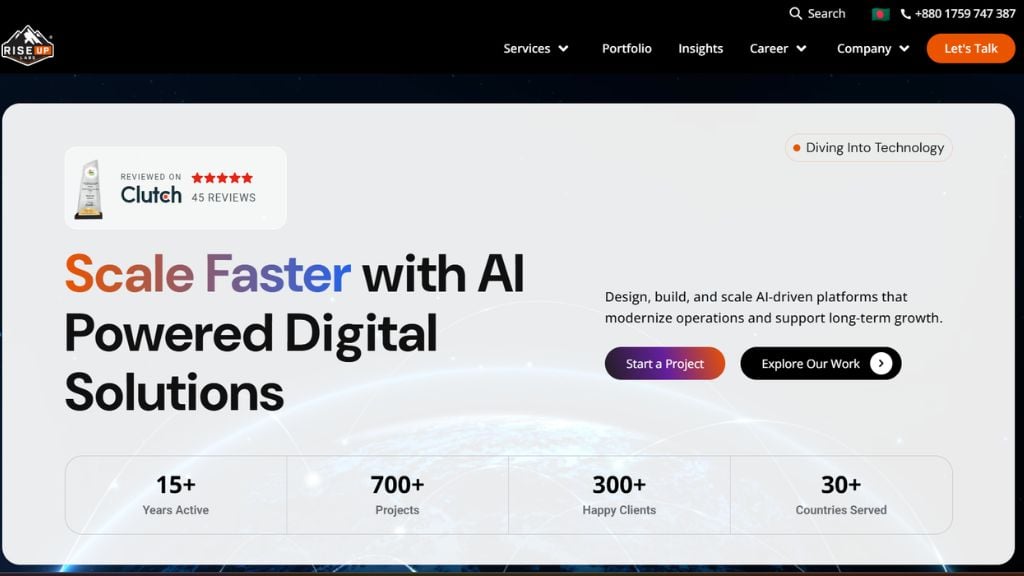
Riseup Labs is one of the more versatile IT outsourcing companies on this list.
Its model combines software engineering with AI, cloud, cybersecurity, resource augmentation, managed services, QA, BPO, and customer experience operations.
The company has completed 700+ projects for 300+ clients across 30+ countries, with an international footprint spanning Bangladesh, the United States, the United Kingdom, and the UAE.
What makes the model interesting is not one headline number.
It is how much of the outsourcing lifecycle sits under the same company.
A business can use Riseup Labs to build a product, add external engineers through IT staff augmentation, introduce AI and automation, move infrastructure into the cloud, test the product, and continue into ongoing managed operations.
That removes one of the annoying parts of outsourcing: finding another provider every time the project enters a new phase.
What Riseup Labs Offers
- Custom software and application development
- AI and automation
- cloud services
- cybersecurity
- IT staff augmentation and dedicated teams
- Managed IT services
- QA and software testing
- UI/UX design
- BPO and customer experience operations
- game development and immersive technology
Notable Proof Points
- 700+ completed projects
- 300+ global clients
- Delivery across 30+ countries
- ISO 9001 and ISO 27001
- SOC 2 Type II and PCI DSS compliant
- Clutch Global Award 2023
- Experience across enterprise systems, healthcare, education, NGOs, AI, mobile applications, and consumer products
Its client footprint also includes organizations such as UNICEF, WHO, UNDP, USAID, KPMG, EY, P&G, BBC Media Action, and other international businesses and institutions displayed across its portfolio and service pages.
There is useful independent validation too. Riseup Labs currently has 46 reviews on Clutch, providing a much larger sample than the handful of testimonials many outsourcing firms rely on. Riseup Labs reviews on Clutch
What puts Riseup Labs first for me is the combination of engineering breadth and engagement flexibility.
For a global ERP transformation involving thousands of consultants, I would still look first at Accenture or TCS.
But for companies that need more than a small software agency while still wanting a focused technical partner, Riseup Labs occupies an interesting middle ground.
2. Accenture — Best for Global Enterprise Transformation
Accenture is one of the most recognizable IT outsourcing companies because its role extends far beyond outsourced development.
It combines technology implementation with consulting, cloud, enterprise applications, AI, cybersecurity, data, and managed operations.
That combination becomes valuable when a technology project is no longer just a technology project.
What Accenture Offers
- Enterprise technology consulting
- Cloud transformation
- AI and data
- Cybersecurity
- Enterprise platforms
- Application modernization
- Infrastructure
- Managed services
Why It Stands Out
Accenture’s biggest advantage is coordination at scale.
Imagine an enterprise transformation involving multiple countries, business units, cloud environments, security programs, ERP platforms, AI initiatives, and several thousand employees.
Using several unrelated vendors can create another management problem on top of the technology problem.
Accenture is built for situations where one provider needs to coordinate many of those moving pieces.
That scale can work against it on smaller engagements.
If you need six developers to build a SaaS product, there are much simpler ways to buy that capability.
Best fit: Multinational organizations undertaking large, interconnected transformation programs.
3. Tata Consultancy Services (TCS) — Best for Large-Scale IT Delivery
TCS is one of the strongest IT outsourcing companies when the requirement is sheer delivery capacity.
As of June 30, 2026, TCS employed 593,798 professionals, operated in 50 countries, and maintained 187 solution centers across 19 countries.
Those numbers are useful because scale is the actual product in many TCS engagements.
What TCS Offers
- Application development and management
- Cloud transformation
- AI and data
- Engineering
- Enterprise platforms
- Cybersecurity
- Infrastructure management
- Managed IT
Why It Stands Out
Suppose an enterprise has hundreds of applications, several legacy environments, multiple cloud platforms, and thousands of employees relying on systems that cannot simply be switched off while modernization happens.
That is a very different outsourcing problem from building one new application.
TCS is particularly well suited to the first.
If you need eight developers, however, access to almost 600,000 employees does not automatically improve your project.
Best fit: Enterprises where the size and complexity of the technology environment are major delivery challenges in their own right.
4. Capgemini — Best for Consulting-Led Technology Transformation
Capgemini is another IT outsourcing company that sits closer to business transformation than conventional software development.
Its service model combines consulting with cloud, engineering, enterprise applications, AI, data, cybersecurity, and managed services.
Its European roots also give it a strong position with organizations operating across European markets, although its actual delivery network is global.
What Capgemini Offers
- Technology consulting
- Cloud transformation
- Enterprise applications
- Data and AI
- Digital engineering
- Cybersecurity
- Managed services
Why It Stands Out
Capgemini becomes more useful when the distinction between technology and business change starts to disappear.
A cloud migration may also require process changes.
An ERP program may affect how entire departments operate.
An AI rollout may require changes to governance, workflows, and data.
Those are situations where consulting expertise adds something beyond pure engineering capacity.
For a straightforward software product, I would probably shortlist a more focused development company first.
Best fit: Large organizations where technology implementation is tied closely to broader operating-model or business transformation.
5. N-iX — Best for Eastern European Software Engineering
N-iX brings a different model to the list.
Rather than competing primarily on global consulting scale, it stays much closer to engineering delivery.
Its global delivery network currently includes 2,400+ engineers across 10 countries and 13 offices, with locations spanning Eastern Europe, Western Europe, the US, Latin America, and India.
What N-iX Offers
- Custom software development
- Cloud engineering
- Data and analytics
- AI and machine learning
- Dedicated engineering teams
- Embedded systems and IoT
- Enterprise modernization
Why It Stands Out
I like N-iX for companies that know they need experienced engineers but do not necessarily need a consulting firm to redesign the business around them.
That distinction sounds small.
It can make the engagement considerably simpler.
You buy technical capacity and engineering expertise without automatically adding a giant transformation structure to the project.
Best fit: European and North American businesses looking for strong distributed engineering teams, particularly with access to Eastern European talent.
6. Globant — Best for AI-Led Digital Engineering
Globant represents another side of modern IT outsourcing.
It began with strong Latin American engineering roots but increasingly competes around digital products, experience design, enterprise modernization, and AI rather than traditional low-cost offshore development.
What Globant Offers
- Digital product engineering
- Enterprise AI
- Cloud
- Data
- Experience design
- Platform modernization
- Digital transformation
Why It Stands Out
Globant is most interesting when the buyer needs more than developers.
Suppose you are rebuilding the digital experience through which customers interact with your business.
The challenge is not only coding.
It includes:
- Product decisions
- Experience design
- Data
- architecture
- AI
- experimentation
- long-term platform evolution
That is where Globant’s broader digital-engineering model becomes more useful.
For basic staff augmentation, it would not be my first choice.
Best fit: Businesses building strategic digital products or incorporating AI into larger customer and business transformation programs.
7. BairesDev — Best for Nearshore Software Development
BairesDev has one of the clearest propositions among the IT outsourcing companies on this list.
It connects North American businesses with software engineering talent across Latin America.
The company reports 4,000+ engineers, 1,480+ delivered projects, and experience across 130+ industry sectors.
Its engagement models include staff augmentation, dedicated teams, and end-to-end outsourcing.
What BairesDev Offers
- Nearshore software development
- Staff augmentation
- Dedicated teams
- End-to-end software outsourcing
- AI and data science
- Cloud and DevOps
- QA and testing
Why It Stands Out
The obvious advantage is time-zone alignment.
But I think the more useful way to describe it is communication speed.
Imagine a product manager in the US asks a development question at 3 PM.
With a distant offshore team, a five-minute clarification may become a next-day decision.
Do that hundreds of times during a project and the cost becomes real.
BairesDev’s LATAM model reduces that friction.
Best fit: US and Canadian businesses that value real-time collaboration alongside access to international engineering talent.
8. Fujitsu — Best for Asia-Pacific Enterprise IT
Fujitsu adds genuine Asia-Pacific depth to this list.
Its outsourcing model is broader than application development, spanning enterprise IT, infrastructure, cloud, systems integration, AI, modernization, and managed technology operations.
That makes it particularly relevant when the technology environment extends below the software layer.
What Fujitsu Offers
- Enterprise IT services
- Cloud
- Infrastructure
- AI and data
- Systems integration
- Application modernization
- Consulting
- Managed operations
Why It Stands Out
Not every outsourcing problem is a software-development problem.
A global enterprise may also need:
- Infrastructure modernization
- Operational support
- Cloud management
- Network systems
- Enterprise platforms
- Long-running technology operations
Fujitsu’s infrastructure and enterprise heritage makes it a stronger candidate in those situations than a software-development specialist.
For a startup building a mobile app, it would be excessive.
Best fit: Large enterprises—particularly those with significant Asia-Pacific operations—that need software and infrastructure capabilities from the same technology partner.
9. Thoughtworks — Best for Digital Product Engineering
Thoughtworks has one of the strongest software-engineering identities among the companies on this list.
Its reputation grew around agile software development, modern architecture, continuous delivery, platform modernization, and product engineering.
That gives it a very different feel from traditional outsourcing firms built around large pools of lower-cost developers.
What Thoughtworks Offers
- Digital product engineering
- Enterprise modernization
- Cloud platforms
- Data and AI
- Platform engineering
- Experience design
- Technology consulting
Why It Stands Out
Thoughtworks makes the most sense when engineering quality itself is part of the business requirement.
For strategically important software, companies need to think beyond:
“Does it work?”
They need to ask:
- Can developers maintain it?
- Can new features ship safely?
- Is the architecture sustainable?
- Can the platform evolve?
- Will technical debt slow the business in three years?
Those questions sit naturally within Thoughtworks’ engineering-led model.
Best fit: Businesses building sophisticated digital products or modernizing software that will remain strategically important for years.
10. Svitla Systems — Best for Flexible Distributed Engineering
Svitla Systems sits between conventional staff augmentation and the giant consulting firms on this list.
The company reports 900+ technology professionals, 15 global locations, and 5,000+ completed projects, with more than 90% of its clients returning for additional work.
That repeat-client figure is particularly interesting.
One-off projects show that a company can sell.
Repeat business provides a better signal that clients were willing to work with the team again.
What Svitla Systems Offers
- Custom software development
- Cloud and DevOps
- Data and analytics
- AI and machine learning
- QA
- Consulting
- Distributed engineering teams
Why It Stands Out
Svitla does not need to turn every engagement into a transformation program.
Sometimes the buyer’s requirement is much simpler:
“We need an experienced software team that can build and maintain this product.”
For those buyers, a focused engineering provider can be easier to work with than a multinational consultancy.
Best fit: Businesses looking for flexible distributed engineering without a heavy consulting layer.
Which IT Outsourcing Company Is Best for Your Business?
The best IT outsourcing company depends on the problem you are trying to solve. Riseup Labs is a strong option for flexible end-to-end delivery, Accenture and TCS fit large enterprise programs, BairesDev stands out for nearshore collaboration, N-iX and Svitla are strong engineering-focused choices, while Globant and Thoughtworks are more compelling for strategic digital products.
| Your Priority | Companies to Consider |
|---|---|
| Flexible end-to-end IT outsourcing | Riseup Labs |
| Dedicated development team | Riseup Labs, N-iX, BairesDev, Svitla |
| Global enterprise transformation | Accenture, TCS, Capgemini |
| AI-led digital transformation | Globant, Accenture, Riseup Labs |
| Nearshore development | BairesDev |
| Eastern European engineering | N-iX, Svitla |
| Asia-Pacific enterprise IT | Fujitsu |
| Digital product engineering | Thoughtworks, Globant |
| Large-scale managed IT | TCS, Accenture, Fujitsu |
| Development plus continued support | Riseup Labs |
I would rather compare three or four companies whose operating models fit the project than build a shortlist of 20 based on brand recognition alone.
How Should You Evaluate IT Outsourcing Companies?
The best way to evaluate IT outsourcing companies is to compare capability, delivery fit, scalability, commercial fit, operational risk, and exit readiness rather than relying on hourly rate or company reputation alone.
Here is the framework I would use.
1. Capability Fit
Do not ask only:
“Do you use AWS, Python, React, or Azure?”
Almost every established software company can produce an impressive technology list.
Ask:
- Have you solved a genuinely similar problem?
- At what scale?
- What were the technical constraints?
- What went wrong?
- Which people with that experience will work on our project?
That final question matters.
A company’s portfolio and the experience of the engineers assigned to you are not necessarily the same thing.
2. Delivery Fit
Clarify:
- Working-hour overlap
- Product ownership
- Technical leadership
- Sprint cadence
- Documentation
- Reporting
- Escalation
- Release responsibilities
A technically excellent company can still be a terrible operational match.
3. Scale Fit
Ask what happens if:
- Five engineers become 15
- You suddenly need a cloud architect
- A senior engineer leaves
- The team needs to shrink
Scalability should work both ways.
4. Commercial Fit
Do not compare hourly rates in isolation.
Compare the cost of achieving the outcome.
5. Risk Fit
Clarify who controls:
- Source code
- Repositories
- Cloud environments
- Credentials
- Production data
- Documentation
- Intellectual property
6. Exit Fit
Ask:
“What happens if we stop working together?”
A healthy outsourcing relationship should allow the project to move without taking your technical knowledge hostage.
What Questions Should You Ask IT Outsourcing Companies?
Before choosing among IT outsourcing companies, ask questions that reveal how the engagement will actually work after the sales team disappears.
These are the ten I would ask:
- Who exactly will work on our project?
- Can we interview the proposed technical lead?
- Which project have you delivered that is genuinely closest to ours?
- What happens if a senior engineer leaves?
- How much of the proposed team is actually senior?
- Who owns the code, repositories, cloud environments, and credentials?
- How do you use AI during development?
- Which delivery and quality metrics do you track?
- What happens if we terminate the engagement?
- What part of this project worries you most?
The last question is one of my favorites.
Sales teams are trained to make everything sound achievable.
A thoughtful technology partner should still be able to identify risk before the contract is signed.
How Much Does IT Outsourcing Cost in 2026?
IT outsourcing costs depend on location, engineer seniority, technical specialization, project complexity, team size, engagement model, and security requirements.
But hourly rate would not be my first filter.
Imagine two proposals:
Company A: $30/hour
Company B: $50/hour
Company A appears much cheaper.
Now suppose Company A requires:
- More internal supervision
- More detailed specifications
- Additional QA
- Frequent rework
- Longer review cycles
Which company is actually cheaper?
You do not know yet.
That is why I would compare:
Vendor fees + internal management + QA + rework + delays + infrastructure + knowledge transfer
That figure is harder to calculate.
It is also much closer to the true cost of outsourcing.
Which IT Outsourcing Model Should You Choose?
Choose staff augmentation when you already have strong internal leadership, a dedicated team when you need stable long-term engineering capacity, project outsourcing when you want the company to own a defined outcome, and managed services when you want to outsource an ongoing operational result.
| Model | Best When | Client Control | Provider Responsibility |
|---|---|---|---|
| Staff Augmentation | You need extra skills or capacity | High | Low–Medium |
| Dedicated Team | You need long-term product development | Medium–High | Medium |
| Project Outsourcing | You have a defined outcome | Medium | High |
| Managed Services | You want an ongoing function outsourced | Lower | Very High |
These are not simply different ways of pricing the same service.
They represent different levels of responsibility.
Staff Augmentation
You manage the work.
The outsourcing company provides the specialists.
This works best when your internal product and engineering leadership is already strong.
Dedicated Team
You gain a stable external team that can build meaningful product knowledge over time.
I like this model for SaaS platforms and long-running enterprise applications.
Project Outsourcing
You are buying a defined outcome rather than individual engineering capacity.
The provider assumes more responsibility for delivery.
Managed Services
You buy an ongoing operational result.
You do not necessarily buy three infrastructure engineers.
You buy monitoring, maintenance, availability, and response.
Once you think of the models this way, choosing among them becomes much easier.
Should You Choose Onshore, Nearshore, or Offshore IT Outsourcing?
Choose onshore outsourcing when proximity and local collaboration matter most, nearshore outsourcing when you want stronger time-zone alignment at a lower cost than local hiring, and offshore outsourcing when access to larger talent pools and cost-efficient engineering are more important.
But outsourcing discussions often focus too much on geography.
The variable I care more about is communication latency.
How quickly can a question become an answer?
How quickly can a bug become a fix?
How quickly can a product manager clarify an ambiguous requirement?
A good offshore team compensates for distance with:
- Strong written documentation
- Defined working-hour overlap
- Clear handovers
- Good asynchronous communication
- Fewer unnecessary meetings
A bad team simply makes you wait.
How Can You Reduce Security, Compliance, and IP Risks?
You can reduce IT outsourcing risk by maintaining clear control over intellectual property, repositories, infrastructure, credentials, production data, access permissions, and the exit process.
Security certifications are useful.
They are not due diligence.
I would still ask:
- Where will production data live?
- Which developers can access it?
- Can production data be copied locally?
- Who controls AWS, Azure, or GCP?
- How is access removed when someone leaves?
- How quickly must incidents be reported?
- Who owns AI-generated code?
- Can proprietary code be submitted to external AI models?
That last question matters much more now than it did only a few years ago.
How Is AI Changing IT Outsourcing Companies in 2026?
AI is changing how IT outsourcing companies develop software, manage projects, and deliver results. By automating repetitive tasks such as coding, testing, documentation, and maintenance, AI helps development teams work more efficiently.
As a result, businesses are beginning to focus less on team size and more on actual delivery performance. A smaller, experienced team using AI effectively may deliver better results than a larger team relying on traditional workflows.
When evaluating IT outsourcing companies, consider:
- How frequently the team delivers new features
- How much testing and QA is automated
- Whether AI has reduced development time
- How often completed work requires rework
- How the company maintains software quality
The key takeaway: The best IT outsourcing companies are not necessarily those with the largest teams, but those that use technology effectively to deliver reliable results, faster development, and long-term value.
What AI Security Questions Should You Ask an IT Outsourcing Company?
If an IT outsourcing company uses generative AI or coding assistants, ask which tools are approved, what project information they can access, whether prompts are retained, whether source code can be submitted externally, and how AI-generated code is reviewed.
“AI-enabled development” sounds attractive.
It can also create another data-security problem.
I would ask:
- Which AI models are approved?
- Can project source code be used in prompts?
- Can customer data be included?
- Are prompts retained?
- Are generated dependencies reviewed?
- Who approves generated code?
- Who remains accountable when AI output is wrong?
The best answer is not necessarily:
“We don’t use AI.”
That may soon become a disadvantage too.
A much more convincing answer is:
“Here is where we use it, here is where we don’t, and here are the controls.”
What Are the Most Common IT Outsourcing Mistakes?
The most common IT outsourcing mistakes include choosing based on price alone, evaluating the company instead of the assigned team, failing to define ownership, ignoring communication fit, neglecting documentation, and forgetting to plan the exit.
Choosing the Cheapest Company
Low hourly rates can quickly become expensive after rework, delays, and additional management.
Evaluating the Brand Instead of the Team
A famous client logo does not tell you who will build your software.
Evaluate the actual team.
Starting Without Clear Ownership
Decide who owns:
- Architecture
- Product priorities
- QA
- Security
- Deployment
- Documentation
before development begins.
Ignoring Knowledge Transfer
Documentation should happen throughout the project.
Not during the final week.
Forgetting the Exit
If moving the project away from the outsourcing company would be extremely difficult, you have created unnecessary dependency.
When Should You Not Use an IT Outsourcing Company?
You should be cautious about outsourcing your core technical differentiator, a badly defined product, a system nobody internally understands, or work whose direction changes constantly.
Outsourcing is not automatically the right answer.
Your Core Technical Advantage
If proprietary technology genuinely represents the company’s competitive moat, I would retain meaningful internal ownership.
A Badly Defined Product
Outsourcing confusion does not make confusion disappear.
It invoices you for it.
A System Nobody Internally Understands
External teams work better when someone inside the business still owns the technical direction.
Constantly Changing Work
External teams can handle change.
But continuous strategic indecision makes almost any outsourcing relationship inefficient.
Outsource execution where it helps.
Do not outsource your ability to make decisions.
Final Thoughts: Which IT Outsourcing Company Should You Choose?
The best IT outsourcing companies are not interchangeable.
For flexible software development, dedicated teams, AI, staff augmentation, and continued managed support, Riseup Labs is one of the strongest all-round choices in this comparison.
For complex multinational transformation, Accenture, TCS, and Capgemini bring much greater consulting and delivery scale.
For Eastern European software engineering, N-iX and Svitla Systems deserve attention.
For Latin American delivery, Globant and BairesDev solve different problems: Globant is stronger around digital products and AI-led transformation, while BairesDev is particularly attractive for nearshore engineering.
For Asia-Pacific enterprise IT, Fujitsu brings broader infrastructure and managed-services experience.
And for product-focused software engineering, Thoughtworks remains one of the more distinctive options.
The main lesson is simple:
Do not try to find the IT outsourcing company that claims to be best at everything.
Find the one whose strongest capability matches the part of your technology problem you actually need someone else to solve.
Frequently Asked Questions
What are the best IT outsourcing companies in 2026?
The best IT outsourcing companies in 2026 include Riseup Labs, Accenture, TCS, Capgemini, N-iX, Globant, BairesDev, Fujitsu, Thoughtworks, and Svitla Systems. The right choice depends on project size, technical requirements, preferred region, engagement model, and budget.
How do I choose the best IT outsourcing company?
Choose an IT outsourcing company by comparing relevant project experience, technical expertise, security practices, engagement models, communication, scalability, and total delivery cost. Shortlist three to five companies and evaluate the actual people who would work on your project.
What services do IT outsourcing companies provide?
IT outsourcing companies commonly provide custom software development, mobile app development, cloud engineering, AI and machine learning, QA, DevOps, cybersecurity, staff augmentation, dedicated teams, managed IT services, and enterprise software development.
How much do IT outsourcing companies charge?
IT outsourcing costs vary by region, engineer seniority, technology, project complexity, and engagement model. Offshore companies generally offer lower rates than providers in North America or Western Europe, but businesses should compare total delivery cost rather than hourly pricing alone.
Which countries have the best IT outsourcing companies?
Leading IT outsourcing companies operate across India, Bangladesh, Eastern Europe, Latin America, Western Europe, North America, and Asia-Pacific. Different locations offer different advantages in cost, engineering talent, working-hour overlap, enterprise scale, and industry specialization.
What is the difference between staff augmentation and IT outsourcing?
Staff augmentation adds external specialists to a team that you continue to manage. Project outsourcing gives the external company greater responsibility for delivering a defined product or outcome. Staff augmentation offers more client control, while full project outsourcing transfers more delivery responsibility to the provider.
Are offshore IT outsourcing companies still worth using?
Yes. Offshore IT outsourcing companies can provide access to large engineering talent pools and lower development costs. Offshore engagements work best when the provider has strong communication, documentation, security practices, technical ownership, and defined working-hour overlap.
Can an IT outsourcing company modernize legacy systems?
Yes. Many IT outsourcing companies provide cloud migration, application modernization, and legacy system modernization. The strongest providers understand both the existing architecture and the business processes that must continue running during modernization.
What are the main risks of IT outsourcing?
The main IT outsourcing risks include poor communication, weak security, unclear IP ownership, vendor dependency, knowledge loss, delivery delays, and hidden management costs. These risks can be reduced through due diligence, clear contracts, governance, documentation, and a defined exit plan.
How is AI changing IT outsourcing companies?
AI is helping IT outsourcing companies automate coding, testing, documentation, modernization, and operational work. Buyers should increasingly compare providers by delivery speed, quality, defect rates, and measurable outcomes rather than simply comparing team size.
Which IT outsourcing company is best for my business?
The best IT outsourcing company depends on your requirements. Riseup Labs is a strong fit for flexible software outsourcing and dedicated teams, Accenture and TCS suit large enterprise transformation, BairesDev is strong for nearshore development, N-iX fits distributed engineering, Globant suits AI-led digital products, and Thoughtworks is a strong choice for product engineering.
This page was last edited on 12 October 2026, at 11:56 am

Start a conversation with our team to solve complex challenges and move forward with confidence.