Enterprise software is the backbone of modern business, enabling organizations to streamline operations, automate workflows, and make data driven decisions. This enterprise software development guide is designed to help you plan, build, and manage enterprise applications with clarity and confidence.
Despite its importance, many enterprise projects face challenges such as budget overruns, inefficiencies, and security risks. Without a structured approach, these issues can impact both performance and long term business success.
This enterprise software development guide provides a practical, step by step framework covering key processes, best practices, and emerging trends. Whether you are building new systems, upgrading existing ones, or planning a digital transformation, this guide will help you make informed decisions and deliver successful outcomes.
What Is Enterprise Software Development?
Enterprise software development is the process of designing, building, integrating, and maintaining applications that automate and optimize business operations on a large scale.
Enterprise software stands apart from consumer or small-business tools by its ability to manage complex, mission-critical processes for large organizations. Its core goal is to drive efficiency, support decision-making, and ensure compliance across diverse departments and workflows.
Key aspects of enterprise software development:
- Automates processes such as HR, finance, operations, and supply chain.
- Prioritizes security, scalability, and integration with legacy systems.
- Examples include ERP (Enterprise Resource Planning), CRM (Customer Relationship Management), BI (Business Intelligence), SCM (Supply Chain Management), and HRM (Human Resource Management).
- Solutions are built to handle high user volumes, regulatory requirements, and demanding SLAs.
Enterprise software development is the creation of tailored digital systems that automate, integrate, and manage complex business processes within large organizations.
By investing in enterprise software, businesses gain a unified, scalable foundation that supports growth, innovation, and long-term resilience.
Why Choose Custom Enterprise Software? Benefits, Use Cases, and Business Impact
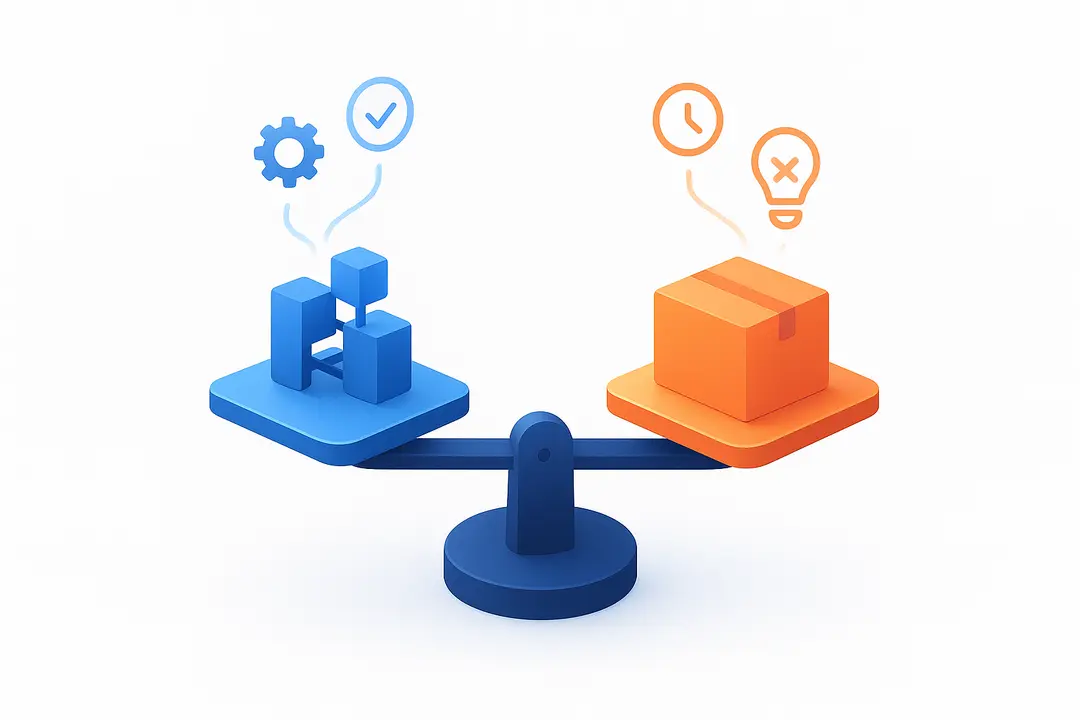
Custom vs. Off-the-Shelf: When to Build vs. Buy
- Custom development fits when business processes are highly unique, when seamless legacy integration is vital, or when proprietary features drive market leadership.
- Off-the-shelf solutions (like standard accounting or CRM platforms) offer faster deployment and lower up-front costs but may limit flexibility or create vendor lock-in.
ROI and Business Drivers
- Deep integration with existing infrastructure.
- Endless scalability as business needs evolve.
- Enhanced security, tailored to industry-specific requirements.
- Unique features or analytics that boost productivity and decision-making.
Featured Use Cases (Mini Case Examples)
- Example 1:
A global retailer implemented a custom inventory management system, resulting in a 15% reduction in stockouts and improved omni-channel customer experiences. - Example 2:
A financial institution built a secure, tailored digital onboarding app, cutting processing time in half compared to commercial alternatives.
Table: Business Drivers for Custom Software
| Business Driver | Custom Software | Off-the-Shelf |
| Process Uniqueness | ✔️ | ❌ |
| Integration Needs | ✔️ | Limited |
| Time to Market | Longer | ✔️ (Faster) |
| Total Cost of Ownership | Variable | Fixed/Subscription |
| Vendor Lock-In Risk | Low | High |
| Competitive Differentiation | ✔️ | Limited |
Custom development isn’t for every scenario, but for organizations with distinctive processes or tight integration needs, it unlocks long-term ROI and strategic agility.
Types of Enterprise Software: ERP, CRM, BI, SCM, HRM, and Beyond
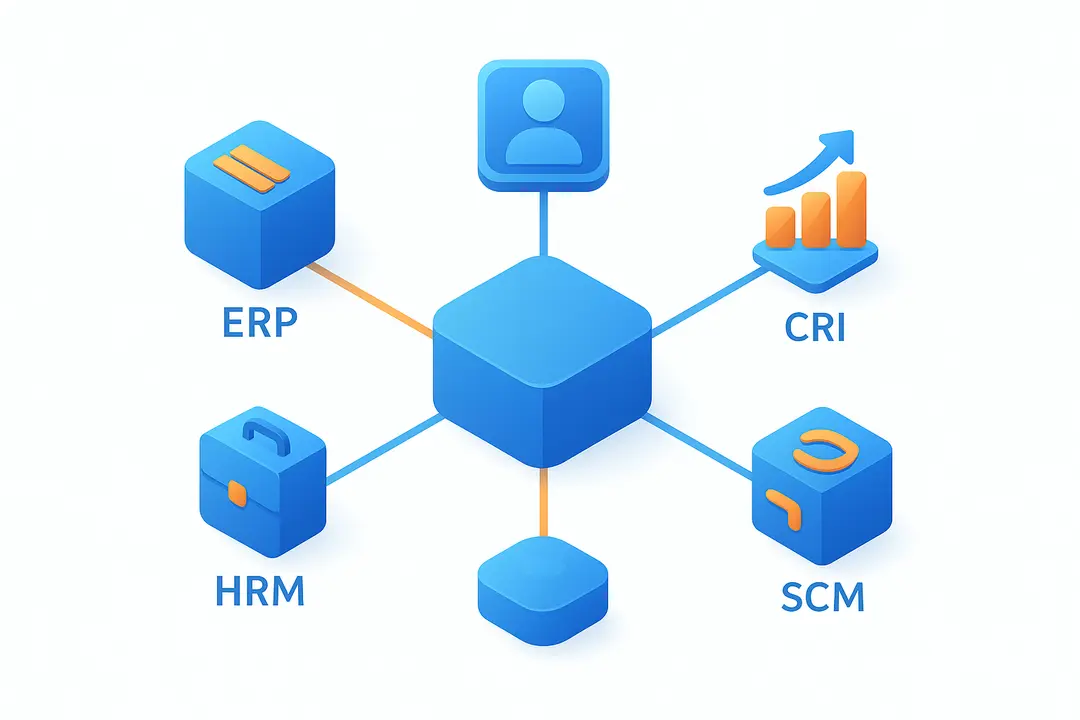
Enterprise software comes in diverse categories, each addressing core business functions vital for operational excellence and scalability.
Primary types and their business roles:
| Type | Definition | Primary Functions | Leading Platforms | Best-Fit Use Case |
| ERP (Enterprise Resource Planning) | Integrates core business processes across finance, HR, inventory, and more | Financials, manufacturing, supply chain, HR, procurement | SAP, Oracle, Microsoft Dynamics | Large organizations requiring unified data and process automation |
| CRM (Customer Relationship Management) | Manages customer information and interactions | Sales, marketing, customer service, support | Salesforce, Microsoft Dynamics, HubSpot | Businesses focused on salesforce automation and customer experience |
| BI (Business Intelligence) | Gathers and analyzes business data for insights | Reporting, dashboards, analytics, forecasting | Tableau, Microsoft Power BI, Qlik | Data-driven organizations needing real-time insights |
| SCM (Supply Chain Management) | Optimizes logistics, inventory, and supplier relationships | Inventory management, logistics, procurement, order fulfillment | SAP SCM, Oracle SCM, Infor | Complex supply chains with global sourcing |
| HRM (Human Resource Management) | Manages employee records, payroll, performance, hiring | Recruitment, payroll, benefits, training | Workday, SAP SuccessFactors, BambooHR | Mid- to large companies prioritizing workforce management |
When to use each:
- ERP: End-to-end process integration and unified data source.
- CRM: Deep customer relationship tracking and marketing automation.
- BI: Advanced analytics and reporting across multiple systems.
- SCM: Managing complex, global supply networks.
- HRM: Streamlining talent and HR processes at scale.
Choosing the right type—or a combination—depends on your business’s operational priorities.
How Is Enterprise Software Development Different from Traditional Software Development?
Enterprise software development involves greater scale, complexity, and business-criticality than traditional, consumer, or SMB-focused software projects.
Key distinctions:
- Scale: Serves thousands of users and integrates with dozens of core systems.
- Integration: Complexity in connecting legacy databases, external APIs, and cloud platforms.
- Stakeholders: Involvement from multiple, often competing, business units and regulatory teams.
- Compliance: Adherence to industry and global regulatory standards (GDPR, HIPAA).
- Technical Debt: Legacy systems often require phased upgrades or careful migration.
Comparison Table: Enterprise vs. Traditional Software Projects
| Aspect | Enterprise Software | Traditional Software |
| User Scale | Thousands, often global | Dozens to hundreds |
| Integration | High (legacy, external apps) | Moderate |
| Compliance | Strict, audited | Variable |
| Speed/Flexibility | Lower, due to complexity | Higher, with fewer constraints |
| Stakeholders | Many (diverse roles/teams) | Few, direct users |
| Technical Debt | Common, must be managed | Less prevalent |
Understanding these differences is critical—misapplying small-project approaches to enterprise environments leads to costly setbacks and missed objectives.
The Enterprise Software Development Lifecycle: Step-by-Step Framework
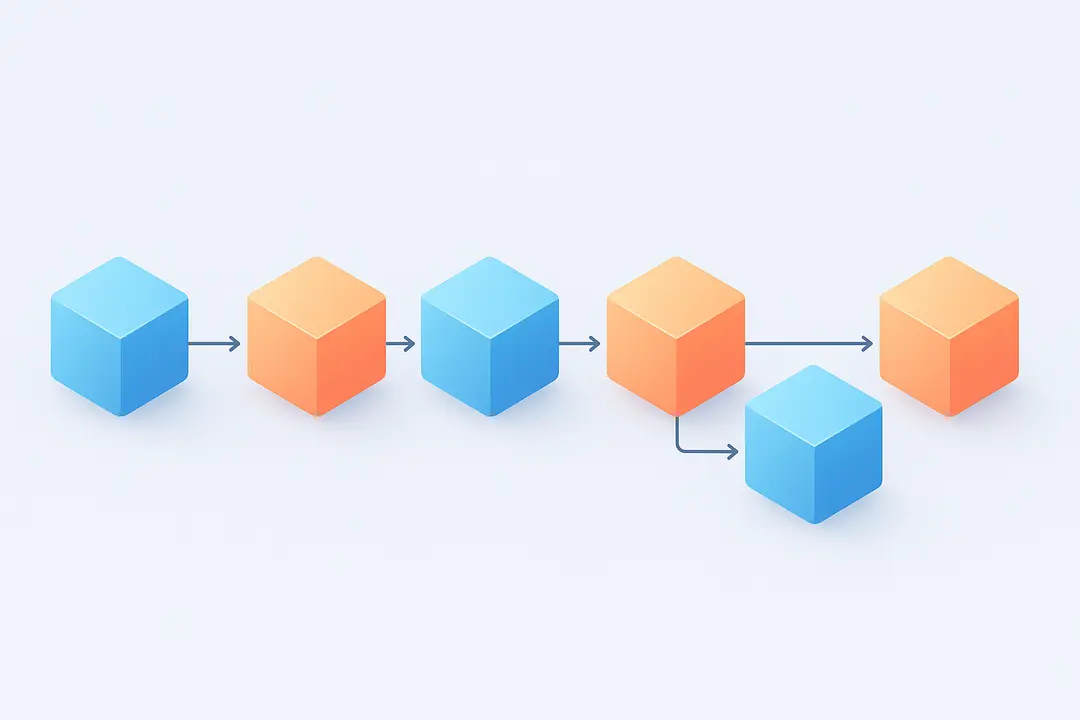
The enterprise software development process follows a structured lifecycle to ensure quality, risk management, and long-term maintainability.
Enterprise SDLC — 6 Essential Steps:
- Requirements Analysis
Identify key business needs, interview stakeholders, and document detailed requirements. - Planning & Design
Develop a solution architecture, create wireframes and prototypes, and map business processes to system workflows. - Development
Employ agile best practices, maintain code quality standards, and ensure tight collaboration among cross-functional teams. - Testing & Quality Assurance
Conduct unit, integration, security, and user acceptance testing to validate stability, compliance, and performance. - Deployment & Integration
Prepare for go-live with cloud setup, data migration, user training, and change management strategies. - Support & Maintenance
Monitor system health, apply patches, introduce enhancements, and scale resources as business needs evolve.
Enterprise Software Development Lifecycle Table
| Step | Key Activities | Best Practices |
| Requirements Analysis | Stakeholder interviews, process mapping | Engage all departments |
| Planning & Design | Architecture, UI/UX, prototyping | Prioritize usability |
| Development | Agile sprints, code reviews, collaboration | Automate CI/CD |
| Testing & QA | Functional, integration, security testing | Test early and often |
| Deployment & Integration | Cloud setup, change management, user onboarding | Pilot before full launch |
| Support & Maintenance | Continuous monitoring, scaling, bug fixes | Plan for improvements |
Pro Tip:
“Iterative delivery and regular feedback loops lead to significantly fewer post-launch defects.” – Enterprise CTO, 2026
What Are the Leading Methodologies for Enterprise Projects? (Agile, Waterfall, DevOps, & More)
Selecting the right software development methodology is crucial for enterprise projects, impacting speed, quality, and adaptability.
Comparison of Top Methodologies:
| Methodology | Strengths | Drawbacks | Best Use Cases |
| Agile | Flexibility, iterative, client collaboration | Challenging in regulated environments | Dynamic requirements, R&D, innovation |
| Waterfall | Structured, clear stages, robust documentation | Rigid, hard to adapt late | Compliance-heavy, government projects |
| DevOps | Fast delivery, automation, collaboration | Cultural shift required | Continuous delivery, large-scale web apps |
| Low-Code/No-Code | Rapid prototyping, empowers business users | Limited for highly custom apps | Early-stage projects, quick MVPs |
Agile enterprise software development dominates in 2024 for its iterative nature and responsiveness to change.
Waterfall remains relevant for projects with fixed requirements or regulatory constraints.
DevOps integrates development and operations, automating testing and deployment for speed and reliability.
Low-code/no-code solutions enable rapid iterative delivery with minimal coding—ideal for digital transformation pilots.
Choosing a methodology should align with your project’s complexity, stakeholder needs, compliance environment, and desired pace of innovation.
Security and Compliance in Enterprise Software: What You Must Know
Enterprise application security and compliance are non-negotiable. Failing in these areas can result in heavy fines, data breaches, and damage to your brand.
Key security and compliance practices:
- Security by Design:
- Implement role-based access controls.
- Encrypt sensitive data at rest and in transit.
- Follow secure coding and DevSecOps principles throughout the SDLC.
- Regulatory Best Practices:
- Align with frameworks like GDPR, HIPAA, CCPA, and adapt for industry-specific needs.
- Integrate data governance and privacy management features.
- Continuous Security Testing:
- Automate vulnerability scans and penetration testing as part of CI/CD pipelines.
- Cloud and Integration Security:
- Ensure cloud-native apps have robust identity management.
- Carefully manage API integrations and third-party data exchanges.
Enterprise Application Security Checklist
- Enforce strong authentication and RBAC
- Encrypt all sensitive data
- Audit and log key activities
- Automate vulnerability scanning
- Validate compliance for every release (GDPR, HIPAA, etc.)
- Conduct regular incident response drills
Proactive security and regulatory compliance protect your business and build stakeholder trust.
How to Select the Right Enterprise Software Vendor or Technical Partner
Partnering with the right vendor is a critical success factor for custom enterprise software development. A strong selection process reduces risk, ensures cultural fit, and builds lasting value.
Vendor Evaluation Steps:
- Screen for Experience and Domain Expertise
Does the vendor have a proven track record in your industry?
Can they work with your preferred stack (SAP, Salesforce, AWS)? - Assess Technical Capabilities
Evaluate their development process, security practices, and scalability experience. - Review References and Case Studies
Ask for previous project outcomes matching your complexity and scale. - Examine Cultural and Communication Fit
Is their approach collaborative, adaptive, and transparent? - Negotiate SLAs, Support, and IP Ownership
Clarify expectations around handover, warranty, ongoing support, and IP rights. - RFP/Shortlisting
Use a structured RFP with key questions around compliance, DevSecOps, and support.
Example Vendor Comparison Table
| Criteria | Vendor A | Vendor B | Vendor C |
| Industry Experience | ✔️ (Finance) | ✔️ (Retail) | ✖️ |
| Tech Stack | SAP, AWS | Salesforce, Azure | Oracle |
| Support SLA | 24/7 | 8×5 | 24/7 |
| DevSecOps Practices | Advanced | Standard | Advanced |
| References | 5+ | 3 | 2 |
Trends and Innovations in Enterprise Software Development
Enterprise software is rapidly evolving. Staying ahead of these trends is critical for future-proofing your technology stack and business strategy.
Top Enterprise Software Trends for 2026
- AI/ML Integration
AI-powered analytics and automation are now embedded in enterprise applications, supporting smarter workflows and predictive maintenance. According to Gartner, over 65% of organizations will use AI-driven decision-making tools by 2025. - Cloud-Native and Multi-Cloud Architectures
Enterprises are migrating critical workloads to AWS, Azure, and Google Cloud while adopting multi-cloud for resilience and flexibility. - Microservices and Modular Architectures
Breaking monolithic apps into microservices accelerates deployment and simplifies scaling. - Low-Code/No-Code Platforms
Citizen developers and business users are driving digital transformation, using platforms enabling rapid “drag-and-drop” app creation. - Enhanced Security and DevSecOps
Continuous security integration (DevSecOps) is moving from best practice to baseline—automated, end-to-end. - Emerging Compliance and Data Privacy
New regulations (beyond GDPR) are influencing global design practices, especially as data localization laws emerge. - IoT and Edge Computing
Manufacturing, logistics, and healthcare are increasingly integrating IoT data for real-time process optimization.
Data Source Callout:
Statista projects global enterprise software revenue to exceed $570 billion by 2028, reflecting sustained growth and transformative investment cycles.
Frequently Asked Questions (Enterprise Software Development Guide)
What is enterprise software development in an enterprise software development guide?
In an enterprise software development guide, enterprise software development refers to building and maintaining large scale applications that automate complex business processes with a focus on scalability, integration, and security within the enterprise software development process.
How does enterprise software differ in an enterprise application development guide?
An enterprise application development guide explains that enterprise software supports multiple users, integrates with legacy systems, and ensures compliance, unlike standard software which is simpler and designed for smaller use cases.
What are the phases in the enterprise software development process?
The enterprise software development process includes requirements analysis, planning, design, development, testing, deployment, and ongoing support, as outlined in an enterprise software development guide.
What challenges are covered in an enterprise software development guide?
An enterprise software development guide highlights challenges such as system integration, legacy constraints, stakeholder alignment, and maintaining security throughout the enterprise software development process.
What are examples in an enterprise application development guide?
An enterprise application development guide includes examples like ERP, CRM, BI tools, supply chain systems, and HR platforms used in large organizations following the enterprise software development process.
How do you choose a methodology in an enterprise software development guide?
An enterprise software development guide recommends choosing Agile for flexibility, Waterfall for structured environments, and DevOps for continuous delivery within the enterprise software development process.
What security practices are essential in the enterprise software development process?
Key practices in the enterprise software development process include encryption, access control, and DevSecOps, all emphasized in an enterprise software development guide.
How is compliance handled in an enterprise application development guide?
An enterprise application development guide ensures compliance by integrating regulations like GDPR and HIPAA into the enterprise software development process from the design phase.
What role does cloud play in an enterprise software development guide?
An enterprise software development guide highlights cloud computing as essential for scalability, flexibility, and cost efficiency in the enterprise software development process.
How much does enterprise software development cost in an enterprise software development guide?
According to an enterprise software development guide, costs vary widely but can range from hundreds of thousands to millions depending on complexity and the scope of the enterprise software development process.
How can businesses scale using the enterprise software development process?
Businesses can scale through the enterprise software development process by adopting cloud infrastructure, modular architectures, and automation strategies outlined in an enterprise software development guide.
Why is an enterprise application development guide important for large organizations?
An enterprise application development guide helps organizations standardize development, reduce risks, and ensure long term success through a structured enterprise software development process.
Conclusion & Next Steps: Building Enterprise Software That Lasts
Enterprise software development plays a vital role in improving efficiency, strengthening competitive advantage, and supporting long term business growth. When guided by a clear process and aligned with modern practices, it enables organizations to build reliable and scalable solutions that deliver real value.
By focusing on strong planning, the right technology choices, and continuous improvement, businesses can successfully navigate complex development challenges. A well executed approach ensures your enterprise systems not only meet current needs but also support future innovation and expansion.
Key Takeaways: Enterprise Software Success Checklist
- Start with a clear, business-aligned requirements analysis involving all critical stakeholders.
- Prioritize security and regulatory compliance from the earliest stages.
- Follow a modular, stepwise development lifecycle adapted to enterprise complexity.
- Choose vendors with deep domain expertise and proven security/DevSecOps processes.
- Monitor emerging trends (AI, low-code, microservices) for strategic advantage.
This page was last edited on 9 July 2026, at 11:10 am

Start a conversation with our team to solve complex challenges and move forward with confidence.