
AI-assisted data labeling uses machine learning to suggest labels, then human experts review and correct them. This hybrid approach delivers faster, more accurate annotated data for AI models while maintaining quality and scalability.
Getting quality labeled data is now one of the biggest hurdles in real-world AI projects. Good data annotation helps models perform reliably, but manual labeling is expensive, time-consuming, and difficult to scale. Fully automated labeling can move faster, but it often sacrifices accuracy.
So, what is AI assisted data labeling? It is an approach that combines AI-powered automation with targeted human review to label training data faster, more accurately, and at scale.
In this article, you will learn how AI-assisted data labeling works, its key benefits, the leading tools for 2026, and why both business leaders and technical teams are adopting this approach.
What Is AI-Assisted Data Labeling? (And How’s It Different?)
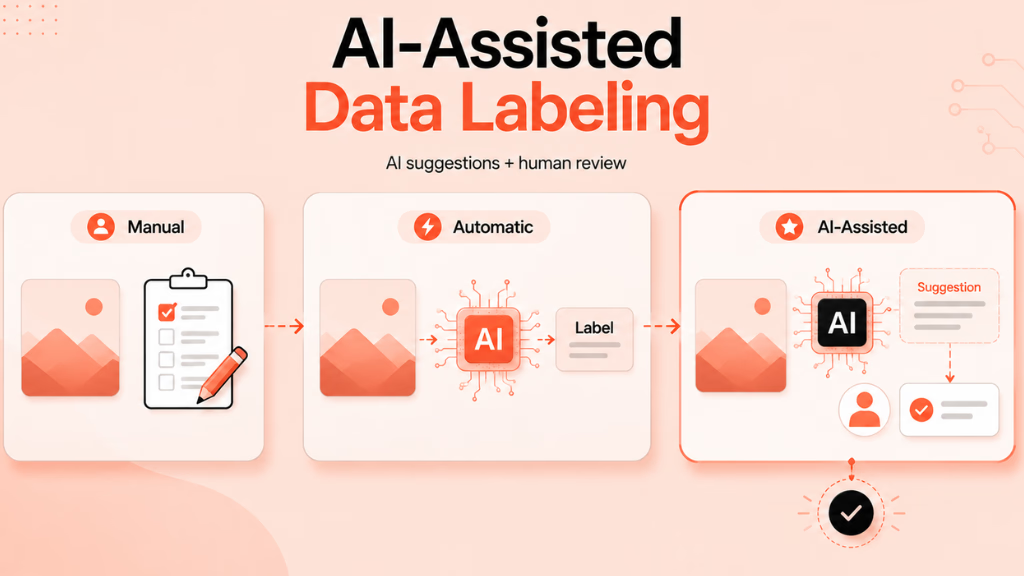
AI-assisted data labeling is a hybrid process where machine learning models suggest labels for data, and humans review or edit these suggestions to reach high-quality annotations.
This approach outperforms only-manual or only-automatic methods. In my experience, hybrid workflows solve two key business needs: speed and precision. Simple automation misses rare cases, while humans alone get overwhelmed at scale. AI-assisted combines smart AI guesses with human expertise for better results.
Here’s a side-by-side view of the three main labeling methods:
| Feature | Manual Labeling | Automated Labeling | AI-Assisted Data Labeling |
| Who adds labels | Humans only | Machines only | AI suggests, humans review/correct |
| Speed | Slow | Fast | Fastest (after iterative improvement) |
| Accuracy | High (depends on human skill) | Variable, often lower | High (combines AI speed and human QC) |
| Cost | High | Low per label, risk of error | Lower than manual, higher ROI |
| Quality Control | Human review | Hard to enforce | Built-in human-in-the-loop |
| Scalability | Hard for big data | Good, but limited by AI quality | Scales with data and team size |
AI-assisted labeling works best for teams that want rapid, reliable data without giving up control over accuracy.
How Does AI-Assisted Data Labeling Work? Step-by-Step Workflow Explained
AI-assisted data labeling follows a clear workflow. This makes it easier for teams to plan resources, set up best practices, and ensure high-quality outputs.
Below, I break down the main steps. In my POV, visualizing your pipeline early prevents costly missteps down the line.
Typical AI-assisted labeling workflow:
- Data collection and preparation
- AI model generates label suggestions
- Human annotators review and correct labels
- Quality assurance through expert or audit review
- Model retrains on improved data for next batches
Let’s look closer at how these steps work.
1. Data Collection and Preparation
Preparing the right data is the first step. Teams gather data samples, clean them, and split into manageable batches.
Many data annotation tools now support easy uploads for images, audio, video, or text.
2. AI Model Generates Label Suggestions
A machine learning model, often pre-trained or fine-tuned for similar tasks, predicts labels for the data. For example, in image labeling, the AI draws boxes or classes objects. For text, it tags topics or keywords.
Automated suggestions speed up the process, but are not always perfect, especially with unique or complex data.
3. Human Annotators Review and Correct Labels
This is where the “human-in-the-loop” shines. Annotators accept, adjust, or reject AI-suggested labels. Relevant tools highlight uncertain or low-confidence suggestions to save time.
In my experience, this review step is critical for catching both obvious and subtle errors.
4. Quality Assurance Through Expert or Audit Review
Quality control measures follow. This can involve audits, double-blind checks, or review by subject matter experts (SMEs) for tricky cases.
Strong QA prevents label drift and ensures output fits business requirements.
5. Model Retrains on Improved Data
Corrected and approved labels feed back into the training loop. The AI learns from its mistakes. Next time, suggestions are better. Projects achieve higher efficiency and accuracy with each cycle.
Here’s a high-level diagram of the workflow:
Raw Data → AI Label Suggestion → Human Review → QA/SME Review → Model Improvement → Repeat
Sample annotated data screenshot:
*(Image would typically show raw data, AI-proposed labels, and human-corrected outputs. Insert sample visual if possible.)*
Best-in-class platforms (like SuperAnnotate, Encord, or Roboflow) now feature UIs blending AI prediction overlays with fast acceptance/edits.
What Are the Key Techniques & Methodologies in AI-Assisted Data Labeling?
AI-assisted data labeling is more than just machine suggestions. Under the hood, several advanced methods power this cycle. Understanding these helps teams pick the right tool or workflow for their data.
In my experience, knowing when and how to use these methods often separates mediocre projects from true business wins.
Active Learning
Active learning is where the AI identifies the hardest, most uncertain data points and asks humans to label those. This “uncertainty sampling” targets what the model is least sure about. It is efficient because teams spend time fixing the most value-adding examples.
Weak Supervision
Weak supervision uses rules, templates, or other programming tricks to apply labels automatically. It is less precise per instance, but very fast for bulk annotation. Later, humans review odd cases. This suits projects where perfect labels are not needed immediately.
Semi-Supervised Learning
Semi-supervised learning involves training the model with a mix of labeled and large amounts of unlabeled data. AI tries to learn patterns from both, guided by the smaller, high-quality labeled set. This reduces annotation workload and works well when data is plentiful but human effort is costly.
Foundation Models for “One-Click” or Zero-Shot Labeling
Recent advances in “foundation models” like Segment Anything Model (SAM) or OWLv2 make it possible to generate useful labels for new data types with almost no fine-tuning. These massive pre-trained models can label images, video, or text after seeing a single example or prompt.
A data scientist I work with noted, “Using SAM for initial segmentation saved us weeks on our last vision project.”
Subject Matter Experts (SMEs)
SMEs play a vital role in high-stakes domains, such as healthcare or defense. Where mistakes may cost lives or money, SME input drives label policy, reviews edge cases, and signs off on gold-standard datasets.
Real-World Example
For AI in agriculture, weak supervision helps tag thousands of plant images with rules (like color thresholds). SMEs then review the small percent that the model marks as “uncertain” for faster, more reliable crop health monitoring.
Summary Table: Key Techniques
| Technique | How It Works | Typical Use Case |
| Active learning | AI flags unclear cases for review | Rare events, costly mistakes |
| Weak supervision | Program rules label easy cases | Bulk labeling, simple data |
| Semi-supervised | Uses both labeled/unlabeled data | Image, language, time-series data |
| Foundation models | Pre-trained AI suggests most labels | Vision, NLP, one-click workflows |
| SME annotation | Experts review and define edge cases | Healthcare, defense, quality audit |
What Are the Main Benefits & ROI of AI-Assisted Data Labeling?
Organizations switch to AI-assisted data labeling to cut costs, speed up projects, and make fewer mistakes. In my practice, the savings show up quickly on large or complex datasets.
Main benefits:
- Cost reduction: Teams see up to 50% lower labeling costs versus manual-only, especially at scale (according to industry benchmarks in 2026).
- Faster turnaround: Hybrid workflows reduce annotation time per data point by 40-70%.
- Improved quality: Human review catches model errors and reduces label drift over time.
- Scalability: Easy to annotate millions of records in vision, audio, or text.
- Expert amplification: Fewer experts do more, thanks to AI batch suggestions and SME review for only the hardest cases.
- Competitive edge: Faster, more reliable labeled data means quicker AI model deployment and better business results.
Here’s a clear ROI comparison by approach:
| Metric | Manual Only | Automated Only | AI-Assisted Hybrid |
| Cost per 1,000 labels | Highest | Lowest, but risky | 30-50% less than manual |
| Time per 1,000 labels | Slowest | Fastest, unreliable | 40-70% less than manual |
| Quality | High (varies) | Variable, needs QC | High, with built-in review |
| Scalability | Poor | Good | Best (with SME as needed) |
| SME time needed | High | Low | Low-moderate (focused on edge cases) |
In my POV, the real payoff comes from better alignment between data quantity, quality, and speed.
What Are the Main Challenges (and How Can You Overcome Them)?
AI-assisted data labeling is not all smooth sailing. I have seen teams stall due to hidden technical or workflow challenges. Knowing these risks early lets you plan smarter.
Top challenges and how to manage them:
- Model bias and annotation drift: AI might reinforce or miss subtle errors. Use regular audit samples and SME checks to catch drift before it spreads.
- Quality control at scale: As data grows, so does the chance of missed issues. Set clear guidelines and automate alerts for outlier or low-confidence labels.
- Data security, privacy, and compliance: Some data is sensitive (health, defense). Pick tools with built-in security features and compliance tracking.
- Tooling integration pains: Not all annotation platforms fit seamlessly with your ML stack. Assess API support and workflow fit before committing.
- Human-in-the-loop fatigue: Too many corrections frustrate staff. Use active learning and filter for only unclear items to focus their effort.
Typical best practices to tackle these issues include:
- Define annotation policies and review cycles upfront
- Pick tools with strong audit and permission features
- Use automation for bulk but route edge cases to SMEs
- Monitor outputs regularly and retrain models if biases grow
The mistake I see often is skipping setup reviews, which invites both error and burnout down the road.
How Does Human-in-the-Loop Annotation & SME Involvement Improve Results?
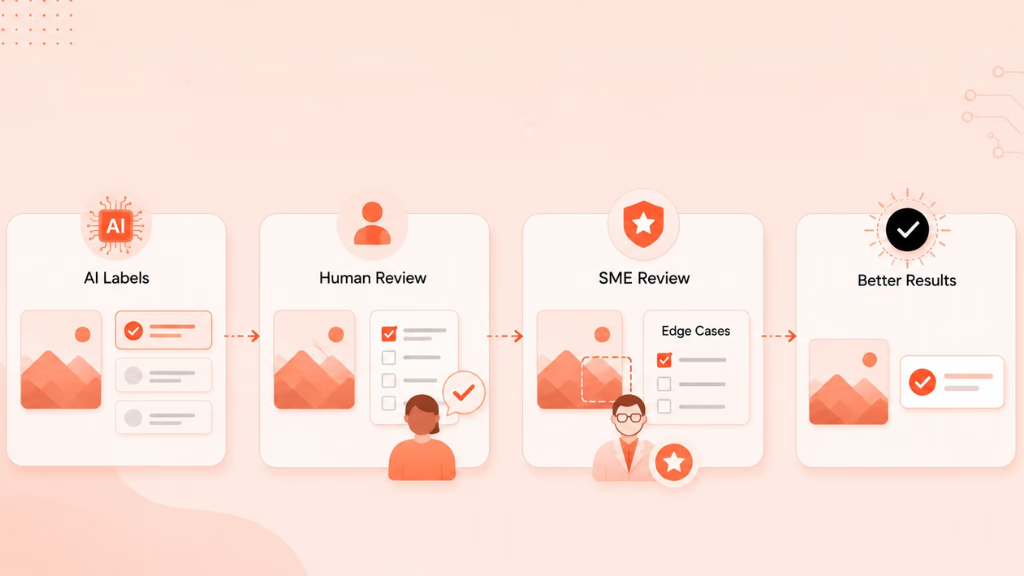
Many think full automation is the end goal. In my experience, the best results come from keeping humans in the loop, especially for complex or regulated domains.
Human-in-the-loop means people supervise, check, and improve machine-labeled data. General annotators handle routine cases. SMEs step in for tough, rare, or high-impact examples.
Quick comparison:
| Role | Typical Tasks | Where Used |
| General annotator | Review, accept, or edit suggestions | Bulk annotation, first pass |
| Subject Matter Expert | Define rules, review edge or critical | Medicine, defense, compliance |
SME input controls for subtle mistakes the model or juniors miss. For example, in healthcare labeling, specialists mark ambiguous scans that junior annotators would misclassify. In defense, SMEs decide on sensitive labels where security protocols apply.
This is where many teams struggle—a lack of SME time stalls projects. A better approach is to batch only the most uncertain or mission-critical samples to SMEs, freeing them from routine labor.
What Are the Top AI-Assisted Data Labeling Tools & Platforms in 2026?
Picking the right tool is critical. In 2026, several platforms and service providers stand out for combining automation, human review, and flexible AI data workflows.
| Platform/Provider | Automation | Human-in-the-loop | Data Types | Foundation Model Support | Integration/API | Best For |
|---|---|---|---|---|---|---|
| Riseup Labs | Yes | Yes | Images, video, text, audio | Yes | Custom | Managed annotation, enterprise scaling |
| Label Studio | Yes | Yes | Images, text, audio, video | Yes | Strong | Open-source, dev teams |
| Encord | Yes | Yes | Vision, medical, video | Yes | Good | Enterprise, healthcare |
| SuperAnnotate | Yes | Yes | Vision, video, text | Yes | Good | Enterprise, SMEs |
| Roboflow | Yes | Yes | Vision, audio | Yes | Very strong | Computer vision, startups |
| Clarifai | Yes | Yes | Vision, audio, text | Yes | Good | Enterprise, verticals |
| Custom/OSS | Varies | Varies | Any, depending on setup | Limited/DIY | Varies | Highly custom needs |
Riseup Labs stands out for businesses that want managed AI data annotation rather than handling the entire labeling process internally. It combines automation-assisted workflows with human review across image, video, text, and audio data, making it suitable for large-scale and enterprise AI projects.
Most leading tools also support AI label suggestions, batch reviews, quality checks, active learning, and integrations with foundation models. The best option depends on your data type, compliance needs, project scale, and how much control you want over the labeling workflow.
How Is AI-Assisted Data Labeling Used Across Industries? (Use Case Breakdown)
AI-assisted data labeling powers many sectors by making large, accurate datasets possible with less manual effort. Based on recent project data and client stories, here is where I see it delivering the most value.
| Industry | Main Use Case | Impact |
| Healthcare | Medical image, diagnostic annotation | Higher diagnosis accuracy, audit trail |
| Agriculture | Plant/crop health monitoring | Faster yield forecasts, large-scale data |
| Manufacturing | Defect detection on assembly lines | Lower product failure, more automation |
| Defense | Signal/image analysis, secure workflows | Improved situational awareness, compliance |
| Financial/NLP | Transaction or document tagging | Faster KYC, better fraud detection |
| Audio/NLP | Speech-to-text, sentiment analysis | More accessible, scalable NLP |
For example, in manufacturing, using AI-assisted data labeling to flag defects on production lines reduced manual review time by 60 percent, according to internal reports from several leading factories in 2026.
9 Best Practices for Successful AI-Assisted Data Labeling Projects
Putting the right workflow in place is as important as picking the right tool. I have seen these nine practices determine success or failure for AI-assisted data labeling projects.
Follow these steps to avoid common pitfalls:
- Define clear annotation guidelines before labeling starts.
- Select the right tool or platform for your project’s data and compliance needs.
- Implement human review at critical steps to catch AI errors.
- Prioritize data security and compliance in both tool and process.
- Route complex or high-impact cases to SMEs, not just general annotators.
- Use automation and active learning for high-volume, low-complexity labels.
- Audit samples regularly to monitor and keep quality on track.
- Integrate data annotation tightly with model training cycles for continual improvement.
- Document and update workflow based on feedback and changing goals.
Teams that master these avoid the cost, quality, and morale issues I often see in the field.
What’s Next? Future Trends in AI-Assisted Data Labeling (2026 & Beyond)
AI-assisted data labeling keeps evolving fast. Staying aware of trends means you will not fall behind in model performance or tooling.
Key trends for 2026 and beyond:
- Foundation models like SAM and OWLv2: Enable almost zero-shot, one-click labeling for new data types.
- AI-powered QA/QC: Smart systems flag or auto-repair obvious label errors before humans see them.
- Low-touch annotation: Fewer clicks, more “accept or correct” workflows.
- Generative AI for labeling: Large language models (LLMs) power text and complex sequence annotation.
- SMEs as augmented reviewers: AI helps, not replaces, experts by pre-filtering tough edge cases.
- Predicted ROI gains: Industry reports show cost per 1,000 labels dropping another 20 percent over the next two years as tools mature.
As one data labeling lead put it, “AI is now good enough to do the first 90 percent—SMEs just need to unlock the last 10 percent much faster.”
Common Mistakes When Implementing AI-Assisted Data Labeling
Rushing in without a plan or clear policy is a mistake I see frequently. Another risk is underestimating the ongoing need for quality checks and human review.
Pitfalls include:
- Not defining annotation rules up front
- Relying solely on automation, ignoring audit cycles
- Skipping SME review for high-risk data
- Failing to evaluate tool API integration
- Not preparing staff for workflow changes
Clarify roles, keep continuous feedback, and use transparent metrics to spot issues before they grow.
Why Work with Riseup Labs for AI-Assisted Data Labeling Projects
If you need to launch, audit, or scale AI-assisted data labeling, Riseup Labs can help. Our team specializes in custom workflows, tool configuration, and connecting domain experts with advanced automation.
We offer:
- Workflow planning, tool selection, and team setup
- SME access for edge-case review in regulated industries
- Support for integration with machine learning pipelines
Get critical projects moving faster and with more confidence.
Conclusion
AI-assisted data labeling now sits at the heart of effective, scalable AI solutions. Bringing together automated machine labeling with targeted human review solves for both speed and accuracy, delivering real business impact.
The key takeaways:
- Hybrid, human-in-the-loop workflows provide the best mix of precision and efficiency
- Foundation models and strong tools make high-quality annotation possible at scale
- Best practices and SME involvement keep quality on track
Consider your data needs, team skill, and integration points before choosing a tool or vendor. Use checklists and audits to avoid classic failures.
To start, compare leading platforms, outline a workflow, and reach out to trusted partners like Riseup Labs for expert support. The future of AI is built on well-labeled data—get it right, and your AI models will deliver real value.
Frequently Asked Questions about AI-Assisted Data Labeling
What is AI-assisted data labeling?
AI-assisted data labeling uses AI to suggest data labels, then humans review and correct them. This hybrid process speeds up annotation and improves accuracy for AI model training.
How does AI-assisted data labeling differ from manual or automated labeling?
Manual labeling relies only on humans, automated labeling uses machines alone. AI-assisted combines both, so AI suggests labels and humans review for quality.
What are the main tools used for AI-assisted data labeling in 2026?
Top tools include Label Studio, Encord, SuperAnnotate, Roboflow, and Clarifai. These support AI suggestions, human review, and integration with modern machine learning workflows.
What are the benefits of AI-assisted data labeling?
Key benefits include lower costs, faster annotation, higher label quality, better scalability, and more effective use of subject matter experts.
What challenges should organizations expect when using AI-assisted labeling?
Challenges include quality drift, bias, data privacy risks, complex integration, and potential annotator fatigue. These can be managed with the right best practices.
How are subject matter experts involved in AI-assisted data labeling?
SMEs define annotation rules, review tricky or critical cases, and audit outputs. Their input ensures accuracy in specialized or regulated domains.
What role do foundation models play in modern data labeling workflows?
Foundation models like SAM offer near zero-shot or “one-click” labeling for new, complex data, saving time and raising the baseline for annotation quality.
Which industries benefit most from AI-assisted data labeling?
Industries with large or complex datasets—like healthcare, agriculture, manufacturing, defense, and NLP tasks—see major gains in speed and quality.
How can organizations maintain quality and security in AI data labeling?
Set clear guidelines, use strong tools with audit and security features, conduct regular reviews, and route sensitive data to controlled workflows.
What are the latest trends in AI-assisted data labeling?
Emerging trends include foundation model integration, AI-powered QA, low-touch annotation interfaces, and expanded SME roles supported by machine learning.
This page was last edited on 19 August 2026, at 10:46 am

Start a conversation with our team to solve complex challenges and move forward with confidence.