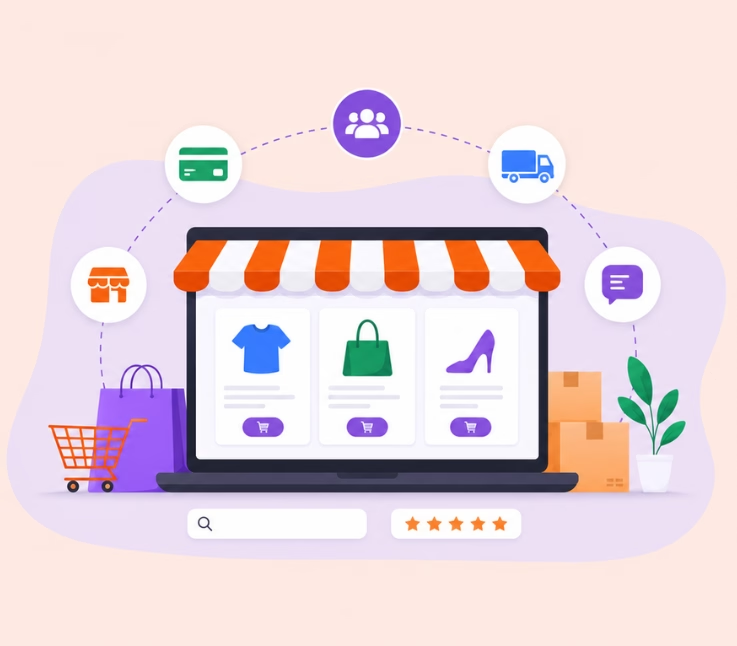
To create an online marketplace in 2026: validate your idea, choose a business model, select a platform, build an MVP, set up payments and compliance, onboard users, launch, and refine using real data.
Building an online marketplace is one of the most complex projects any founder or product lead will tackle. I have seen teams move too fast, invest in the wrong tech, or get tangled in regulations.
The real issue is not just launching. It’s connecting sellers and buyers, ensuring safe payments, and scaling without losing trust. Most teams miss a critical step early on.
This article lays out a step-by-step plan for launching an online marketplace in 2026. Every section is built for founders, SaaS operators, and business managers who want real answers, not just theory. You’ll leave with actionable steps, current platform advice, legal essentials, and pro tips learned the hard way.
What Is an Online Marketplace, and How Is It Different From E-commerce?
An online marketplace is a digital platform that connects multiple sellers and buyers, allowing transactions between them. You act as the facilitator, not just a single store.
In my experience, confusion often starts here. Unlike standard e-commerce, where a store sells products directly, a marketplace is two-sided. Sellers join, list products or services, and buyers choose between different vendors. The platform handles payments, trust, and sometimes logistics.
Key attributes of online marketplaces:
- Multi-sided: enables seller-buyer relationships
- Seller onboarding: anyone can register, pending approval
- Payment split: money flows to sellers minus platform fees
- Types: product (Etsy), service (Upwork), rental (Airbnb), digital goods
| Feature | Online Marketplace | Single-Vendor E-commerce |
| Sellers | Many | One |
| Buyers | Many | Many |
| Platform Role | Facilitator | Merchant |
| Payment Processing | Multi-sided/split | Direct |
Airbnb, Sharetribe, and Upwork are real-world examples. If your goal is to connect multiple sellers with many buyers, a marketplace model fits.
Why Building an Online Marketplace Is the Next Big Opportunity
The global digital-commerce sector continues to grow rapidly. Grand View Research estimates that the worldwide B2C e-commerce market will reach $8.5 trillion in 2026, rising from $7.2 trillion in 2025. Marketplace models are increasingly used across product sales, professional services, rentals, and peer-to-peer transactions.
A marketplace enjoys the “network effect.” As you add sellers and buyers, value grows. This is why companies like Etsy and Upwork have strong moats. Yet, it gets complicated. You have to handle compliance, trust, tech scaling, and two-sided operations.
This guide delivers a clear blueprint for building and scaling a marketplace. Expect practical steps, platform insights, expert anecdotes, and relevant 2026 trends. You’ll find what most guides miss: real-world validation, payment/legal details, and how to avoid classic mistakes.
Steps to Create an Online Marketplace in 2026
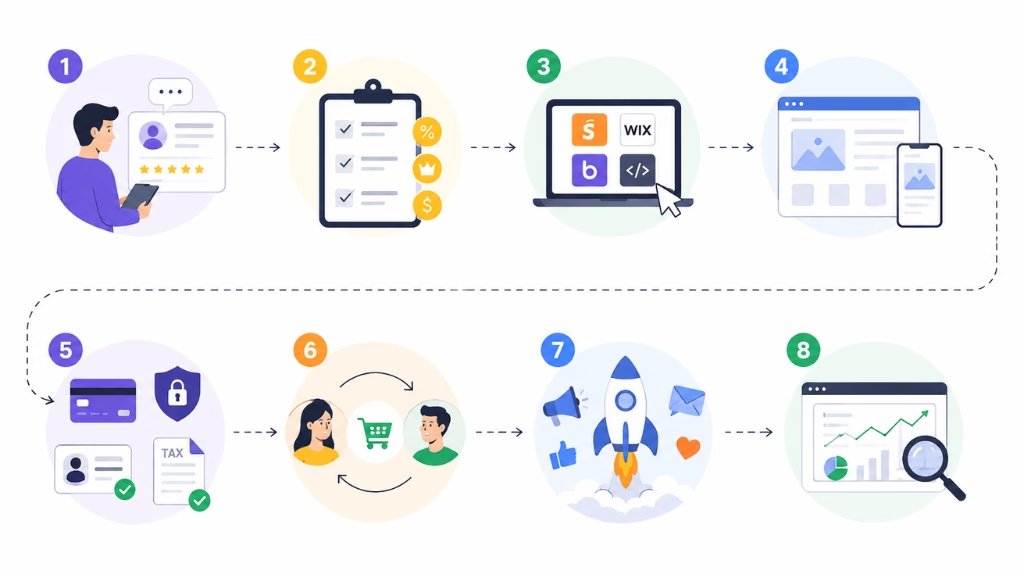
Launching a marketplace requires a repeatable, proven process. Here’s the sequence many successful founders—and our own clients—follow:
- Validate your marketplace idea with real users.
- Choose your business model (commission, subscription, listing).
- Select your marketplace platform (Sharetribe, Wix, custom, etc.).
- Build a minimum viable product (MVP), using no-code/low-code or developers.
- Set up payment processing and ensure compliance (KYC, tax, GDPR).
- Onboard both sellers and buyers—avoid the “chicken and egg” trap.
- Launch and market your platform to attract users.
- Iterate and scale using user data and feedback.
Each step below breaks down what, why, and—critically—how to make the right choice for your business.
Marketplace Types and Business Models: Which Fits Your Idea Best?
Defining your marketplace’s type and business model early on avoids costly pivots. Different structures suit different audiences, industries, and monetization goals.
Marketplaces are not all the same. Each comes with its own risks and growth levers. You need clarity on the best fit before selecting technology or onboarding sellers.
Marketplace Types and Structures
There are several main models for online marketplaces. Each targets specific use cases.
| Type | Buyers | Sellers | Examples | Best For |
| B2C | Consumers | Businesses | Etsy, Amazon | Products |
| C2C | Consumers | Consumers | eBay, Vinted | Resale, Rentals |
| B2B | Businesses | Businesses | Alibaba | Wholesale, SaaS |
| Vertical | Niche Audience | Niche Sellers | 1stDibs | Specific sectors |
| Horizontal | Broad Audience | Many Sellers | Craigslist | Multi-category |
In my view, vertical marketplaces work best when you have deep knowledge of an industry and can offer tailored features. Horizontal marketplaces suit broader markets but require more resources to compete.
Marketplace Business Models: Pros, Cons, 2026 Trends
Choosing a monetization model shapes revenue, growth, and operations.
| Model | How it Works | Pros | Cons | Example |
| Commission | % per transaction | Scales with use | Complex payment split | Airbnb, Upwork |
| Subscription | Monthly/yearly access | Predictable cashflow | Can deter new users | Sharetribe Flex |
| Listing Fee | Pay to list item | Simple upfront revenue | May slow marketplace | eBay Classic |
| Hybrid | Combo of above | Blends revenue styles | Complex to manage | Upwork Pro |
Recent years have brought new trends: AI-powered features, micro-commissions, and decentralized marketplaces using blockchain for trustless transactions.
Commission vs. Subscription vs. Listing Fees: How to Decide
Your business model should match your target audience’s needs and willingness to pay.
- Commission works best when users value trust and volume. Examples include Airbnb or service platforms.
- Subscription is better for professional users or SaaS-style tools, such as curated job boards.
- Listing fees suit marketplaces with high turnover, such as classifieds.
A mistake I see often is trying to stack every fee type early. Start simple, then expand as you scale.
How to Build, Launch, and Grow Your Online Marketplace in 2026
Creating a marketplace is a journey. Each stage has pitfalls, but also proven shortcuts. Here’s the full process I recommend:
Step 1: Validate Your Marketplace Idea and Audience
Before building anything, make sure people actually want what you plan to offer. Many founders skip this—and regret it.
Talk to potential buyers and sellers. Use surveys, interviews, and run a basic pilot. Validation hacks for 2026 include launching a simple landing page or running small paid ads to collect sign-ups. Tools like Airtable, Typeform, and Figma prototypes help gather quick feedback before full development.
In my experience, three honest conversations with real users will save you months of wasted work.
Step 2: Choose the Right Business Model and Monetization Structure
Clarity on your business model is a foundation for your tech and pricing. Review your audience. Will they prefer to pay per use or for unlimited access?
Map your target users to the right model using a pros-cons chart or flowchart. Hybrid models are popular now: for example, charging a commission on transactions plus an optional subscription for premium exposure.
The mistake I see often is copying another marketplace’s model without considering your own vertical’s specifics. Think about your path to profit from day one.
Step 3: Compare and Select a Marketplace Platform (2026 Edition)
Tech choices matter early. The wrong platform can set you back months, or worse, force a rebuild. Review live platforms and see what features are essential.
Here’s a 2026 comparison of top marketplace platforms:
| Platform | Type | Cost | Scalability | Customization | Best For |
| Sharetribe | No-code | $ | High | Moderate | Rapid MVP/prototyping |
| Wix | No-code | $$ | Medium | Low | Small catalogs |
| Softr | No-code | $ | Limited | High | Digital services |
| Custom Code | Developer | $$$ | Highest | Complete | Mature platforms |
Most new teams start no-code, using Sharetribe or Wix to test the MVP. As you grow, moving to custom code or an agency helps scale and tailor features.
Step 4: Build Your Marketplace MVP (No-Code, Low-Code, or Custom Development)
When it’s time to build, focus on the minimum features needed for users to transact safely. Tools in 2026 make this faster—no-code platforms, low-code tools, or agencies.
A basic MVP should include:
- User registration (buyers, sellers)
- Listings
- Messaging or communication
- Payment integration
- Reviews or ratings
Don’t build everything at once. In my POV, launching fast with about 80% of planned features has higher odds of success. Wireframes in Figma or Miro help clarify the user flow before you code.
Step 5: Integrate Payments and Ensure Global Compliance
Handling payments on a marketplace is complex. You’re moving money between third parties and must keep everything legal.
Payment gateways like Stripe Connect, PayPal Adaptive, Mangopay, and Adyen offer global payouts, KYC, and anti-fraud in 2026. Stripe Connect remains the industry standard for split payments and regulatory compliance.
Compliance checks depend on your region, but every marketplace must:
- Verify sellers (KYC/AML)
- Collect/submit tax info where required (Marketplace Facilitator Laws)
- Protect user data (GDPR for EU, CCPA for California, etc.)
A basic compliance checklist:
- Choose a gateway supporting your key countries
- Set up automated KYC for sellers
- Ensure GDPR-compliant data storage
- Create tax reporting workflow
I have seen payment holds wreck early cash flow. Always test payment flows and compliance automations before launch.
Step 6: Onboard Sellers and Buyers—Solving the “Chicken and Egg” Problem
No sellers means no buyers, and vice versa. This “chicken and egg” issue is notorious. The better approach is to focus on a small core group of either sellers or buyers, then invite the other side.
Early onboarding hacks:
- Find 5-10 “anchor” sellers—offer free listings or reduced commission
- Partner with established sellers or local groups
- Use incentives for first buyers (discounts, referral rewards)
- Automate onboarding using chatbots and easy sign-ups
For service marketplaces, I’ve seen success with local events and direct outreach to professionals. For product marketplaces, co-marketing with micro-influencers helps.
Step 7: Launch and Market Your Online Marketplace
Going live is only the start. Prepare a launch checklist:
- Launch a landing page and start an email list early
- Set up press outreach and key partnerships
- Spend on paid ads for first users
- Run influencer or co-marketing campaigns
Scaling from your first 100 to 1,000 users will reveal weak points. Use analytics tools to see what works and double down. In 2026, AI helpers and automated social posts speed up initial traction.
Step 8: Iterate, Scale, and Optimize Based on User Data
The job isn’t done at launch. Use your platform analytics to track successful features versus what gets ignored. Talk to users. Optimize onboarding, fix friction, and add features based on real needs.
As you scale, watch for:
- Tech bottlenecks—system can’t handle load
- Supply/demand mismatch (too many sellers, not enough buyers)
- New compliance rules as you enter new countries
Scaling in 2026 means using AI for personalization, localized payouts, and growth experiments. At this stage, consider bringing on partners or funds only after you’ve shown traction.
Legal, Compliance, and Payment Issues: What You Must Know (2026)
Legal compliance makes or breaks online marketplaces. I’ve seen founders face payment freezes or fines when neglecting key rules.
You’re often considered a “marketplace facilitator” (especially in the US/EU), which means you have legal obligations such as:
- Collecting/remitting sales tax where required
- Verifying sellers meet KYC/AML (Identity verification, anti-money laundering)
- Following data privacy laws, like GDPR or CCPA
Payments get held up most when you use a gateway that doesn’t fit your region or seller type. Always consult a compliance specialist as you scale to new countries.
Quick checklist:
- Use payment providers that offer marketplace accounts and KYC
- Set up clear terms of service and privacy policy
- Store only necessary data, encrypted, and comply with data subject requests
- Get expert advice when expanding globally
In my experience, solving compliance before launch builds long-term trust with users and payment partners.
Marketplace Success Stories and Lessons Learned (2026 Edition)
Looking at real success stories helps make the process tangible. Here are concise examples based on my work and recent industry benchmarks.
Case 1: Product Marketplace
A niche craft platform used Sharetribe to launch. The founder validated with 15 local artisans in 30 days, went live in two months, and reached 500 buyers in the first quarter. Quick seller response: “Fewer features, but sales started right away.”
Case 2: Service Marketplace
A legal tech market built an MVP in 60 days using custom code, solved compliance using Stripe Connect, and offered free initial listings. Growth was slow until they formed a partnership with a local bar association.
Early focus (vertical + strong anchor sellers) wins. Complex builds slow launch, but compliance handled up front avoids headaches later.
From my POV, listening to seller and buyer complaints post-launch is where 80% of optimization comes from.
Pitfalls, Mistakes, and Pro Tips for Marketplace Founders
The biggest marketplace failures I’ve seen trace back to a few classic mistakes. Here’s what to avoid:
- Skipping validation before building
- Choosing a platform that can’t scale or lacks support
- Ignoring payment or regional compliance
- Overcomplicating the business model early on
- Focusing too much on one side (supply/buyer) and neglecting the other
- Not automating onboarding or support as users grow
Pro Tips:
- Interview at least five real users before launch
- Run live payment tests before announcing your platform
- Stay lean—add features only based on live user feedback
- Join startup forums or Reddit for practical, current advice
In my experience, acting on user data and being honest about flaws is what sets apart the winners.
How Riseup Labs Can Help Build Your Online Marketplace
I see many founders hit a wall when scaling beyond MVP. Need expert help to build a secure, compliant, and scalable marketplace?
Riseup Labs works with founders and SaaS teams to:
- Audit your marketplace idea
- Set up custom or no-code builds
- Review compliance and payment flows
- Guide onboarding and data-driven growth
If you need a tech partner for launch or a roadmap review, contact Riseup Labs for an expert assessment.
Conclusion
Building an online marketplace in 2026 is both a challenge and an opportunity. Start by validating with real users, pick the right business model for your audience, and select the platform that matches your goals. Compliance and smooth payments are not optional.
I have seen most founders fail by skipping steps or scaling too soon. You now have a blueprint built from live case studies, platform trends, and the realities of 2026 compliance.
If you want a full checklist or wish to discuss your roadmap with experts who have seen marketplace issues firsthand, consider working with teams like Riseup Labs.
The future of online marketplaces is data-driven and AI-assisted, but success still depends on strong planning and expert partnership. Take action today, build right, and position your platform to thrive.
FAQs
What are the steps to create an online marketplace in 2026?
Validate your idea, choose a business model, pick a platform, build an MVP, set up payments and compliance, onboard users, launch, and refine based on data.
Do I need programming skills to launch a marketplace?
No, many platforms in 2026 let you build a marketplace with no-code or low-code tools. Coding is only needed for deep customization or scaling.
What platform/software is best for marketplaces in 2026?
Top options include Sharetribe, Wix, and Softr for no-code; custom development for advanced needs. Choose based on features, support, and scale.
How much does it cost to build a marketplace?
Costs vary. No-code MVPs start at a few hundred dollars a month; custom builds can reach tens of thousands depending on features and complexity.
How do you process payments in a multi-vendor marketplace?
Use payment gateways like Stripe Connect or Mangopay. These platforms split payments, handle KYC/AML, and ensure sellers get paid securely.
What’s the ‘chicken-and-egg’ problem, and how do I solve it?
It refers to needing both sellers and buyers when starting. Start by focusing on one group, offer incentives, and build momentum before scaling.
What are the key legal and compliance challenges?
Key challenges include KYC/AML checks, marketplace facilitator tax laws, data privacy (GDPR, CCPA), and choosing the right payment gateway.
What’s the difference between a marketplace and a regular e-commerce store?
Marketplaces connect multiple sellers and buyers; e-commerce stores have a single seller. Marketplaces require split payments and compliance.
Can I use no-code tools to build my platform?
Yes, in 2026 no-code tools like Sharetribe and Softr let you launch and manage a marketplace without custom coding.
What are the biggest mistakes new marketplace founders make?
Skipping market validation, choosing the wrong tech, ignoring compliance, neglecting user onboarding, and scaling before finding product-market fit.
This page was last edited on 16 July 2026, at 2:48 pm

Start a conversation with our team to solve complex challenges and move forward with confidence.