
Quick Answer: To find a tech partner to develop a product, define your product goals, outline the MVP, identify required technical skills, shortlist experienced development teams, review portfolios, check industry expertise, compare communication styles, discuss pricing and ownership, run discovery calls, and start with a small pilot before committing to full development.
A strong product idea can still fail when the wrong team builds it.
Many founders do not struggle because they lack vision. They struggle because they choose a development partner too quickly, start building without a clear MVP, or work with a team that only follows instructions instead of helping shape the product.
That is why knowing how to find a tech partner to develop a product matters. The right partner helps you turn an idea into a practical roadmap, choose the right features, avoid costly technical mistakes, and build a product that can grow after launch.
This is especially important because software projects often face budget and delivery problems. McKinsey found that large IT projects run 45% over budget, 7% over time, and deliver 56% less value than expected on average.
For non-technical founders, the best tech partner is not just a coding team. It is a product development partner that understands strategy, communication, scalability, and long-term business goals.
What Is A Tech Partner In Product Development?
A tech partner is a person, team, or company that helps you plan, build, launch, and improve your digital product.
This partner may be a technical cofounder, CTO, software development agency, freelancer, or dedicated development team. The right option depends on your product stage, budget, technical complexity, and long-term business goals.
A tech partner can help with:
- Product discovery
- MVP planning
- UI/UX design
- Software architecture
- Web or mobile app development
- API integrations
- Cloud setup
- Testing and quality assurance
- Security planning
- Product launch
- Maintenance and scaling
A good tech partner does not just ask what features you want. They help you understand what should be built first, what can wait, what may increase cost, and what technical risks should be solved early.
Why Finding The Right Tech Partner Matters
Choosing a tech partner is one of the most important early product decisions.
The wrong partner may build too many features, choose the wrong technology, miss deadlines, communicate poorly, or leave behind code that becomes expensive to maintain.
The right partner helps you:
- Build the right MVP
- Avoid unnecessary features
- Estimate cost more accurately
- Choose a scalable technology stack
- Reduce technical debt
- Test the product before launch
- Improve the product after user feedback
- Protect your time and budget
The right software development partner affects how quickly a business can execute, how consistently it can deliver, and how confidently it can scale.
This means the decision is not only about coding skills. It is about trust, communication, product judgment, and long-term execution.
Types Of Tech Partners You Can Choose
Before searching, you need to understand the main partner options. Each one fits a different business situation.
| Partner Type | Best For | Main Benefit | Main Risk |
|---|---|---|---|
| Technical Cofounder | Long-term startup building | Deep commitment and ownership | Hard to find and requires equity |
| CTO Or Fractional CTO | Technical strategy and leadership | Senior guidance without hiring a full team | May not handle daily development |
| Development Agency | MVP or full product development | Full team, structured process, faster start | Higher cost than freelancers |
| Freelancer | Small tasks or prototypes | Flexible and affordable | Limited capacity and higher dependency |
| Dedicated Development Team | Ongoing product development | Scalable team extension | Requires strong management |
| No-Code Or Low-Code Partner | Early idea testing | Fast MVP validation | May limit future scalability |
The best choice depends on your budget, product complexity, timeline, and how much technical ownership you need.
Step-By-Step Process To Find A Tech Partner To Develop A Product
Finding a tech partner should not start with sending random messages to developers. It should follow a clear process.
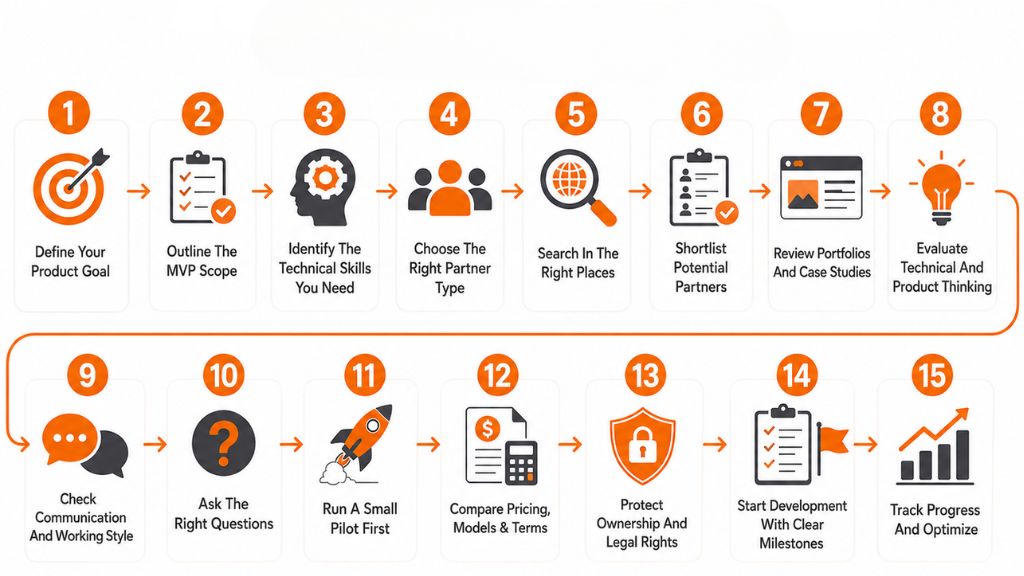
These steps help you move from a product idea to a confident partner decision.
Step 1: Define Your Product Goal
Start by explaining what your product should achieve.
Write down:
- The problem your product solves
- Who the target users are
- What users will do inside the product
- What business outcome you expect
- What makes the product useful
- What success looks like after launch
This helps potential tech partners understand the product beyond the feature list.
For example, “I want to build a booking app” is too vague. A better version is: “I want to build a booking platform for local service providers where customers can compare availability, book appointments, pay online, and receive reminders.”
That level of clarity leads to better conversations and more accurate estimates.
Step 2: Outline The MVP Scope
Your MVP should include only the features needed to test the product with real users.
A strong MVP scope separates must-have features from nice-to-have features. Arbisoft’s MVP partner guide highlights the importance of choosing a technology partner that can build fast while keeping the product secure, scalable, and ready for future growth.
Your MVP scope should include:
- Core user journey
- Essential user features
- Basic admin features
- Login or account setup if needed
- Payment features if needed
- Notifications if needed
- Analytics or tracking
- Security requirements
- Launch success metrics
Avoid adding every idea to the first version. A bloated MVP costs more, takes longer, and delays real feedback.
Step 3: Identify The Technical Skills You Need
Different products need different technical skills.
A SaaS platform may need front-end, back-end, cloud, database, and subscription billing experience. A mobile app may need iOS, Android, API, and push notification expertise. An AI product may need data handling, model integration, prompt design, and security planning.
Common technical skills include:
- Front-end development
- Back-end development
- Mobile app development
- UI/UX design
- API development
- Database design
- Cloud architecture
- DevOps
- Security
- QA testing
- AI or machine learning
- Payment integration
- Analytics setup
You do not need to know every tool. But you should understand the type of product you are building so you can choose a partner with relevant experience.
Step 4: Choose The Right Partner Type
Once you understand your product goal and technical needs, decide which partner type fits best.
Use this guide:
| Your Situation | Best Partner Type |
|---|---|
| You need long-term technical leadership | Technical cofounder or CTO |
| You need to build an MVP quickly | Development agency |
| You need a small prototype | Freelancer |
| You need ongoing product updates | Dedicated development team |
| You need strategy before development | Fractional CTO |
| You need to test the idea cheaply | No-code or low-code partner |
Fast Company advises companies to scope the problem before designing the team, because building the wrong team around an unclear problem can create poor delivery decisions.
This means you should not hire first and plan later. Plan first, then choose the partner model.
Step 5: Search In The Right Places
Where you search depends on the type of partner you need.
Good places to find tech partners include:
- Personal referrals
- Startup communities
- Founder groups
- Accelerators
- Hackathons
- Tech meetups
- Freelance platforms
- Agency directories
- Product development communities
- Investor or mentor referrals
Start with warm referrals when possible. A recommended partner with proven work is often safer than a random cold search.
For LinkedIn, search terms like:
- tech partner for startup
- product development partner
- MVP development company
- software development agency
- technical cofounder
- startup CTO
- SaaS development partner
Step 6: Shortlist Potential Partners
After searching, create a shortlist of 5 to 10 potential partners.
Review each partner based on:
- Relevant experience
- Portfolio quality
- Product type
- Industry knowledge
- Technical skills
- Communication style
- Team size
- Pricing model
- Time zone fit
- Reviews or references
- Security awareness
- Post-launch support
Do not choose only by price. The cheapest team may become expensive if the product needs to be rebuilt later.
Step 7: Review Portfolios And Case Studies
A portfolio shows what the partner has built before.
Look for projects similar to your product in:
- Industry
- Platform
- Feature complexity
- User experience
- Integrations
- Technical depth
- Design quality
- Business model
Ask:
- Have they built products from scratch?
- Have they worked with startups?
- Have they built MVPs?
- Did they handle design, development, and testing?
- Can they explain why they made certain product decisions?
- Did they support the product after launch?
A strong portfolio should show thinking, not just screenshots.
Step 8: Evaluate Technical And Product Thinking
A good tech partner should be able to explain technical decisions in simple language.
Ask questions like:
- What tech stack would you recommend and why?
- What are the biggest technical risks?
- What features should be in the MVP?
- What features should wait?
- How would you handle user growth?
- How would you manage security?
- How would you test the product?
- What could increase the cost?
- What information do you need before starting?
The best partners do not just agree with everything. They challenge unclear ideas and explain trade-offs.
Step 9: Check Communication And Working Style
Product development requires constant decisions. Communication matters as much as coding ability.
Look for:
- Clear answers
- Fast response time
- Honest feedback
- Simple explanations
- Written documentation
- Structured meeting process
- Realistic expectations
- Respect for deadlines
- Ability to discuss problems openly
If communication is weak during early calls, it will likely become worse during development.
Step 10: Ask The Right Questions Before Hiring
Discovery calls should help you test fit, not just hear a sales pitch.
Ask:
- Have you built a similar product before?
- Who will work on the project?
- What is your development process?
- How do you estimate cost and timeline?
- How do you handle scope changes?
- How do you manage delays?
- How often will we get updates?
- What tools do you use?
- How do you test quality?
- How do you handle security?
- Who owns the source code?
- What happens after launch?
- Can we speak with past clients?
- Can we start with a pilot?
A reliable partner should answer clearly and transparently.
Step 11: Run A Small Pilot First
Before committing to full development, start with a small paid pilot.
A pilot can include:
- Product discovery
- MVP scope document
- Wireframes
- Clickable prototype
- Technical feasibility review
- Architecture plan
- One core feature
- Code audit
- Small integration
This helps you test quality, speed, communication, and reliability before making a larger investment.
A pilot also gives both sides a chance to see whether the working relationship is a good fit.
Step 12: Compare Pricing Models Carefully
Tech partners may charge in different ways.
| Pricing Model | How It Works | Best For |
|---|---|---|
| Fixed Price | One price for a defined scope | Clear MVP or small project |
| Time And Materials | Pay based on hours worked | Flexible or evolving products |
| Dedicated Team | Monthly cost for assigned developers | Ongoing development |
| Equity-Based | Partner receives ownership instead of full payment | Cofounder relationship |
| Hybrid | Lower cash plus equity or revenue share | Early startups with limited budget |
A good estimate should explain:
- What is included
- What is not included
- Timeline assumptions
- Team structure
- Payment milestones
- Maintenance cost
- Change request process
- Risk areas
Avoid vague estimates that do not explain scope and assumptions.
Step 13: Protect IP, Ownership, And Legal Rights
Before development starts, ownership must be clear.
Important documents include:
- Service agreement
- Scope of work
- NDA if needed
- IP assignment agreement
- Source code ownership clause
- Payment terms
- Confidentiality terms
- Data protection terms
- Maintenance agreement
- Termination clause
For cofounders, also consider:
- Founder agreement
- Equity split
- Vesting schedule
- Role responsibilities
- Decision-making rights
- Exit terms
Do not rely on verbal promises. Put ownership, source code rights, design files, and product assets in writing.
Step 14: Set Up A Clear Collaboration Process
Even a strong tech partner needs a clear process.
Define:
- Weekly meetings
- Project management tool
- Communication channel
- Sprint schedule
- Demo process
- Feedback process
- Testing process
- File sharing
- Approval rules
- Launch checklist
- Bug reporting
- Post-launch support
Common tools include Slack, Microsoft Teams, Jira, Trello, Asana, GitHub, GitLab, Figma, Notion, Google Drive, and ClickUp.
Clear collaboration prevents confusion and keeps the project moving.
Step 15: Track Progress With The Right Metrics
Do not measure progress only by how busy the team seems.
Track:
- Completed milestones
- Sprint delivery
- Feature acceptance
- Bug count
- Timeline status
- Budget used
- Scope changes
- QA results
- User feedback
- Launch readiness
For MVPs, also track:
- Signups
- Activation rate
- User retention
- Conversion rate
- Feature usage
- Support requests
- Customer feedback
The goal is not only to ship software. The goal is to build something useful, stable, and ready for improvement.
Technical Cofounder Vs. CTO Vs. Agency Vs. Freelancer
Different founders need different types of partners. Choosing the wrong model can slow development or create avoidable conflict.
Technical Cofounder
A technical cofounder is best when technology is central to the business and you need someone committed for the long term.
Choose a technical cofounder if:
- You need long-term technical ownership
- You are building a product-led startup
- You want someone involved in strategy
- You are willing to share equity
- You need investor confidence in the founding team
Y Combinator offers a co-founder matching platform for founders who are actively looking for a cofounder, showing how common this need is for early-stage startups.
CTO Or Fractional CTO
A CTO or fractional CTO is useful when you need technical leadership but do not yet need a full development department.
Choose this option if:
- You need architecture guidance
- You need help hiring developers
- You need technical due diligence
- You need a roadmap before development
- You want senior-level advice without full-time hiring
Development Agency
A development agency is best when you need a full team to build the product.
Choose an agency if:
- You need to build an MVP quickly
- You need UI/UX, development, QA, and project management together
- You do not want to recruit developers yourself
- You have a defined budget and timeline
- You need structured delivery
A good agency can help you move faster, but you need to check their process, team quality, communication, and post-launch support.
Freelancer
A freelancer is best for smaller tasks, prototypes, bug fixes, or specific development needs.
Choose a freelancer if:
- Your scope is small
- You have a limited budget
- You need one specific skill
- You can manage the project closely
- You already understand the technical direction
Freelancers can be useful, but they may not be enough for complex products that need strategy, architecture, QA, integrations, and long-term maintenance.
When Do You Need A Tech Partner?
You need a tech partner when your product depends on technology, but you do not have the internal skills, team, or time to build it properly.
You may need a tech partner if:
- You are a non-technical founder
- You have a product idea but no development team
- You need to build an MVP
- You are unsure which technology stack to use
- You need help turning requirements into features
- Your current freelancer or team is not delivering
- You need a scalable product architecture
- You want to reduce risk before raising funds
- You need a team that can support the product after launch
This is especially important for SaaS platforms, mobile apps, marketplaces, ecommerce systems, AI tools, fintech products, healthcare platforms, and custom business software.
Common Mistakes Founders Make
Many founders repeat the same mistakes when choosing a tech partner.
Starting Without A Clear MVP
If the MVP is unclear, every partner will estimate differently. This creates confusion, scope creep, and budget problems.
Choosing Only By Price
Low cost can become expensive if the product is poorly built and needs to be rebuilt later.
Skipping Reference Checks
References help you understand how a partner handles deadlines, quality, communication, and problems.
Giving Equity Too Early
Do not give large equity before testing commitment, skills, and working style.
Ignoring IP Ownership
Make sure the company owns the code, designs, documentation, and product assets.
Not Planning For Maintenance
A product needs updates, bug fixes, hosting, security checks, and improvements after launch.
Conclusion
Finding the right tech partner is one of the most important decisions a founder can make before building a product.
The process should not start with hiring developers immediately. It should start with clarity. Define your product goal, outline the MVP, understand the skills you need, choose the right partner type, shortlist carefully, review past work, ask the right questions, and start with a small pilot before committing to full development.
The best tech partner is not simply the team that can write code. It is the team that understands your product goals, explains technical trade-offs, communicates clearly, protects your ownership, and helps you build the first version without creating unnecessary risk.
When you know how to find a tech partner to develop a product, you can move from idea to execution with more confidence, better planning, and fewer expensive mistakes.
FAQs About How To Find A Tech Partner To Develop A Product
What is a tech partner in product development?
A tech partner is a person, team, or company that helps plan, build, launch, and maintain a digital product. This may include a technical cofounder, CTO, software agency, freelancer, or dedicated development team.
How do I find a tech partner to develop a product?
To find a tech partner, define your product goals, create an MVP scope, identify required skills, search through referrals, LinkedIn, startup communities, freelance platforms, and agency directories, then vet each partner through calls, portfolios, references, and a small pilot project.
What should I look for in a tech partner?
Look for product understanding, relevant experience, technical skills, clear communication, transparent pricing, strong references, security awareness, QA process, and post-launch support.
Should I choose a technical cofounder or an agency?
Choose a technical cofounder if you need long-term technical leadership and are willing to share equity. Choose an agency if you need a structured team to build an MVP or product without hiring internally.
How do I know if a tech partner is reliable?
A reliable tech partner communicates clearly, gives realistic estimates, explains risks, shows relevant work, provides references, documents scope, and is transparent about pricing, ownership, and timelines.
Where can I find a technical cofounder?
You can find a technical cofounder through your network, startup events, founder communities, LinkedIn, hackathons, cofounder matching platforms, accelerators, and referrals from investors or mentors.
How much does a tech partner cost?
The cost depends on the partner type, product complexity, location, scope, and timeline. Freelancers may cost less for small tasks, while agencies and dedicated teams usually cost more but provide broader capabilities and structure.
Should I give equity to a tech partner?
Equity is usually appropriate for a true cofounder or long-term CTO, not for a standard vendor relationship. If you offer equity, use vesting and legal agreements to protect both sides.
Why is an MVP important before hiring a tech partner?
An MVP helps define the smallest useful version of your product. It reduces cost, shortens development time, and gives your tech partner a clearer scope to estimate, build, and test.
What legal documents do I need before product development?
Common documents include a service agreement, scope of work, NDA, IP assignment agreement, payment terms, data protection terms, and maintenance agreement. For cofounders, you may also need a founder agreement and vesting schedule.
What are red flags when hiring a tech partner?
Red flags include vague pricing, unrealistic promises, poor communication, no references, unclear ownership terms, weak portfolio, no QA process, and a partner who agrees to every request without challenging the scope.
Can I build a product with freelancers instead of a tech partner?
Yes, freelancers can help with prototypes, small features, or specific tasks. For complex products, you may need a more structured partner such as an agency, CTO, or dedicated development team.
This page was last edited on 9 July 2026, at 11:10 am

Start a conversation with our team to solve complex challenges and move forward with confidence.