- How Business Data Delays AI Implementation
- Assess Data Readiness Before AI Investment
- How Poor Data Readiness Drives Up AI Costs
- AI Data Readiness Checklist for Businesses
- Measure Your Business Data Readiness for AI
- Prioritize Data Problems Before AI Implementation
- Decide When to Fix Data or Start an AI Pilot
- Overcoming Data Challenges Before AI Adoption
A 2026 survey found that only 6% of organizations surveyed had enterprise data fully ready for AI at scale, highlighting a significant gap in AI implementation readiness.
Your business could be investing thousands in AI development while the real problem remains hidden in your existing data.
Customer records don’t match across systems. Your CRM holds outdated information. Critical operational data is missing. By the time these issues surface, your AI project is already over budget or behind schedule.
So, how can you tell whether your data will support your AI investment before spending on development?
A data readiness assessment for AI helps you spot these problems early and understand what needs fixing.
This guide covers how to evaluate your data, uncover costly gaps, estimate preparation expenses, and decide whether your business should fix its data first or start an AI pilot.
Why Does Business Data Become a Roadblock to AI Implementation?
I’ve seen that having large amounts of business data doesn’t always mean a company is ready for AI. You may have thousands of customer records, sales reports, and operational documents. But the real question is whether your AI system can access and use that information correctly.
One of the biggest challenges I notice is how businesses manage their data across different systems. Customer information sits in a CRM, transactions are stored in an ERP, and important documents remain scattered across spreadsheets or legacy applications. These data silos make it difficult for AI systems to access complete and consistent information.
Take an eCommerce business planning to automate customer support. Its AI agent may need customer details from the CRM and order updates from the ERP. If these systems aren’t connected, the agent could provide outdated information or fail to resolve customer requests.
From my perspective, five common data problems deserve attention before AI implementation:
- Poor data quality: Missing records, duplicate entries, and outdated information reduce data accuracy, completeness, and consistency. This can affect the reliability of AI responses.
- Disconnected business systems: CRM, ERP, and legacy applications may lack the APIs or data pipelines required for smooth data integration.
- Limited data accessibility: Important information may be stored in PDFs, spreadsheets, or restricted databases. AI systems need suitable formats and authorized access to use this information.
- Weak data governance: Unclear data ownership, poor access controls, and inadequate data security can expose businesses to compliance and operational risks.
- Inadequate data preparation: Inconsistent formats, unstructured records, and missing data validation can prevent AI applications from using business information effectively.
What concerns me most is that businesses often discover these issues after development has started. By then, fixing data readiness gaps can mean additional engineering costs, delayed deployment, and more manual work.
That’s why I consider a data readiness assessment for AI an important step before investing in development. It helps identify whether your existing data can support the intended AI application and which problems need attention first.
“I’ve found that the most expensive AI problems often start before development. A CRM that cannot share customer records or a knowledge base filled with outdated information can undermine the entire solution. My advice is to assess the data required for your highest-priority AI use case, fix critical gaps, and validate the results through a small pilot before committing to a larger investment.”

How to Assess Data Readiness Before Starting an AI Project
A data readiness assessment for AI helps you identify whether your existing data can support an AI project. It reveals data quality issues, integration gaps, security risks, and preparation costs before development begins.
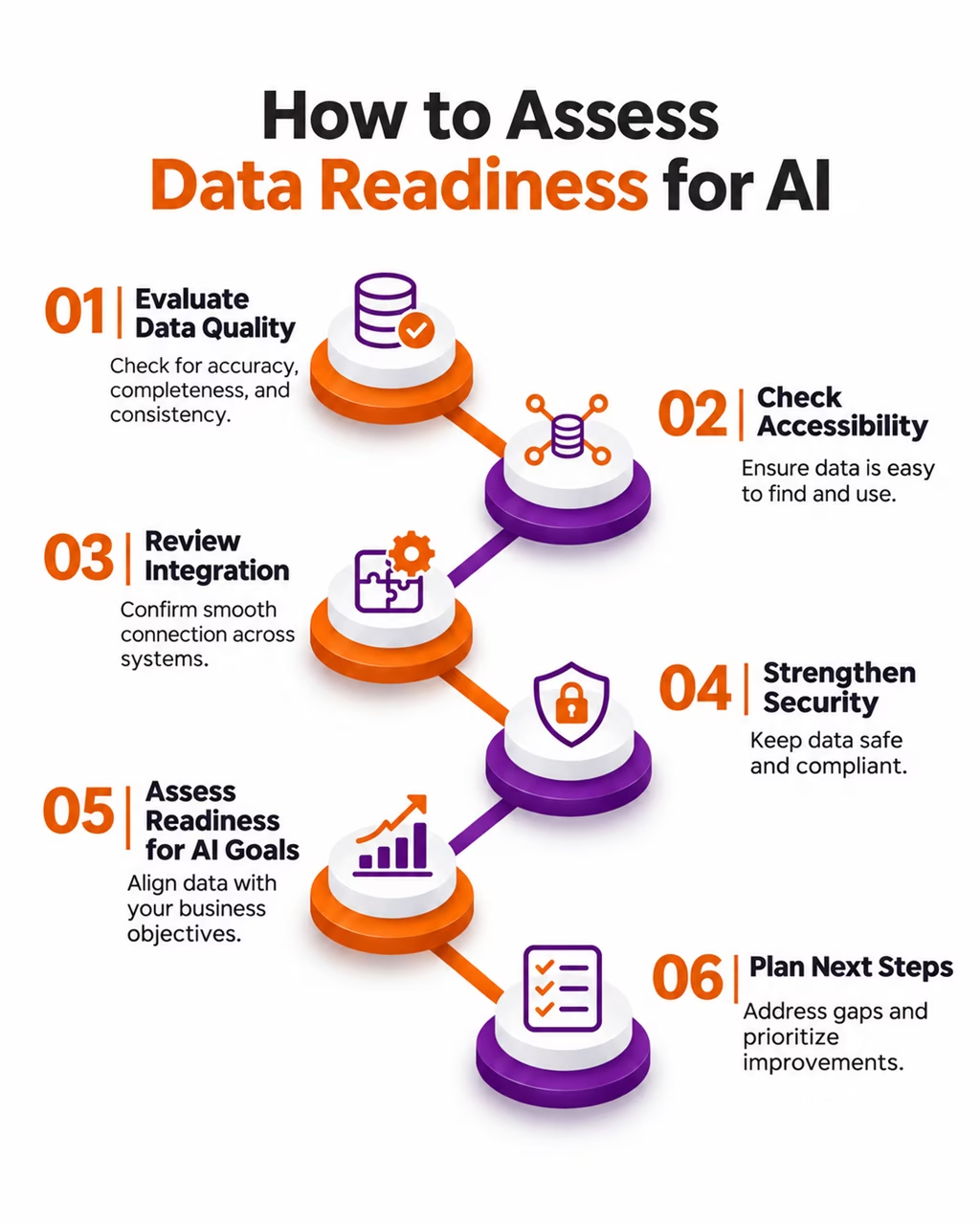
Follow these six steps to evaluate your business’s data readiness for AI implementation.
Step 1. Identify the Business Problems Your AI Project Needs to Solve
Start by defining what you want AI to achieve. It could be reducing customer support costs, automating BPO workflows, or improving sales forecasts.
Before choosing the technology, you should also identify the business problems worth solving with AI. This helps you focus on use cases with clear operational value.
Each use case requires different data. For example, an AI customer service agent needs customer histories, product information, and support policies. Identify which datasets are essential, where they are stored, and whether they are available.
This keeps your AI data readiness assessment focused on data that directly supports your business goals.
Step 2. Check Whether Your Existing Data Is Accurate and Reliable
Poor data quality can cause incorrect AI responses, unreliable predictions, and processing errors.
Conduct a data quality assessment for AI by checking data accuracy, completeness, consistency, integrity, and freshness. Look for duplicate records, missing fields, and outdated information.
For example, an AI sales assistant may recommend unavailable products if inventory records are not updated.
Use data validation and cleansing to correct critical issues before AI implementation.
Step 3. Identify Data Gaps Across CRM, ERP, and Legacy Systems
Business information often remains scattered across CRM, ERP, and legacy applications. These data silos prevent AI systems from accessing complete and updated information.
For example, an AI support agent may fail to resolve billing inquiries if customer records and payment information are stored in disconnected systems.
Check data accessibility, API connectivity, data pipelines, and synchronization between applications. Identify where targeted integration or infrastructure improvements are required.
For customer-facing applications, understanding how to integrate an AI chatbot into your existing application can help you evaluate connectivity requirements before development.
Step 4. Evaluate Whether Your Data Can Support AI-Powered Automation
Your data must support the specific tasks you want AI to automate.
For example, a BPO company automating invoice processing needs readable invoices, accurate supplier information, and clear payment rules. Missing details can cause processing errors.
Review data formats, workflow requirements, and exception-handling processes. Then test representative business scenarios using a small dataset.
This helps determine AI project feasibility before full-scale development. For businesses automating connected sales, billing, and customer workflows, understanding AI automation for revenue operations can provide additional implementation context.
Step 5. Review Data Security, Privacy, and Governance Risks
AI systems often access sensitive customer, financial, and operational information. Weak access controls or unclear data ownership can create security and compliance risks.
Review data governance policies, access permissions, encryption, and applicable privacy regulations such as GDPR.
For example, an enterprise AI assistant should not expose confidential employee records to unauthorized users.
Identify and resolve critical data security gaps before connecting sensitive information to AI applications.
Step 6. Estimate the Cost of Making Your Business Data AI-Ready
Data preparation can increase your AI implementation budget. Common expenses include data cleansing, API development, system integration, infrastructure upgrades, and ongoing monitoring.
For example, a SaaS company may need additional engineering work to connect its CRM and billing systems before deploying an AI customer support agent.
Estimate one-time preparation costs and recurring maintenance expenses. Compare the total investment with expected business benefits. If your project involves AI agents, reviewing the AI agent development cost breakdown can help you understand additional factors that influence the budget.
A data readiness assessment for AI helps you prioritize essential improvements, control unnecessary spending, and decide whether to fix critical gaps or proceed with an AI pilot.
Free AI Training
Is Your Data Holding Back AI?
Fix the data problems limiting your AI project’s potential.
Explore AI TransformationHow Can Poor Data Readiness Increase Your AI Project Costs?
Poor data readiness increases AI project costs through unexpected data preparation, system integration, repeated testing, and ongoing maintenance. When businesses discover these issues during development, they often face budget overruns and delayed returns on investment (ROI).
Here are the major cost drivers:
| Data readiness problem | Impact on AI project costs |
|---|---|
| Poor data quality | Inaccurate, incomplete, and duplicate records require additional data cleansing and validation. |
| Disconnected systems | Data silos across CRM, ERP, and legacy applications increase integration and API development costs. |
| Limited data accessibility | Incompatible formats and missing data pipelines require extra engineering work. |
| Inadequate data infrastructure | Outdated systems may require storage, processing, or infrastructure upgrades. |
| Weak data governance | Poor access controls and data security gaps increase compliance and remediation costs. |
| Unreliable AI outputs | Inconsistent or outdated data leads to repeated testing, manual corrections, and ongoing monitoring expenses. |
For example, a SaaS company developing an AI customer support agent may discover that its CRM records don’t match its billing system. Fixing these inconsistencies requires additional integration and data preparation work. This increases costs before the AI agent can reliably resolve customer requests.
A data readiness assessment for AI helps businesses identify these expenses before development begins. By evaluating data quality, accessibility, and integration requirements early, you can prioritize critical improvements, avoid unnecessary spending, and make more informed AI investment decisions.
AI Data Readiness Checklist for Business Owners
Before approving an AI project, use this checklist to identify the areas that require additional investigation.
The checklist is intended as an initial management review, not a replacement for technical testing or security assessment.
As part of your data readiness assessment for AI, review the following questions:
- Have we clearly defined the business problem our AI project needs to solve?
- Do we have the essential customer, operational, or transactional data required for AI implementation?
- Is our existing data accurate, complete, consistent, and up to date?
- Can our AI system securely access the required business information?
- Can our CRM, ERP, and legacy systems exchange data through APIs or data pipelines?
- Is our data structured and suitable for the intended AI-powered automation?
- Have we identified data silos, duplicate records, and missing information?
- Are our data governance, privacy, and security policies clearly defined?
- Have we identified critical data readiness gaps that require cleansing or validation?
- Can our existing data infrastructure support the proposed AI application?
- Have we estimated data preparation, system integration, and ongoing maintenance costs?
- Can we test our AI use case using a reliable and representative dataset?
How to Measure Your Business Data Readiness for AI
Completing an AI data readiness checklist helps you identify potential issues. But how do you measure whether your business is ready to move forward?
A data readiness assessment for AI uses a weighted scoring framework to evaluate key data requirements. It helps you identify critical gaps, prioritize improvements, and make informed AI investment decisions.
AI Data Readiness Scoring Framework
Evaluate your business data across five dimensions. Each dimension has a suggested weight based on its importance to AI implementation.
| Assessment Criteria | Weight |
|---|---|
| Data Quality and Integrity | 30% |
| Data Accessibility | 20% |
| Data Integration and Infrastructure | 20% |
| Data Governance and Security | 20% |
| AI Use-Case Suitability | 10% |
| Total | 100% |
Rate each dimension from 0 to 5 using the following scale.
| Score | Readiness Level |
|---|---|
| 0 | Not Ready – Required data or capabilities are unavailable |
| 1 | Very Low – Major gaps prevent implementation |
| 2 | Low – Significant improvements are needed |
| 3 | Moderate – Core requirements are partly met |
| 4 | High – Most requirements are met |
| 5 | Fully Ready – Requirements are verified for the intended AI use case |
Calculate your overall score using this formula:
AI Data Readiness Score (%) = Σ [(Dimension Score ÷ 5) × Dimension Weight (%)]
Source: Adapted from the Weighted Scoring Model (WSM) used in Multi-Criteria Decision Analysis (MCDA).
While this score focuses on data, a broader AI readiness assessment can help you evaluate whether your business strategy, technical resources, and operations are also prepared.
Example of an AI Data Readiness Assessment
Consider a mid-sized SaaS company planning to implement an AI customer support agent.
| Assessment Criteria | Score and Weighted Result |
|---|---|
| Data Quality and Integrity (30%) | 3/5 → 18% |
| Data Accessibility (20%) | 4/5 → 16% |
| Data Integration and Infrastructure (20%) | 2/5 → 8% |
| Data Governance and Security (20%) | 3/5 → 12% |
| AI Use-Case Suitability (10%) | 4/5 → 8% |
| Total AI Data Readiness Score | 62% |
The company’s overall readiness score is 62%. Its weakest area is system integration. Customer and billing information remain disconnected.
Rather than replacing its entire data infrastructure, the company could prioritize essential API integrations. It could also launch a limited AI knowledge-base pilot using verified product information.
Which Data Problems Should You Fix Before AI Implementation?
Not every data problem needs to be fixed before starting an AI project. Cleaning every dataset or upgrading every system can increase costs and delay implementation.
Instead, use your data readiness assessment for AI to identify issues that directly affect AI performance, security, and business outcomes. Prioritize these data readiness gaps based on their impact.
- Missing or Inaccurate Data (Critical Priority): Fix incomplete records, incorrect information, and duplicate entries that could affect AI decisions. Use data cleansing and validation to improve data accuracy, completeness, and integrity.
- Data Security and Governance Gaps (Critical Priority): Resolve unauthorized access, privacy risks, and unclear data ownership. Ensure sensitive information is protected before connecting it to AI applications.
- Disconnected CRM, ERP, and Legacy Systems (High Priority): Address data silos that prevent AI from accessing essential business information. Use APIs or data pipelines to improve data accessibility and integration.
- Outdated or Inconsistent Records (High Priority): Update critical customer, product, and operational information. Establish regular data quality checks to prevent unreliable AI outputs.
- Inadequate Data Infrastructure (Medium Priority): Assess whether existing storage, processing, and integration systems can support the intended AI workload. Upgrade only the components that limit AI performance.
- Unrelated or Nonessential Datasets (Low Priority): Defer data preparation for information that does not directly support your AI use case. Focus resources on critical business requirements.
For example, a SaaS company implementing an AI customer support agent should prioritize accurate product documentation, updated customer records, and reliable CRM integration. Cleaning unrelated historical marketing data may not be necessary for the initial deployment.
Should Your Business Fix Its Data First or Start an AI Pilot?
Start an AI pilot if your essential data is accurate, accessible, and secure. Fix critical data gaps first if they affect AI performance or reliability. A Data Readiness Assessment for AI helps you choose the right approach before making a larger investment.
Your decision should depend on data quality, system integration, security risks, and expected business value. Here are three scenarios to consider.

1. Start an AI Pilot When Your Essential Data Is Ready
If your data meets the requirements of your AI use case, start with a small proof of concept (PoC). Test one business workflow before committing to full-scale development.
For example, a SaaS company with an updated knowledge base can test an AI support assistant without integrating every CRM or billing system.
Measure response accuracy, task completion rates, and human escalation frequency. Use these results to evaluate AI project feasibility and potential ROI.
2. Fix Critical Data Gaps Before Starting the Pilot
If your AI data readiness assessment identifies inaccurate records, missing information, or disconnected systems, address the issues that could prevent a meaningful pilot.
For example, a BPO company automating invoice processing may need to correct inconsistent supplier records before testing payment workflows.
Prioritize data cleansing, validation, and essential API integrations. Focus on the data readiness gaps that directly affect your intended AI application.
3. Reconsider the AI Project If Data Risks Outweigh the Benefits
If essential data is unavailable, security requirements cannot be met, or preparation costs exceed the expected benefits, reconsider the project scope.
For example, a business planning AI-powered demand forecasting may lack reliable historical sales and inventory data.
Instead of investing in an unreliable solution, consider collecting the missing information, improving data infrastructure, or selecting a less data-intensive AI use case.
Businesses uncertain about which initiative to pursue can also review where to start with AI before committing to a development strategy.
How Can Businesses Overcome Data Challenges Before AI Implementation?
Businesses can overcome data challenges by improving data quality, integrating disconnected systems, and strengthening data governance. A data readiness assessment for AI helps identify critical gaps before development begins.
Data engineering services improve data accuracy and consistency through cleansing and validation. Custom software development and API integration connect CRM, ERP, and legacy systems to ensure reliable data accessibility.
For businesses facing infrastructure limitations, cloud modernization can improve data processing and system performance. Strong data governance also protects sensitive information.
Organizations pursuing AI Digital Transformation can use AI consulting and automation services to prioritize improvements, assess project feasibility, and test solutions through controlled pilots.
For a broader view of how these improvements fit into business operations, explore the AI digital transformation guide.
The goal is to build reliable, secure, and accessible AI-ready data without unnecessary implementation costs.
Know What Needs Fixing Before You Invest
Get expert guidance on data quality, system integration, and AI readiness.
Talk About Your ProjectMake Sure Your Business Data Is Ready Before Investing in AI
Investing in AI without understanding your existing data can lead to unexpected costs, integration challenges, and disappointing results. That’s why a data readiness assessment for AI should come before major development decisions.
By evaluating data quality, accessibility, system integration, and security, you can identify critical gaps and avoid spending on unnecessary improvements.
You don’t need perfect data across every system. You need reliable, secure, and accessible information that supports your specific AI goals.
Before committing to your next AI project, assess what you have, fix what matters, and validate your approach with a small pilot. This helps you make informed investment decisions and build a stronger foundation for long-term AI success.
Frequently Asked Questions
Here are answers to common questions business owners ask before assessing their data readiness and investing in AI implementation.
1. How do I know if my business data is ready for AI?
Start by evaluating whether your business has accurate, relevant, accessible, and appropriately governed data for its intended AI use case. Review data quality, integration capabilities, security controls, and operational suitability. A data readiness assessment and a controlled pilot can help identify whether critical gaps must be resolved before implementation.
2. Can businesses implement AI with incomplete or unstructured data?
Yes, depending on the application. Some AI systems can process unstructured documents, images, and text, while others require highly structured datasets. Missing or inconsistent information may still affect performance. Businesses should determine whether the available data is sufficient for their specific AI workflow and validate that assumption through testing.
3. What are the biggest data readiness challenges for enterprise AI?
Common challenges include fragmented data sources, inconsistent records, legacy system limitations, outdated information, unclear data ownership, and security restrictions. Large enterprises may also face complicated integration requirements across departments, regions, and applications. The most serious challenges are those that directly affect the AI system’s reliability or permitted use.
4. Do businesses need to replace their CRM or ERP before implementing AI?
Not necessarily. Existing CRM and ERP platforms can often support AI applications through APIs, middleware, or data integration services. Whether replacement is necessary depends on the system’s capabilities, security limitations, performance, and the intended workflow. A readiness assessment can help determine whether targeted integration or modernization is sufficient.
5. How much does it cost to prepare business data for AI?
The cost depends on the condition of existing datasets, the number of systems involved, integration complexity, security requirements, and ongoing maintenance needs. A business with clean, accessible data may require relatively limited preparation, while an enterprise with fragmented legacy applications may need significant engineering work. Costs should be estimated against a defined AI use case.
6. How long does a data readiness assessment take?
The timeline depends on the scope of the assessment, the number of relevant data sources, system complexity, and availability of technical documentation. Evaluating one narrowly defined AI use case is generally simpler than assessing enterprise-wide data readiness across multiple departments. Businesses should agree on the assessment scope and required evidence before establishing a timeline.
7. What is the difference between AI readiness and data readiness?
AI readiness evaluates whether an organization has the strategy, technology, people, processes, governance, and resources needed to adopt AI effectively. Data readiness focuses specifically on whether the information required for an AI application is accurate, accessible, suitable, and appropriately governed. Data readiness is therefore an important component of broader organizational AI readiness.
This page was last edited on 24 November 2026, at 4:26 pm

Start a conversation with our team to solve complex challenges and move forward with confidence.