
Some of the top offshore software development companies in 2026 include Riseup Labs, BairesDev, EPAM Systems, GlobalLogic, Accenture, Andela, Turing, ScienceSoft, Vention, and FPT Software. Each stands out for different strengths, from AI and staff augmentation to enterprise engineering and large-scale digital transformation.
Have you tried to hire a senior developer this year? If so, you already know the problem. Good engineers are hard to find. The best ones get hired fast, often by two or three firms at once. This is why so many businesses now turn to offshore software development companies. It beats fighting for the same small pool of local talent.
Offshore software development is not a shortcut anymore. It is how modern products get built. Startups use it to launch faster. Enterprises use it to modernize old systems without draining their budget. Founders use it to get senior engineers on their team in weeks, not months.
In this guide, we cover the best offshore software development companies in 2026. We also cover what they cost and how to pick the right one. We built this list after digging through vendor data and client reviews. We also drew on our own experience running distributed teams across time zones. This is not a generic list. It is a real buyer’s guide.
What Is an Offshore Software Development Company?
An offshore software development company builds software using engineers based in another country. That country usually has lower operating costs. You get trained developers, testers, and designers. But you skip the cost of hiring them as full-time local staff.
This is different from nearshore development. With nearshore, your team works in a nearby time zone. It is also different from plain outsourcing. With outsourcing, you hand a project to a vendor. Then you wait for the finished product. A true offshore development team works closely with you instead. They join your calls. They follow your sprints. They act like part of your in-house staff, just based somewhere else.
Businesses use offshore software development services for a few clear reasons.
- To fill a skills gap they cannot fill locally
- To cut development costs without cutting quality
- To move faster on a product roadmap
- To scale a team up or down without long hiring cycles
Why Businesses Are Turning to Offshore Development Teams in 2026
Demand for developers has not slowed down. If anything, it has gotten worse for firms that only hire locally.
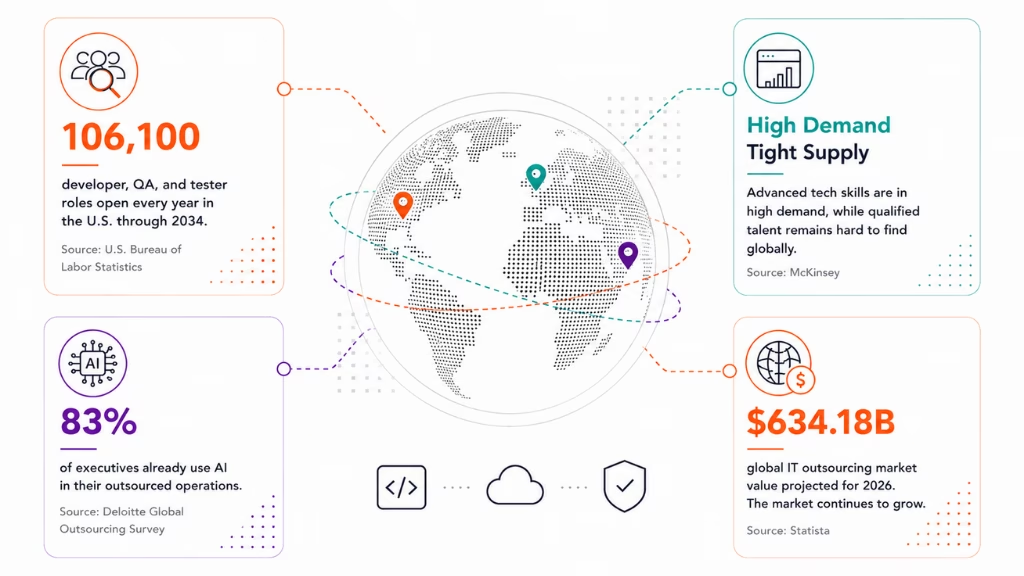
Look at the United States. The U.S. Bureau of Labor Statistics has a number for this. It projects about 106,100 job openings a year for developers, QA analysts, and testers. This holds true through the next decade. The field is growing. Workers are also retiring or switching careers. That means a lot of open seats. And not enough experienced engineers to fill them.
McKinsey’s research tells a similar story. Its team studied millions of job postings. They found a real gap. Demand for advanced tech skills is high. The supply of qualified people is not. This is true for AI, cloud, and cybersecurity roles especially. When the talent is not in your city, offshoring stops being optional. It becomes the practical answer.
Cost still matters too. But it is no longer the only reason firms offshore. Deloitte’s research on outsourcing found that 83% of executives already use AI as part of their outsourced work. That shows how far the model has come. It is no longer just about cutting costs. And according to Statista, the global IT outsourcing market should hit $634.18 billion in 2026. That number keeps climbing. More firms are building distributed teams instead of purely local ones.
In short, offshore software outsourcing lets you:
- Cut costs. Senior engineers in offshore hubs often cost 40 to 70% less. That is compared to the same experience level in the US, UK, or Western Europe.
- Access specialized skills. AI engineers, DevOps experts, and cloud architects are easier to find offshore. Local markets are often already picked over.
- Move faster. A vetted offshore development center can staff a project in weeks. Local hiring can take months.
- Scale without risk. You can grow or shrink your offshore team as your roadmap changes. No layoffs. No long-term contracts.
- Work around the clock. Time zones can work in your favor. Code gets reviewed and shipped while your in-house team sleeps.
How Much Do Offshore Software Development Companies Charge in 2026?
Rates vary by region, by seniority, and by contract type. Here is a general breakdown for a mid-to-senior developer in 2026.
| Region | Typical Hourly Rate | What You’re Paying For |
| South Asia (Bangladesh, India, Pakistan) | $20 – $45 | Strong technical depth, English fluency, and the lowest cost per senior developer |
| Southeast Asia (Vietnam, Philippines) | $25 – $50 | Growing technical maturity and competitive pricing |
| Eastern Europe (Poland, Ukraine, Romania) | $40 – $90 | Deep experience with complex systems and enterprise architecture |
| Latin America (Brazil, Argentina, Mexico) | $45 – $85 | Real-time overlap with US business hours |
| United States (for comparison) | $80 – $160 | The fully loaded cost of a domestic senior hire |
Most businesses save between 40% and 60% when they offshore instead of hiring locally. That is, without giving up quality. The savings mostly come from lower salary benchmarks in offshore hubs. They do not come from cutting corners on the actual work.
The Best Offshore Software Development Companies in 2026
We looked at pricing and engineering depth. We also checked client reviews, certifications, and how each firm sets up its contracts. Here are 20 offshore software development companies worth your attention this year.
| Best For | |
| Riseup Labs | A single long-term offshore technology partner across development, AI, staffing, and support |
| BairesDev | Time-zone-aligned Latin America teams at scale |
| EPAM Systems | Enterprise-grade digital transformation |
| GlobalLogic | Connected-product engineering under one contract |
| Accenture | Full digital transformation with consulting attached |
| Andela | Hiring individual offshore developers fast |
| Turing | AI-driven engineer matching |
| ScienceSoft | US contract, Eastern European teams |
| Vention | Startup-focused product development |
| FPT Software | Large-scale Asia-Pacific teams with Japan ties |
| Wipro | Broad technical coverage for big firms |
| Infosys | Large, multi-year global transformation programs |
| Cognizant | US contract with large-scale offshore teams |
| Tata Consultancy Services | Long-term partnerships in regulated industries |
| Globant | Design-led engineering for consumer brands |
| Thoughtworks | Deep engineering discipline for technical overhauls |
| SoftServe | Consulting plus Eastern European engineering talent |
| Nagarro | Agile, ongoing product development |
| Endava | Design-led development with Balkans-region talent |
| Simform | Hands-on, co-engineering model for cloud-native builds |
1. Riseup Labs
Riseup Labs is our top pick. Here is why. It is one of the few offshore software development companies that does it all. It combines full-stack engineering, AI-native development, staff augmentation, and managed operations. All under one roof. It backs this up with real certifications, not just marketing claims.
Riseup Labs was founded in 2009. It is based in Dhaka, Bangladesh. For over 15 years, it has built software and AI products. Its clients span more than 30 countries. It now runs offices in the US, UK, and UAE. That is on top of its Bangladesh headquarters. That gives clients local contacts, even though the work happens offshore.
What sets Riseup Labs apart is its range. Most firms pick one lane. Some focus on custom development. Others focus on staff augmentation or BPO. Riseup Labs runs all three. It also runs a dedicated AI practice. This covers generative AI, computer vision, NLP, and agentic AI systems. That matters in 2026. Most software projects now touch AI in some form. You do not want three separate vendors to get there.
| Riseup Labs at a Glance | Details |
| Founded | 2009 |
| Headquarters | Dhaka, Bangladesh |
| Global Offices | Bangladesh, USA, UK, UAE |
| Experience | 15+ years, 700+ projects delivered, 300+ clients |
| Countries Served | 30+ |
| Certifications | ISO 9001, ISO 27001, SOC 2 Type II, PCI DSS |
| Core Services | AI and automation, custom software and app development, IT staff augmentation, managed cloud and DevOps, BPO and CX outsourcing |
| Engagement Models | Dedicated offshore development team, staff augmentation, managed services, project-based delivery |
| Notable Recognition | Clutch Global Award, ASOCIO DX Award, ranked among the Top 500 Global Outsourcing Firms |
| Best For | Companies that want one long-term offshore technology partner, instead of juggling multiple vendors for development, AI, and support |
A few things stood out to us while researching this list. First, the security posture is real. ISO 9001, ISO 27001, SOC 2 Type II, and PCI DSS are rare among offshore software development agencies. Riseup Labs has all four. It matters if you handle sensitive customer or financial data.
Second, the industry range is wide. Riseup Labs has worked in eCommerce, fintech, health tech, EdTech, automotive, and government projects. That tells you the team has been tested across very different technical needs. Not just one niche.
Third, clients mention this most in reviews. The company acts like a long-term partner. Not a one-off project shop. That lines up with what we said earlier. Retention and direct access matter more than the sticker price. Do you want a team that can grow into managed operations and support later? Riseup Labs is built for that.
Best for: Startups and mid-market firms that want a single offshore technology partner. One that covers software development, AI integration, staff augmentation, and managed services. All backed by real security certifications.
2. BairesDev
BairesDev is one of the largest offshore software development companies out of Latin America. Its teams span Argentina, Mexico, Colombia, and Brazil. Founded in 2009, it is based in San Francisco. It has grown into a firm with thousands of engineers. It also carries a strong reputation on review platforms like Clutch.
The advantage here is time zone overlap. If your team sits in the US, this helps. Latin American developers share your business hours. That means faster feedback and fewer late-night calls. The tradeoff is scale. A firm this large cannot always match the personal touch of a smaller offshore agency.
Best for: US firms that want strong time-zone alignment and are fine working with a large, big, known vendor.
3. EPAM Systems
EPAM Systems is a publicly traded engineering and consulting firm. It has deep roots in Eastern Europe. It also has a large presence in India and Latin America. It is one of the more enterprise-focused names on this list. It often works with Fortune 500 firms on multi-year big change programs.
This is not a light staff augmentation shop. EPAM blends consulting with engineering. That means longer sales cycles and higher rates. But it also means very senior talent for complex, large-scale builds.
Best for: Big firms running complex, long-term change projects with bigger budgets.
4. GlobalLogic
GlobalLogic is a digital engineering firm. Hitachi acquired it in 2021. That gave it the backing of a much larger industrial parent company. It focuses on connected products, automotive systems, healthcare platforms, and industrial engineering. It combines design work with backend development.
Because of the Hitachi connection, GlobalLogic tends to land large, full-scope projects. Not small, single-team projects.
Best for: Enterprises building connected hardware-software products that want design and engineering under one contract.
5. Accenture
Accenture is one of the largest consulting and technology firms in the world. Its teams sit in India, the Philippines, Eastern Europe, and Latin America. Its offshore engineering supports everything from cloud migration to full big tech changes.
Accenture fits organizations that already work with big consulting firms. Ones that want tech work bundled with strategy and change plans.
Best for: Enterprises that need end-to-end digital transformation, not just a dedicated offshore development team.
6. Andela
Andela works differently from most names on this list. It is not a traditional firm. It runs a talent marketplace instead. It connects firms with vetted, independent offshore developers across more than 100 countries. This gives you speed. You can hire offshore developers fast for one exact skill.
The tradeoff is that you manage the relationship more directly. Andela matches you with talent. It does not run a full, managed team on your behalf.
Best for: Companies that want to hire individual senior engineers fast, rather than build a full dedicated team.
7. Turing
Turing pairs AI-powered developer matching with a growing services arm. That arm supports work for major AI labs. It is one of the newer names here, founded in 2018. But it has grown fast. Demand is high for engineers who know both traditional software and AI/ML systems.
Best for: Companies whose projects touch AI development and want AI-driven matching over a traditional hiring process.
8. ScienceSoft
ScienceSoft is based in the US. Its teams sit in Eastern Europe. That gives clients a domestic contracting entity, while the engineering happens offshore. It has built a strong niche in cybersecurity, business intelligence, and custom business software.
Best for: Mid-market firms that want a US-based contract, backed by Eastern European engineering talent.
9. Vention
Vention was formerly known as iTechArt. It focuses on venture-backed startups and growth-stage firms. It draws from a deep bench of Eastern European engineers. It has a long track record. Its startups often go on to raise real funding.
Best for: Venture-backed startups that want an offshore product development company used to startup speed.
10. FPT Software
FPT Software is the largest IT services firm in Vietnam. It is a subsidiary of a publicly traded parent company. It has a strong presence in the Japanese market. That makes it a good fit for Asia-Pacific customers or partners.
Best for: Enterprises wanting a large, known Asia-Pacific offshore partner with strong Japan market experience.
11. Wipro
Wipro is one of the largest offshore IT services firms in the world. It is based in Bangalore, India. It covers a huge range of work. Cloud migration, cybersecurity, full digital engineering- all of it. It mostly serves big clients with complex, multi-year programs.
Because of its size, Wipro can staff almost any skill set you need. The tradeoff is that smaller clients sometimes get less attention. A boutique offshore agency might offer more.
Best for: Big firms that need broad tech coverage under one vendor.
12. Infosys
Infosys is a publicly traded offshore software development company. It is also based in Bangalore. It is one of the best-known names in global IT outsourcing. It runs everything from custom app development to large-scale AI and cloud work.
Infosys is built for scale. Enterprises pick it when they need a partner who can run a global program. One with hundreds of engineers, not just a single product team.
Best for: Global firms running large, multi-year change programs.
13. Cognizant
Cognizant is a US-based technology services firm. Most of its engineering work sits in India. It focuses on digital transformation, cloud work, and IT upgrades. Its clients span banking, healthcare, and retail.
Best for: Firms that want a US-based contract, paired with large offshore teams.
14. Tata Consultancy Services (TCS)
TCS is one of the largest IT services firms on the planet. It is part of the Tata Group. Its base is Mumbai. Its offshore development network is huge. Its client relationships often run for a decade or more. This is especially true in banking, insurance, and public sector work.
Best for: Enterprises that want a long-term partner with deep experience in regulated industries.
15. Globant
Globant is a publicly traded, modern engineering firm. Its major hubs sit in Argentina, Colombia, Mexico, and Brazil. It stands out for blending strong UX and design work with core engineering. That appeals to consumer-facing brands.
Best for: Companies focused on customer experience and product design, as well as backend engineering.
16. Thoughtworks
Thoughtworks is a global technology consulting firm. It is known for its engineering-first culture. It has shaped modern practices like continuous delivery. Its teams span Asia-Pacific, Europe, Latin America, and North America.
Best for: Companies in a technical overhaul that want deep engineering skill. Not just extra hands on deck.
17. SoftServe
SoftServe is a consulting-led offshore engineering firm. It has one of the largest talent networks in Eastern Europe. Its reach spans Ukraine, Poland, Bulgaria, and Romania. It leans into data, AI, and platform upgrade work for mid-to-large firms.
Best for: Companies that want consulting expertise paired with deep Eastern European talent.
18. Nagarro
Nagarro is a publicly traded, agile-first product engineering firm. It is based in Germany. Its teams span India, Eastern Europe, and Latin America. It is known for flexible, team-based deals. Not rigid, fixed-scope contracts.
Best for: Mid-size firms that want an engineering-first partner for ongoing product work.
19. Endava
Endava is a publicly traded offshore software development company. It is based in London. Its engineering talent runs deep across Romania, Moldova, Serbia, and the wider Balkans region. It combines design with software engineering. It is often chosen for platform modernization work.
Best for: Companies that want design-led work, paired with strong Eastern European teams.
20. Simform
Simform is a product engineering firm. It centers on cloud, data, and AI-enabled software development. It uses a co-engineering model. Its teams work alongside your in-house staff. They do not operate as a separate, siloed vendor.
Best for: High-growth firms that want a hands-on offshore product development company for cloud-native builds.
How to Choose the Right Offshore Software Development Company
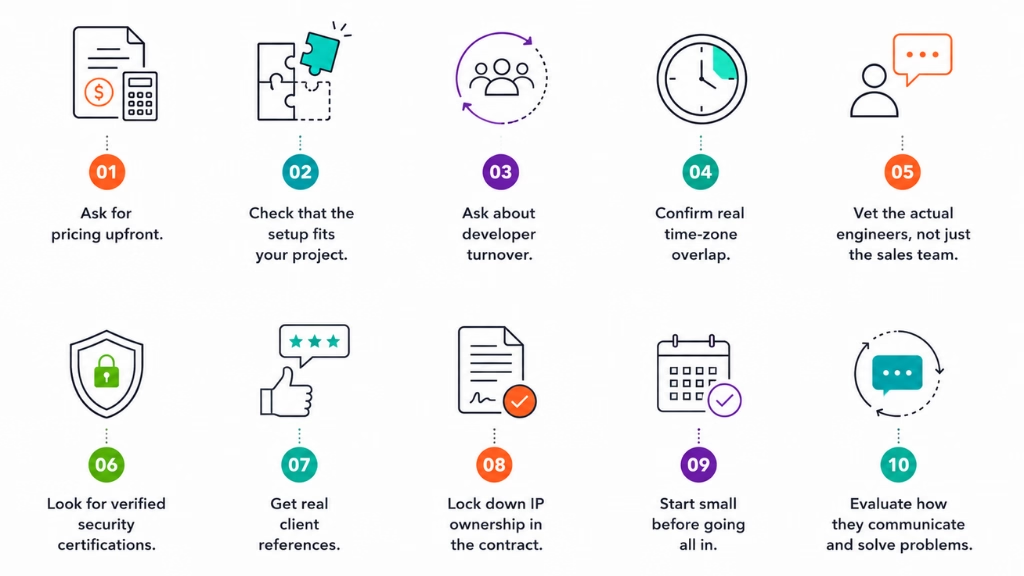
Picking the wrong offshore partner costs you. Not just money. Time you cannot get back. Here are the practices we always share with clients before they sign anything.
Ask for pricing upfront. A real offshore software development agency can give you a rate before the first call. If every answer is “let’s schedule a call to scope it,” watch out. That often signals a project shop. One trying to lock you into a vague, high-margin contract.
Check that the setup fits your project. Staff augmentation works well when you already have in-house leads. You just need more hands. A dedicated offshore team works better for ongoing product work. A fixed-scope project only makes sense for small, clear builds.
Ask about developer turnover. High turnover means you keep paying to onboard new people onto your codebase. If a firm will not answer this question directly, that is a red flag.
Confirm real time-zone overlap. Even async teams need a few hours of daily overlap. You need it for code review, standups, and quick decisions. Without it, small questions turn into two-day delays.
Vet the actual engineers, not just the sales team. Ask to talk to the developers who will do the work. A good offshore engineering partner will welcome this. A bad one will resist it.
Look for verified security certifications. ISO 27001 and SOC 2 matter. So does HIPAA or PCI DSS, depending on your industry. These are not just checkboxes. They show that the offshore development center takes data protection seriously.
Get real client references. Anyone can post logos on a homepage. Ask for two reference clients you can actually talk to. Then check independent review platforms for a fuller picture.
Lock down IP ownership in the contract. Whatever the offshore team builds should belong to you. Fully. Make sure the contract says so clearly. Ask who controls repository access. Ask what happens to that access once the work ends.
Start small before going all in. A short pilot, or a 30-day trial, beats any pitch deck. It shows you how a team communicates and solves problems in practice.
What We’ve Learned From Real Offshore Engagements
We have worked with many teams that tried offshore development. The results were very different from team to team. Some built long, healthy partnerships. Others got burned. The difference rarely came down to the country. It came down to the model.
Here is what we have seen work, again and again:
Direct access to developers beats a middleman. The best projects let clients talk to the real engineers. No relay through an account manager. If you cannot speak to your developer without three layers of approval, expect delays.
Retention matters more than the hourly rate. A developer on your codebase for two years knows your product well. A brand-new hire does not, at least not yet. High turnover on the vendor side means you keep paying to train someone new. Ask any offshore software development agency for their annual retention rate. Ask before you sign anything.
A small pilot project beats any sales pitch. We always suggest a two- to four-week trial task first. It shows you how the team communicates. It shows how they handle unclear requirements. Do they ask good questions, or just guess?
Security certifications are not optional. If your offshore partner lacks ISO 27001 or SOC 2, that is a real gap. This matters most if you handle customer data, payments, or health records.
Common Mistakes Companies Make When Offshoring
Even with good intentions, firms still get their first offshore deal wrong. Here are the mistakes we see most, so you can avoid them.
- Chasing the lowest rate. The cheapest offshore developers often end up the most expensive. Count the cost of rework, missed deadlines, and turnover.
- Skipping the pilot project. Signing a six-month contract without a test run first is a costly, common mistake.
- Treating the offshore team like a black box. Handing over a spec and walking away rarely works. The best results come from treating offshore developers like part of your own team. Give them context on why the product matters, not just what to build.
- Ignoring communication style, not just language. English fluency is the floor, not the ceiling. What matters more? Whether a developer speaks up when the spec looks wrong.
- Not documenting anything. Weak documentation makes onboarding painful. It slows everyone down when a new developer joins the project.
Frequently Asked Questions
What is an offshore software development company?
An offshore software development company builds software using engineering talent based in another country. That country typically has lower labor costs. The team works remotely, usually with some daily overlap with your business hours. It can work as a dedicated offshore development team, staff augmentation, or a project-based contract.
How much does it cost to hire offshore developers?
Rates in 2026 generally run from $20 to $90 an hour. It depends on the region and the seniority level. South Asia and Southeast Asia tend to offer the lowest rates. Eastern Europe and Latin America sit in the middle. US-based senior developers cost much more, on a fully loaded basis.
What is the difference between offshore, nearshore, and outsourcing?
Offshore means your team sits in a country with a big time-zone gap from yours. Nearshore means the team is in a similar or nearby time zone. Outsourcing is a broader term. It can mean handing a whole project to a vendor. That is different from folding a dedicated team into your workflow.
How do I choose the best offshore software development company?
Start by picking the setup that fits your project. Staff augmentation, a dedicated team, or a fixed-scope build. Then check pricing transparency, developer retention, security certifications, and communication quality. Always ask for reference clients you can actually speak with, before you sign a contract.
Is offshore software development safe?
Yes, as long as you work with a company that holds real security certifications. Look for ISO 27001 or SOC 2. Also make sure the contract spells out clear IP ownership and data protection terms. The real risk comes from skipping due diligence, not from offshoring itself.
What is the difference between offshore development and staff augmentation?
Offshore development describes where the work happens. Staff augmentation describes how you engage the people doing it. You can combine both. You can hire augmented offshore staff. These are dedicated developers, based offshore, who work as part of your team. They are not a separate vendor with a fixed scope.
Who owns the code after an offshore team builds it?
You should, in full. This needs to be written clearly into the contract. Under a staff augmentation or dedicated team model, the code is usually treated as work-for-hire. It belongs to you, the same way work from an in-house employee would.
How long does it take to start working with an offshore development team?
Most offshore software development companies can staff a team in two to six weeks. It depends on the skills you need. Firms with large, pre-vetted talent pools often move faster.
Which countries are best for offshore software development?
It depends on what you want most. South Asian countries like Bangladesh offer strong technical talent at competitive rates. Eastern Europe has some of the deepest benches for complex systems work. Latin America offers the best time-zone overlap for US teams. Southeast Asia keeps growing as a lower-cost, scalable option.
Why do offshore software development projects fail?
Most failures come down to the model, not the developers. A lack of direct communication is a common cause. So is high turnover. So is a vague spec, or treating the team like a black box. A partner with a stable team and clear communication solves most of these problems early.
Final Thoughts
Offshore software development is not about finding the cheapest developer anymore. It is about finding a real technology partner. One who moves fast. One who protects your data and sticks around long enough to know your product.
Out of everything we reviewed for this list, Riseup Labs stood out. It combines certified security, a wide range of services, and 15-plus years in the field. Its work spans more than 30 countries. Do you want a team that can grow with your business? Not just fill a short-term gap? Put Riseup Labs at the top of your list.
Whichever offshore software development company you choose, take your time. Ask the hard questions. Start small if you can. The businesses that get the most out of offshoring treat it like a hiring decision. Not just a purchase.
This page was last edited on 1 September 2026, at 12:09 pm

Start a conversation with our team to solve complex challenges and move forward with confidence.