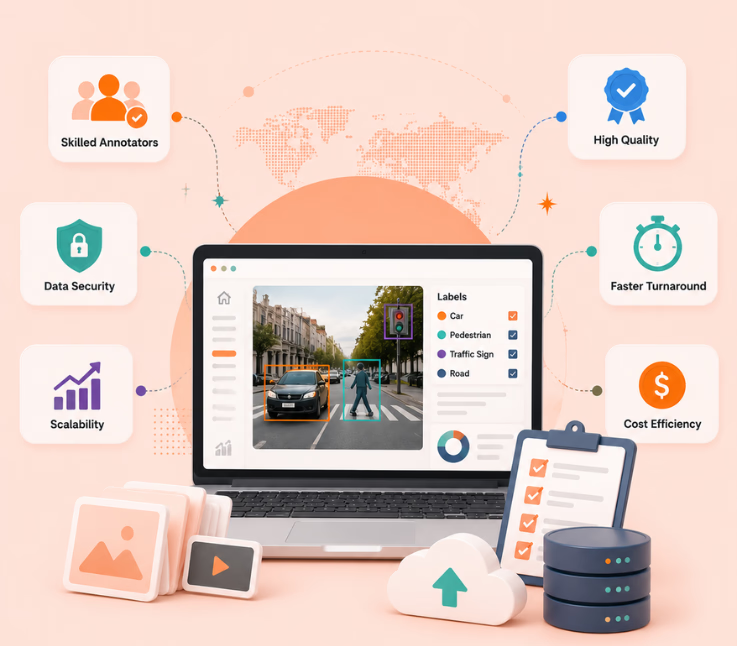
Choosing the right AI data annotation outsourcing provider requires evaluating expertise, annotation quality, security, scalability, pricing, and QA processes. A reliable partner helps businesses create accurate training data while reducing costs and accelerating AI development.
AI can’t learn from raw data alone. Whether you’re building a computer vision system, training an LLM, or developing an autonomous solution, your data needs to be accurately labeled before it can become useful training data.
But building an in-house annotation team takes time, money, and constant quality control. Choosing an outsourcing provider isn’t easy either. A poor fit can mean inconsistent labels, security concerns, missed deadlines, and costly rework.
In this guide, we’ll cover the leading AI data annotation providers, outsourcing models, services, costs, quality and security considerations, and the key factors to check before choosing the right partner
What Is AI Data Annotation Outsourcing?
AI data annotation outsourcing is the process of hiring an external company or specialized team to label, classify, categorize, or organize data used to train and improve artificial intelligence and machine learning models.
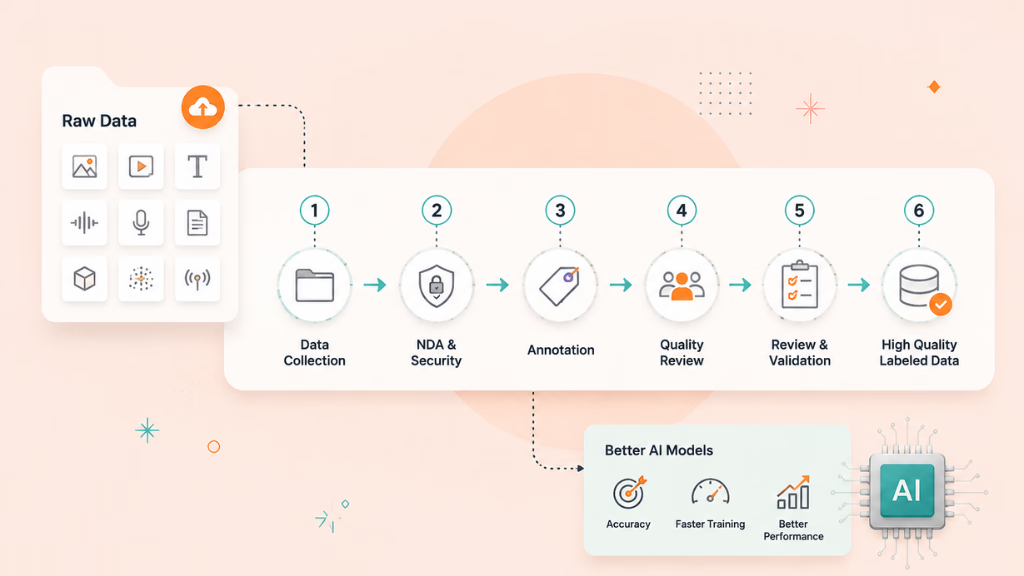
Depending on the project, the data may include:
- Images
- Videos
- Text
- Audio
- Speech
- Documents
- 3D data
- LiDAR and point clouds
- Sensor data
The type of annotation depends on what the model needs to learn.
For example, an autonomous vehicle model may require objects such as cars, pedestrians, traffic signs, and road markings to be identified in images or 3D environments. An NLP model may require text to be labeled according to sentiment, intent, entities, or other characteristics.
The goal is to transform raw data into structured, usable training data that helps AI models learn more effectively.
Data annotation vs. data labeling
The terms data annotation and data labeling are often used interchangeably.
However, annotation can involve more detailed and structured tasks than simple labeling.
For example, labeling an image as “car” is relatively simple. Annotation could involve drawing a precise bounding box around every car, creating segmentation masks, identifying vehicle attributes, or tracking the same vehicle across multiple video frames.
As annotation becomes more complex, trained annotators and reliable QA processes become increasingly important.
Why Is AI Data Annotation Outsourcing Important ?
Modern AI systems require more than massive datasets. They need accurately labeled and consistently structured data that models can learn from.
Building an internal annotation team can become expensive as data volumes increase. Companies have to recruit and train annotators, manage quality assurance, invest in tools, and maintain security processes.
Outsourcing can provide access to trained professionals, established workflows, and scalable capacity while allowing internal AI teams to focus on model development and deployment.
Key benefits of outsourcing AI data annotation
- Scale annotation capacity without building a large internal team
- Access trained and specialized annotation professionals
- Reduce operational and recruitment costs
- Speed up AI data preparation
- Support multilingual and domain-specific projects
- Establish structured quality assurance processes
- Handle large or fluctuating datasets more efficiently
- Reduce the management burden on internal teams
However, outsourcing does not automatically guarantee better results. The provider you choose, the quality of your guidelines, and the QA process all have a direct impact on the final dataset.
Top AI Data Annotation Outsourcing Providers in 2026
The data annotation market includes enterprise AI companies, specialized annotation providers, technology platforms, and managed outsourcing teams.
The right provider depends on your data type, project size, quality requirements, security needs, budget, and desired level of management.
Here are several providers worth considering.
1. Riseup Labs
Riseup Labs provides data annotation and outsourcing services for businesses that need structured and consistently labeled data for AI and machine learning applications.
Its outsourcing model can support businesses that need external teams rather than relying entirely on internal annotation resources.
Best for: Businesses looking for AI data annotation, dedicated teams, and scalable outsourcing support.
Consider it when: You want to work with a technology and outsourcing company that can support your project from planning through delivery.
Potential advantage: An outsourcing-based engagement can allow businesses to increase annotation capacity without building a large permanent internal team.
2. Scale AI
Scale AI is a major provider in the AI training data market, supporting data annotation, model evaluation, and AI development workflows.
Best for: Large-scale AI projects, computer vision, LLMs, autonomous systems, and model evaluation.
Consider it when: You need an enterprise-oriented provider with extensive AI data capabilities.
3. Appen
Appen is a long-established provider of training data and AI data services, with capabilities across data collection, annotation, language data, and AI-related workflows.
Best for: Large multilingual datasets, language-related AI projects, search, and machine learning applications.
Consider it when: Your project requires large distributed workforces or significant multilingual capabilities.
4. TELUS Digital
TELUS Digital provides AI data and language services covering areas such as data annotation, AI training, search relevance, and linguistic data.
Best for: Multilingual AI, language data, search-related applications, and large-scale AI training.
Consider it when: Your project requires global language coverage and distributed annotation capacity.
5. iMerit
iMerit specializes in data annotation and AI data services across areas such as computer vision, healthcare, geospatial data, and other specialized applications.
Best for: Specialized and domain-specific annotation projects.
Consider it when: Your dataset requires specialized workflows or domain expertise beyond basic image and text labeling.
6. Sama
Sama provides data annotation and AI training data services with a strong focus on computer vision and human-in-the-loop workflows.
Best for: Image and video annotation, computer vision, and large-scale AI training datasets.
Consider it when: Your project involves high-volume visual data and requires structured human review.
7. Labelbox
Labelbox combines data annotation, data management, and AI development workflows through a dedicated platform.
Best for: Computer vision, data labeling workflows, model-assisted annotation, and teams that want greater control over their annotation operation.
Consider it when: Your internal ML team wants to remain closely involved in the annotation process.
8. Toloka
Toloka provides data labeling and AI training data services through distributed human workforces and technology-supported workflows.
Best for: Large-scale labeling, multilingual projects, and flexible data preparation.
Consider it when: You need to expand annotation capacity across different AI data tasks.
9. Surge AI
Surge AI focuses on human feedback and data work for advanced AI systems, including LLM training and evaluation.
Best for: LLMs, human feedback, model evaluation, and advanced AI training.
Consider it when: Your project requires human expertise to evaluate or improve sophisticated AI outputs.
How Should You Compare AI Data Annotation Providers?
Don’t choose a provider based only on the lowest price or largest workforce.
Instead, compare:
| Criteria | What to Evaluate |
|---|---|
| Data expertise | Experience with your specific data type |
| Annotation quality | Accuracy targets and QA methodology |
| Scalability | Ability to increase capacity as your dataset grows |
| Security | Data protection and access controls |
| Compliance | Relevant certifications and regulatory processes |
| Domain expertise | Experience with specialized datasets |
| Technology | Annotation tools and workflow capabilities |
| Pricing | Transparent and predictable costs |
| Communication | Project management and reporting |
| References | Relevant case studies and client experience |
A provider that specializes in LLM evaluation may not be the best choice for LiDAR annotation. Likewise, a self-service platform may not be suitable if you want a dedicated team to manage the entire workflow.
The best provider is the one that fits your project’s data, complexity, security requirements, and long-term goals.
What Are the Main Models of AI Data Annotation Outsourcing?
Different businesses require different levels of control and support. The four most common approaches are dedicated teams, managed services, marketplaces or platforms, and crowdsourcing.
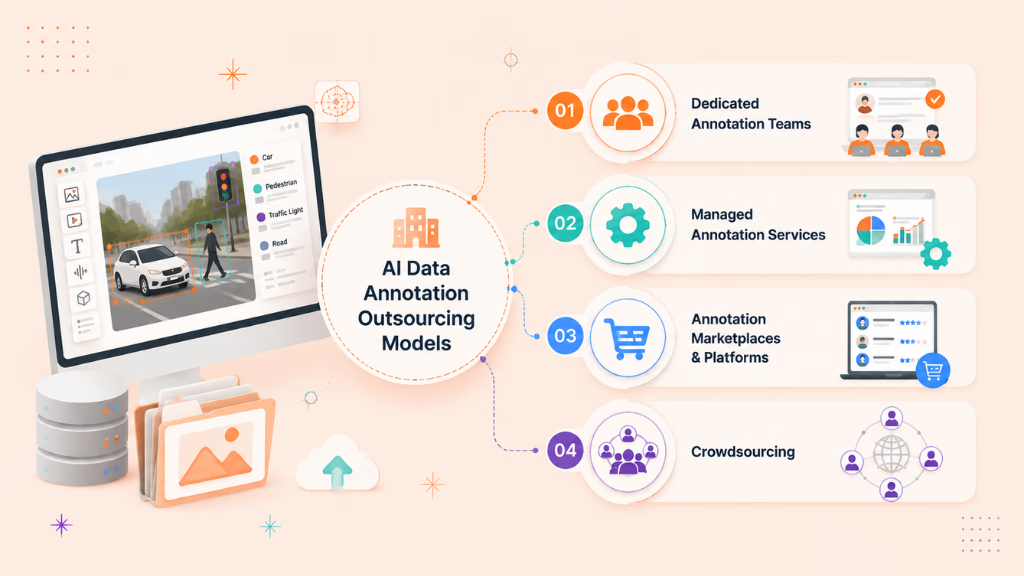
1. Dedicated Annotation Teams
A dedicated team works specifically on your project and becomes familiar with your data, tools, guidelines, and requirements.
Best for:
- Large datasets
- Long-term projects
- Sensitive data
- Complex annotation
- Regulated industries
Advantages:
- Consistent team
- Better project familiarity
- Easier communication
- Greater workflow control
- Scalable capacity
Potential drawback: Dedicated teams can cost more than task-based outsourcing.
2. Managed Annotation Services
With a managed service model, the provider handles most of the annotation operation, including team management, workflow coordination, QA, and delivery.
Best for:
- Companies without internal annotation expertise
- Large-scale projects
- Businesses that want minimal day-to-day management
- Organizations looking for end-to-end delivery
The main advantage is simplicity. Instead of managing individual annotators and reviewers, the client works with a single delivery partner.
3. Annotation Marketplaces and Platforms
Marketplaces and platforms connect businesses with annotation workers, freelancers, or service providers.
Best for:
- Small projects
- Short-term requirements
- Experimental datasets
- Businesses that want flexibility
The trade-off is that the client may need to take more responsibility for quality, communication, workforce management, and security.
4. Crowdsourcing
Crowdsourcing divides annotation work into smaller tasks and distributes them among a large workforce.
Best for:
- High-volume datasets
- Simple annotation tasks
- Non-sensitive data
- Projects where speed and cost are major priorities
Crowdsourcing may be less suitable for highly confidential, regulated, or domain-specific datasets.
What Data Annotation Services Can Be Outsourced?
AI data annotation covers several data types and use cases:
Computer Vision
- Image and video labeling
- Bounding boxes and segmentation
- Object tracking
- 3D and LiDAR annotation
NLP & Text
- Sentiment and intent analysis
- Named entity recognition
- Text classification
- LLM and conversation annotation
Audio & Speech
- Transcription
- Speaker identification
- Emotion and language labeling
- Event detection
Video
- Object tracking
- Activity and event detection
- Scene classification
3D & LiDAR
- 3D bounding boxes
- Point cloud segmentation
- Object and lane annotation
These services support applications across AI, robotics, healthcare, automotive, retail, and other industries.
What Is Domain-Specific Data Annotation?
Some datasets require more than general labeling skills.
Healthcare, finance, legal, automotive, and other specialized industries may involve complex terminology, strict accuracy requirements, and sensitive information.
Healthcare
Annotation can involve medical images, clinical documents, medical terminology, or privacy-sensitive datasets.
Legal
Legal annotation may involve contracts, clauses, entities, legal terminology, and document classification.
Financial
Financial annotation can include transactions, financial documents, fraud-related data, and risk classification.
Retail
Retail projects may involve product attributes, product images, customer reviews, and sentiment analysis.
For these projects, choose a provider based on domain expertise, training procedures, QA processes, and security controls, not simply annotation volume.
What Security and Compliance Standards Matter?
Data annotation may involve confidential business data, customer information, healthcare records, financial information, or proprietary datasets.
Security requirements depend on the nature of the project and the applicable regulations.
Important standards and regulations may include:
- GDPR
- HIPAA
- ISO 27001
- SOC 2
- PCI DSS
However, a certification alone does not tell you everything about how your data will be handled.
Before outsourcing, ask:
- How is data encrypted?
- Who can access the data?
- How is access controlled?
- Are access logs maintained?
- Is client data segregated?
- Are annotators required to sign NDAs?
- How long is data retained?
- How is data deleted after the project?
- What happens in the event of a security incident?
For sensitive projects, security should be evaluated before the first dataset is transferred.
How Much Does AI Data Annotation Outsourcing Cost?
There is no single price for data annotation.
The cost depends on the type of data, annotation complexity, dataset size, quality requirements, and project timeline.
Major cost factors include:
Data type: Text, images, audio, video, and 3D data require different levels of effort.
Annotation complexity: Simple classification generally requires less work than segmentation, tracking, or detailed semantic annotation.
Dataset volume: Larger projects may allow more efficient workflows.
Quality requirements: Multiple QA layers and higher accuracy targets require additional effort.
Domain expertise: Specialized medical, legal, financial, or technical annotation may require more highly trained teams.
Turnaround time: Urgent projects may require additional resources.
Security requirements: Highly restricted environments and additional security controls can affect project costs.
Instead of comparing providers only by price per annotation, request a project-specific estimate and run a pilot first.
How to Choose the Right AI Data Annotation Provider
Choosing a provider is about more than finding the lowest price.
1. Check Relevant Experience
Does the provider have experience with your specific data type and annotation requirements?
2. Evaluate the QA Process
Ask how quality is measured and what happens when annotations fail to meet the required standard.
3. Verify Security
Request documentation for relevant security and compliance practices.
4. Consider Scalability
Can the provider increase the team if your dataset grows?
5. Evaluate Workforce Expertise
Find out how annotators are recruited, trained, tested, and monitored.
6. Review Communication
A clear communication process becomes essential when guidelines change or new edge cases appear.
7. Check Technology
Understand what annotation tools and platforms the provider uses and whether they fit your workflow.
8. Ask for References
Relevant case studies and previous project experience can provide useful evidence of capability.
9. Review the Contract
Pay attention to:
- Data ownership
- Intellectual property
- Confidentiality
- Security responsibilities
- Service levels
- Error correction
- Data retention
- Data deletion
What Mistakes Should You Avoid When Outsourcing Data Annotation?
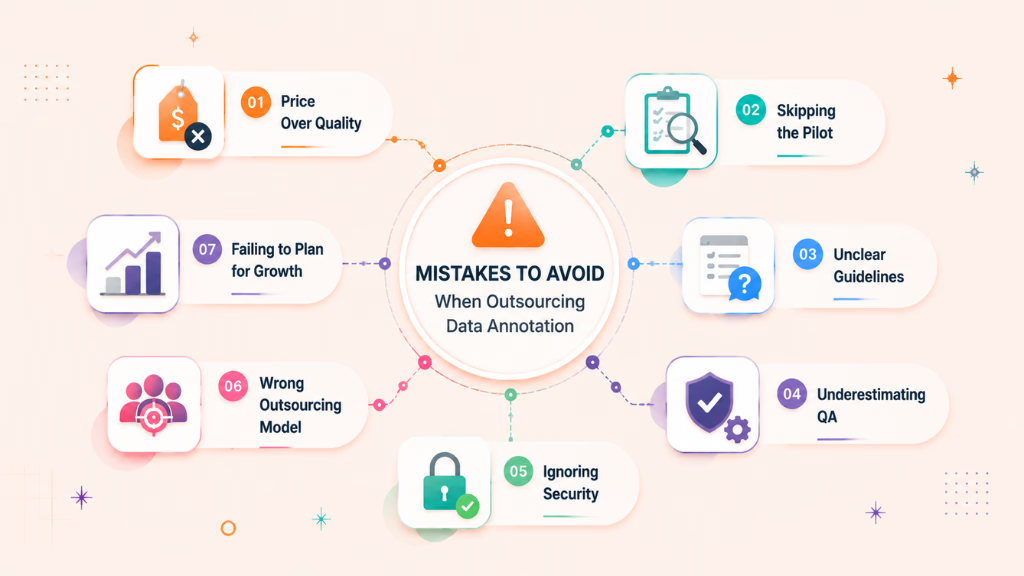
Choosing Based Only on Price
A low annotation rate can become expensive if poor-quality data requires extensive rework.
Skipping the Pilot
A pilot allows you to identify problems before they affect a large dataset.
Using Unclear Guidelines
Even experienced annotators cannot produce consistent results if instructions are vague.
Underestimating QA
Quality assurance should be part of the workflow from the beginning.
Ignoring Security
Sensitive datasets should not be transferred until security requirements have been reviewed.
Choosing the Wrong Outsourcing Model
Crowdsourcing may work well for simple image classification but may not be appropriate for sensitive medical or financial data.
Failing to Plan for Growth
Your provider should be capable of increasing annotation capacity as your AI project expands.
Why Choose Riseup Labs for AI Data Annotation Outsourcing?
Finding the right data annotation partner means balancing quality, scalability, security, expertise, and cost.
Riseup Labs’ data annotation services are designed to help businesses prepare structured and consistently labeled data for AI and machine learning applications.
For businesses that need external annotation capacity, working with an outsourcing partner can reduce the burden of recruiting, training, and managing a large internal annotation team.
Riseup Labs can support businesses looking for scalable outsourcing solutions and dedicated teams for technology projects.
Conclusion
AI data annotation outsourcing has become an important part of scaling modern AI and machine learning projects.
The right provider can give your business access to trained annotation teams, structured workflows, quality assurance, and scalable capacity without requiring you to build everything internally.
But choosing a provider requires more than comparing prices. Evaluate annotation expertise, QA, security, compliance, scalability, technology, and project management before making a decision.
Start with a clear scope, test potential providers through a pilot, and choose the outsourcing model that fits your project’s complexity and risk.
If you need an external team to prepare high-quality training data for your AI project, Riseup Labs can help you explore a data annotation outsourcing approach built around your requirements.
FAQs About AI Data Annotation Outsourcing
1. What is AI data annotation outsourcing?
AI data annotation outsourcing is the process of hiring an external company or specialized team to label, classify, or organize data for AI and machine learning applications. The data can include images, video, text, audio, documents, and 3D datasets.
2. Why do companies outsource data annotation?
Companies outsource data annotation to access trained teams, scale production, reduce operational overhead, speed up data preparation, and avoid building a large internal annotation workforce.
3. What types of data can be annotated?
Common types include images, video, text, audio, speech, documents, 3D data, LiDAR, and sensor data. The specific annotation method depends on the AI application.
4. How do annotation providers maintain quality?
Providers can use detailed guidelines, annotator training, secondary reviews, gold-standard datasets, consensus checks, random audits, and continuous feedback to maintain annotation quality.
5. How much does AI data annotation outsourcing cost?
The cost varies depending on data type, annotation complexity, volume, quality requirements, domain expertise, turnaround time, and security requirements. A pilot project can help establish a more accurate estimate.
6. Is outsourced data annotation secure?
It can be, provided the provider has appropriate security controls. Businesses should evaluate encryption, access controls, audit logs, data segregation, confidentiality policies, data retention, and relevant compliance requirements.
7. Should I use a dedicated team or managed annotation service?
Dedicated teams are useful for large, long-term, sensitive, or complex projects. Managed services are more suitable when you want the provider to handle most of the annotation workflow and project management.
8. Can data annotation outsourcing support specialized industries?
Yes. Specialized annotation can support industries such as healthcare, finance, legal, automotive, retail, and insurance when the provider has the required domain expertise and security processes.
9. Should I run a pilot before outsourcing a large dataset?
Yes. A pilot helps evaluate accuracy, consistency, turnaround time, communication, QA performance, and whether the provider can follow your annotation guidelines.
10. How do I choose the right AI data annotation provider?
Compare providers based on their experience with your data type, QA methodology, security practices, scalability, workforce expertise, technology, pricing, references, and contract terms. Avoid making the decision based on price alone.
This page was last edited on 13 August 2026, at 3:05 pm

Start a conversation with our team to solve complex challenges and move forward with confidence.