
- AI Transformation Journey
- 5 Stages of the AI Transformation Journey
- Stage 1: Awareness & Readiness
- Stage 2: Experimentation & Validation
- Stage 3: Integration & AI Adoption
- Stage 4: Optimization & Scaling
- Stage 5: Transformation & Reinvention
- In Which Stage You Are?
- What Makes the Journey Successful?
- Business Strategy
- People & Culture Transformations
- Reliable Data & System
- Governance & Security
- Performance Measurement
- Why Do Businesses Get Stuck
- How Do You Measure the Progress
- Where Should You Start AI Journey
- Frequently Asked Questions
- Final Thoughts
AI tools are everywhere. But 88% of organizations are still in the early stages of their AI transformation journey. Here you’ll learn how to become one of the 12% making real progress with AI.
Almost every department in your company is using AI in its daily activities. The majority of them are using AI chatbots. Some of them have built their own AI assistant to boost their productivity. Some have even tried to automate workflows. Everything sounds very impressive and promising.
When the monthly review arrives, customer complaints still take too long to resolve. Employees keep moving information between systems. And your finance lead asks a fair question: “What has actually helped to increase revenue?”
That’s where I say, using AI tools for one thing. And starting the AI transformation journey is completely different.
An AI transformation journey is the progression from exploring artificial intelligence to making it a useful part of everyday business operations and decisions. It often moves through five broad stages: awareness and readiness, experimentation and validation, integration and adoption, optimization and scaling, and transformation and reinvention. The goal is not to use more AI. It is to deliver better business results.
But here is the part many businesses miss: You cannot judge progress by the number of AI tools your employees use. You need to know what has changed for customers, teams, costs, or performance (outcomes).
What Is an AI Transformation Journey?
An AI transformation journey is the ongoing process of changing how an organization works with artificial intelligence. It starts with understanding business problems. Over time, it can lead to redesigned workflows, connected systems, new employee responsibilities, and better decisions.
The word ‘journey’ matters. A pilot might take a few weeks. Business transformation takes continued learning, investment, and adjustment.
Think about an online store. An AI chatbot that answers “Where is my order?” is useful. But customers may still wait while an employee checks a delivery system, contacts a courier, and approves a refund.
Now imagine AI can retrieve the right order information, identify a delayed shipment, suggest an approved next action, and send unusual cases to a person. That changes the workflow, not just the first reply.
For a broader explanation of AI’s role in business outcomes, understanding the complete AI digital transformation may help a lot. Whether you will need an AI transformation or not depends on your business needs and which stages you’re currently in.
Where to Start the Transformation Journey?
Assess your current readiness and identify which AI opportunities deserve attention first.
5 Stages of the AI Transformation Journey
These five stages are a practical way to understand progress from starting the journey to continuous improvements. Remember, these are not a universal certification or a rigid checklist. They align with a commonly described progression from awareness to transformation:
| Stage | What is happening? | Evidence that you’re moving forward |
| 1. Awareness & Readiness | Leaders understand the opportunity and examine current capabilities. | A clear business problem, owner, and readiness gaps |
| 2. Experimentation & Validation | Teams test a focused AI use case. | Results against a baseline and a decision to continue or stop |
| 3. Integration & Adoption | AI becomes part of real business workflows. | Reliable production use and employees adopting the process |
| 4. Optimization & Scaling | Proven workflows improve and expand. | Sustained KPIs and repeatable operating practices |
| 5. Transformation & Reinvention | AI helps change how the business creates value. | New or fundamentally redesigned capabilities with measurable outcomes |
Important Note: Data security, training, and measurement must continue across all five stages. You do not finish governance in Stage 1 and forget about it until something breaks.
Stage 1: Awareness & Readiness
At this stage, business leaders begin asking whether AI can solve problems worth paying attention to. At Riseup Labs, we started AI transformation by prioritizing high-impact AI use cases based on our real problems, expected value, and available resources.
The starting point is not a list of popular AI tools. It is the work your organization does today. You need to assess where employees repeat the same steps. Where do customers wait? Which decisions rely on scattered information? Where do errors create extra costs?
Consider a customer support operation. The team may receive hundreds of delivery questions. Before buying a chatbot, the manager should understand how those questions are handled, how often they become complaints, and why agents cannot resolve them faster.
Then comes readiness. Check the basics:
- Processes: Do you know how the current work actually happens?
- Data: Is the information accurate, available, and properly controlled?
- Systems: Can the tools involved share information reliably?
- People: Do teams understand the proposed change and their responsibilities?
- Risk: What could go wrong, and who can intervene?
An organization does not need perfect systems to begin. But it does need to know which weaknesses could make an AI project unsafe or ineffective.
This is also where leadership should agree on an outcome. “We want to use AI” is not an outcome. “We want to reduce the time customers spend waiting for an accurate order update” is much closer.
I would like to suggest you can start the transformation journey by naming a real business problem, identifying an accountable owner, describing today’s baseline, and explaining the main readiness gaps.
If the answers are unclear, that is also useful information. Sometimes the smartest first move is improving a process or cleaning up data, rather than launching an AI pilot.
Stage 2: Experimentation & Validation
You have identified a problem in the previous stage. Should you invest in the full-scope AI solution without any evidence? No, first you need to follow a structured AI proof of concept to test your idea and measure its potential value.
This is where controlled pilots, proofs of concept, or proofs of value become useful. The aim is to learn with limited exposure before committing to a larger rollout.
For our online store, the team might test an assistant that retrieves order status from approved data and drafts answers for a small group of agents. Humans review the responses before customers receive them.
The team should define success before the test:
- What is the current average handling time?
- How often are answers accurate?
- How many cases require an employee to correct the AI?
- Are customers getting a better experience?
- Does the improvement justify the expected cost and risk?
A nice demo does not answer these questions. It only shows what the tool can do under the conditions of the demo. Real business work has missing data, unusual customers, changing policies, and the occasional order that appears to have gone on a sightseeing trip.
Do not force AI into every problem. If a straightforward rule or a better approval process is cheaper and more reliable, use that instead.
At the end of the pilot, make a decision: continue, improve, or stop. Stopping an unsuitable pilot can protect time and budget. It is not automatically a failure.
Stage 3: Integration & AI Adoption
After completing an AI pilot successfully, you need to operationalize it. So that you can transform promising experiments into real business outcomes for everyday operations.
An assistant that works with sample data may struggle when it must handle live records, changing permissions, busy systems, and thousands of requests. A pilot is not production just because someone changed its label.
The online store now needs more than a response generator. The assistant may need approved access to order records, delivery updates, and customer history. It also needs clear limits on what it can do without a person’s approval.
Successful integration usually involves four changes:
- Systems connect. AI can work with relevant, authorized business information.
- Workflows change. Teams remove unnecessary handoffs instead of adding AI as another step.
- People adapt. Employees receive training and understand when to review or override AI output.
- Responsibility becomes clear. Someone owns performance, security, incidents, and improvements.
This organizational side matters. In a 2026 McKinsey survey, 70% of respondents said they felt personally ready to use AI, while only 27% of a surveyed leader subgroup believed their organizations were ready for the needed changes. The research covered 750 AI-using respondents; organizational readiness was asked of 608 leaders. It is a survey of these groups, not a count of all companies.
From this research, I found that employees may learn AI faster than a company changes its workflow with AI.
Stage 4: Optimization & Scaling
Now the business has something useful running. The next challenge is to make it consistently better and, where appropriate, available to more teams.
This stage is not about copying the first pilot into every department. It is about learning which parts can be reused and where the workflow needs to change. So, you need to move forward by making very smart decisions while maintaining proper AI strategy.
Our online store might discover that the assistant handles simple delivery updates well but struggles with damaged items or refund exceptions. The team can improve data access, adjust approval rules, train employees, and measure performance again.
Only after the process proves reliable should leaders consider expanding it to other support channels or related workflows.
Useful questions include:
- Are response times improving without reducing accuracy?
- How often does the AI require human correction?
- Has employee workload changed helpfully?
- Can another team reuse the same controls and integration patterns?
- Are running costs still reasonable as usage grows?
This is also a good time to improve documentation, monitoring, security reviews, and support ownership. These may not be the most exciting parts of AI. They are often the parts that keep the exciting bits working on Tuesday morning.
Ready to move on? The organization can repeat successful practices, demonstrate sustained results, and manage more than one AI-enabled workflow without starting from zero each time.
Stage 5: Transformation & Reinvention
Optimization helps a business do existing work better. Reinvention asks a bigger question: What can we now offer or accomplish that was difficult before?
For the online store, the goal might shift from answering delivery complaints faster to preventing many of those complaints. Connected systems could identify likely delivery problems, notify customers early, and recommend approved resolutions before someone needs to ask for help.
That is a change in the service model, not simply an improvement to a chatbot.
At this stage, AI may influence how teams collaborate, how services are designed, how decisions are supported, and how the organization competes. People still need clear accountability. Greater automation does not remove the need for judgment, safety controls, or customer trust.
McKinsey describes a related progression through three broader horizons: enablement, automation, and reinvention. Its distinction is useful: Giving people AI tools is different from changing the company’s operating model.
What does success look like? Business outcomes remain strong, AI supports important workflows, and the organization can adapt as customers, risks, and technology change.
There is no graduation ceremony for AI transformation. Businesses keep learning, measuring, and adjusting.
Which Stage of the AI Transformation Journey Is Your Business In?
You do not need a complicated maturity report to begin this conversation. Start with the statement that sounds most like your organization.
| If this sounds familiar… | Your likely starting point | Your next question |
| “We talk about AI, but we have no agreed business case.” | Stage 1 | Which business problem is worth solving? |
| “We have several AI pilots, but little evidence of value.” | Stage 2 | Which pilot deserves to continue? |
| “A pilot works, but it is not part of normal operations.” | Stage 3 | What data, workflow, and ownership changes are missing? |
| “AI works in one team, but expansion is difficult.” | Stage 4 | What can we improve and reuse safely? |
| “AI helps us redesign services and decisions across the business.” | Stage 5 | How do we sustain and extend that advantage? |
This is an illustrative self-assessment, it helps you start a discussion, not assign your company an official grade. If you really want to learn the next step of your AI transformation journey, let’s figure it out together.
What Makes an AI Transformation Journey Successful?
All stages we have discussed above will help you to identify your progress on the AI transformation progress of your business. But you still don’t know how to reach the destination on this journey.
In the Q2 & Q3 townhall event, the CEO and Founder of Riseup Labs, Ershadul Hoque explained why most of the companies live in the early stage of the AI transformation journey.
“Less than 25% of organizations are deeply transforming their businesses with AI. The problem isn’t access to AI tools or budget; it’s the foundation. If your data isn’t ready, your people aren’t trained, and your AI agents aren’t prepared, AI won’t transform your business. It will simply become another expense.”

So building a solid foundation is very important when you are starting your transformation journey. Here are a few points we improved when we started our AI transformation journey at Riseup Labs.
Business Strategy and Leadership Alignment
Every significant AI initiative should have a business owner and an intended business outcome. Leaders need to agree on what matters: faster service, fewer errors, better decisions, revenue growth, reduced risk, or capacity for higher-value work.
Without that agreement, teams may build impressive solutions that nobody needs to operate.
People, Skills, and Management Transformations
Employees need more than a training video and a login portal. They need to understand how their work will change, which decisions remain theirs, and where to get help. Building an AI-first company culture helps employees understand how to use AI and adapt to new ways of working.
Managers also need time to listen to concerns and explain the new process. Trust grows when people can question AI output and see that problems are corrected.
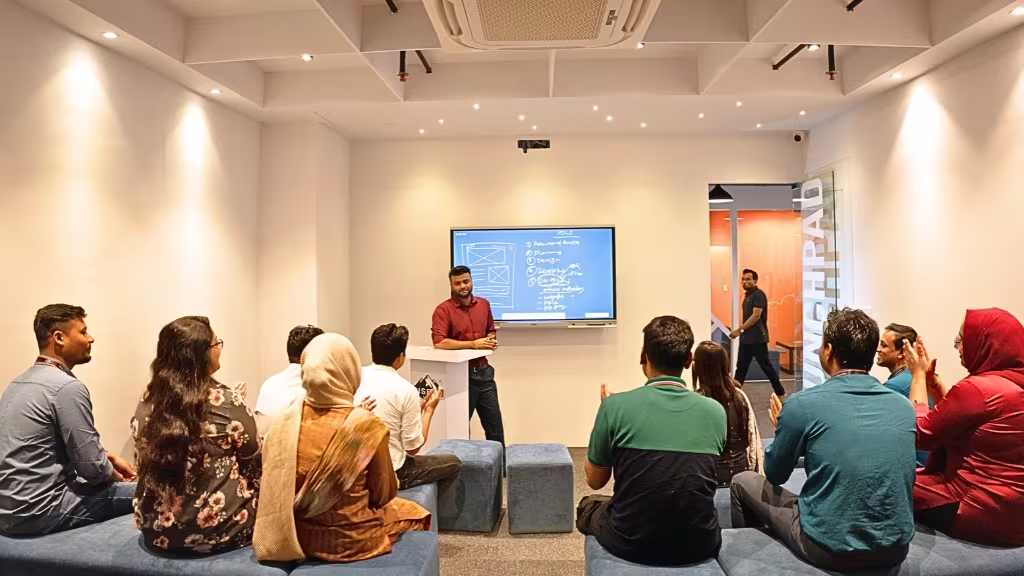
Make Your Team Confident for AI Transformation
Get FREE AI TrainingReliable Data and Connected Technology
Before making AI work for you reliably, AI needs organized, structured, and clean data to ensure the best output from AI.
AI cannot reliably answer an order question if the order data is unavailable or wrong. Relevant information must be accessible to authorized systems, properly maintained, and suitable for the task.
Not every company needs to replace old software. Sometimes the first improvement is a secure connection between systems that already work.
Governance, Security, and Human Oversight
Set controls before sensitive information or automated actions are involved. Define what the system can access, what it can recommend, and what needs human approval.
The US National Institute of Standards and Technology organizes AI risk management around four functions: Govern, Map, Measure, and Manage. Its AI Risk Management Framework is voluntary guidance that businesses can adapt to their circumstances.
Performance Measurement and Continuous Improvement
Keep measuring after launching your first AI pilot. AI quality, business conditions, costs, and employee needs can change. A solution that worked well during a pilot may need regular review in production.
Microsoft’s 2026 AI Strategy Roadmap also emphasizes business strategy, technology and data, employee experience, organizational culture, and governance as connected drivers of progress.
These foundations work together. Better technology cannot fully compensate for unclear ownership. And enthusiastic employees cannot fix unreliable data by being extra enthusiastic.
Why Do Businesses Get Stuck During Their AI Transformation Journey?
Getting stuck does not always mean the AI model is bad. Often, the surrounding business process has not changed enough.
Consider three common situations:
- The team starts with a tool instead of a problem. A new assistant launches because everyone is talking about it. Months later, no one can explain the intended business outcome. The next move is to return to the workflow and define what should improve.
- A pilot succeeds, but nobody owns production. The demonstration works with clean test data. Real systems introduce permissions, errors, exceptions, and support needs. The next move is to assign operational ownership and test the full process, not just the AI output.
- Employees use AI, but the old bottleneck remains. A report now takes five minutes to prepare, yet it still waits three days for approval. The next move may be to redesign the approval process. Faster preparation alone does not make the customer wait less.
So before asking “Why haven’t we reached Stage 5?”, ask yourself, “What is preventing this workflow from delivering its next measurable improvement?”
Then you will find a solid direction about exactly what the speed breaker is in your AI transformation journey.
How Do You Measure Progress Through the AI Transformation Journey?
Do not rely only on how many AI accounts your business has purchased or how many employees tried a prompt. These are activity measures. They do not prove business impact. Choosing the right AI performance metrics helps business leaders understand whether their AI investments are delivering real value.
| Business goal | Example measures | What to watch |
| Faster customer service | Resolution time, first-contact resolution | Accuracy and customer satisfaction |
| Less manual work | Minutes per item, rework rate | Human review and exception handling |
| Better decisions | Forecast error, decision turnaround | Data quality and decision accountability |
| More reliable operations | Error rates, downtime, incident frequency | Security and operating cost |
| Sustainable growth | Revenue per process, capacity, service quality | Whether benefits continue at higher volume |
Imagine a support team handling 2,000 inquiries per month. Each takes an average of eight minutes, or roughly 267 staff hours. After redesigning the workflow and introducing appropriate AI assistance, the average drops to six minutes.
That releases about 67 staff hours per month (2,000 inquiries × 2 minutes ÷ 60). But the business should also check answer accuracy, customer satisfaction, review time, and system costs.
And those 67 hours are capacity released, not automatically cash saved. The team might use that capacity to handle more complex cases or improve service quality. Financial savings depend on what the business actually changes.
This is why an honest business case includes a baseline, the cost of running the new process, the expected benefit, and the conditions that must hold for that benefit to appear.
To build a stronger business case, learn how AI delivers real ROI through cost savings, productivity improvements, and business growth.
What Does an AI Transformation Journey Look Like in Practice?
We have seen this distinction between AI use and AI-enabled work inside Riseup Labs itself. In our company, our team moved beyond experimenting with individual tools toward making AI part of everyday operations.
One part of that work was introducing an AI Development Lifecycle (AIDLC) to support activities throughout software delivery. Another was developing Riseup Labs Mission Control (RMC) to connect internal AI agents, knowledge, business systems, and workflows.
The important lesson is not that every company needs the same tools or platform. It is that isolated AI assistance and connected business operations solve different problems.
A company might begin by helping employees finish tasks faster. As the journey develops, it can ask whether work should move differently between teams, systems, and decision-makers.
That shift from helping with tasks to improving the way work flows is what leaders should pay attention to.
One important note here, individual upskill important but it can’t make the transformation. AI transformation requires organizational changes and workflow improvements. It should not be treated as proof of a particular ROI unless that outcome is separately measured and verified.
Where Should Your Business Start Its AI Transformation Journey?
You do not need to start where another company started. Because their workflow, goals, process, people, and everything is different than your company. So choose a next step based on the work already happening in your organization.
If you’re new to AI, identify one business problem worth solving. If you already have AI pilots, check whether they’re delivering measurable results before investing further.
As your business grows, the challenge shifts from testing AI to making it work across teams. That’s why where your business should start with AI often depends on your current challenges, resources, and readiness to scale.
Frequently Asked Questions
Here are a few commonly asked questions about AI transformations we often get from clients:
What Are the Five Stages of the AI Transformation Journey?
One practical model includes awareness and readiness, experimentation and validation, integration and adoption, optimization and scaling, and transformation and reinvention. These describe increasing business maturity, not a mandatory sequence for every organization.
How Do I Know Which Stage My Business Is In?
Examine one important workflow. Is AI being discussed, tested, used in normal operations, improved at scale, or helping create a fundamentally new capability? Your answer provides a starting point. Different departments may be at different stages.
How Long Does an AI Transformation Journey Take?
There is no fixed timeline. A narrow pilot can be much shorter than redesigning several interconnected business processes. Data quality, integration needs, risk, leadership decisions, and employee adoption all affect progress. Measure readiness and outcomes instead of promising a universal completion date.
What is the Difference Between AI Adoption and AI Transformation?
AI adoption means people or teams begin using AI capabilities. AI transformation means those capabilities help change workflows, decisions, services, or the operating model in ways that produce measurable business value. Adoption can support transformation, but it does not guarantee it.
Can a Small Business Start an AI Transformation Journey?
Yes. A smaller business can begin with one costly or repetitive workflow. It does not need to build an enterprise-wide AI platform on day one. The important questions are whether the problem is worth solving and whether the proposed solution is practical and safe.
Who Should Lead an Organization’s AI Transformation Journey?
An accountable business leader should own the desired outcome, supported by the people who run the process and those responsible for technology, data, security, and change. The exact team depends on the scope. Leaving everything to IT can make business ownership unclear.
What is the Biggest Challenge in Moving from AI Pilots to Transformation?
The difficult step is often turning a controlled experiment into a dependable workflow. That requires real data, system connections, operational ownership, employee adoption, and ongoing measurement—not just a model that performs well in a demonstration.
Does Every Organization Need to Complete All Five Stages?
No. The stages are a useful guide, not an official requirement. Organizations can move at different speeds, repeat earlier activities, or develop some capabilities sooner than others. The goal is measurable improvement, not earning a Stage 5 label.
Final Thoughts
Your business does not need another AI initiative without a clear purpose. It needs to understand where value may be hiding, what could prevent progress, and which change deserves attention first.
Start by choosing one important workflow. Measure how it operates today. Talk to the people who run it. Then decide whether AI can improve the result enough to justify the effort, cost, and risk.
At Riseup Labs, we help businesses examine their workflows, identify promising AI opportunities, and build a prioritized transformation plan based on their actual needs.
Free AI Assessment
Don’t Let Your Next AI Project Become an Expensive Experiment
Find where AI can reduce costs, improve efficiency, and deliver measurable business results before investing your time and budget.
Get Your Free AI AssessmentThis page was last edited on 11 November 2026, at 3:05 pm
Start a conversation with our team to solve complex challenges and move forward with confidence.