The best AI image annotation service providers in 2026 are Riseup Labs Voxel51, Labelbox, CloudFactory, and Scale AI. These companies deliver high annotation accuracy, compliance, advanced quality checks, and strong MLOps integration. Vendor choice impacts AI model quality, compliance, and project ROI.
Manual and automated image annotation is central for machine learning projects. In my experience, the success of computer vision in business often depends on quality labeled data—not just advanced models.
Picking the right data labeling company is not simple. The wrong partner can cost you time, money, or data security. The stakes have grown with higher volumes, regulatory scrutiny, and smarter automation.
This guide gives you a clear way to compare the best AI image annotation service providers. Use it to build a shortlist, test solutions, and make confident, fact-based decisions.
What Is an AI Image Annotation Service Provider and Why Does It Matter in 2026?
AI image annotation service providers are companies that tag or label images to train machine learning models. They may use manual, automated, or hybrid workflows, often tailored for computer vision applications.
Choosing the right provider affects your model’s accuracy, bias, scale, and compliance. Poor annotation can delay releases, inflate costs, or embed errors in your AI products. The best data labeling companies support tasks like bounding box, segmentation, and object tracking for images, video, LiDAR, and more.
Core annotation tasks include:
- Bounding box annotation
- Polygon/segmentation annotation
- Keypoint annotation
- Object classification
- Video and LiDAR annotation
Selecting a high-quality annotation partner is critical for ML projects in 2026. Reliable providers offer accurate data, audit-friendly compliance, and strong integration with machine learning pipelines.
How Do AI Image Annotation Services Work? (Step-by-Step Workflow & Technology Overview)
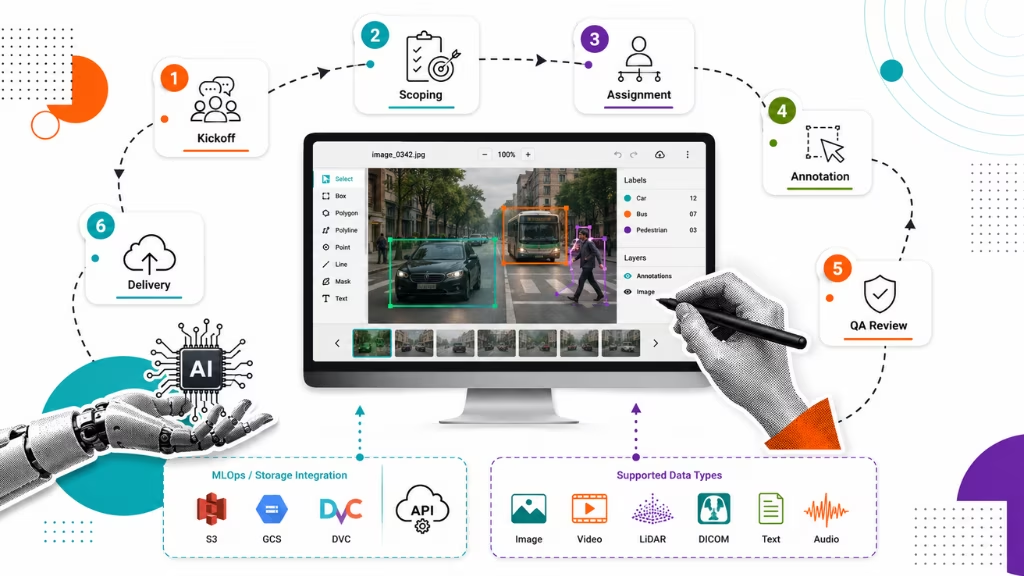
AI image annotation services deliver labeled datasets by following structured project workflows. This process can involve both expert human reviewers and smart automation tools, depending on project needs.
First, clients share their requirements—data types, volumes, and tasks. The provider assigns these files for labeling within a secure tech platform. Human annotators or automated tools then tag the images, followed by quality assurance reviews. Deliverables are packaged and sent back to clients, often ready for direct use in ML pipelines via API or cloud integration.
Typical annotation process:
- Project kickoff: Define goals, data types, and compliance needs.
- Scoping: Estimate volume, complexity, and timelines.
- Task assignment: Distribute data to annotators or automation models.
- Annotation: Humans, algorithms, or both label the data.
- Quality assurance (QA): Multi-step review to catch errors.
- Delivery & feedback: Annotated data transferred to client systems, with option for iterative review.
- MLOps integration: Connect output to platforms like S3, DVC, or GCS for training cycles.
Providers may offer manual, automated, or hybrid models. Manual is best for high-complexity or compliance cases, while automated works for simple, large datasets. Hybrid approaches mix both for efficiency and quality.
Common supported data types:
- Images (JPEG, PNG, TIFF)
- Video (frame-by-frame, object tracking)
- LiDAR/3D point clouds
- DICOM (medical imaging)
- Text, audio
Modern annotation service vendors increasingly support “model-in-the-loop” active learning, allowing dynamic re-labeling and feedback during ML training.
Top 15+ AI Image Annotation Service Providers by Features, Pricing & Compliance
This table compares the best AI image annotation service providers across critical factors for 2026. Use it to quickly filter vendors for your needs before deep-diving into profiles.
| Provider | Annotation Types | Key Differentiators | Industries | Compliance | Pricing Model | Integration | Review Rating* |
|---|---|---|---|---|---|---|---|
| Riseup Labs | Image, Video, Text, Audio | Managed teams, automation-assisted workflows, multilevel QA, project management | AI/ML, healthcare, retail, enterprise | ISO 9001, ISO 27001, SOC 2 Type II, PCI DSS | Custom project or dedicated-team pricing | Client tools, APIs, cloud and custom workflows | 4.9 (Clutch)* |
| Voxel51 | Image, Video, LiDAR | MLOps focus, open-source, advanced QA | Automotive, research | Insufficient data | Custom, usage-based | Advanced APIs | 4.8 (G2) |
| Labelbox | Image, Video, DICOM | Model-in-loop, API-first, automation | Medical, enterprise | SOC 2, HIPAA | Subscription/usage | Strong APIs | 4.6 (G2) |
| CloudFactory | Image, Video | Large manual workforce, at-scale QA | Multiple industries | SOC 2, GDPR | Volume-based | Standard APIs | 4.7 (Clutch) |
| Scale AI | Image, LiDAR, Video | Compliance, automated QA, regulated-data focus | Automotive, medical, retail | HIPAA, FedRAMP | Custom, large-volume | Enterprise integrations | 4.5 (G2) |
| Hive | Image, Video, Audio | Pre-built models, rapid delivery | Retail, advertising, security | SOC 2 | Per-label | API | 4.4 (G2) |
| AWS SageMaker GT+ | Image, Video, Text | AWS ecosystem, scalable cloud infrastructure | Enterprise | SOC 2, HIPAA | AWS billing | AWS ecosystem | 4.4 (G2) |
| Appen | Image, Text, Audio | Global workforce, multi-data support | Enterprise, research | SOC 2, ISO 27001 | Usage/subscription | Multiple platforms | 4.2 (Clutch) |
| SuperAnnotate | Image, Video, 3D | Hybrid workflow tools, strong interface | Drone, medical | SOC 2 | License/usage | APIs | 4.6 (G2) |
| Cogito | Image, LiDAR, Video | Large annotation workforce, bulk labeling | Insurance, automotive | HIPAA, GDPR | Flexible | API | 4.5 (Clutch) |
| Roboflow | Image, Video | Developer focus, dataset version control | Startups, research | Insufficient data | Free and paid tiers | APIs/toolkits | 4.5 (G2) |
| Kili | Image, Text, Audio | Collaboration and quality-control workflows | Healthcare, finance | SOC 2, GDPR | Usage/license | API | 4.4 (G2) |
| SuperbAI | Image, Video, 3D | QA platform, auto-labeling, scalability | Automotive, drone | SOC 2 | Usage-based | API | 4.3 (G2) |
| Playment | Image, LiDAR, 3D | 3D specialization, strong QA, scalability | Autonomous vehicles | SOC 2 | Usage/enterprise | API | 4.5 (G2) |
| Ango Hub | Image, Video, Text | Flexible deployment and on-premise options | Enterprise, research | HIPAA, GDPR | Usage/subscription | API/on-premise | 4.3 (G2) |
| V7 | Image, Video, 3D | Smart automation, QA and visual pipelines | Medical, automotive, retail | SOC 2, HIPAA | Usage-based | API | 4.6 (G2) |
| Supervisely | Image, Video | ML toolkit, developer community, plugins | Research, education | Insufficient data | License/usage | API | 4.4 (Capterra) |
| Dataloop | Image, Video, LiDAR | MLOps focus, cloud and edge workflows | Automotive, agriculture, retail | SOC 2, GDPR | Usage/subscription | API/cloud | 4.2 (G2) |
| Encord | Image, Video, 3D | Model-in-loop, audits and compliance controls | Medical, security | HIPAA, SOC 2 | Usage-based | API | 4.4 (G2) |
| Keymakr | Image, Video | Quick pilots and scalable annotation teams | Real estate, automotive | GDPR | Volume-based | API | 4.2 (Clutch) |
*Review ratings are current as of 2026, sourced from G2, Clutch, or Capterra.
In-Depth Reviews: Strengths, Weaknesses & Best Uses of Leading AI Image Annotation Companies
1. Riseup Labs: Best for Managed Data Annotation Services
Riseup Labs provides fully managed image annotation services for companies that want to outsource labeling execution, workforce management, quality assurance, and delivery. Its dedicated teams support large or time-sensitive projects without requiring clients to recruit and supervise annotators internally.
Strengths:
- Managed annotation teams with project oversight
- Supports image, video, text, and audio datasets
- Multilevel quality assurance and automation-assisted workflows
- Flexible capacity for pilot projects and large-scale delivery
- ISO 9001, ISO 27001, SOC 2 Type II, and PCI DSS credentials
Weaknesses:
- Not a self-service annotation software platform
- Pricing typically requires a custom project quote
- Less suitable for teams that want complete day-to-day control over annotators
Best for: Companies that need outsourced labeling operations, dedicated teams, quality control, and scalable project delivery.
Quick Verdict: Strong managed-service option for organizations that want annotation work handled by an external team rather than purchasing another labeling platform.
2. Voxel51: Best for MLOps & Advanced QA
Voxel51 focuses on deep integration with ML workflows. It offers open-source tools and advanced QA features. Its active learning options suit dev and data science teams who want pipeline flexibility and custom controls.
Strengths:
- Open-source, modifiable toolkit
- Deep MLOps integration (S3, GCS, DVC)
- Robust active learning and quality assurance
- Strong community and pilot support
Weaknesses:
- May require technical ramp-up
- Not ideal for purely manual labeling needs
- Compliance details may require direct request
Best for: Teams with skilled ML engineers, large R&D projects, and custom workflow needs.
Quick Verdict: Flexible, developer-focused, excellent for complex ML projects.
3. CloudFactory: Best for Scalable Human-in-the-Loop Annotation
CloudFactory provides a large manual workforce and proven scalability for human-in-the-loop annotation. I have seen teams benefit from its fast ramp-up and reliable quality control, especially for big multi-domain image projects.
Strengths:
- Human-in-the-loop at enterprise scale
- Cost-effective for large datasets
- Supports rapid onboarding and multi-industry use
- SOC2, GDPR alignment
Weaknesses:
- Less advanced automation/model-in-the-loop features
- Not always the best fit for highly regulated (medical) data
Best for: Scaling large labeling projects with strict manual QA.
Quick Verdict: Reliable at scale, strong for manual accuracy.
4. Labelbox: Best Platform for Automation & Integration
Labelbox excels with an API-first approach, modern UI, and automation tools. I have seen teams get value from model-in-the-loop features and robust integration support. Its platform fits businesses needing flexibility and developer productivity.
Strengths:
- Easy API and workflow integration
- Model-assisted and active learning features
- Diverse data type support, including DICOM and videos
- SOC2 and HIPAA compliance
Weaknesses:
- Usage pricing can escalate on big datasets
- Deep automation features may need extra onboarding
Best for: Teams using diverse data formats, integration-heavy ML pipelines.
Quick Verdict: Leading choice for automated, integrated annotation workflows.
5. Scale AI: Best for High-Volume & Regulated Industries
Scale AI brings tight compliance and rapid turnaround, built for regulated verticals. Its robust QA processes and automation work well for autonomous vehicle, retail, and medical applications.
Strengths:
- Industry certifications (HIPAA, FedRAMP)
- Secure, enterprise-grade infrastructure
- Advanced QA and automation
- High-volume data handling
Weaknesses:
- Custom pricing, sometimes less transparent
- Integration may require technical adaptation
Best for: Companies in highly regulated spaces with massive, ongoing annotation needs.
Quick Verdict: Gold standard for compliance and scale, especially in critical industries.
6. Hive: Fast Delivery for Media, Retail, Security
Hive offers pre-built models and rapid annotation for images, audio, and video. It suits companies in retail ads and security that need fast, template-driven outputs.
Strengths:
- Ready-to-use models for common visuals
- Fast, per-label pricing
- SOC2 compliance
Weaknesses:
- Less customized for niche/domain-specific data
- May lack in-depth QA options
Best for: Retail, digital ads, and security use cases with straightforward labeling.
Quick Verdict: Efficient and fast, best for common annotation tasks.
7. AWS SageMaker Ground Truth Plus: Integrated Cloud Annotation
AWS SageMaker Ground Truth Plus is tightly bound to the AWS ecosystem. It suits teams already managing data and workloads in AWS, especially for cloud-based computer vision workflows.
Strengths:
- Strong cloud scalability and reliability
- Automated quality assurance
- HIPAA and SOC2 compliance
Weaknesses:
- Requires AWS environment
- Can be complex for first-time users
Best for: Enterprises entrenched in AWS cloud systems.
Quick Verdict: Practical for AWS-centric ML programs.
8. Appen: Worldwide Data Labeling Capacity
Appen provides a global annotation workforce, serving various data types at scale. Its coverage and compliance fit enterprise and research-grade projects.
Strengths:
- Large, distributed team for scale
- Offers many data/media types
- SOC2, ISO27001 security certifications
Weaknesses:
- Varying review ratings on quality
- Automation options not as advanced as peers
Best for: Enterprises, research institutions needing broad capability.
Quick Verdict: Versatile option for multinational, high-volume annotation.
9. SuperAnnotate: Visual Pipeline and Hybrid Workflows
SuperAnnotate stands out for its user-friendly interface and hybrid (human-machine) workflow flexibility.
Strengths:
- Effective UI for collaborative projects
- Customizable pipelines
- Quickly supports multi-format data types
Weaknesses:
- Primarily SaaS, on-prem support limited
Best for: Visual data projects spanning images, video, and 3D.
Quick Verdict: Intuitive choice for teams valuing visual workflow clarity.
10. Cogito: Cost-Effective with Indian Annotation Talent
Cogito provides cost-effective annotation using a qualified workforce, especially strong on insurance, automotive, and bulk labeling tasks.
Strengths:
- Manual QA focus
- HIPAA, GDPR awareness
- Flexible project engagement
Weaknesses:
- Limited automation/tooling
- Integration options more basic
Best for: Firms needing manual annotation or price-sensitive projects.
Quick Verdict: Sensible for manual-heavy, high-volume annotation on a budget.
11. Roboflow: Developer Toolkit with Dataset Version Control
Roboflow appeals to ML engineers and startups that need versioning, pre-processing, and labeling tools.
Strengths:
- APIs and pipelines for developers
- Simple onboarding for small teams
Weaknesses:
- Scale suitability depends on project
- Compliance status unclear—ask for certificates
Best for: Startups, internal data science teams running experiments.
Quick Verdict: Agile toolkit for developer-driven projects.
12. Kili: Collaboration and Quality for Complex Data
Kili blends collaboration, QA, and support for text, image, and audio labeling, with a focus on privacy and transparency.
Strengths:
- Collaborative platform, strong QA
- SOC2, GDPR compliance
Weaknesses:
- Pricing can increase with complexity
Best for: Teams valuing communication and joint project visibility.
Quick Verdict: Solid for mid- to large-scale, regulated data projects.
13. SuperbAI: Automation-Focused with QA Highlights
SuperbAI excels with a strong automation platform, active QA, and scalable deployment.
Strengths:
- Smart QA features
- High scalability for enterprise projects
Weaknesses:
- Advanced automation may require setup
Best for: Fast-turnaround, large-scale annotation needing consistent QA.
Quick Verdict: Great for companies seeking automated QA alongside high volume.
14. Playment: 3D/LiDAR Annotation for Autonomous Vehicles
Playment is tailored for complex 3D, LiDAR, and video annotation, making it highly used in autonomous driving.
Strengths:
- 3D/LiDAR support
- Advanced QA for complex vectors
Weaknesses:
- Focused on narrow use cases
Best for: Automotive, robotics, advanced vision projects.
Quick Verdict: Best-in-class for 3D and LiDAR annotation.
15. Ango Hub: Flexible Deployment
Ango Hub offers flexible deployment, including on-premises, supporting teams with privacy or data residency needs.
Strengths:
- Deploys cloud or on-premises
- HIPAA, GDPR enabled
Weaknesses:
- Smaller client base
Best for: Enterprises with strict data control or localized legal needs.
Quick Verdict: Flexible deployment, good for privacy-sensitive sectors.
V7, Supervisely, Dataloop, Encord, Keymakr
For these providers, key strengths include smart automation, strong active learning (V7), developer communities (Supervisely), cloud/edge options (Dataloop), compliance-driven annotation (Encord), and quick ramp-up bulk projects (Keymakr).
Quick Verdict: Each matches different niches, from on-prem/cloud flexibility to speed on bulk projects.
Key Criteria for Choosing the Best AI Image Annotation Service Provider
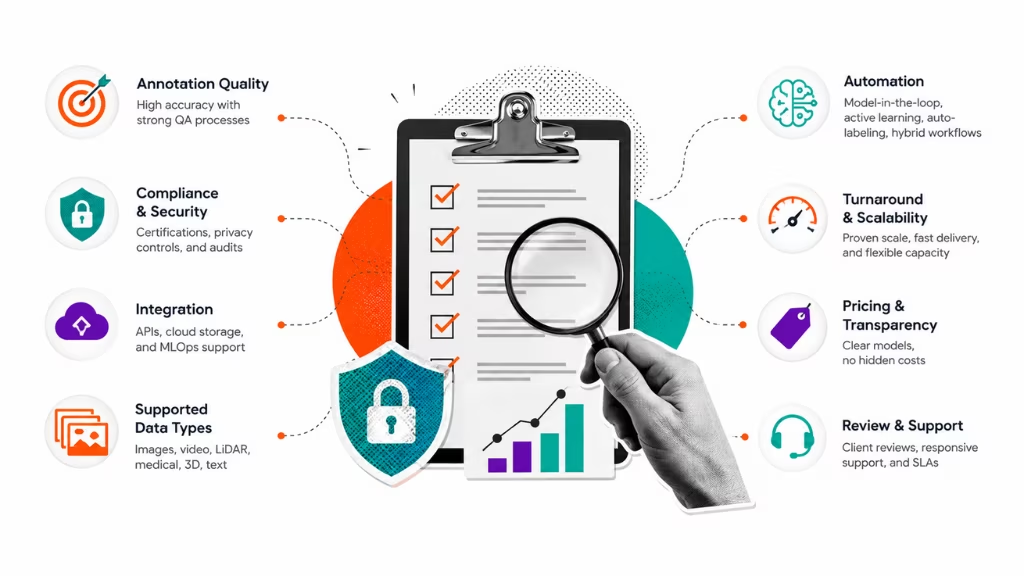
Choosing the best AI image annotation service provider matters for cost, quality, compliance, and future scaling. In my POV, I always urge teams to focus on these main criteria rather than lowest price.
Key evaluation factors:
- Annotation Quality: Review quality assurance methods, human oversight, and accuracy guarantees.
- Compliance & Security: Confirm industry certificates (HIPAA, SOC2, GDPR), process audits, encryption, and privacy controls.
- Integration: Check MLOps pipeline support (API, S3, DVC, GCS), platform compatibility, and workflow automation.
- Supported Data Types: Ensure the provider handles your use cases (video, LiDAR, medical, 3D, text).
- Automation: Assess model-in-the-loop, active learning, auto-labeling, and hybrid workflow options.
- Turnaround & Scalability: Look for evidence handling your dataset size, batching needs, and variable demand.
- Pricing & Transparency: Compare models (hourly, per-label, subscription), upfront clarity, and hidden fees.
- Review & Support: Seek real client reviews (Clutch, G2), direct support, and SLAs.
Checklist to shortlist vendors:
- Can they prove annotation accuracy above 98%?
- Are they certified for your required compliance?
- Do they offer integrations you use (cloud, APIs)?
- Do they support your task types and data formats?
- What is the average project turnaround?
- Is support responsive and US/EU-based if needed?
- Can they run an initial pilot project?
How to Test, Pilot, and Successfully Deploy an Image Annotation Vendor (Step-by-Step)
Running a pilot with an annotation company has saved teams I have worked with from costly mistakes. A small test project reveals fit, quality, and workflow snags before a big spend.
Step-by-step guide:
- Scope your pilot: Pick a sample dataset that covers key edge cases and data types.
- Define metrics: Set targets for accuracy, turnaround, and error rates.
- Onboard securely: Vet data privacy, user access, and platform security before sending files.
- Run annotation task: Let the vendor label the sample, using your success criteria.
- Review results: Check sample output for accuracy, consistency, and blind spots.
- Feedback loop: Provide comments, request fixes or clarity in edge cases.
- Workflow test: Validate API or integration fit with your pipeline. Resolve IT/security questions.
- Check support: Rate response times, communication, and issue handling.
- Make a go/no-go decision: Only scale after these steps are met.
What you’ll need:
- Sample dataset
- Success metric definition
- Privacy and compliance checklist
- Integration test plan
Confirm the process, communication, and QA before full deployment. Never skip the pilot phase if accuracy or compliance matters.
Industry-Specific Use Cases & Success Stories in Image Annotation Outsourcing
Different industries have special annotation needs and compliance constraints. I have seen that picking a domain-matched provider makes project launch, review, and audit far smoother.
Medical Imaging:
- HIPAA-compliant DICOM annotation for diagnostic AI
- Example: Hospitals use Labelbox and Scale AI for privacy-anchored medical labeling
Autonomous Vehicles:
- LiDAR, 3D, and multi-sensor object tracking, with frame-by-frame workflow
- Example: Playment and Scale AI serve leading auto brands with high-accuracy LiDAR annotation
Retail/CPG:
- Product classification and shelf tracking from store photos
- Example: Hive and CloudFactory handle large retail datasets, powering smarter checkout AI
Robotics:
- Navigation, surface, or segmentation annotation
- Example: Supervisely and Dataloop support robotics clients with complex data and advanced labeling tooling
Security/Surveillance:
- Crowd counting, object detection, event tagging in video footage
- Example: Hive delivers fast annotation for large security video networks
Match your project to providers with proven domain fit and samples or case studies relevant to your needs.
What Are the Top Trends & Innovations in AI Image Annotation for 2026?
The annotation market in 2026 is faster, more automated, and shaped by stricter compliance rules. Last year when our dev team evaluated new vendors, these trends made a real impact.
Biggest trends:
- Widespread auto-labeling with foundation models (few-shot learning for scale)
- Rise of hybrid annotation blending AI and human review
- More advanced QA (model-in-the-loop, annotator scoring)
- Privacy-first setups (FedRAMP, on-prem, granular audit trails)
- Deep MLOps integration (plug-and-play APIs, cloud connectors)
- Platform interoperability—easier migration and vendor switching
Teams need vendors who are both consistent with today’s best practices and agile for these coming shifts.
The Top Mistakes to Avoid When Selecting an AI Image Annotation Partner
I have seen teams waste months or risk compliance on these common mistakes. Avoiding them will save time and budget.
- Prioritizing lowest price over validation of quality controls
- Overlooking compliance (HIPAA, SOC2) for regulated data
- Skipping the pilot project or not reviewing vendor references
- Underestimating the complexity of workflow integration
- Relying on “black box” vendors with little or no external reviews
A better approach:
- Always request proof of process, not just sales pitches.
- Look for real security, accuracy metrics, and public review feedback.
- Insist on a demo or pilot before long-term commitment.
Conclusion
Choosing the right AI image annotation service provider impacts your model’s success, quality, and business ROI. The stakes in 2026 are higher than ever—volumes are growing, as are privacy and regulatory pressures. In my experience, disciplined evaluation is vital.
To prepare your team:
- List your required data types, compliance needs, and ML integrations.
- Build a vendor shortlist using criteria and the comparison table above.
- Contact top picks for demo sessions.
- Run a focused pilot for at least one project.
- Ask for client references and security proof before full rollout.
The quality of labeled data is the foundation of any successful computer vision model. By choosing the best AI image annotation service providers now, you set the stage for trustworthy, scalable, and audit-ready AI development.
Partnering with the right experts is the fastest way to future-proof your computer vision and machine learning projects.
FAQs
How do I choose the best AI image annotation service provider?
Compare providers on annotation quality, compliance, supported data types, MLOps integration, pricing, reviews, and support. Run a pilot project before scaling.
What is the difference between manual and automated image annotation?
Manual annotation uses trained humans for labeling, ideal for complex or regulated tasks. Automated annotation uses AI, best for large, simple datasets. Hybrid models mix both.
How are accuracy and quality ensured in image annotation services?
Vendors use multi-step quality checks, human reviews, and model-in-the-loop audits to prevent errors. Always ask for their QA protocols before signing.
What does HIPAA or SOC2 compliance mean for annotation vendors?
HIPAA and SOC2 compliance ensure the vendor uses strict data privacy, security controls, and regular audits, important for regulated or sensitive data.
What pricing models do annotation providers use?
Common models include per-label, hourly, subscription, or volume-based. Some offer custom quotes for large or complex projects. Always clarify costs upfront.
Can annotation services be integrated into my MLOps pipeline?
Most top providers offer APIs and connectors for integration with machine learning and data ops pipelines (e.g., S3, DVC, GCS).
Which providers support specialized data types like LiDAR or DICOM?
Look for Scale AI, Playment, Labelbox, SuperAnnotate, and Dataloop for LiDAR/3D. Labelbox, V7, and Ango Hub support DICOM and medical imaging.
How do annotation service providers protect data privacy and security?
They use encryption, access controls, private cloud or on-premises deployments, and follow compliance rules (HIPAA, SOC2, GDPR) for secure handling.
What is the process for running a pilot project with an annotation company?
Send a test dataset, define accuracy and turnaround goals, check results, provide feedback, and confirm integration and support before large-scale rollout.
What are the latest trends in AI image annotation for 2026?
Trends include more automation and hybrid workflows, advanced quality automation, stricter compliance, on-prem deployment, and smoother platform migration options.
This page was last edited on 1 August 2026, at 3:26 pm

Start a conversation with our team to solve complex challenges and move forward with confidence.