Scaling customer onboarding has never been more complex—or more critical. As products, regulations, and user expectations grow, manual onboarding processes struggle to deliver fast, engaging experiences at scale.
The challenge: High churn rates, rising support costs, and inconsistent implementation often plague onboarding. Teams need a way to provide every new user with seamless, personalized guidance—without ballooning headcount or sacrificing compliance.
The promise: AI automation for customer onboarding streamlines each touchpoint, adapts to every user, and delivers measurable business value. This guide lays out a step-by-step framework, tool comparisons, and industry insights to empower you in building a future-ready onboarding engine.
What you’ll achieve: Deep understanding of trends, actionable frameworks, and a clear path to shorten time-to-value, boost retention, and optimize resource spend—across any industry.
What Is AI Automation for Customer Onboarding?
AI automation for customer onboarding is the use of artificial intelligence to streamline, personalize, and manage the end-to-end onboarding process, reducing manual work while improving user engagement and retention.
AI onboarding blends automation technologies—like smart workflow engines, chatbots, and adaptive content queues—to accelerate setup, guide customers, and resolve problems proactively. It integrates with the broader customer journey, starting at sign-up and extending to feature adoption and support.
Key benefits:
- Removes bottlenecks from the onboarding experience
- Adapts onboarding steps dynamically to each user
Core technologies include:
- Natural language processing for understanding user queries
- AI-powered workflow automation
- Integration with customer data platforms
AI onboarding automation sits at the center of the modern customer lifecycle, bridging the gap between first touch and product mastery.

Why Automate Customer Onboarding?
Automating onboarding delivers measurable gains in retention, speed, and efficiency. Organizations see faster time-to-value, reduced churn, and cost savings when they integrate AI-driven onboarding workflows.
Quantifiable Benefits of AI Automation in Onboarding
| Benefit | Typical Impact (2025/2026 Benchmarks) |
| Churn Reduction | 15–30% decrease in onboarding-related churn[1] |
| Faster Time to Value | 40–60% reduction in onboarding duration[2] |
| Onboarding Completion | 25–50% higher walkthrough completion rates[3] |
| Cost Savings | 20–40% reduction in support and admin costs |
| Personalization & Scale | Context-aware flows for every user, any locale |
Retention & Churn: Companies using AI onboarding report lower dropout rates and increased lifetime value, thanks to guided workflows and proactive engagement.
Cost Savings: Workflow automation reduces manual tasks, scales support, and redeploys team resources to value-adding activities.
Personalization & Global Reach: AI adapts each interaction, recognizing user role, geography, or industry, resulting in higher engagement—no more generic “one size fits all.”
“Since streamlining onboarding with AI, our time-to-first-value dropped by 45%—and NPS rose by double digits.”
— Customer Success Lead, SaaS Financial Platform (2025 survey)
How Does AI Work in the Customer Onboarding Journey? (Step-by-Step Visual Framework)
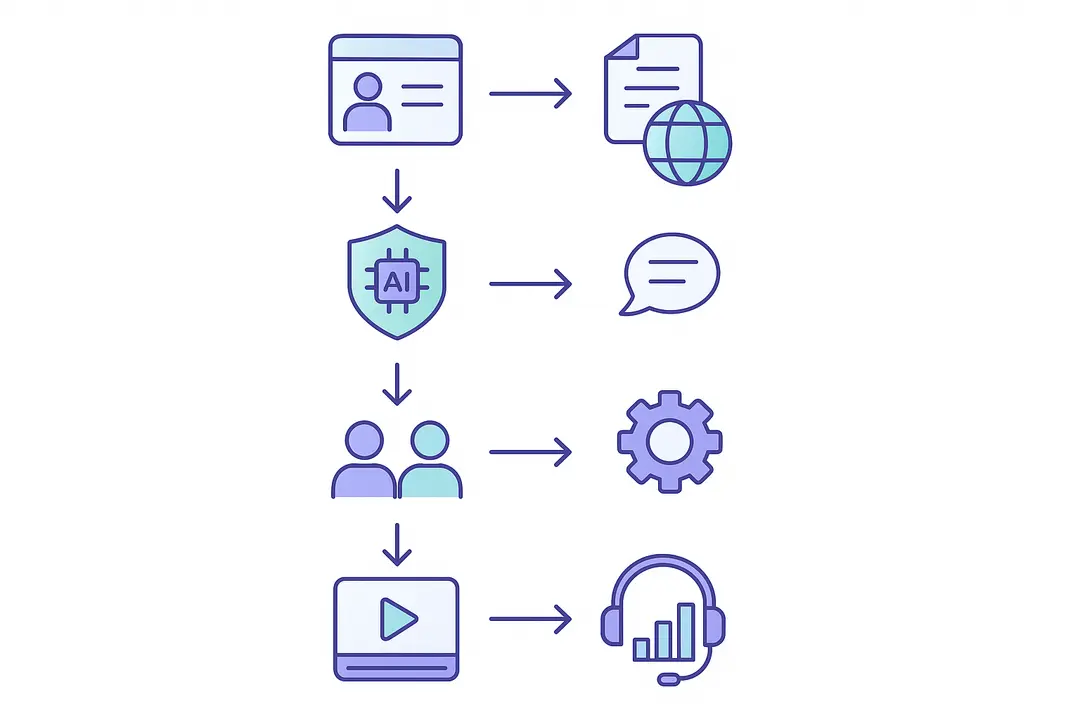
AI automates customer onboarding through a series of intelligent, data-driven steps covering sign-up, setup, training, and support—creating a streamlined, adaptive customer journey.
Below is a breakdown of the core stages, where AI and workflow automation drive efficiency and personalization at every point.
AI Onboarding Journey Overview
- Sign Up & Data Collection
- Personalized Welcome & Orientation
- Role-Based Account Setup
- Training & Feature Adoption
- Ongoing Support & Analytics
Let’s explore each step.
Sign Up & Data Collection
AI accelerates sign-ups with automated data capture and secure identity verification. This supports compliance-heavy industries like finance and healthcare, where Know Your Customer (KYC) steps are mandatory.
- Automated form population and validation
- AI-driven document recognition and fraud detection
- Regulatory compliance checks (e.g., KYC, AML for financial services)
Example: A banking app uses AI to auto-verify identity documents within seconds, eliminating manual review and expediting account access.
Personalized Welcome & Orientation
AI crafts adaptive welcome flows based on user type, location, or behavior profile. New customers receive unique, relevant greetings and curated resource previews that fast-track value discovery.
- Dynamic “Welcome” scripts (multilingual as needed)
- Tailored orientation modules based on industry, role, or intent
- Adaptive next-step prompts
Example: SaaS platforms send a personalized onboarding video based on the features each customer selected during sign-up.
Role-Based Account Setup
Modern onboarding tools use AI to pre-configure user roles, permissions, and dashboards. Logic-driven pathways help customers choose the best journey while ensuring critical steps aren’t missed.
- Automated role assignment and content access
- Scenario-based “Choose your journey” flows
- Integration prep for enterprise accounts
Practical note: This step is crucial for B2B products with multiple user personas or complex account structures.
Training & Feature Adoption
AI-driven tutorials, interactive walkthroughs, and chatbots guide users through key actions—raising engagement and confidence. Progress tracking and timely nudges maximize completion.
- Interactive product tours offered by AI onboarding tools
- Self-serve knowledge bases and support bots
- Automated reminders to complete essential milestones
Insight: According to Wyzowl (2026), interactive onboarding modules boost feature adoption rates by 30%+ compared to static guides.
Ongoing Support & Analytics
Even after onboarding, AI keeps users engaged with proactive support and real-time analytics.
- Automated support escalation based on user sentiment or behavior
- In-app feedback collection and sentiment analysis
- Continuous improvement cycles (live A/B testing, instant updates)
Example: Healthcare platforms deploy AI to prompt users for feedback after every training milestone, feeding insights directly into product development.

Which AI Tools & Platforms Lead in 2026?
Selecting the right AI onboarding platform requires comparing features, integrations, and ease of use—all essential for delivering a transformative onboarding experience. Below is a practical comparison of leading onboarding automation tools.
Side-by-Side Feature Table
| Tool | Top Features | Integrations | Pricing Range | Best for |
| OnRamp | Workflow automation, analytics, AI-driven personalization | Salesforce, HubSpot, Slack | $$$ | Complex, multi-role B2B onboarding |
| WalkMe | No-code onboarding flows, user analytics, in-app guidance | CRM, HRIS, Custom APIs | $$–$$$ | Enterprise SaaS & CX |
| UserPilot | Feature adoption, NPS tracking, customizable modules | Product analytics tools | $$ | Product-led SaaS onboarding |
| Frigade | API-first onboarding workflows, progress tracking | Engineering stacks | $$ | Developer-centric tools |
Note: Prices and integrations reflect 2026 industry standards. Reference each provider’s documentation for tailored plans, demo access, and community feedback.
Implementation Experience
- OnRamp: Known for robust analytics, flexible integrations, and strong compliance support. “Setup was intuitive; the visual workflow builder saved weeks of dev time.”
- WalkMe: Praised for low-code, customizable flows that empower teams to launch without engineering bottlenecks.
- UserPilot: Valued by Product Owners for rapid iteration and effective feature adoption tracking.
- Frigade: Preferred by technical teams needing deep integration into existing developer workflows.
Reviewing user forums and real-world case studies consistently highlights two factors: ease of setup and the availability of role-based, multilingual onboarding templates.
How Can AI Personalize and Localize Onboarding at Scale?
AI-driven onboarding creates tailored user experiences by adapting content, flows, and messaging to each individual’s role, location, and behavior. This ensures every customer feels understood—no matter their language, industry, or product familiarity.
Personalization Strategies
- Role-Based Journeys: AI tracks user-selected roles during sign-up, then delivers relevant modules and resources unique to sales, admin, end user, etc.
- Behavioral Adaptation: AI analyzes user interaction data mid-onboarding, dynamically adjusting tutorials, pace, and help prompts.
- Segmentation: Automated user grouping enables targeted onboarding for enterprise vs. SMB, or novice vs. advanced users.
Localization and Multilingual Onboarding
- AI Language Models: Onboarding flows and documentation are translated and contextually adapted into multiple languages.
- Locale-Specific Compliance: Region-based workflows factor in legal and cultural requirements (e.g., KYC in the EU vs. US).
- Accessible Content: AI personalizes onboarding for users with varying abilities or technology access levels.
Case Example:
A global healthcare SaaS firm implemented AI-enabled onboarding across five languages, cutting onboarding time by 50% for non-English speakers and raising CSAT by over 20%.
How Do You Measure Success? (Key Onboarding Metrics & Feedback Loops)
Defining and tracking the right onboarding metrics ensures your automation delivers real business value and continuous improvement. Analytics and feedback loops surface bottlenecks, highlight impact, and drive optimization.
Essential Customer Onboarding KPIs
| Metric | What it Measures | Why it Matters |
| Time to First Value (TTV) | How fast a customer achieves success | Predicts retention & ROI |
| Onboarding Completion Rate | % of users finishing all steps | Signals process clarity |
| Engagement Rate | Active participation in onboarding | Correlates with long-term use |
| Net Promoter Score (NPS) | Willingness to recommend onboarding | Overall satisfaction |
| Customer Health Score | Composite of usage, engagement, & risk | Early churn predictor |
Setting Up Analytics & Feedback Loops
- Dashboards: Use onboarding tools to monitor completion, drop-off, and sentiment in real time.
- Surveys & In-App Feedback: Automate short surveys after milestones or key events.
- Sentiment Analysis: AI reviews open feedback for signals of frustration or delight.
Pro Tip: Regularly iterate onboarding processes using data from both quantitative metrics and qualitative feedback.
What Is the Day 0 to Day 30 Implementation Roadmap?
Deploying AI onboarding automation is most effective when following a structured, 30-day roadmap—from strategy to continuous improvement.
Day 0–7: Discovery, Tool Selection & Buy-In
- Define onboarding objectives and KPIs
- Audit your current onboarding process
- Evaluate and shortlist AI onboarding tools/platforms
- Secure stakeholder commitment (product, CS, compliance, IT)
Day 8–14: Workflow Mapping & Pilot Creation
- Map the onboarding journey for each user segment
- Build a pilot workflow using your chosen tool
- Prep data integrations (CRM, product analytics, identity)
Day 15–21: Testing, Training & Compliance
- Run internal tests with sample users
- Conduct staff/admin training
- Validate compliance with data privacy/KYC as required
Day 22–30: Go-Live, Monitor & Optimize
- Launch with a controlled user subset
- Monitor metrics and capture early feedback
- Iterate quickly—adjust content, pacing, or messaging
What Pitfalls to Avoid? (Common Challenges & Troubleshooting Tips)

Even the best AI onboarding projects face pitfalls—knowing them in advance helps avoid costly setbacks.
Common AI Onboarding Pitfalls
- Over-Automation: Removing every human touch can make onboarding feel robotic. Retain live support or personal check-ins at critical stages.
- Poor Data Quality: Inaccurate or siloed data undermines workflow logic and personalization.
- Integration Friction: Misaligned tech stacks or lack of API support can delay go-live.
- Regulatory Compliance Gaps: Especially in finance/healthcare, missing KYC or data protection steps can lead to risk.
Troubleshooting Tips
- Collaborate closely with IT and compliance early
- Pilot with a small cohort before full rollout
- Build in human “fallback” options (e.g., live chat)
- Regularly review feedback and adjust workflows
Real-World Case Studies: AI Onboarding Success Across Industries
Cross-industry adoption of AI automation in onboarding delivers measurable wins—in SaaS, finance, and healthcare alike.
SaaS: ChurnZero Boosts User Adoption
A leading SaaS company implemented ChurnZero’s AI-driven onboarding, automating product tours and sending adaptive reminders based on user activity. Result: 35% higher onboarding completion, 20% reduction in churn, and NPS up by 15 points.
“Personalized onboarding flows doubled our trial conversion in six months.”
— Customer Success Manager, ChurnZero client
Financial Services: OnRamp Simplifies KYC
A global bank deployed OnRamp to automate KYC document checks, drastically cutting time-to-activate. Fraud risk dropped, while user satisfaction increased, thanks to multilingual support and real-time help bots.
Healthcare: Multilingual, Compliance-Friendly Onboarding
A healthcare SaaS expanded globally, using UserPilot to launch AI-localized onboarding in seven languages—including accessible content for different user roles. Result: onboarding time halved for new clinics, and CSAT jumped by 18%.
Each of these cases demonstrates the tailored application of AI onboarding workflows and their tangible impact on efficiency, compliance, and user delight.
Frequently Asked Questions: AI Customer Onboarding Essentials
1. What is AI automation for customer onboarding?
AI automation for customer onboarding uses artificial intelligence to streamline critical tasks and processes, providing personalized support and faster product adoption. It reduces manual effort, enhances user engagement, and delivers measurable business value.
How does AI personalize the customer onboarding process?
AI assesses user roles, behavior, and preferences to serve relevant content, tutorials, and support. These dynamic, adaptive flows ensure each customer’s onboarding path suits their needs, location, and goals.
Which AI tools are best for automating customer onboarding in 2026?
Top tools in 2026 include OnRamp, WalkMe, UserPilot, and Frigade. Each offers a distinct blend of workflow automation, analytics, personalization, and integration capabilities suitable for a range of industries and onboarding complexities.
How do you implement AI for onboarding without making it impersonal?
Maintain a balance by combining automated flows with human support options, such as live chat or personalized check-in emails. Segment users for tailored experiences and encourage direct feedback during onboarding.
What key metrics should you track for AI-enabled onboarding?
Critical KPIs include time-to-first-value, onboarding completion rate, user engagement, Net Promoter Score (NPS), and customer health score. These metrics trace process effectiveness and highlight opportunities for continuous improvement.
Is AI onboarding automation suitable for small businesses?
Yes. Many AI onboarding platforms offer scalable, modular solutions with low-code or no-code interfaces, making them affordable and accessible for growing SMBs looking to improve efficiency while scaling their customer base.
How can AI reduce onboarding friction and churn?
AI identifies friction points, triggers in-app guidance, and adapts the onboarding path for struggling users. By addressing issues early and maintaining engagement, AI helps lower early-stage churn.
What are the challenges of AI-automated onboarding?
Common challenges include over-automation (loss of human touch), data quality issues, integration complexity, and ensuring ongoing compliance—especially in regulated industries. Careful planning and workflow testing mitigate these risks.
How to make onboarding multilingual with AI?
Use AI-driven language models to translate and localize onboarding content, flows, and support bots. Context-aware adaptation helps maintain message accuracy and relevance across languages.
What’s the future of AI in customer onboarding?
AI will continue to make onboarding smarter and more adaptive—anticipating user needs, integrating new channels (voice, AR), and driving higher satisfaction and retention across every touchpoint.
Conclusion
AI automation is reshaping customer onboarding—delivering faster time-to-value, higher user satisfaction, and scalable, personalized experiences across industries. By leveraging a strategic framework, proven tools, and practical KPI tracking, you can transform onboarding from a bottleneck to a competitive advantage.
Key Takeaways
- AI onboarding automation increases retention and reduces costs with adaptive, personalized workflows.
- Leading tools in 2026—OnRamp, WalkMe, UserPilot, Frigade—offer robust, industry-agnostic automation.
- Track essential metrics (TTV, completion rate, NPS) and establish feedback loops for continuous improvement.
- Personalization and localization are crucial for global onboarding success, addressing user, role, and language diversity.
- Start with a 30-day, phased implementation plan to accelerate results and minimize risk.
This page was last edited on 23 April 2026, at 5:05 pm

Start a conversation with our team to solve complex challenges and move forward with confidence.