Hiring Python developers in Asia presents a unique strategic edge for tech-driven companies. With global demand for Python soaring—from web development to AI and automation—Asia’s developer market stands out for its scale, cost-effectiveness, and technical breadth. Yet, many hiring managers struggle with finding reliable talent, navigating legal hurdles, and optimizing for quality and efficiency.
This guide eliminates those pain points by providing a step-by-step framework tailored to Asia’s talent landscape. You’ll learn how to minimize risk, optimize costs, and secure high-quality Python developers—supported by tables, regional analysis, checklists, and vetted platform recommendations.
What you’ll get:
- Concrete tables comparing countries by cost, skills, and English proficiency
- Actionable five-step hiring framework
- Legal and IP safeguards explained
- Downloadable checklists and resource templates
- Pro tips for risk, retention, and onboarding
Why Hire Python Developers in Asia?
Asia offers unmatched depth, versatility, and value for hiring Python developers, making it a preferred destination for tech leaders worldwide.
Key advantages of hiring Python developers in Asia:
- Vast Talent Pool: Asia produces more STEM graduates than any other region, fueling a massive supply of Python talent.
- Cost Efficiency: Salaries are often 40–75% lower than in North America or Western Europe for comparable skill levels (per StackOverflow and Hired).
- Broad Technical Skills: Developers skilled in web frameworks (Django, Flask), AI/ML, data science, and automation.
- English Proficiency: Major talent hubs (e.g., India, Philippines, Vietnam) rank high in global English communication indices.
- Timezone Flexibility: Enables 24/7 development cycles and accelerated releases for global teams.
By leveraging Asia’s strengths, companies can accelerate time-to-market, reduce expenses, and access specialized Python skills at scale.
Comparative Advantages by Region: Cost, Talent, and Language
| Country | Avg Python Salary (USD/yr) | Skill Breadth | English Proficiency | Notable Specializations |
| Bangladesh | $7,000–$20,000 | Medium-High | Medium | Web, Scripting |
| India | $10,000–$30,000 | Very High | High | Web, AI/ML, Backend |
| Vietnam | $8,000–$25,000 | High | Medium-High | Web, Data Engineering |
| Philippines | $12,000–$28,000 | High | Very High | Web, QA, Customer-facing |
| China | $18,000–$40,000 | Very High | Medium | AI/ML, Enterprise, Backend |
| Pakistan | $8,000–$17,000 | Medium | Medium | Web, Small/Mid Project Focus |
Note: Salary ranges and English ratings from StackOverflow Developer Survey 2025 and Glassdoor Asia. For the most niche AI or data science roles, expect a 20–40% skill premium in all regions.
Top Countries for Hiring Python Developers in Asia
| Country | Strengths | Weaknesses | Best For | Platform Density |
| Bangladesh | Fast-growing, affordable | Less experience at scale | Startups, web, small teams | Low-Medium |
| India | Deep talent pool, strong English, AI | Turnover risk in metros | Scalable, diverse projects | Very High |
| Vietnam | Consistent work ethic, affordable rates | English variable by city | Cost-sensitive, web/data proj | Medium-High |
| Philippines | Excellent communication, remote savvy | Tech skills cluster | Customer-facing, QA, web | Medium |
| China | World-class ML/AI, large teams | Complex legal/IP issues | AI, enterprise, R&D labs | Medium |
Emerging Markets: Pakistan, Sri Lanka, Indonesia—growing fast, but data on skill density and English proficiency is still limited.
Where Can You Find Python Developers in Asia? Best Platforms & Agencies

Finding trusted Python talent hinges on choosing the right sourcing channel—vetted platforms, agencies, or curated freelance marketplaces.
- Vetted Platforms: Sites like Unicorn.dev and Digiqt specialize in pre-screened, high-skill developers from Asia. Managed processes and guarantees.
- Open Marketplaces: Upwork, Freelancer offer scale and budget flexibility, but require heavier vetting.
- Regional Agencies: Local firms (e.g., Ontik in Bangladesh, Truss in Central Asia) provide staff augmentation or fully managed teams, often with compliance support.
When to choose each model:
- Vetted platforms: For time-critical or high-complexity projects.
- Agencies: When you need local compliance, payroll, or dedicated teams.
- Marketplaces/freelancers: Best for budget or highly flexible, short-term needs.
| Platform/Agency | Vetting Level | Region Focus | Pricing Model | Support Level |
|---|---|---|---|---|
| Riseup Labs | High | Asia (Global Delivery) | Flexible | Managed, Enterprise Support |
| Unicorn.dev | High | Pan-Asia | Hourly/Monthly | Managed, EoR opt |
| Digiqt | High | SE Asia, India | Flexible | Managed |
| Truss | High | Central Asia | Monthly/Project | Compliance, EoR |
| Upwork/Freelancer | Low-Med | Global | Hourly/Project | Minimal, self-serve |
| Ontik | Medium | Bangladesh | Flexible | Agency-managed |
Always review recent client feedback and seek provider guarantees.
Vetted Talent Platforms vs. Marketplaces: Comparison Table
| Model | Pros | Cons | Best For |
| Vetted (e.g., Unicorn.dev) | Quality, support, speed, compliance | Higher hourly rates | Fast start, low risk |
| Agency | Local expertise, team management, EoR | Less control vs. direct hire | Large/team needs |
| Open Marketplace | Flexibility, massive pool, cost control | Risk of poor vetting, quality gaps | Budget, small tasks |
What Is the Step-by-Step Process for Hiring Python Developers in Asia?
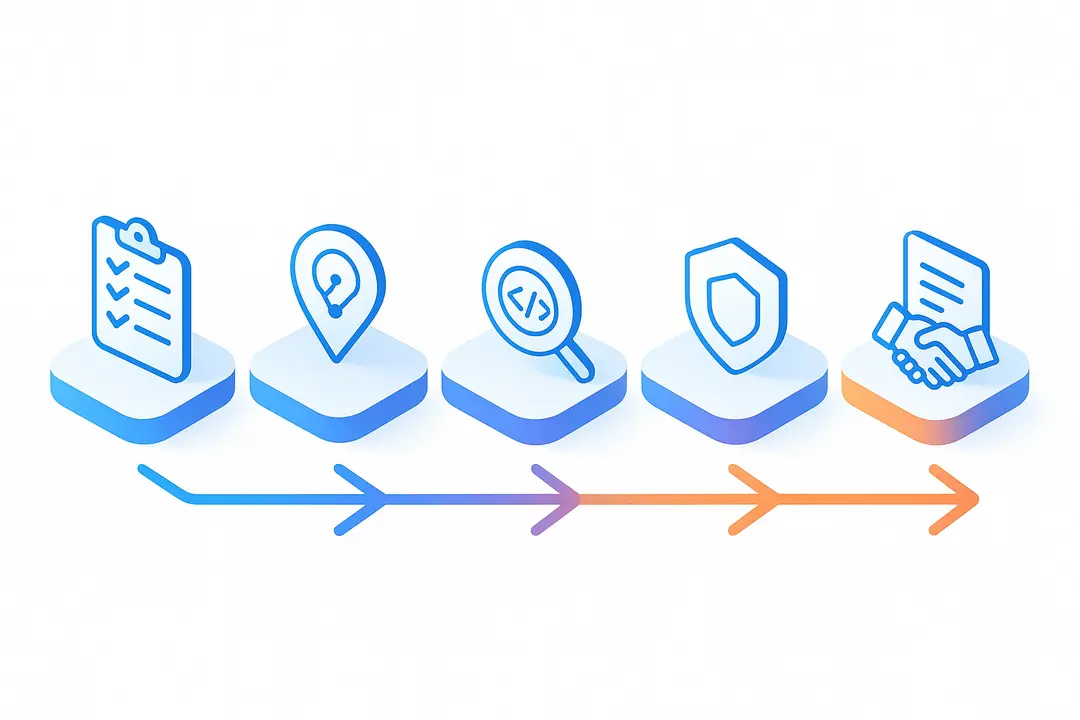
Follow this proven, five-step process to hire Python developers in Asia with confidence:
- Define your project requirements
- Select the right country and platform
- Implement robust vetting and technical assessments
- Address legal, compliance, and IP safeguards
- Make your offer, onboard, and integrate remotely
This checklist-driven approach helps you minimize risks and maximize fit for any Python development need.
1. Define Your Project Requirements
Accurately defining your needs is the first (and most critical) hiring step.
Checklist for defining your Python hire:
- Clarify project scope (web, automation, AI/ML, data)
- Must-have Python skills (Django, Flask, Pandas, NumPy, etc.)
- Experience required (junior, mid, senior)
- Familiarity with your stack (databases, APIs)
- Soft skills (communication, remote work experience)
- Delivery timelines and expected availability
2. Select the Right Country and Platform
Match your requirements to the best-fit regional market and hiring channel.
Decision matrix:
- If strong English and deep talent pool required → India or Philippines + Unicorn.dev/Digiqt
- If cost is critical and the project is less complex → Vietnam/Bangladesh + regional agency
- For AI/ML/data science demands → India or China, vetted platform specialized in niche skills
- High-compliance or payroll needs → Agency with Employer of Record (EoR) offering
3. Vetting and Technical Assessment Strategies
Ensure quality by combining technical vetting with soft skills and real-world proof.
Recommended approach:
- Technical screening: Code sample tests or live coding exercises
- Paid test/mini project: Simulates actual work, reduces hiring risk
- Reference/background checks: Verify past work and reliability
- Communication interview: Assess English and collaboration skills
4. Legal, Compliance, and IP Safeguards
Avoid headaches with robust contracts and regionally compliant hiring.
| Country | NDA/IP Required | Payroll Compliance | EoR Availability | Other Legal Notes |
| India | Yes | Salary/tax reporting | Widely available | Labor laws pro-employee |
| Vietnam | Yes | Local contract basics | Select platforms | Growing EoR ecosystem |
| Philippines | Yes | Payroll strict | Common | Offshore employment allowed |
| China | Yes | Complicated, variable | Fewer options | IP enforcement is complex |
| Bangladesh | Recommended | Local rules apply | Limited | Best via agency |
Key safeguards:
- Always use NDAs and explicit IP transfer agreements
- Prefer EoR (Employer of Record) for full-time hires outside your entity
- Align contracts to local labor requirements
- Ensure international payment compliance (tax and payroll documentation)
5. Make the Offer, Onboard, and Integrate Remotely
Successful onboarding accelerates productivity and retention—but is often overlooked.
Remote onboarding checklist:
- Finalize offer and contract documentation
- Set up payroll, benefits, and legal paperwork
- Provide access to core tools (Slack, Jira, GitHub, documentation)
- Deliver onboarding/training resources (video walkthroughs, team intros)
- Establish meeting cadence and project methodologies
- Encourage feedback and early milestone reviews
How Much Does It Cost to Hire a Python Developer in Asia?

Cost varies by country, skill level, and specialization. Asia consistently outperforms Western markets in cost efficiency.
| Country | Junior (USD/yr) | Mid-Level (USD/yr) | Senior (USD/yr) | AI/ML/Data Science Premium | Sourcing Fees/Hidden Costs |
| Bangladesh | $7,000 | $12,000 | $20,000 | +10–30% | 5–10% |
| India | $10,000 | $18,000 | $28,000 | +20–40% | 8–15% (platform/agency) |
| Vietnam | $8,000 | $14,000 | $22,000 | +20–35% | 5–12% |
| Philippines | $12,000 | $19,000 | $27,000 | +20–30% | 8–15% |
| China | $18,000 | $28,000 | $40,000 | +30–50% | 10–18% |
Additional factors:
- Payroll taxes and benefits vary; usually lower than Western standards
- Agencies/vetted platforms may add a margin or placement fee
- City-level salary variance exists, but country averages are usually sufficient for budgeting
What Are the Risks and Best Practices for Success?
Hiring from Asia is high-reward but comes with unique risks. Plan proactively to ensure smooth, long-term collaborations.
Top risks and mitigations:
- IP leakage: Use clear contracts, NDAs, and proven platforms
- Compliance gaps: Engage EoR or expert local legal partners
- Candidate churn: Employ trial-to-hire periods, offer competitive pay/benefits
- Quality inconsistency: Layer vetting steps, maintain regular code reviews
- Communication breakdowns: Favor countries/teams with strong English and set clear routines
Communication, Cultural, and Time Zone Strategies
Smooth collaboration hinges on clear communication and cultural awareness.
Best practices:
- Use proven tools: Slack, Zoom, Asana, Microsoft Teams
- Establish daily syncs or async updates (adapt to time zones)
- Align on workflows, deadlines, and feedback expectations early
- Foster inclusivity and respect cultural holidays/customs
- Document processes and decisions for distributed access
Training managers in remote collaboration increases team cohesion and reduces misunderstandings.
Managing Quality & Reducing Churn
Retaining top Python talent requires attention to both technical standards and team culture.
Retention checklist:
- Set up regular code reviews and feedback sessions
- Conduct biannual pay/benefits benchmarking
- Recognize achievements publicly (shoutouts, bonuses)
- Provide a clear path for career growth and advanced training
- Treat offshore engineers as integral “core team” members
High retention boosts consistency, lowers costs, and drives better project outcomes.
FAQ: Hiring Python Developers in Asia
What is the average cost to hire a Python developer in Asia?
The average annual salary ranges from $8,000 to $30,000 USD depending on country, experience level, and skill specialization. India and Vietnam are often the most cost-competitive.
Which countries in Asia have the best Python developers?
India, Vietnam, and the Philippines lead for skill breadth, English proficiency, and availability. China excels in AI/ML and enterprise projects but may present complex legal and IP issues.
What platforms specialize in vetted Python talent from Asia?
Leading options include Unicorn.dev, Digiqt, and Truss. These platforms pre-screen developers and offer managed hiring or team-building services.
How do you vet remote Python developers from Asia?
Use a combination of code assessments, paid test projects, reference checks, and live interviews focused on both technical and communication skills.
What legal or compliance steps are needed for Asian hires?
Secure NDAs, clear IP transfer clauses, and use an Employer of Record where possible to ensure payroll and local labor law compliance in the developer’s country.
How do you manage communication across time zones with Asian developers?
Adopt synchronous and asynchronous tools (Slack, Zoom), establish clear routines, and align on expectations from the start to minimize time zone friction.
What are main risks and how to avoid them?
Key risks include IP leakage, compliance failures, and quality inconsistency. Minimize by using robust contracts, multi-step vetting, and managed hiring channels.
Should I use an agency or direct hiring?
Agencies or vetted platforms are best for compliance, quality, and scale. Direct hiring or open marketplaces may suit small, short-term, or budget projects but require more vetting effort.
What onboarding best practices work for remote Asian teams?
Ensure structured documentation, clear tool access, regular check-ins, and early skills support. Invest in remote-first training to accelerate productivity and retention.
How does IP protection work when hiring developers in Asia?
IP protection rests on legal contracts, NDAs, and enforceable IP transfer agreements. Use reputable platforms or agencies familiar with local legal frameworks to safeguard your intellectual property.
Conclusion
Hiring Python developers in Asia allows companies to access world-class expertise, drive down costs, and rapidly scale their tech teams—if done right. By following this framework—country and platform comparison, robust vetting, legal safeguards, and seamless onboarding—you can avoid the most common pitfalls and build lasting engineering partnerships.
Key Takeaways
- Asia’s Python talent market offers a unique blend of cost efficiency, skill scale, and global communication abilities.
- India, Vietnam, and the Philippines are leading destinations, each with distinct strengths.
- Use vetted platforms or agencies for quality, compliance, and reduced risk—especially for longer-term or complex projects.
- Follow a step-by-step hiring process: define, source, vet, secure legally, and onboard intentionally.
This page was last edited on 3 May 2026, at 5:02 pm

Start a conversation with our team to solve complex challenges and move forward with confidence.