
- AI Use Case Prioritization Challenges
- AI Use Cases That Solve Costly Problems
- Assessing AI Business Value Before Investment
- Assessing Feasibility of High-Value AI Use Cases
- AI Use Case Prioritization Matrix
- AI Use Case Prioritization Framework
- AI Use Cases Your Business Should Prioritize
- Avoiding Costly AI Implementation Failures
- Preparing to Execute Your AI Priorities
Only 37% of respondents report that AI has positively contributed to their organization’s earnings, according to a 2026 global AI survey. But what happens when your business invests in AI, and the expected returns never materialize?
You’re still spending heavily on software maintenance. Manual processes continue to eat into your profit margins. Customer complaints are piling up despite increasing service costs.
You know AI could help. But with several business problems demanding attention and a limited budget, how do you decide which one to solve first?
The answer lies in AI use case prioritization. It helps you determine which opportunities can deliver the greatest business value without stretching your budget or exceeding your implementation capabilities.
In this guide, you’ll learn how to assess competing AI opportunities, uncover hidden implementation costs, and use a practical scoring framework to make more confident, financially sound AI investment decisions.
Why Businesses Struggle to Prioritize the Right AI Use Cases
When I look at AI investment decisions from a business perspective, one challenge stands out. Businesses often know where AI could help, but they struggle to determine where it would deliver the most value.
Your software team may want to accelerate product releases. Your operations team may want to reduce processing costs. Your CX team may need to improve service quality without increasing headcount. Each has a valid business case, but which one deserves funding first?
I believe the difficulty with AI use case prioritization comes down to six fundamental challenges:
- Competing Business Priorities: What seems valuable to one department may not address the company’s most urgent business needs. Without strategic alignment, AI investments can become fragmented and deliver limited enterprise-wide value.
- Unrealistic ROI Expectations: I would never recommend evaluating AI investments based solely on employee hours saved. A reliable AI ROI assessment should establish whether those hours can translate into lower expenses, additional revenue, or greater operational capacity.
- Hidden Implementation Complexity: An AI use case may look promising on paper. However, legacy software, fragmented CRM and ERP systems, and poor data readiness can make implementation more expensive than anticipated.
- Overlooking Operational Readiness: Automating an inefficient workflow does not necessarily make it better. Before selecting an AI use case, I would assess process maturity, workforce readiness, and exception-handling requirements.
- Underestimating AI Ownership Costs: Development is only one part of the investment. Businesses must also consider integration, model usage, infrastructure, human oversight, and maintenance when calculating the total cost of ownership (TCO).
- Choosing Easy Wins Over Strategic Value: I understand why businesses prefer AI initiatives that promise quick returns. However, delaying essential software modernization or data infrastructure improvements can limit the feasibility of more valuable AI opportunities.
My recommendation is to establish consistent AI use case evaluation criteria before comparing investment opportunities. A structured AI use case prioritization framework helps businesses balance financial returns, technical feasibility, operational readiness, and long-term strategic value.
“The question business leaders should ask is not how much AI they can implement, but how much business value they can create with the resources they have. Look at where your profit margins are shrinking, where your employees are losing productive hours, and where your customers are losing patience. Start there. You don’t need the perfect technology to make progress. You need the right business problem, a realistic implementation plan, and a clear way to measure success.”

Identifying AI Use Cases That Solve Your Most Expensive Business Problems
Before deciding where to invest in AI, I recommend looking at where your business is already losing money. Review your recurring operational expenses, delayed software releases, manual workloads, service bottlenecks, and customer complaints.
These are often the starting points for an effective AI opportunity assessment.
Instead of asking where your business can use AI, ask yourself the following questions:
- Which business processes consume the most time and resources?
- Where are recurring errors increasing operational costs?
- Which software limitations are slowing down business growth?
- Where are poor customer experiences affecting revenue and retention?
- Which workflows cannot scale without increasing headcount?
The answers can help you identify AI use cases that address measurable business problems rather than perceived technology needs.
| Business pain point | Potential AI use case |
|---|---|
| Rising software development and testing costs | AI-powered software testing |
| Expensive legacy system maintenance | AI-assisted software modernization |
| High manual document processing costs | Intelligent document processing (IDP) |
| Repetitive and resource-intensive operations | AI-powered workflow automation |
| Increasing customer service expenses | AI customer service agents |
| Inconsistent customer service quality | AI-powered quality monitoring |
| Fragmented customer journeys | Omnichannel AI CX solutions |
| Frequent service delays and escalations | AI-powered intelligent routing |
However, I would not recommend AI use case selection based solely on the severity of a business problem. You also need to determine whether AI is the most cost-effective solution.
For example, a business struggling with invoice processing delays may not need generative AI. If its invoices follow a standardized format, rules-based automation may be sufficient. However, if invoices arrive in different formats and languages, intelligent document processing may offer greater business value.
Before shortlisting an opportunity, assess its potential financial impact, measurable outcomes, strategic alignment, and suitability for AI.
Effective AI use case prioritization starts with identifying problems that are worth solving. This prevents unnecessary technology investments and directs your budget toward opportunities with a stronger business case.
How to Assess AI Business Value Before Committing Your Budget
An AI solution may promise significant cost savings, faster service delivery, or greater operational efficiency. But how much of that value will your business actually realize?
I recommend conducting an AI business value assessment before approving any development budget. It helps you determine whether the expected financial and operational benefits justify the investment.
Here are four areas I would evaluate to build a reliable business case for AI.
Quantify the Cost of the Existing Business Problem
Before calculating how much AI could save, determine how much the existing problem is costing your business. Establish a performance baseline using actual financial and operational data.
Focus on expenses such as:
- Software maintenance and defect resolution costs.
- Manual processing and repetitive administrative expenses.
- Customer service delivery and escalation costs.
- Revenue lost through customer churn and delayed service delivery.
- Rework caused by operational errors.
For example, consider a BPO operation that manually processes 20,000 documents every month.
| Cost indicator | Current performance |
|---|---|
| Monthly document volume | 20,000 |
| Average cost per document | $2.50 |
| Monthly processing cost | $50,000 |
| Annual processing cost | $600,000 |
If intelligent document processing (IDP) reduces the cost per document to $1.75, the potential annual cost reduction would be $180,000, assuming the same processing volume.
This gives you a measurable starting point for AI use case evaluation. However, you still need to account for implementation expenses and determine how much of the projected savings can actually be realized.
Estimate Realistic Financial and Operational Benefits
One mistake I would avoid during AI use case prioritization is treating every productivity gain as a financial return.
Suppose AI agent assistance saves your customer support team 1,000 working hours per month. Those saved hours do not automatically reduce your operating expenses. The financial benefit depends on how your business uses that additional capacity.
Can you reduce overtime? Can you handle more customer requests without hiring additional agents? Can you improve customer retention through faster issue resolution?
To estimate realistic AI business value, establish relevant key performance indicators (KPIs) for each business function.
| Business function | Business value metrics |
|---|---|
| Software development | Development costs, release cycle time, defect rates, maintenance expenses |
| BPO and business operations | Cost per transaction, processing accuracy, turnaround time, SLA compliance |
| Customer experience (CX) | Cost per resolution, first contact resolution (FCR), customer satisfaction (CSAT), customer retention |
| AI digital transformation | Operational efficiency, scalability, system interoperability, time to value |
Set a measurable improvement target for each selected KPI. Use historical performance data to support your estimates. Consider employee adoption rates, automation accuracy, and operational limitations.
This approach makes AI value realization easier to track after implementation.
Account for the Full Cost of AI Ownership
The initial development cost rarely represents the entire AI investment. A solution with a relatively low upfront price may become expensive to operate over time.
Before conducting an AI cost-benefit analysis, calculate the total cost of ownership (TCO).
| Cost component | What to consider |
|---|---|
| Development and licensing | AI model selection, customization, software development, subscription fees |
| Data preparation | Data collection, cleansing, labeling, and governance |
| System integration | CRM, ERP, APIs, and legacy software integration |
| Infrastructure | Cloud computing, data storage, and model inference costs |
| Operational expenses | Employee training, workflow redesign, and human oversight |
| Maintenance and governance | Model monitoring, performance optimization, security, and compliance |
For example, an AI customer service agent may have affordable licensing costs. However, connecting it with your CRM, order management system, and existing support channels could require substantial integration work.
I recommend estimating both one-time implementation costs and recurring operational expenses. Include the cost of resolving data readiness and technical feasibility gaps.
Understanding these expenses early helps prevent unexpected costs from weakening your original AI investment strategy.
Evaluate ROI, Payback Period, and Time to Value
A high-return AI investment may not always be the best choice for your business. You also need to consider how long it takes to recover your investment and when you can expect measurable results.
I recommend evaluating three financial indicators during AI use case prioritization:
- Return on Investment (ROI): Measures whether the expected financial benefits justify the total investment.
- Payback Period: Determines how long it takes to recover the initial investment through net financial benefits.
- Time to Value (TTV): Indicates how quickly your business begins experiencing measurable improvements after initiating an AI project.
Based on the standard ROI calculation methodology, businesses can calculate AI ROI using the following formula:
AI ROI (%) = [(Total Financial Benefits − Total Costs) ÷ Total Costs] × 100
For example, suppose your business plans to invest $80,000 in intelligent document processing. The solution requires an additional $40,000 in annual operating costs. It is expected to generate $180,000 in first-year financial benefits.
Based on these projections, your business would achieve:
- First-year total investment: $120,000
- Estimated net financial benefit: $60,000
- First-year ROI: 50%
- Estimated payback period: 6.9 months
These figures are illustrative. The payback estimate assumes consistent monthly benefits and operating costs, with no deployment delays.
However, financial returns tell only part of the story. If the solution requires extensive data preparation or ERP integration, its time to value could increase significantly.
This is particularly important for startups and scaleups that need faster returns to maintain cash flow. Large enterprises may accept longer payback periods when an AI initiative supports long-term strategic objectives.
Are Manual Workflows Costing You?
Automate where your business needs it most.
Explore AutomationCan Your Business Realistically Implement Its Most Valuable AI Use Cases?
Your business can realistically implement a high-value AI use case when it has the necessary data, technical infrastructure, operational readiness, financial resources, and risk controls.
During AI use case prioritization, I recommend conducting an AI feasibility assessment based on six key factors:
- Data Readiness: Assess data availability, accuracy, accessibility, and quality. Poor data readiness can increase preparation costs and reduce AI reliability.
- Technical Feasibility: Evaluate software architecture, cloud infrastructure, APIs, and CRM or ERP integration. Legacy systems may require modernization before implementation.
- Operational Readiness: Assess process maturity, workflow standardization, and employee readiness. Automating inefficient processes can amplify existing problems.
- Resource Availability: Determine whether your business has sufficient funding, technical expertise, and workforce capacity to develop and maintain AI solutions.
- Risk and Compliance: Conduct an AI risk assessment covering data privacy, security, model reliability, regulatory compliance, and human oversight.
- Scalability: Determine whether the solution can support growing transaction volumes, additional users, and complex enterprise workflows.
Beyond these factors, consider the cost of closing feasibility gaps. Additional spending on data engineering, software modernization, or system integration can significantly reduce projected ROI.
If resolving these barriers still supports your expected financial returns, prioritize the necessary improvements. Otherwise, reconsider the investment.
Once you have assessed both business value and implementation feasibility, use an AI use case prioritization matrix to determine which opportunities deserve funding first.
AI Use Case Prioritization Matrix for Smarter Business Investments
An AI use case prioritization matrix is a decision-making tool that categorizes AI opportunities based on business value and implementation feasibility. It helps businesses determine which initiatives deserve immediate investment, require further preparation, or should be deferred.
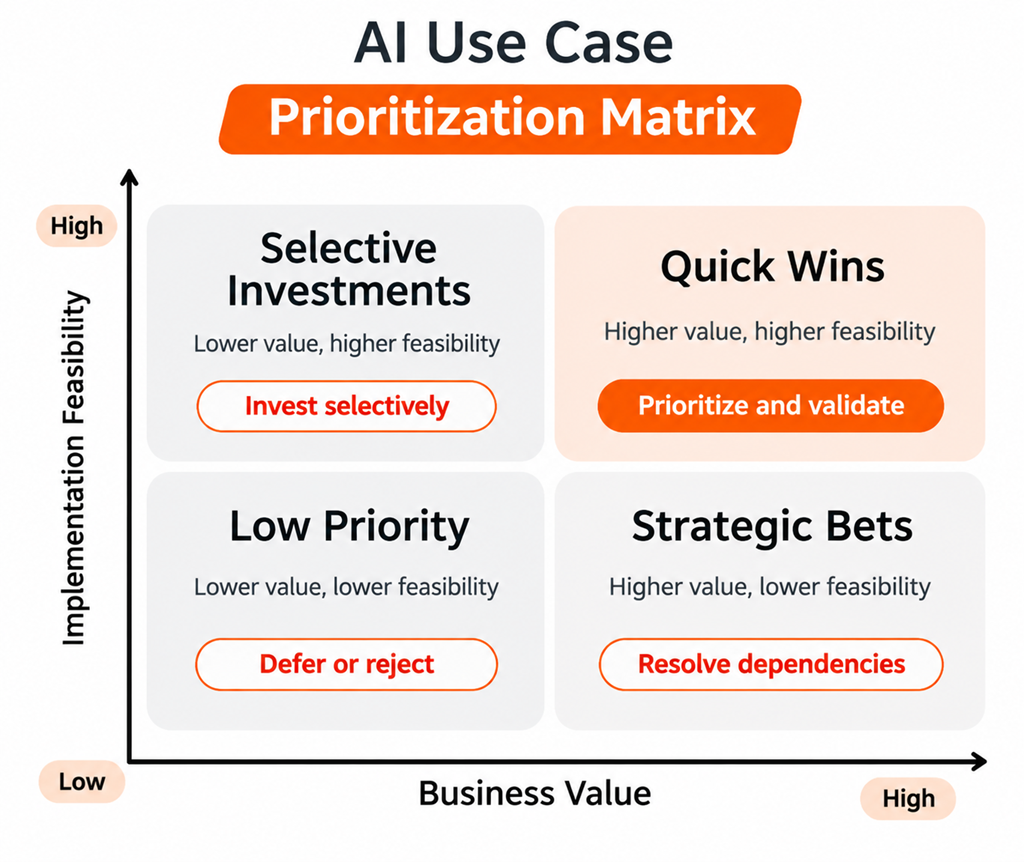
The matrix evaluates AI use cases across two dimensions:
- Business Value (X-axis): Expected financial returns, operational efficiency, customer impact, and strategic alignment.
- Implementation Feasibility (Y-axis): Data readiness, technical capabilities, integration complexity, resource availability, and operational readiness.
Based on these dimensions, you can classify AI opportunities into four investment categories:
1. Quick Wins (High Value, High Feasibility)
Prioritize these AI use cases for validation and implementation. They offer significant business benefits with manageable implementation requirements. For example, intelligent document processing can be a strong investment for a BPO operation with standardized workflows and reliable data.
2. Strategic Bets (High Value, Low Feasibility)
These opportunities offer substantial business value but require additional preparation. For example, autonomous customer service agents may require extensive CRM integration and software modernization. Address these dependencies before committing the full implementation budget.
3. Selective Investments (Low Value, High Feasibility)
These AI use cases are relatively easy to implement but offer limited business returns. An internal AI knowledge assistant with low employee demand could fall into this category. Invest only if the solution addresses a specific business objective or supports a more valuable future initiative.
4. Low Priority (Low Value, Low Feasibility)
These opportunities require considerable resources without sufficient financial or strategic justification. Developing complex AI-powered software features with limited customer demand is one example. I recommend deferring or rejecting such initiatives to avoid unnecessary expenditure.
During AI investment prioritization, I would not reject a high-value opportunity simply because its current feasibility is low. Resolving shared data, software, or integration barriers may make several valuable AI initiatives possible.
A Practical AI Use Case Prioritization Framework for Business Leaders
An AI use case prioritization framework is a structured approach to evaluating, scoring, and ranking AI opportunities. It helps businesses allocate budgets and resources based on measurable business value, implementation feasibility, strategic alignment, and risk.
I recommend following these six steps to make informed AI investment decisions across software, BPO, and customer experience.
Step 1: Establish Business-Specific Investment Criteria
Start by defining what makes an AI investment worthwhile for your business. Your evaluation criteria should reflect your financial objectives, operational challenges, and long-term business strategy.
For example, a SaaS company may prioritize faster product releases. A BPO operation may focus on reducing processing costs. A digital-first business may prioritize customer retention and service scalability.
Consider the following AI use case evaluation criteria:
- Expected financial and operational impact.
- Financial viability and investment recovery time.
- Strategic alignment and customer impact.
- Data readiness and availability.
- Technical feasibility and system integration.
- Operational readiness and resource availability.
- Risk manageability.
Before scoring, establish mandatory requirements for data privacy, security, regulatory compliance, and business ownership. Reject or pause initiatives that cannot meet these requirements.
Step 2: Assign Weights Based on Business Priorities
Not every evaluation criterion deserves equal importance. Assign percentage weights based on your business objectives and implementation constraints.
The following weighting model provides a starting point for AI investment prioritization.
| AI Use Case Evaluation Criteria | Weight |
|---|---|
| Financial and operational impact | 25% |
| Financial viability | 15% |
| Strategic alignment and customer impact | 15% |
| Data readiness | 15% |
| Technical and integration feasibility | 15% |
| Operational and resource readiness | 10% |
| Residual risk manageability | 5% |
| Total | 100% |
This model allocates 55% of the total weight to business value and 45% to implementation feasibility.
I recommend adjusting these weights according to your business priorities. A startup facing cash flow constraints may place greater emphasis on financial viability. An enterprise undergoing AI digital transformation may prioritize technical feasibility and strategic alignment.
These weights are illustrative, not established industry benchmarks.
Step 3: Score AI Use Cases Using Measurable Evidence
Evaluate each shortlisted AI opportunity using a consistent scoring scale. Base your scores on financial records, operational KPIs, data quality assessments, and technical evaluations.

Use the following five-point scoring scale:
- 1 (Very Low): Significant barriers or unfavorable conditions.
- 2 (Low): Substantial improvements are required.
- 3 (Moderate): Viable with reasonable preparation.
- 4 (High): Favorable conditions with strong supporting evidence.
- 5 (Very High): Highly favorable conditions with well-supported evidence.
For example, an intelligent document processing solution may receive a data readiness score of five if the business has accurate, accessible, and representative document records.
An autonomous customer service agent may receive a technical feasibility score of two if it requires extensive CRM integration and legacy software modernization.
For risk manageability, a higher score indicates better control over remaining risks.
Avoid assigning high scores based on assumptions alone. Record any uncertainties that require further investigation.
Step 4: Calculate and Compare AI Use Case Prioritization Scores
Once you have scored each criterion, calculate the overall weighted score. This AI use case scoring model follows the principles of weighted Multi-Criteria Decision Analysis (MCDA).
AI Use Case Prioritization Score (%) = Σ [(Criterion Score ÷ 5) × Criterion Weight (%)]
For example, consider a business evaluating AI-powered document processing for its back-office operations.
| Evaluation Criteria | Weighted Score |
|---|---|
| Financial and operational impact | (5 ÷ 5) × 25% = 25% |
| Financial viability | (4 ÷ 5) × 15% = 12% |
| Strategic alignment and customer impact | (4 ÷ 5) × 15% = 12% |
| Data readiness | (5 ÷ 5) × 15% = 15% |
| Technical and integration feasibility | (4 ÷ 5) × 15% = 12% |
| Operational and resource readiness | (4 ÷ 5) × 10% = 8% |
| Residual risk manageability | (4 ÷ 5) × 5% = 4% |
| Total Prioritization Score | 88% |
The AI initiative achieves an overall prioritization score of 88% under these hypothetical business conditions.
However, I would not recommend relying solely on the combined score. Calculate business value and implementation feasibility separately by dividing each dimension’s weighted score by its total possible weight.
This produces a business value score of 89.1% and a feasibility score of 86.7%.
Plot these scores on your AI use case prioritization matrix. This prevents strong projected financial returns from concealing critical implementation barriers.
Step 5: Validate Investment Assumptions Before Approving Funding
A high prioritization score does not guarantee successful AI implementation. Your assessment may rely on estimated development costs, projected savings, or untested technical capabilities.
Before approving funding, validate your assumptions through:
- Proof of Concept (PoC): Test the technical viability of the proposed solution.
- Controlled Pilot: Measure performance within representative business workflows.
- Sensitivity Analysis: Evaluate how changes in costs and expected benefits affect ROI.
- Stakeholder Review: Confirm financial estimates, operational requirements, and implementation responsibilities.
For example, an AI document processing solution may offer a projected ROI of 50%. However, unexpected ERP integration costs or higher exception rates could substantially reduce that return.
Update your AI use case assessment whenever new evidence changes the original investment assumptions. This helps prevent costly decisions based on overly optimistic projections.
Step 6: Decide Which AI Use Cases to Fund, Prepare, or Reject
The final step is turning your evaluation results into actionable investment decisions.
- Fund: Prioritize high-value opportunities with sufficient implementation readiness, validated benefits, and acceptable risks.
- Prepare: Resolve data, infrastructure, software integration, or operational barriers affecting high-value opportunities.
- Validate Further: Conduct additional testing when financial or technical evidence remains insufficient.
- Defer: Postpone initiatives that offer limited immediate value or compete with more urgent business priorities.
- Reject: Eliminate opportunities with weak financial justification, unacceptable risks, or no clear advantage over simpler alternatives.
Remember that AI use case prioritization is not a one-time activity. Review your AI portfolio as business objectives, implementation costs, and technical capabilities change.
A well-structured prioritization framework helps you build an AI implementation roadmap based on business needs rather than technology trends.
Free AI Assessment
What’s Next for Your AI Priorities?
Move from use case evaluation to practical implementation.
Explore AI SolutionsWhich AI Use Cases Should Your Business Invest in First?
Your business should prioritize AI use cases that solve urgent business problems, deliver measurable returns, and have manageable implementation requirements.
However, investment priorities vary depending on your business objectives, financial constraints, and operational readiness.
I recommend considering the following business scenarios before making an investment decision:
AI-Powered Software Development and Modernization
Prioritize AI-powered software testing or application modernization if outdated systems, frequent defects, and lengthy development cycles are increasing costs. Assess your existing software architecture and integration capabilities before investing.
AI-Enabled Business Process Automation
Consider intelligent document processing (IDP) and workflow automation if repetitive tasks, manual errors, and high processing costs are reducing profit margins. Start with high-volume, standardized workflows to reduce implementation complexity.
AI-Driven Customer Experience Transformation
Prioritize AI agent assistance, intelligent routing, or customer service automation if rising support costs and slow resolution times are affecting customer retention. Evaluate CRM integration, knowledge base quality, and human escalation requirements before implementation.
AI-Enabled Operational Scalability
Startups and scaleups should consider AI use cases that help them manage growing workloads without proportionally increasing operational expenses. Focus on repetitive processes that consume significant workforce capacity.
Enterprise AI Digital Transformation
If fragmented systems and inaccessible data are restricting AI adoption, prioritize data engineering, software modernization, and system integration. These foundational investments can improve the technical feasibility of multiple future AI initiatives.
Effective AI use case prioritization goes beyond ranking opportunities. Prioritize initiatives with measurable business value and manageable implementation risks. Use early results to guide future investments and build a sustainable AI implementation roadmap.
How to Avoid Costly AI Implementation Failures After Prioritization
Even a high-priority AI use case can fail during implementation. Unexpected integration costs, unreliable model performance, poor employee adoption, and operational disruptions can quickly reduce projected ROI.
To protect your investment, I recommend connecting AI use case prioritization with a structured implementation and validation process.
Consider the following practices before committing to full-scale deployment:
- Validate Technical Feasibility: Conduct a proof of concept (PoC) to test model accuracy, data compatibility, and system integration.
- Run Controlled Pilots: Test AI within real business workflows to identify performance gaps and operational limitations.
- Define Go or No-Go Criteria: Establish measurable success thresholds for cost savings, accuracy, service quality, and operational efficiency.
- Release Funding in Stages: Approve additional investment only when the solution meets predefined business and technical requirements.
- Maintain AI Governance: Conduct regular AI risk assessments. Establish security controls, human oversight, and fallback mechanisms.
- Monitor Realized Business Value: Track actual ROI, employee adoption, and operational performance against your initial AI business value assessment.
For example, an AI customer service agent may reduce human agent workloads. However, an increase in repeat customer contacts could indicate unresolved issues. Scaling the solution at this stage could increase service costs rather than reduce them.
I recommend addressing these performance gaps before approving further investment. Before moving beyond the pilot phase, establish production-level performance requirements, operational responsibilities, and monitoring processes. A structured approach to operationalizing AI after the pilot phase can help your business avoid premature scaling.
Is Your Business Ready to Execute Its AI Priorities?
Identifying high-value AI use cases is only the beginning. Does your business have the technical expertise, data infrastructure, and operational capabilities to implement them? Legacy systems and limited internal resources can delay implementation and weaken projected ROI.
AI digital transformation services can help you address these gaps without building every capability internally. From modernizing legacy software to automating complex business workflows and improving customer experience, specialized expertise can reduce implementation complexity and accelerate time to value.
With the right technology partner, you can turn your AI use case prioritization results into an actionable implementation roadmap, minimize investment risks, and achieve measurable business outcomes.
Free AI Training
Where Should Your AI Budget Go?
Find the AI opportunities that justify your investment.
Let’s ConnectFinal Thoughts
The success of your AI investment depends on which business problems you choose to solve first. Even the most advanced AI solution can become a costly investment without clear business objectives and sufficient implementation readiness.
I recommend approaching AI use case prioritization as an ongoing business decision rather than a one-time assessment. Balance expected ROI with technical feasibility, operational readiness, and strategic alignment.
Start with initiatives that offer measurable business value. Address implementation barriers before pursuing more complex opportunities. Reassess your priorities as business needs and actual performance change.
Ultimately, your AI strategy should not be measured by how many solutions you implement. It should be measured by how effectively those solutions reduce costs, improve customer experience, and support sustainable business growth.
FAQs
Here are answers to common questions about AI use case prioritization to help you evaluate investment opportunities, overcome implementation barriers, and make more informed business decisions.
How should businesses prioritize AI use cases with limited implementation budgets?
Businesses should prioritize AI use cases that address financially significant problems, offer measurable returns, and require manageable implementation resources. A value-feasibility matrix and weighted scoring model can help identify high-impact opportunities. Controlled pilots and phased funding can further reduce financial exposure before businesses commit to full-scale implementation.
How can businesses compare AI investments across software, BPO, and CX?
Businesses can compare AI investments using shared evaluation criteria, including financial impact, strategic alignment, total cost of ownership, implementation feasibility, and risk. Each business function should also have specific performance indicators, such as software development costs, BPO processing expenses, or customer service resolution quality, connected to measurable business outcomes.
Should businesses prioritize AI automation or software modernization first?
Businesses should prioritize software modernization first when outdated architecture, inaccessible data, or integration limitations prevent AI automation from operating reliably. However, if existing systems can support AI and business workflows are sufficiently standardized, targeted automation may deliver earlier returns without requiring extensive modernization.
How do legacy systems affect AI use case prioritization?
Legacy systems can reduce AI implementation feasibility by restricting data accessibility, limiting API integration, increasing development costs, and creating security or scalability challenges. Businesses should assess these dependencies before approving AI investments and determine whether targeted integration or broader software modernization is financially justified.
This page was last edited on 27 November 2026, at 4:32 pm

Start a conversation with our team to solve complex challenges and move forward with confidence.