
Staying ahead in technology is no longer optional, it is essential for survival and growth. As businesses adapt to rapid digital change, understanding the top it outsourcing trends has become critical for making smarter, future ready decisions.
IT outsourcing is evolving quickly, driven by factors such as AI adoption, shifting global talent pools, and increasing security and compliance demands. For CIOs, CTOs, and IT leaders, this creates both opportunity and complexity, requiring a more strategic and proactive approach.
This playbook provides a clear, forward looking view of the top it outsourcing trends shaping the industry. You will gain practical insights, proven strategies, and decision frameworks to help your organization navigate change, reduce risk, and maximize value from outsourcing in the years ahead.
Executive Summary: What Are the Leading IT Outsourcing Trends for 2026?

The leading IT outsourcing trends for 2026 provide CIOs and business leaders with a roadmap for resilience, innovation, and growth. Here are the top trends shaping the future of IT outsourcing:
- AI-First Outsourcing Strategies: Automation, AI development, and prompt engineering become core to contracts and delivery.
- Hybrid Outsourcing Models: Blended in-house, co-managed, and provider-led operating models gain ground for flexibility.
- Cloud Infrastructure Bundling: Organizations embrace multi-cloud and bundled infrastructure outsourcing to boost agility.
- Outsourced Cybersecurity and Compliance: Heightened focus on threat defense, regulatory change, and data sovereignty.
- Verticalization and Sector-Specific Solutions: Providers offer tailored models, tools, and expertise for industries like finance and healthcare.
- Talent Shortages and Global Sourcing: Offshore and nearshore partnerships expand to access scarce skills and manage costs.
- Co-Innovation & Upskilling Partnerships: Outsourcers collaborate on innovation, R&D, and digital capability building.
- Social and Environmental Responsibility: Organizations increasingly weigh ESG factors in outsourcing decisions.
Global IT outsourcing spend is expected to grow steadily through 2027, with APAC and EMEA leading in adoption and innovation (Everest Group, Grandview Research data).
Overview: How Is the IT Outsourcing Market Evolving?
The IT outsourcing market continues its strong growth trajectory, driven by digital transformation demands, remote work, and the need for agile technology delivery.
- Market Size & Growth:
According to Statista and Grandview Research, the global IT outsourcing market is projected to exceed $500 billion by 2027. - Drivers:
- Accelerated digitalization and cloud adoption
- Persistent talent shortages in key geographies
- Escalating security and compliance requirements
- The rise of complex, AI-driven workloads
- Regional Highlights:
- APAC: Leading gains in talent access, competitive cost, and digital services innovation.
- EMEA: Strong adoption in financial services and compliance-driven outsourcing.
- Americas: Focus on co-innovation, high-value managed services, and automation.
| Region | Market Share (est.) | Key Focus Areas |
|---|---|---|
| APAC | 35%+ | Talent access, digital services |
| EMEA | 30% | Compliance, fintech, cloud growth |
| Americas | 30% | Automation, co-managed services |
(Source: Compiled from Everest Group, Statista, Grandview Research)
Understanding Core IT Outsourcing Models: Which Structure Fits Your Needs?
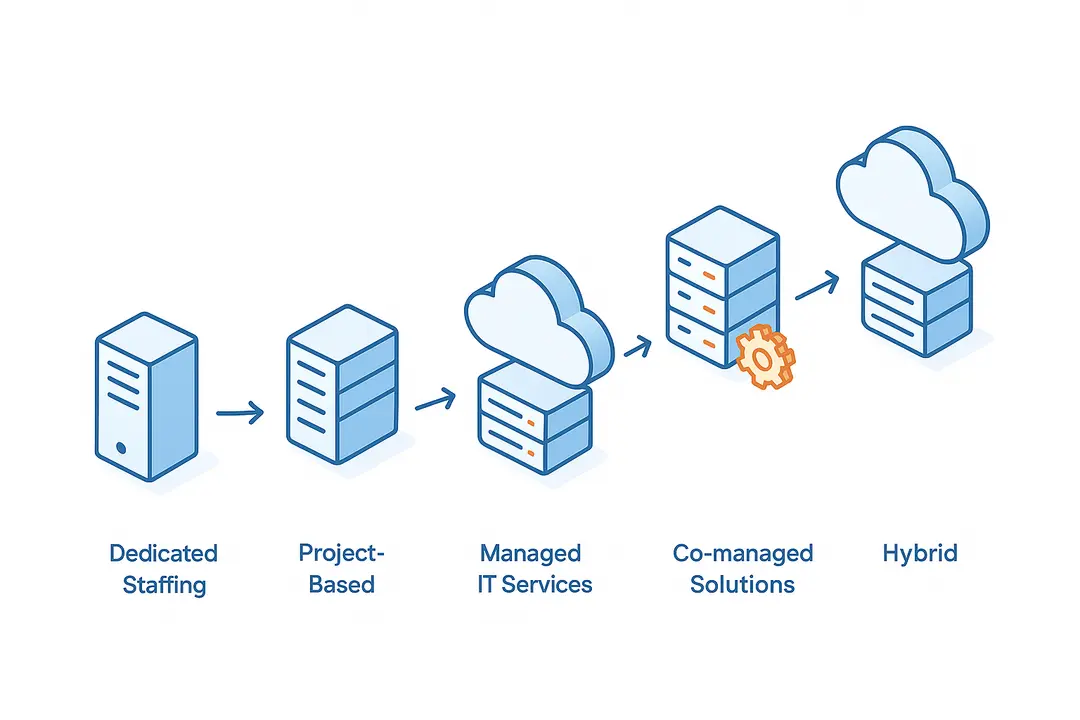
Choosing the right IT outsourcing model is pivotal for achieving business goals and managing risk. Core models include dedicated teams, project-based delivery, managed services, co-managed solutions, BPO, and hybrid structures.
| Model | Best For | Pros | Cons |
|---|---|---|---|
| Dedicated Staffing | Long-term, strategic projects | Deep expertise, continuity, control | Higher overhead, management needed |
| Project-Based | Defined, short-term initiatives | Predictable cost/timeline, clear scope | Less flexibility, handover risks |
| Managed IT Services | Routine ops, 24/7 support | Proactive management, cost-effective | Provider dependency, less flexibility |
| Co-Managed | Shared-responsibility operations | Flexibility, shared risk, rapid scaling | Role clarity, integration hurdles |
| Business Process Outsourcing (BPO) | Non-core functions | Economies of scale, cost savings | Quality oversight, time zone risk |
| Hybrid | Complex, evolving requirements | Blends control/cost, adaptable | Complexity, governance challenges |
Use-Case Example:
A large healthcare organization might combine dedicated staffing for core clinical IT with managed services for infrastructure, and a hybrid BPO for back-office operations.
Deep Dive: What Are the Top IT Outsourcing Trends for 2026?
1. AI-First and Workflow Automation
AI is central to outsourcing strategies in 2026.
Organizations are engaging providers not just for automation, but for AI model development, data labeling, and prompt engineering. Outsourcing contracts increasingly include outcome-based automation milestones, ensuring tangible efficiency and innovation.
- Example:
Rapid adoption of AI-powered service desks and automated incident response. - Actionable Tip:
Evaluate providers’ AI-enabled workflows and their ability to co-innovate on automation.
2. Cloud Infrastructure and Multi-Cloud Management
Cloud outsourcing evolves as companies migrate workloads across providers for reliability and cost control.
Managed service partners are key for multi-cloud orchestration, bundled cloud infrastructure, and remote IT management.
- Practical Example:
Enterprises shifting key applications to both AWS and Microsoft Azure, managed via a single outsourcing provider. - Operational Advice:
Prioritize providers with deep experience in multi-cloud and proactive cost governance frameworks.
3. Outsourced Cybersecurity and Regulatory Compliance
Security and compliance challenges have intensified.
Organizations rely on specialized partners for 24/7 threat monitoring, DDoS defense, data residency, and evolving regulatory mandates across regions.
- Industry Insight:
Surge in demand for managed security services and compliance consulting, particularly in finance and healthcare. - Checklist:
Ensure providers offer strong incident response, regulatory alignment (GDPR, HIPAA), and transparent reporting.
4. Verticalization and Sector-Specific Solutions
Outsourcing partners are offering industry-specific tools, playbooks, and compliance expertise.
This trend benefits highly regulated or specialized sectors—finance, healthcare, and retail—helping organizations address both technical and compliance nuances.
- Example:
A financial firm leverages a provider with pre-built anti-fraud analytics and tailored regulatory workflows. - Tip:
Shortlist providers with proven experience in your industry vertical.
5. Talent Shortages and Global/Offshore Scaling
Scarcity of specialized IT talent pushes organizations to expand their global sourcing.
APAC, EMEA, and Latin America emerge as critical talent pools, while nearshoring offers both skill access and better alignment with business hours.
- Current Trend:
Enterprises diversify by combining onshore project leadership with offshore development teams. - Practical Advice:
Balance cost savings with skill depth, and verify providers’ talent retention and training practices.
6. Hybrid and Co-Managed Services
Clients seek hybrid and co-managed models for greater flexibility and shared responsibility.
These structures combine the stability of managed services with the agility of internal teams.
- Case Insight:
Retailers blending in-house IT with a co-managed helpdesk to handle seasonal peaks. - Action Point:
Define clear roles and real-time collaboration protocols with your provider.
7. Social and Environmental Responsibility
ESG (environmental, social, governance) criteria are increasingly factored into provider selection.
While specific data trends are still emerging, a growing number of enterprise buyers require sustainability practices and social impact governance from their outsourcing partners.
- Current Perspective:
RFI/RFP processes now ask about carbon footprint, local development, and fair labor policies.
Industry Spotlight: How Are Key Sectors Transforming with IT Outsourcing?
Industry-specific challenges are driving tailored IT outsourcing strategies.
Understanding unique sector requirements can maximize value and ensure regulatory alignment.
| Sector | Key Trends | Outsourcing Priorities |
|---|---|---|
| Finance | Automation, AI for compliance, cybersecurity | Managed security, anti-fraud automation, reporting |
| Healthcare | Data privacy, telemedicine IT | HIPAA/GDPR compliance, clinical support, cloud-enabled EHR |
| Retail | Omnichannel, digital CX | Real-time helpdesk, e-commerce integration, seasonal scaling |
| SMBs | Agility, cost-efficiency | Modular, right-sized managed services (high-level only) |
Finance:
Heavily invested in compliance-driven automation, advanced threat defense, and pandemic-resilient operations.
Healthcare:
Outsourcing IT to support secure telemedicine, patient data management, and robust privacy regulation adherence.
Retail/E-commerce:
Leveraging managed services for omnichannel experience, customer analytics, and handling rapid demand swings.
Small & Medium Businesses:
While detailed SMB models are less publicized, right-sized outsourcing solutions help with resource constraints and digital transformation (INSUFFICIENT DATA for granular examples).
Making the Right Choice: How Should Organizations Select an IT Outsourcing Provider?
Selecting the right IT outsourcing provider is critical to avoid hidden risks and ensure strategic alignment.
Organizations should follow a structured evaluation and due diligence process to safeguard outcomes.
Key Selection Criteria:
- Proven capabilities in target technologies and industries
- Strong compliance and data protection frameworks
- Demonstrated track record and client references
- Transparent contracting with outcome-based SLAs and adaptive pricing
- Ability to scale, innovate, and flex with business needs
RFP/Selection Checklist:
- Define business and technical requirements.
- Assess vendor certifications, security, and compliance history.
- Review team credentials and retention rates.
- Insist on measurable KPIs and escalation procedures.
- Request case studies and industry-specific experience.
- Clarify governance protocols and communication frequency.
- Validate disaster recovery and data residency assurances.
Pitfalls and Risks to Avoid:
- Overlooking regulatory risk (especially for global/regulated industries)
- Focusing excessively on unit cost rather than long-term value or innovation
- Underestimating integration complexity or talent turnover
Strategies to Maximize ROI from IT Outsourcing: What Works in 2026?

Maximizing IT outsourcing ROI requires a strategic, measured approach—combining robust contracts, relationship management, and ongoing optimization.
Proven Strategies:
- Optimize Contracts: Employ unit pricing where possible; lean toward outcome- or value-based agreements over pure time/materials.
- Manage Relationships Proactively: Schedule regular, transparent reviews; focus equally on SLAs and the spirit of partnership.
- Measure What Matters: Link provider outcomes to KPIs—like uptime, mean time to resolution, and business impact metrics.
- Co-Innovate: Encourage providers to co-develop digital solutions or automation projects; leverage their expertise to upskill your teams.
- Continuous Review: Monitor costs, compliance, and innovation outcomes; be ready to recalibrate as tech and business needs shift.
| Step | Description |
| Contract Execution | Define SLAs, outcome metrics, pricing tiers |
| Operational Review | Regular joint performance/innovation sessions |
| Continuous Learning | Upskill teams, share lessons |
| Value Realization | Measure savings, efficiency, and business gain |
Regional and Geopolitical Insights: Where Is IT Outsourcing Headed Globally?
Global IT outsourcing’s future is shaped by shifting talent pools, regional regulations, and geopolitical cross-currents.
Growth Regions and Hubs:
- APAC: India, Philippines, Vietnam lead in application services, AI, and cloud talent.
- EMEA: Poland, Ukraine, and Ireland shine in fintech, data compliance, and regulated delivery.
- Americas: Latin America (Mexico, Brazil, Colombia) rises as a nearshore hub for North America, offering timezone and language alignment.
Regulatory & Geopolitical Factors:
- Data residency laws (GDPR in the EU, local storage mandates in APAC)
- Shifting trade policies and cybersecurity frameworks
- Political risk and resilience planning—recent disruptions underline the necessity of multi-region sourcing
Actionable Guidance:
- Diversify vendor and talent locations to de-risk country-specific challenges.
- Stay updated on regional legal changes and cybersecurity developments.
Frequently Asked Questions: IT Outsourcing in 2026 & Beyond
What are the top it outsourcing trends shaping the future?
The top it outsourcing trends include AI driven services, hybrid outsourcing models, cloud transformation, and stronger cybersecurity practices. These trends reflect broader it outsourcing market trends and the future of it outsourcing.
How is AI impacting the top it outsourcing trends?
AI is a major driver in the top it outsourcing trends, enabling automation, predictive analytics, and smarter operations. The future of it outsourcing increasingly depends on AI integration across services.
What outsourcing models align with the top it outsourcing trends?
The top it outsourcing trends include models such as managed services, staff augmentation, project based outsourcing, and hybrid approaches. These models reflect evolving it outsourcing market trends.
Which industries are most influenced by the top it outsourcing trends?
Industries like finance, healthcare, and retail are heavily influenced by the top it outsourcing trends due to their need for secure and scalable solutions in the future of it outsourcing.
How can businesses maximize value from the top it outsourcing trends?
To benefit from the top it outsourcing trends, companies should focus on clear KPIs, outcome based contracts, and strong vendor collaboration. These strategies align with modern it outsourcing market trends.
What risks come with the top it outsourcing trends?
The top it outsourcing trends also bring risks such as cybersecurity threats, compliance issues, and hidden costs. Understanding the future of it outsourcing helps mitigate these risks.
How should companies choose partners based on the top it outsourcing trends?
Selecting the right partner for the top it outsourcing trends requires evaluating technical expertise, compliance, scalability, and innovation. These factors are key in it outsourcing market trends.
What does market growth indicate about the top it outsourcing trends?
Market projections show strong growth, reinforcing the importance of the top it outsourcing trends. The future of it outsourcing is expected to expand significantly across regions.
What is the difference between services in the top it outsourcing trends?
In the context of the top it outsourcing trends, managed services provide ongoing support, while staff augmentation adds temporary resources. Both reflect evolving it outsourcing market trends.
Which regions lead the top it outsourcing trends globally?
Regions like APAC, EMEA, and Latin America are leading the top it outsourcing trends, each contributing to the future of it outsourcing with specialized expertise.
Why are it outsourcing market trends important for businesses?
It outsourcing market trends help organizations stay competitive by guiding decisions on technology, cost optimization, and vendor selection within the top it outsourcing trends.
How will the future of it outsourcing evolve in coming years?
The future of it outsourcing will focus on automation, AI integration, and global collaboration, making the top it outsourcing trends essential for long term strategy.
Conclusion
IT outsourcing continues to evolve as a strategic driver of growth, innovation, and efficiency. With advancements in AI, flexible engagement models, and industry specific solutions, organizations that stay informed and adaptable are better positioned to succeed.
By understanding these trends and aligning them with your business goals, you can make smarter decisions, reduce risks, and build stronger partnerships. A thoughtful approach to outsourcing will help you create long term value and keep your IT strategy competitive in a rapidly changing landscape..
Key Takeaways
- The future of IT outsourcing hinges on AI, hybrid models, and industry-specific expertise.
- Market growth is robust—APAC and EMEA are especially dynamic regions.
- Success depends on the right model choice, rigorous provider selection, and outcome-focused contracts.
- Regulatory compliance and cybersecurity are now “must-have” outsourcing criteria.
- Industry verticalization and co-innovation will drive value for leading organizations.
This page was last edited on 9 May 2026, at 11:33 am

Start a conversation with our team to solve complex challenges and move forward with confidence.