
E-learning is transforming how organizations deliver training, upskill talent, and respond to rapid business change.
Yet, building custom platforms in-house can quickly stretch resources, delay launches, and limit innovation. That’s why many organizations are choosing to outsource software development for e-learning solutions to access specialized expertise, accelerate delivery, and scale efficiently.
By leveraging the right partners, businesses can reduce risk, control costs, and implement high-quality learning platforms tailored to their needs. This guide provides a step-by-step playbook, vendor comparison frameworks, and practical insights to help you successfully navigate outsourcing and maximize the impact of your e-learning initiatives.
What Does “Outsourcing Software Development for E-Learning Solutions” Mean?
Outsourcing software development for e-learning solutions refers to hiring external specialists to design, build, or enhance digital learning platforms, content, and integrations instead of using only in-house teams.
Outsourcing in this context covers both technical services (like LMS/portal development and customization) and learning services (such as instructional design, localization, and eLearning content authoring).
What’s Included?
- Platforms: Learning Management Systems (LMS), Learning Experience Platforms (LXP), Learning Content Management Systems (LCMS), custom training portals.
- Content: Instructional design, courseware creation, multimedia and interactive learning objects, eLearning content localization and translation.
- Integrations: HRIS/LMS connectors, analytics dashboards, external tool plug-ins, SCORM/xAPI compliance.
- Who Uses Outsourcing?
- Large enterprises scaling global training
- SMBs seeking affordable EdTech expertise
- EdTech startups accelerating product timelines
Outsourcing may be partial (by module) or full (end-to-end), depending on your organizational strategy and existing capabilities.
Why Should Organizations Outsource Software Development for E-Learning Solutions?
Outsourcing eLearning software development offers tangible business and technical advantages—including reduced costs, access to deep expertise, and improved scalability.
Key Benefits of E-Learning Outsourcing
- Cost Efficiencies: Avoids the expense of recruiting, training, and retaining a full in-house team.
- Expertise Access: Leverages specialized providers skilled in EdTech, UX, accessibility, compliance (GDPR, SCORM, ADA), and localization.
- Speed to Market: Accelerates launches using existing vendor frameworks, agile teams, and proven workflows.
- Scalability & Flexibility: Quickly adapt to changing project scopes or add features without long hiring cycles.
- Risk Mitigation: Outsourcing partners offer best practices, proven QA, and can help you avoid common project pitfalls.
Typical Use Cases
- Launching new product suites or training initiatives
- Modernizing legacy training systems
- Rolling out learning solutions to distributed, global audiences
| Category | In-House | Outsourced |
|---|---|---|
| Cost | High, ongoing HR/infrastructure | Predictable, project-based |
| Expertise | Limited by internal resources | Deep, cross-industry, current |
| Speed | Slower due to hiring/onboarding | Faster launch, proven processes |
| Flexibility | Rigid, fixed roles | Scale up/down as needed |
| Risk | Full burden on org | Shared/vendor-managed |
In-House vs. Outsourced E-Learning Development—Which Is Right for You?
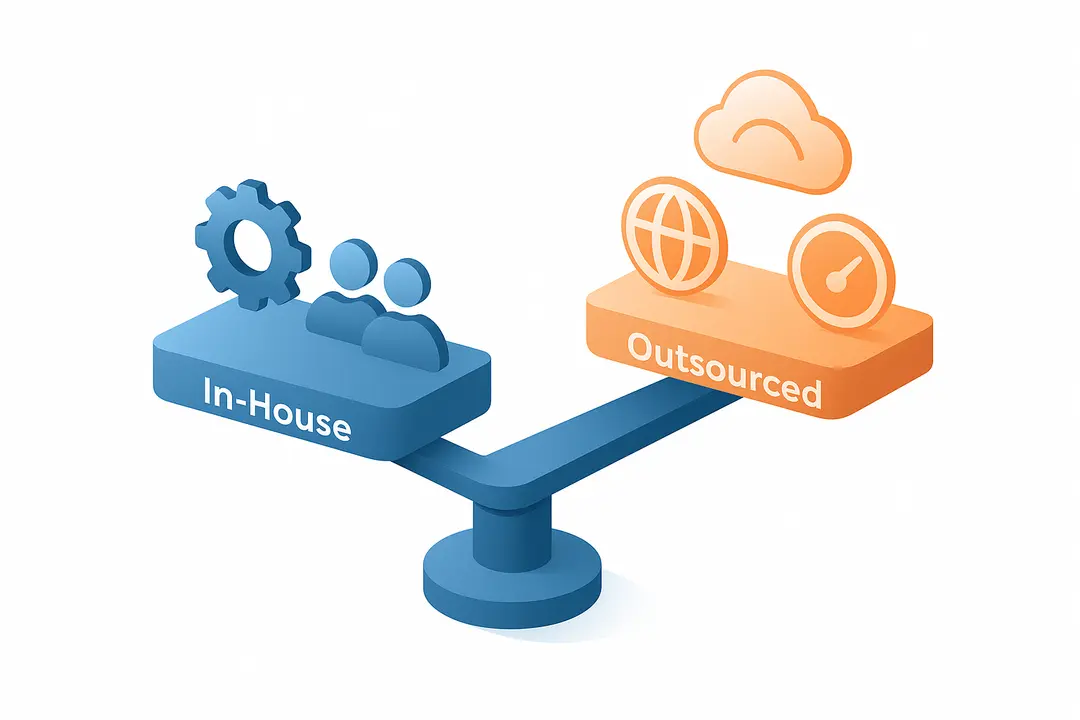
Choosing between in-house and outsourced eLearning development depends on your goals, timelines, internal skills, and budget.
Comparison: Strengths & Weaknesses
- In-House Approach:
Strengths: Full control, direct knowledge transfer, easier change management.
Weaknesses: High fixed costs, slower innovation, resource bottlenecks, harder to scale quickly. - Outsourced Approach:
Strengths: Access to best-in-class technology and instructional design, rapid scaling, specialized compliance expertise.
Weaknesses: Less direct day-to-day control, need for strong communication, potential integration challenges.
When Each Model Fits Best
Choose in-house if you have a mature learning and IT team, require frequent updates, and training is your organization’s core product.
Choose outsourcing if you need to launch fast, lack specialized skills, or want to maximize ROI and minimize risk.
| Criteria | In-House | Outsourcing |
|---|---|---|
| Cost | High, recurring | Lower, fixed/project-based |
| Time to Launch | 6–18 months | 2–6 months |
| Tech Stack | Often legacy | Latest tools/frameworks |
| Support | Full internal responsibility | Included via SLA |
| Innovation | Incremental | Access to latest trends |
What Aspects of E-Learning Development Can Be Outsourced? Content, Platform, or Both?
Organizations can outsource one, several, or all parts of their eLearning initiatives, tailoring partnerships to their strengths and gaps.
Most Commonly Outsourced Elements:
- Content Authoring & Instructional Design Outsourcing
- Curriculum design
- Multimedia and interactive courseware production
- Localization and translation
- Platform/Software Development
- Learning Management System (LMS) development or customization
- Building LXPs, LCMS, or training portals
- Integrating with HRIS, CRM, or other enterprise systems
- Integrations & Analytics
- Connecting APIs for data syncs
- Custom analytics dashboards
- SCORM/xAPI certification
- Hybrid (Modular) Models
- Outsource only what’s needed: content creation, QA, platform build, or full end-to-end solutions
Bulleted List: What to Outsource
- Instructional design and content creation
- LMS/LXP/LCMS or platform development
- Content translation/localization
- Integration with other software (HR, analytics)
- Compliance setup (SCORM, ADA, GDPR)
- Testing and ongoing support
How to Successfully Outsource E-Learning Software Development: An 8-Step Process
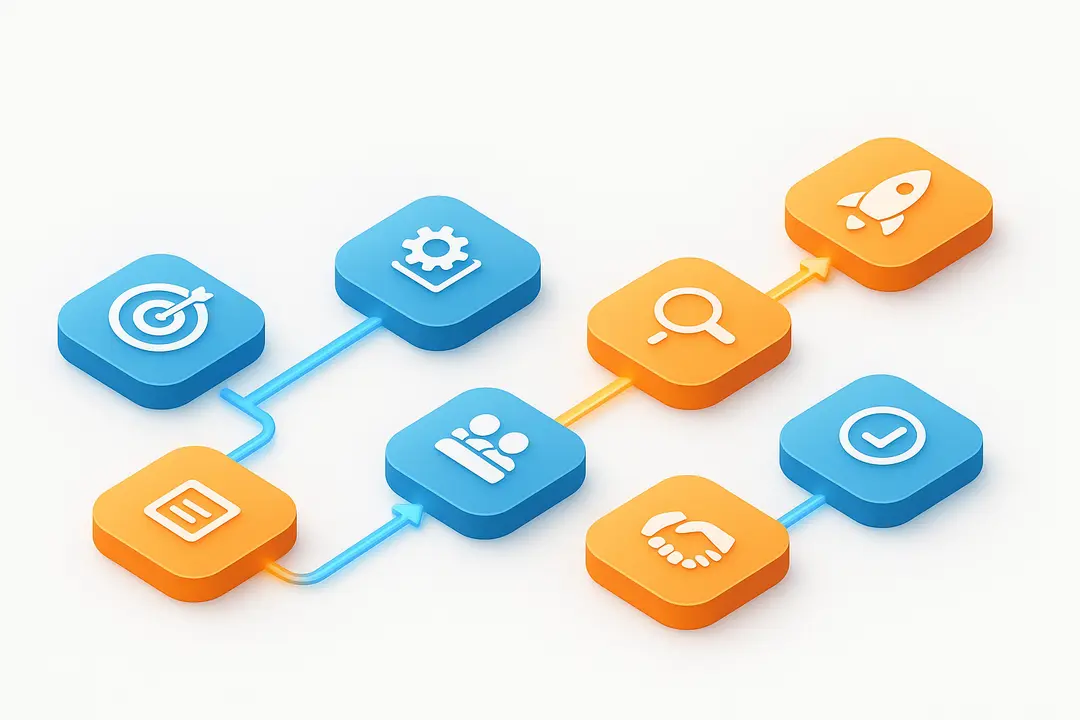
Outsourcing software development for e-learning solutions works best with a clear, step-by-step approach—from goal-setting to vendor management and support.
Step 1: Define Learning & Business Objectives
Start by aligning learning outcomes with strategic business goals.
List target learner groups, essential features, content formats, compliance needs, and conversion metrics (KPIs).
Example: If rolling out global compliance training, objectives might include multilingual content and SCORM compatibility.
Step 2: Assess Internal Capabilities & Readiness
Map current resources—skills, tools, and bandwidth.
Identify gaps that require external support, such as instructional design, localization, or mobile development.
Ask: Do you have in-house project management and QA capacity?
Step 3: Draft Scope of Work & Requirements
Write a detailed statement covering:
- Functional specs (LMS/LXP features, mobile access)
- Technical stack, integrations, compliance standards
- Content types and formats
Be explicit on “must-have” vs “nice-to-have” features. This minimizes scope creep and surprises.
Step 4: Research & Shortlist Qualified Vendors
Look for partners with proven eLearning experience, up-to-date tech stacks, strong portfolios, and positive client feedback.
Industry directories (eLearning Industry, Training Industry), LinkedIn, and reviews are good places to start.
Shortlist 3–5 vendors for deeper evaluation.
Step 5: Evaluate Vendors (Checklist & Table)
Assess vendors against a clear list of criteria:
| Criteria | Vendor A | Vendor B | Vendor C |
|---|---|---|---|
| EdTech Experience | Yes | Yes | Partial |
| SCORM/xAPI Expertise | Yes | Yes | No |
| Compliance (GDPR/ADA) | Yes | Partial | Yes |
| Customization | High | Medium | High |
| Support/SLAs | 24/7 | Standard | 24/5 |
| References | Excellent | Good | Average |
| Budget Fit | Within | Above | Below |
Request proposals, demos, and references. Interview their teams and check prior project outcomes.
Step 6: Negotiate, Contract, and Set Up Collaboration
Align on deliverables, milestones, intellectual property terms, security, and data ownership.
Establish communication cadence, project management tools (Jira, Slack, MS Teams), and escalation paths.
Step 7: Oversee Development & Ensure Quality Assurance
Agree on development methodology (Agile or Waterfall).
Set up rigorous QA cycles, regular review points, and clear acceptance/release criteria.
Involve end users early for feedback and validation.
Step 8: Go-Live, Training, and Ongoing Support
Prepare for roll-out:
- Organize user training and onboarding.
- Plan change management.
- Define ongoing support via Service Level Agreements (SLAs) and routine performance reviews.
Outsourcing Workflow Recap:
- Set objectives
- Audit internal resources
- Detail scope and requirements
- Identify vendors
- Evaluate methodically
- Contract and align
- Manage and QA
- Roll out, support, and improve
How Much Does Outsourcing E-Learning Development Cost? [Cost Factors & ROI]
![How Much Does Outsourcing E-Learning Development Cost? [Cost Factors & ROI]](https://riseuplabs.com/wp-content/uploads/2026/04/how-much-does-outsourcing-e-learning-development-cost-cost-factors-roi.webp)
Outsourcing costs depend on project size, required features, complexity, and vendor geography.
Upfront clarity on scope and quality standards minimizes overruns while boosting ROI.
Key Cost Drivers
- Scope and Complexity: Custom vs. template-based builds, number of courses, advanced features (AI, AR/VR, analytics).
- Content Needs: Original content creation, localization, multimedia inclusion.
- Vendor Location: Offshore teams (Asia, Eastern Europe) often have lower hourly rates than onshore providers (U.S., Western Europe).
- Integration & Compliance: More integrations or strict compliance (GDPR, HIPAA, ADA) increase costs.
| Feature/Service | Estimated Hours | Price Range (USD) |
|---|---|---|
| Simple LMS Setup | 120–200 | $15,000–$30,000 |
| Custom Course Module | 50–120 | $5,000–$15,000 |
| SCORM Integration | 30–80 | $4,000–$8,000 |
| Content Localization | Per language | $2,000–$7,000 |
| Advanced Analytics | 50–100 | $7,000–$12,000 |
Note: Ranges above reflect industry averages. Scope, vendor, and complexity may alter totals.
Calculating ROI
According to research by Grand View Research and Statista, organizations that outsource e-learning development report:
- Reduction in development timelines by up to 30%
- Savings of 20–40% over comparable in-house builds
- Faster scaling into new markets through localized content
ROI also comes from increased learner engagement, higher adoption rates, and lowered administrative burden.
How Do You Select the Best E-Learning Software Development Vendor?
Selecting the right eLearning development partner requires a structured evaluation to ensure fit, accountability, and long-term value.
Core Evaluation Criteria:
- EdTech Expertise: Depth in similar projects, robust domain understanding
- Tech Stack Mastery: Modern, scalable technologies and integration experience
- Security & Compliance: Adherence to GDPR, SCORM, ADA, xAPI, HIPAA (if relevant)
- Cultural & Communication Alignment: Overlapping time zones, language proficiency, proactive engagement
- Budget & Flexibility: Transparent pricing, willingness to iterate or adjust scope
- References & Case Studies: Demonstrated track record, recent success in your sector
Vendor Shortlisting Matrix
| Criteria | Onshore Vendor | Offshore Vendor |
|---|---|---|
| Cost | Higher | Lower |
| Communication | Direct | Varies |
| Compliance Adaptability | High | Good |
| Support Availability | 9–5 or 24/7 | 24/7 |
| Customization Levels | High | High |
| Cultural Fit | Easier | Assess needed |
| Portfolio Depth | Broad | Often deep |
Onshore vs. Offshore: Pros & Cons
- Onshore:
+ Easier communication, fewer time zone challenges, higher rates. - Offshore:
+ Lower costs, often deeper EdTech talent pool, requires strong project management and communication processes.
Vendor Evaluation Checklist (Downloadable):
- Is their technical and domain expertise proven?
- Are compliance requirements met?
- Can they provide relevant user references?
- Are IP and data protections contractually defined?
- Do their QA and support models align with your needs?
What Trends & Innovations Are Shaping Outsourced E-Learning Development (2025–2026)?
Outsourced eLearning is evolving rapidly, shaped by technological advances, shifting learner expectations, and global compliance needs.
Current & Emerging Innovations:
- AI-Driven Personalization: Deliver adaptive content and assessment at scale. AI helps tailor learning paths based on real-time analytics.
- Microlearning and Mobile-First Design: Short, mobile-optimized lessons cater to busy professionals and boost engagement.
- Immersive Technologies (AR/VR): Simulations, virtual labs, and real-world scenario training enhance outcomes in safety, healthcare, and compliance training.
- Data Security & Privacy: Vendors increasingly comply with GDPR, HIPAA, and xAPI standards as regulations tighten.
- Localization & Accessibility: Automated translation and content adaptation ensure learning is accessible for global and diverse audiences.
- Hybrid Work Integration: Solutions are built to support remote, hybrid, and blended learning environments seamlessly.
According to Statista, the global e-learning market is projected to surpass $400 billion by 2026, fueled by these trends and the rising demand for continuous workplace learning.
Real-World Case Studies & Success Metrics for Outsourced E-Learning Development
Organizations worldwide have scaled faster and achieved measurable results by outsourcing eLearning development.
Example Case Summaries
- Global Manufacturer: Outsourced end-to-end LMS platform build and multilingual content creation. Results: Launched in 5 months, accessed by 12,000 employees in 9 languages, 95% user adoption within 3 months.
- Financial Services Provider: Partnered for SCORM-compliant compliance training modules. Results: Reduced internal development costs by 35%, improved course completion rates.
- Healthcare Company: Contracted AR-based clinical skills simulations. Results: 40% improvement in skill assessment scores, accelerated onboarding of new staff.
Lesson Learned:
Across projects, success is linked to clear requirements, robust vendor communication, and phased rollouts with user feedback.
What Are the Risks of Outsourcing E-Learning—and How Do You Mitigate Them?
While outsourcing offers accelerated value, unaddressed risks can derail eLearning initiatives—ranging from misaligned expectations to security vulnerabilities.
Major Outsourcing Risks:
- Misalignment of Goals: Unclear or shifting requirements create project delays.
- Scope Creep: Poorly defined contracts lead to budget/time overruns.
- Data Security & Compliance: Inadequate protections risk breaches or regulatory violations.
- Quality Issues: Insufficient reviews or weak QA yield subpar learner experiences.
Mitigation Strategies Checklist
- Define scope, timelines, and acceptance criteria in a detailed contract
- Require regular project updates and clear communication channels
- Conduct compliance and security audits
- Insist on trial projects or pilot phases
- Set clear SLAs for support and performance
Risks vs. Mitigations Table
| Risk | Mitigation Approach |
|---|---|
| Vague requirements | Thorough, signed scope document |
| Late delivery | Penalties/incentives in contract |
| Data/privacy breaches | Security audits; compliance by design |
| Weak QA | Staged reviews and structured UAT |
| Cultural/time zone gaps | Overlapping work hours, proactive PM |
Frequently Asked Questions About Outsourcing E-Learning Development
What does it mean to outsource software development for e-learning solutions?
To outsource software development for e-learning solutions means hiring external experts to design, build, and maintain digital learning platforms instead of relying only on internal teams. Many organizations use e-learning software development outsourcing to access advanced skills and scalable delivery.
Why do companies outsource software development for e-learning solutions?
Organizations choose to outsource software development for e-learning solutions to gain specialized expertise, reduce time to market, and lower costs. Using edtech development services also helps businesses stay competitive with modern learning technologies.
Which components can you outsource software development for e-learning solutions?
When you outsource software development for e-learning solutions, you can delegate instructional design, LMS development, multimedia content, integrations, localization, and ongoing support to experienced edtech development services providers.
How do I choose the right partner to outsource software development for e-learning solutions?
To successfully outsource software development for e-learning solutions, evaluate vendors based on experience, portfolio, technology stack, and client feedback. Reliable e-learning software development outsourcing partners will also offer strong communication and support models.
What are the benefits of outsourcing compared to in-house development?
Choosing to outsource software development for e-learning solutions offers faster delivery, lower operational costs, and access to global expertise. Many edtech development services providers also enable easier scalability than in-house teams.
What is the process to outsource software development for e-learning solutions?
The process to outsource software development for e-learning solutions includes defining goals, setting requirements, selecting vendors, managing development, and ensuring quality delivery. Structured e-learning software development outsourcing reduces project risks.
How much does it cost to outsource software development for e-learning solutions?
Costs to outsource software development for e-learning solutions can range from $15000 to over $100000 depending on complexity. Pricing varies across e-learning software development outsourcing providers based on features and integrations.
What risks should I consider when I outsource software development for e-learning solutions?
Common risks when you outsource software development for e-learning solutions include miscommunication, security concerns, and quality issues. Choosing trusted edtech development services helps mitigate these challenges.
How do I ensure security when I outsource software development for e-learning solutions?
To securely outsource software development for e-learning solutions, work with vendors experienced in compliance standards like SCORM, xAPI, and GDPR. Established e-learning software development outsourcing firms prioritize data protection.
What trends are shaping the future when you outsource software development for e-learning solutions?
Trends impacting those who outsource software development for e-learning solutions include AI driven learning, AR and VR training, and personalized experiences. Leading edtech development services are already adopting these innovations.
When is the right time to outsource software development for e-learning solutions?
The right time to outsource software development for e-learning solutions is when internal resources are limited, timelines are tight, or specialized expertise is required for scaling learning platforms.
How do edtech development services improve learning outcomes?
Edtech development services enhance engagement, personalize learning paths, and integrate analytics, making it easier for organizations that outsource software development for e-learning solutions to achieve better results.
Conclusion & Next Steps: Turn Insight into Action
Outsourcing e learning software development can be a powerful way to accelerate innovation, improve quality, and deliver impactful learning experiences at scale. When approached with clear goals, the right partner, and strong project management, it allows organizations to build effective solutions without overextending internal resources.
By making informed decisions and focusing on long term value, you can create scalable and engaging learning platforms that support growth and adaptability. With the right strategy in place, outsourcing can turn your e learning vision into a practical and successful outcome.
Key Takeaways
- Outsourcing software development for e-learning solutions offers cost savings, access to expertise, and rapid scaling.
- Use a structured, 8-step process—from defining goals to ongoing support—to maximize project success.
- Vendor choice should be objective, data-driven, and aligned to your compliance and innovation needs.
- Emerging trends like AI, microlearning, and AR/VR are reshaping EdTech outsourcing strategies for 2025–2026.
- Careful risk management and clear contracts help mitigate common outsourcing pitfalls.
This page was last edited on 9 July 2026, at 11:10 am

Start a conversation with our team to solve complex challenges and move forward with confidence.