
Synthetic data is computer-generated information that mimics real-world data, making it possible to train AI models safely and at scale. It solves privacy, cost, and bias issues, but also introduces new risks like bias reinforcement and loss of model quality.
Many AI leaders face growing pressure to unlock new model capabilities while dealing with data privacy laws and rising costs. In my experience, finding enough reliable training data without violating regulations or introducing bias has become a daily battle.
There is real hope in synthetic data. It can provide fresh, compliant data streams for model training, but it is not a magic fix either. Serious risks like model collapse and trust issues now demand careful handling.
This article explains key frameworks, risks, best practices, and industry examples from 2026. It shows how synthetic data fits into your AI strategy so you can make confident, future-ready choices.
Why Synthetic Data Is Vital to the Future of AI
Synthetic data fills a growing gap where real data is limited, sensitive, or too biased for safe use. Its strategic role in AI is no longer optional for fast-moving teams.
In my POV, the rush to build large language models (LLMs) and other advanced AI has far outstripped the supply of useful real data. Privacy laws, high costs, and biased data sets often slow or block projects. Synthetic data solves many of these problems by simulating new, safe data for training, testing, and validation.
Why Synthetic Data Matters for AI (2026):
| Reason | Impact |
| Real-world data shortage | Keeps AI development moving |
| Strict privacy regulations | Enables compliant model training |
| High data acquisition costs | Reduces time and spend |
| Bias in existing datasets | Supports fairer, safer models |
| Demand for edge-case scenarios | Simulates rare but critical events |
According to IBM Think (2026), synthetic data is increasingly being used in finance and healthcare to enable AI innovation while protecting sensitive information. However, IBM also highlights growing risks around bias, privacy, accuracy, and regulatory compliance, making continuous testing and responsible governance essential.
What Is Synthetic Data?
Synthetic data is information generated by computer algorithms to mirror real-world data patterns and features. It matches the statistical structure of real data but does not come from actual human or device records.
From what my team and I encounter, synthetic data can replace or expand real data for AI training, testing, or validation. It can fill gaps that natural data cannot due to privacy, costs, or missing scenarios.
Types of Synthetic Data Generation
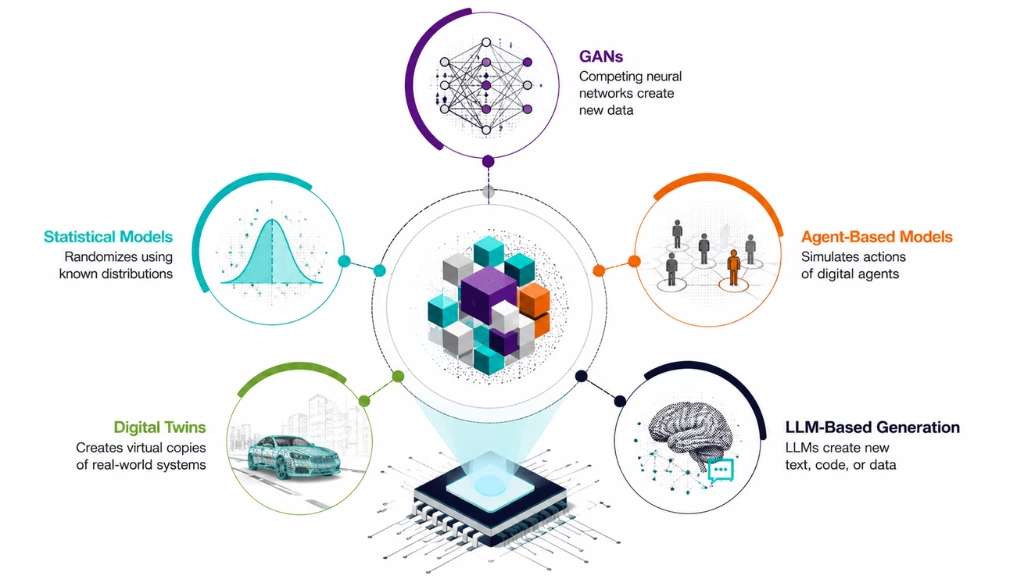
Different generation methods suit different business and technical needs. Understanding them helps choose the right approach for your use case.
Table: Types of Synthetic Data in AI (2026)
| Generation Type | How It Works | Common Use Cases |
| Statistical Models | Randomizes using known distributions | Tabular finance, health data |
| GANs (Generative Adversarial Networks) | Competing neural networks create new data | Images, video, LLM pre-training |
| Agent-Based Models | Simulates actions of digital agents | Traffic, economic systems, logistics |
| Digital Twins | Creates virtual copies of real-world systems | Autonomous vehicles, IoT, industrial |
| LLM-Based Generation | LLMs create new text, code, or data | Data augmentation, NLP |
I have worked with digital twins for automotive safety and GANs for image privacy. Each type trades off between realism, cost, and risk.
How Is Synthetic Data Generated? Methods & Tools
To generate synthetic data, teams choose methods that align with data needs, accuracy goals, and risk appetite.
Most popular approaches in 2026:
- Simulation-based: Software models recreate scenarios impossible or unsafe to record in real life. Example: multi-agent traffic jams.
- GANs: Two AI models compete, producing realistic visuals or tabular data. For example, GANs make anonymized X-ray images for medical research.
- LLM-based: Large language models like Nemotron-4 generate synthetic text, code, and tables at scale, helping create new data for LLM fine-tuning.
- Hybrid: Combines above techniques to improve both accuracy and diversity.
Emerging tools, such as LAB (used in IBM’s AI systems) and Nemotron-4, make these processes faster and more reliable. Open-source libraries simplify basic generation but may lack robust controls for bias and quality.
Generating synthetic data sounds easy, but controlling quality, variety, and fidelity remains a core challenge. In my experience, a mismatch here can undermine downstream models.
How Does Synthetic Data Compare to Real Data?
Synthetic and real data each have strengths and limits. This comparison is critical for tech leaders choosing training strategies.
Table: Synthetic vs Real Data for AI in 2026
| Feature | Synthetic Data | Real Data |
| Privacy | Strong (anonymized) | Variable, often restricted |
| Bias Risk | Moderately controllable | Often contains historic bias |
| Cost/Availability | Low, scalable | High, may be limited |
| Edge Cases | Easy to simulate | Often missing |
| Regulatory Burden | Lower if well-governed | High, many consent issues |
| Authenticity | May lack real-world flaws | High, but may be messy |
| Model Performance | High for some tasks, variable | Strong, but limited for edge cases |
Recent benchmarks (Nature, 2026) show hybrid datasets—real plus synthetic—can outperform either alone when designed with care.
A better approach is using real data for core validation and edge cases from synthetic sources, but without careful onboarding this mix can create model collapse or hidden bias.
What Are the Key Benefits of Synthetic Data in AI?
Synthetic data offers practical, business-critical benefits that help AI teams succeed, often where real data fails.
Key Advantages of Synthetic Data (2026):
- Privacy & Anonymization: Synthetic data can remove all direct and indirect identifiers, placing models in “safe harbor” status. In my experience, this unlocks projects blocked by GDPR or HIPAA rules.
- Filling Data Gaps & Edge Cases: Teams can easily simulate rare failures, types of fraud, or infrequent events. I have seen this help in medical and fraud detection projects.
- Cost & Speed: Synthetic datasets eliminate lengthy approval, licensing, or cleaning steps. This shrinks model-building timelines from months to weeks.
- Scalability: Models can be trained at much larger scale, without hitting acquisition bottlenecks.
- Data Augmentation: Improves AI model robustness by diversifying available examples.
Lifecycle of Synthetic Data in AI (2026):
- Assess data needs and privacy risks.
- Choose the right generation method.
- Generate and test synthetic sets.
- Validate for bias, utility, and fit.
- Deploy in model training and production.
- Monitor, audit, and iterate.
The mistake I see often is skipping steps 4 or 6—leading to either poor model accuracy or compliance failures.
What Are the Risks and Challenges of Relying on Synthetic Data?
Synthetic data brings real risk for teams who focus only on speed or cost. Knowing these dangers protects both results and reputation.
The real issue is unseen model failures caused by hidden flaws in the data itself. In 2026, top risks include:
- Bias Amplification: If source data or generation models are biased, synthetic data can make the problem worse, not better. This is where many teams struggle.
- Model Collapse (AI Autophagy): If models are trained only on synthetic or “AI-generated” data, diversity can drop until the model fails. Nature’s 2026 study calls this “AI eating AI.”
- Trust and Authenticity: It can be hard to audit or prove that a data set is synthetic, leading to trust problems in regulation or court cases.
- Provenance and Traceability: At scale, keeping track of synthetic data creation and use is complex.
A flowchart of risk propagation would show how one bias in the generator can affect all downstream models and business outcomes.
How Is Synthetic Data Governed? Regulation, Auditing, & Best Practices
Synthetic data is now a direct regulatory concern in many regions. Good governance is the backbone of compliant, safe AI.
In my experience, robust synthetic data management is built on these pillars:
- Data Provenance & Traceability: Always record source, generation method, and purpose. Add “data nutrition labels” that detail content, limits, and risk.
- Validation & Auditing: Regularly assess synthetic data for bias, accuracy, and utility. Audit full pipeline from generation to deployment.
- Best-Practice Checklist for Compliance:
- Define use case and risks before generation.
- Use approved generation tools (e.g., Nemotron-4, LAB).
- Validate with both synthetic and real-world benchmarks.
- Store audit trails for regulators.
- Label synthetic datasets in model input records.
Key Regulatory Requirements (2025–2026):
- EU: Synthetic data should have documented provenance, audit trails, and risk assessments (per new AI Act guidelines).
- US/FTC: Focus on transparency, consent, and clear liability for synthetic datasets.
- ISO/IEEE: Working groups on “digital nutrition labels” for all training datasets.
The mistake I see often is poor labeling or lost records—opening teams to regulatory fines or worse.
How Do Hybrid Approaches Work? Combining Synthetic and Real Data
Hybrid data strategies now set the bar for high-performing, compliant AI systems. Combining synthetic and real data maximizes both performance and safety.
I have seen that real data anchors AI to reality, while synthetic data fills rare or missing cases. In my POV, hybrid approaches support robustness without risking model collapse.
Best Practices for Hybrid Datasets:
- Use real data as “anchor” for main features and validation sets.
- Add synthetic data for edge cases, underrepresented groups, or rare events.
- Benchmark all models using both real and synthetic test scenarios.
- Monitor for drift or overfit caused by too much synthetic input.
A balanced mix, guided by clear validation, prevents the “all synthetic” trap.
Where Is Synthetic Data Used?
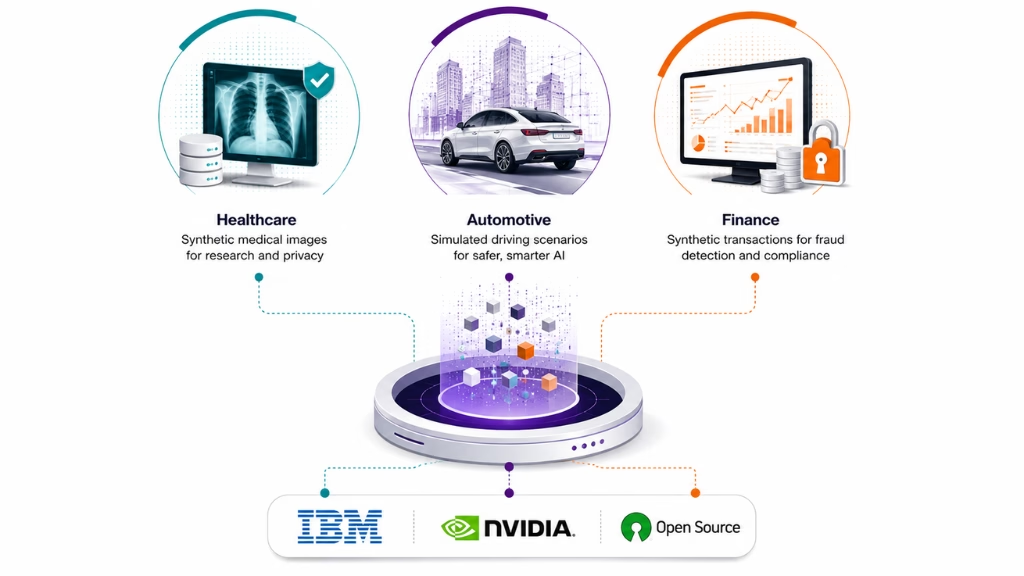
Synthetic data is delivering real impact across many sectors. Here are three standout applications from recent years:
Healthcare:
Synthetic medical images allow research without exposing patient identities. I have seen rare disease detection models built using “fake” X-rays—unlocking progress without risking privacy.
Automotive:
Digital twins now simulate millions of road miles for self-driving cars. Teams generate rare accident scenarios safely, improving model reliability before any real-world rollout.
Finance:
Banks and fintech firms use synthetic transaction streams for fraud detection and regulatory reporting. This approach meets privacy rules while allowing new detection algorithms to be built and tested.
Recent Industry Leaders:
- IBM, Nvidia, and open-source projects have all released synthetic data frameworks validated in production. According to IBM Research (2026), synthetic data reduced time-to-market for LLMs by 30 percent in pilot projects.
- Nvidia’s Nemotron-4 powers image and text generation in autonomous vehicle workflows.
What Trends and Open Questions Define the Future of Synthetic Data in AI?
Synthetic data’s role in AI is just beginning. From my view, several forces will define the next phase:
- Overuse risks “AI autophagy,” where too much synthetic input causes models to drift from real-world relevance.
- New standards in provenance, real-time auditing, and “nutrition labels” for datasets are emerging across industries.
- Regulatory convergence promises more global rules, simplifying cross-border work but raising compliance stakes.
- Tough open questions remain: Can fully synthetic data ever match the depth of real data? What are the ethical limits as models generate models?
Future Outlook:
- Expect automated risk scans and real-time traceability for all data inputs.
- Hybrid designs will likely dominate most AI projects.
- Teams skilled in governance-first AI will stand out for trust and results.
Common Mistakes When Using Synthetic Data for AI
Rushing to generate synthetic data without a plan almost always increases risk for both teams and customers. I have seen projects fail due to lack of careful validation, poor documentation, or using synthetic data as a shortcut for true innovation.
Common pitfalls include:
- Skipping real-world benchmarking
- Over-relying on synthetic data for all use cases
- Lacking clear audit trails for regulation
- Not testing for bias in generation models
A better approach is to treat synthetic data as a tool within a larger data strategy. Always match generation methods and governance to the problem at hand.
How Riseup Labs Can Help Solve Synthetic Data Challenges
Finding the right balance between innovation and compliance with synthetic data is hard. In my experience, expert support is essential for safe AI scaling.
Riseup Labs helps organizations generate, validate, and govern synthetic data—from setup to full audit trails. Our team builds custom workflows for regulated industries, LLMs, and any case that demands privacy or advanced scale.
For clients in healthcare, finance, and automotive, we provide hands-on training and deliver compliance-ready synthetic data pipelines. Contact us to see proven benchmarks and get a step-by-step governance checklist.
Conclusion
Synthetic data now anchors the future of AI innovation, but it demands careful handling. Building advanced models with privacy, speed, and inclusiveness is possible—but only if you manage risks like bias and loss of authenticity.
A smart synthetic data strategy means starting with governance, building strong audit trails, and always validating with both real and synthetic data. From what I have seen, teams that ignore careful planning end up solving old problems while creating new ones.
Working with experts lets you avoid common mistakes and adapt as standards shift. Connect to Riseup Labs for data strategy support or download our comprehensive checklist to kickstart your governance-first AI roadmap.
AI that learns well and earns trust will come from skilled teams mixing the best data—real and synthetic—with robust practices guiding every step.
FAQs
What is synthetic data and how is it used in AI?
Synthetic data is computer-generated information that mimics real data. It is used in AI to safely train, test, and improve models when real data is restricted or insufficient.
What are the advantages of using synthetic data for AI models?
Key advantages include improved privacy, faster AI development, lower costs, the ability to simulate rare cases, and addressing bias or data gaps in model training.
What are the main risks or challenges of synthetic data in AI?
Risks include reinforcing hidden bias, loss of model accuracy, trust issues, challenges with provenance, and compliance problems if not properly documented or validated.
How does synthetic data compare to real data for training AI?
Synthetic data offers better privacy and scalability but may lack some real-world complexity. Real data provides authenticity but is more limited by privacy and cost.
What is model collapse and why does it matter in the context of synthetic data?
Model collapse occurs when AI models trained mostly on synthetic data lose diversity and accuracy, leading to degraded or unstable performance.
How can companies ensure the quality and privacy of synthetic data?
Companies should use validated generation tools, audit all synthetic data for quality and bias, label data sources, and follow strict governance practices and regulations.
Are there regulatory guidelines for synthetic data use in AI?
Yes. Regulations in the EU, US, and other regions now require provenance tracking, audit trails, and transparency for synthetic datasets used in AI systems.
In which industries is synthetic data most beneficial?
Synthetic data is most beneficial in healthcare, automotive, finance, and sectors needing privacy, rare event simulation, or access to new data for AI models.
How can synthetic and real data best be combined for AI training?
The best practice is to use real data for core model training and validation, while using synthetic data for edge cases or filling key gaps in the dataset.
What are the emerging trends for synthetic data and AI in 2026?
Top trends include automated risk checks, real-time data labeling, strict cross-border compliance, and broader use of hybrid datasets in enterprise AI projects.
This page was last edited on 3 August 2026, at 1:13 pm

Start a conversation with our team to solve complex challenges and move forward with confidence.