To outsource mobile app development, choose an experienced partner that can handle strategy, design, development, testing, launch, and ongoing support. Compare companies based on relevant expertise, portfolio, pricing, communication, security, and technical capabilities to find the right team for your app.
You have a strong app idea, a business problem to solve, or an existing product that needs to scale. But building the right internal team could take months—and hiring developers is only one part of the process.
A successful mobile app also requires product planning, UI/UX design, backend engineering, quality assurance, security, app store submission, and ongoing maintenance.
This is why many companies choose to outsource mobile app development to an experienced technology partner.
The right outsourcing company can provide the complete team, technical expertise, and development process needed to move from idea to launch. It can also help you avoid long recruitment cycles and expand your development capacity without building every capability internally.
However, choosing the wrong partner can create missed deadlines, unclear costs, weak code quality, security concerns, and long-term vendor dependency.
This guide explains how mobile app development outsourcing works, how to select the right agency, what affects the cost, which engagement model fits your project, and how to protect your product throughout development.
What Does It Mean to Outsource Mobile App Development?
Outsourcing mobile app development means hiring an external agency, dedicated team, or software development company to design, build, test, launch, or maintain your mobile application.
You can outsource the entire app development lifecycle or only the parts your internal team cannot handle.
Commonly outsourced services include:
- Product strategy and discovery
- Business analysis
- UI and UX design
- Native iOS development
- Native Android development
- Cross-platform development
- Backend and API development
- Quality assurance and testing
- Cloud infrastructure
- App store submission
- Maintenance and technical support
The outsourced company may work as your complete product development team or collaborate with your existing designers, developers, and product managers.
The right setup depends on your internal capabilities, timeline, technical requirements, and level of control.
Why Outsource Mobile App Development?
Companies often begin exploring outsourcing because they want to reduce development costs. However, the strongest benefits extend beyond hourly rates.
Access a Complete Development Team Faster
Recruiting mobile developers, designers, backend engineers, QA specialists, and project managers individually can delay development.
An established outsourcing company already has these roles available and can build a team around your project requirements.
This allows you to begin product discovery and development without spending months recruiting every specialist internally.
Find Skills That Are Difficult to Hire Locally
Your application may require expertise in:
- Swift or SwiftUI
- Kotlin or Jetpack Compose
- Flutter
- React Native
- Cloud architecture
- Payment integration
- Location and mapping
- Real-time communication
- Artificial intelligence
- Healthcare or fintech security
- Third-party API integration
Outsourcing gives you access to specialized engineers without turning every required skill into a permanent position.
Launch the Product Faster
A prepared development team can begin working sooner than a team that still needs to be recruited and trained.
An experienced agency may also already have established processes for:
- Product discovery
- Design approval
- Sprint planning
- Code review
- Testing
- Deployment
- App store submission
This helps reduce avoidable delays and keeps the project moving through each development stage.
Scale the Team Around Your Needs
Your resource needs will change throughout the project.
You may need more designers during the early stages, additional developers during implementation, and a larger QA team before launch.
An outsourced partner can adjust the team as the workload changes, helping you avoid maintaining unnecessary capacity throughout the entire project.
Keep Your Internal Team Focused
Your employees may need to focus on business strategy, operations, customer acquisition, partnerships, or an existing product.
Outsourcing technical delivery allows your internal team to focus on those priorities while remaining responsible for product direction and major business decisions.
Riseup Labs provides full-cycle mobile app delivery covering design, development, quality assurance, and ongoing support.
When Should You Outsource Mobile App Development?
Outsourcing can be a strong choice when:
- You do not have an internal mobile development team.
- Hiring locally would delay your launch.
- Your existing team lacks particular technical skills.
- You want to validate an idea through an MVP.
- Internal developers are already committed to other projects.
- You need both iOS and Android expertise.
- You require design, development, and testing from one partner.
- You need additional developers for a specific delivery period.
- You want ongoing technical support after launch.
However, outsourcing is not a substitute for product ownership.
Before starting, your company should have someone who can define priorities, answer business questions, approve important decisions, and represent the needs of users.
10 Best Companies to Outsource Mobile App Development
If you want to outsource mobile app development, choosing a company with proven technical expertise, a strong delivery process, and reliable post-launch support is essential. Here are some mobile app development companies businesses can consider for outsourced development projects.
1. Riseup Labs
Riseup Labs is a full-cycle mobile app development company providing strategy, UI/UX design, native and cross-platform development, backend engineering, quality assurance, deployment, and ongoing maintenance. Businesses can outsource complete mobile app projects or extend their existing teams with experienced development professionals.
2. Droids On Roids
Droids On Roids is a mobile app development company specializing in Android, iOS, Flutter, and cross-platform application development. The company works with startups and established businesses on product design, development, testing, and ongoing improvement.
3. Netguru
Netguru provides mobile product development, product design, consulting, and software engineering services. Its teams work with businesses that need support building or scaling mobile and digital products.
4. ScienceSoft
ScienceSoft provides mobile application development and broader software engineering services for businesses across multiple industries. Its capabilities include native and cross-platform applications, backend development, integrations, testing, and maintenance.
5. Appinventiv
Appinventiv is a digital product development company offering mobile application development, UI/UX design, product strategy, backend engineering, and digital transformation services for startups and enterprises.
6. hedgehog lab
hedgehog lab develops mobile and digital products for organizations seeking custom application development. Its services cover product strategy, user experience design, mobile engineering, and ongoing product development.
7. BairesDev
BairesDev provides outsourced software development, mobile app development, dedicated development teams, and staff augmentation. It can be suitable for businesses that need additional engineering capacity or longer-term development support.
8. Goji Labs
Goji Labs is a product development agency offering mobile app development, UX/UI design, product strategy, and software development. It works with startups and organizations developing new digital products or improving existing applications.
9. Intellectsoft
Intellectsoft provides custom software and mobile app development services for businesses and enterprises. Its services include consulting, application development, modernization, integrations, and ongoing technical support.
10. Simform
Simform provides product engineering and software development services, including mobile application development, cloud engineering, backend development, and dedicated development teams. Businesses can use its teams to supplement internal engineering resources or outsource larger development initiatives.
When comparing these companies, evaluate them based on relevant project experience, technical capabilities, communication, development methodology, security practices, pricing model, and post-launch support rather than choosing solely on hourly rates.
How to Select the Right Mobile App Development Company
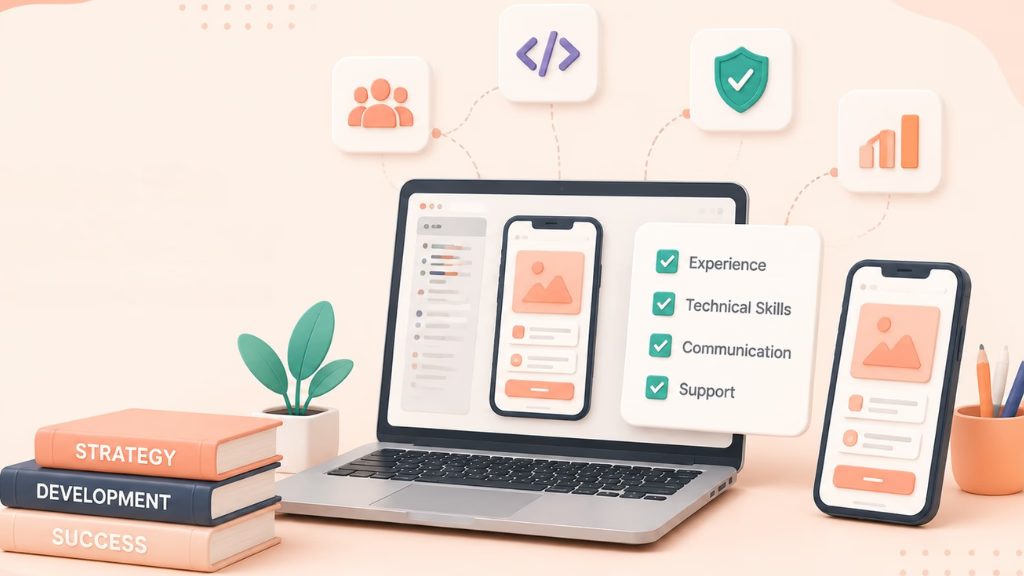
Choosing the right outsourcing partner requires more than comparing prices or portfolios. Focus on experience, technical expertise, team quality, communication, and long-term support.
Look for Relevant Experience
Review projects similar to yours in industry, platform, features, integrations, and technical complexity.
When evaluating Riseup Labs, check its mobile app development experience and relevant projects to see whether they match your requirements.
Ask what the agency actually delivered instead of relying only on portfolio visuals.
Evaluate the Proposed Team
Ask who will work on your project and whether the team includes the right developers, designers, QA engineers, and project managers.
Also confirm how the company handles team changes, resource scaling, and knowledge transfer during development.
Ask About the Development Process
A reliable vendor should clearly explain how it manages discovery, design, development, testing, deployment, and maintenance.
Look for a process that includes regular updates, working demos, clear approvals, and visibility into project progress.
Check Technical Capabilities
Ask the vendor about its expertise in native and cross-platform development, backend technologies, APIs, cloud infrastructure, security, testing, performance, and scalability.
A full-cycle provider such as Riseup Labs should be able to explain which technologies and development approach best fit your app’s requirements and long-term goals.
The vendor should justify its recommendations instead of suggesting a technology before fully understanding your project.
Speak With Previous Clients
Ask previous clients about communication, timelines, code quality, scope changes, unexpected costs, and post-launch support.
Their feedback can help you understand how the company performs when challenges arise during a real project.
Review Communication and Time-Zone Overlap
Clarify working hours, meeting schedules, response times, project management tools, reporting methods, and main points of contact.
Clear communication and reliable time-zone overlap can make remote collaboration effective regardless of where the development team is located.
Which Outsourcing Model Should You Choose?
The right engagement model depends on how clearly the project is defined and how much flexibility you need.
Fixed-Price Development
A fixed-price project defines the scope, deliverables, timeline, and price before development begins.
It is most suitable when:
- Requirements are clear.
- The project is relatively small.
- Major changes are unlikely.
- Deliverables can be defined accurately.
Its main advantage is budget predictability.
Its main weakness is limited flexibility. New requirements may need formal change requests that increase the cost and timeline.
Time and Materials
Under a time-and-materials model, you pay for the time spent by the assigned team.
It works well when:
- Requirements may evolve.
- User feedback will influence priorities.
- Technical uncertainty exists.
- The app will be delivered in phases.
- You need flexibility to change features.
This model requires active budget and backlog management.
Dedicated Development Team
A dedicated team works on your product over an extended period.
It may include developers, designers, QA engineers, and a project manager.
This model works well for:
- Long-term products
- Scaling startups
- Regular feature releases
- Complex applications
- Evolving requirements
- Businesses without a complete internal engineering department
You receive more control and flexibility, but your company must remain actively involved in setting priorities.
Staff Augmentation
Staff augmentation adds individual outsourced specialists to your existing team.
It works best when:
- You already have internal technical leadership.
- A specific skill is missing.
- You need temporary additional capacity.
- Your internal team will manage the work.
It is less appropriate when you need the vendor to manage the complete product lifecycle.
How Much Does It Cost to Outsource Mobile App Development?
The cost to outsource mobile app development typically ranges from $20,000 to $150,000+, depending on the app’s complexity, platforms, features, and development team.
Typical Cost by App Complexity
- Simple app: $20,000–$40,000
- Medium-complexity app: $40,000–$80,000
- Complex app: $80,000–$150,000+
Features such as payments, real-time messaging, AI, geolocation, video streaming, and third-party integrations can increase development costs.
What Affects the Cost?
The main cost factors include iOS and Android support, UI/UX complexity, backend development, API integrations, security requirements, and the outsourcing company’s location and experience.
You should also budget for post-launch maintenance, which commonly adds ongoing costs for bug fixes, security updates, cloud services, OS updates, and new features.
Before outsourcing, request a detailed estimate based on your actual requirements rather than choosing a development partner based only on the lowest hourly rate.
Common Outsourcing Risks and How to Control Them
Outsourcing offers flexibility, but it also introduces risks that need to be addressed early.
Unclear Scope
Risk: The vendor misunderstands the project, leading to revisions and additional costs.
Solution: Use discovery, wireframes, user stories, and acceptance criteria before major development begins.
Hidden Costs
Risk: Important services are excluded from the initial estimate.
Solution: Ask for a detailed list of included services, exclusions, assumptions, third-party fees, and change-request rates.
Missed Deadlines
Risk: Progress becomes difficult to track until the project is already delayed.
Solution: Use short development cycles, milestone reviews, working demos, and documented escalation procedures.
Weak Code Quality
Risk: The application works initially but becomes difficult and expensive to maintain.
Solution: Require code reviews, automated testing, technical documentation, repository access, and defined coding standards.
Vendor Dependency
Risk: Only the outsourcing company knows how to run, update, or deploy the application.
Solution: Keep source code, credentials, documentation, cloud accounts, and deployment instructions under your control.
Poor Communication
Risk: Decisions are delayed, misunderstood, or lost across messages.
Solution: Set communication expectations, response times, meeting schedules, documentation standards, and a clear decision-making process.
How to Protect Security, Data, and Intellectual Property
Security and ownership must be discussed before development starts.
Sign an NDA Before Sharing Sensitive Information
A nondisclosure agreement can define how the vendor must protect confidential business information.
However, an NDA alone is not enough.
The main development contract should also cover data access, intellectual property, security responsibilities, and incident handling.
Define Intellectual Property Ownership
The contract should state who owns:
- Source code
- Designs
- Documentation
- Databases
- Custom libraries
- Product data
- Project assets
- Infrastructure configurations
It should also explain when ownership transfers and how third-party or open-source components may be used.
Keep Critical Accounts Under Your Control
Whenever possible, your business should own:
- Source code repositories
- Cloud infrastructure accounts
- Apple App Store account
- Google Play Console account
- Analytics accounts
- Payment accounts
- Domain names
- API credentials
- Design files
The vendor can receive the access needed to work without becoming the sole owner of essential systems.
Review the Vendor’s Security Practices
Ask how the company manages:
- User access
- Authentication
- Encryption
- Code repositories
- Secrets and credentials
- Employee devices
- Vulnerability testing
- Third-party libraries
- Backups
- Incident response
- Data deletion
Request practical evidence of the process rather than accepting general claims such as “we follow best practices.”
Control Data Access
Give each team member access only to the information needed for their role.
For sensitive applications, also define:
- Data storage locations
- Permitted subprocessors
- Data retention
- Data deletion
- Breach notification
- Audit rights
- Development and testing data
How to Manage Your Outsourced App Development Team
Hiring a capable agency does not mean the project should operate without client involvement.
Assign an Internal Product Owner
Choose one person who can:
- Approve designs
- Clarify priorities
- Answer business questions
- Review completed work
- Accept deliverables
- Resolve conflicting feedback
This prevents developers from receiving different instructions from multiple stakeholders.
Review Working Software Regularly
Ask the team to demonstrate real builds throughout development.
Regular reviews allow you to identify:
- Missing requirements
- Confusing workflows
- Performance issues
- Visual inconsistencies
- Integration problems
- Device-specific errors
Finding these problems early is less expensive than waiting until the final release.
Keep Decisions Documented
Use shared systems for:
- Requirements
- User stories
- Designs
- Bugs
- Technical decisions
- Change requests
- Meeting notes
- Release plans
Important decisions should not exist only in calls or private messages.
Monitor Budget and Scope
Review regularly:
- Work completed
- Budget consumed
- New requirements
- Delivery risks
- Open defects
- Upcoming priorities
This is particularly important for time-and-materials and dedicated-team engagements.
Avoid Micromanaging Individual Tasks
Your focus should remain on:
- User needs
- Business outcomes
- Product priorities
- Quality
- Delivery risk
A capable technical partner should manage implementation details while keeping you informed about decisions that affect the product.
Why Choose Riseup Labs to Outsource Mobile App Development?
When choosing an outsourcing partner, you need more than developers who can complete assigned tasks.
You need a team that understands product goals, manages technical delivery, tests thoroughly, communicates clearly, and supports the application after launch.
Riseup Labs provides full-cycle mobile app services, including design, development, QA, and ongoing support. Its mobile app development offering is positioned around creating scalable applications that support user retention and measurable business outcomes.
Businesses can work with Riseup Labs for:
- Product planning
- UI and UX design
- Native app development
- Cross-platform development
- Backend and API engineering
- Quality assurance
- Application modernization
- Launch support
- Ongoing maintenance
Riseup Labs also states that it has delivered more than 700 projects for over 300 clients across 30-plus countries. These figures are company-reported and provide context on its delivery experience.
Conclusion
Choosing to outsource mobile app development can help your business access specialized expertise, launch faster, and scale technical capacity without building an entire in-house team.
Success depends on choosing a partner that understands your business goals—not simply one that offers the lowest rate.
Clear requirements, relevant experience, transparent communication, secure development practices, strong contracts, and reliable post-launch support all contribute to a successful outsourcing relationship.
Partner with Riseup Labs for mobile app strategy, UI/UX design, development, QA, launch, and long-term technical support.
Frequently Asked Questions
What Does It Mean to Outsource Mobile App Development?
It means hiring an external agency, team, or specialist to design, build, test, launch, or maintain a mobile application rather than completing all development through internal employees.
Why Should a Company Outsource Mobile App Development?
A company may outsource to access specialized skills, avoid lengthy hiring processes, expand its development capacity, launch faster, and receive design, engineering, testing, and support from one team.
How Much Does It Cost to Outsource Mobile App Development?
The cost depends on app complexity, platforms, design, backend requirements, integrations, security, testing, team location, and engagement model. A detailed discovery process is usually required before a reliable estimate can be provided.
How Do I Choose the Right Mobile App Development Partner?
Review the vendor’s relevant experience, proposed team, development process, technical skills, communication, client references, security practices, contract terms, and post-launch support.
Is Outsourcing Mobile App Development Safe?
It can be safe when the vendor is evaluated carefully and the contract clearly covers security, data access, intellectual property, confidentiality, source code, infrastructure ownership, and incident response.
Should I Choose Native or Cross-Platform Development?
Native development may be preferable when the app requires maximum platform-specific performance or advanced device integration. Cross-platform development can be useful when shared development across iOS and Android supports the product’s requirements.
Which Outsourcing Model Is Best?
Fixed price works best for clearly defined projects. Time and materials or dedicated teams are generally more suitable for evolving products. Staff augmentation works when you already have an internal team that can manage development.
Will an Outsourcing Company Maintain the App After Launch?
Many agencies provide post-launch maintenance, but support should be defined in the contract. Confirm response times, covered services, maintenance fees, monitoring, operating system updates, and feature-request pricing.
This page was last edited on 17 August 2026, at 4:01 pm

Start a conversation with our team to solve complex challenges and move forward with confidence.