Global technology teams face a widening talent gap, rising software development costs, and increasing pressure to deliver products faster with predictable quality. Traditional offshoring and onshoring models often fail to balance talent, cost, time zones, and effective collaboration.
Nearshoring software product development offers a smart, future-ready alternative—leveraging agile teams in nearby countries, optimizing costs without sacrificing quality or control. This expert playbook for 2024–2026 provides actionable frameworks, cost data, regional insights, and hands-on checklists for decision-makers tasked with building or scaling custom product engineering teams.
Read on for practical tools, updated guidance, and clear next steps to future-proof your software product strategy using nearshore partners.
Quick-Start Summary:
- Talent shortages and budget constraints are accelerating interest in nearshoring software product development.
- Nearshoring solves key offshoring problems—time zones, culture, communication—while maintaining cost savings.
- This guide delivers up-to-date models, costs, partner selection checklists, and region-by-region intelligence for 2024–2026 success.
What Is Nearshoring Software Product Development? (Definition, Models, Core Value)
Nearshoring software product development means partnering with engineering teams in nearby countries—often within similar time zones—to develop, test, and maintain digital products. It bridges cost, talent, and collaboration gaps between offshore and onshore models.
Understanding Nearshoring:
Nearshoring software product development is the outsourcing of product engineering tasks to teams in geographically proximate countries, delivering major benefits in collaboration speed, cost optimization, and cultural alignment compared to classic offshoring or onshoring.
Evolution and Trends:
Nearshoring gained popularity as companies in North America and Western Europe sought closer, more responsive alternatives to far-shore (e.g., Asia-based) outsourcing. Latin America and Eastern Europe (EMEA) rapidly became nearshore hubs, fueled by strong STEM education, growing English proficiency, and time zone alignment with clients.
Core Value vs. Traditional Models:
- Real-time collaboration due to minimal time differences
- Greater cultural and language compatibility
- Significant cost savings over local hiring, but with closer quality control compared to offshore
- Easier travel and oversight
Common Engagement Scenarios:
- Mid-market SaaS companies scaling product teams
- Enterprises seeking agile squads for new product delivery
- Fintech and healthcare expanding R&D capacity without local hiring
Nearshoring software product development outsources engineering to teams in neighboring or similar time-zone countries—offering better real-time collaboration, cost savings, and cultural fit than offshore or onshore models.
Nearshore vs. Offshore vs. Onshore Software Development—How Do They Compare?
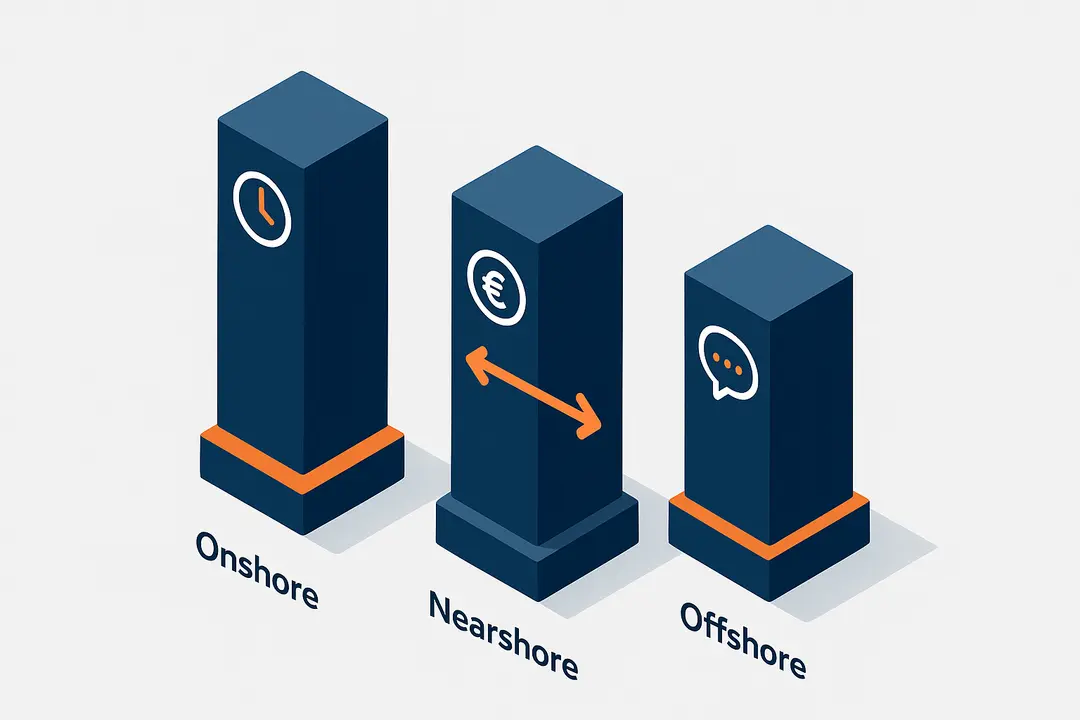
Nearshore, offshore, and onshore software development models differ in cost, talent access, collaboration, and time zone fit. The table below summarizes key factors to guide your decision.
| Model | Geography/Regions | Cost ($/hr) | Time Zone Overlap | Collaboration & Communication | Cultural Fit | Best Use Cases |
| Onshore | Within home country | $90–$200+ | Full | Easiest, direct | Full alignment | High-control, compliance-critical |
| Nearshore | Neighboring/region countries | $35–$75 | 4–8 hours | High, similar working hours | Strong alignment | Agile delivery, frequent iteration |
| Offshore | Distant regions (Asia, Africa) | $20–$45 | 0–4 hours | Mixed, asynchronous often | Moderate/low | Cost-driven, large-scale dev |
Pros & Cons by Model
- Onshore
_Pros:_ Maximum control, compliance, communication ease
_Cons:_ Highest cost, talent shortages - Nearshore
_Pros:_ Cost savings, real-time collaboration, cultural affinity
_Cons:_ Moderate travel costs, balancing rates versus skills - Offshore
_Pros:_ Lowest cost, large talent pool
_Cons:_ Challenging time zones, cultural and communication hurdles, increased oversight required
Choose nearshore for projects that demand agility, close collaboration, and cost optimization without sacrificing quality or control.
Comparison Table (AEO/Featured Snippet):
| Onshore | Nearshore | Offshore | |
| Cost | $$$$ | $$–$$$ | $–$$ |
| Time | Full overlap | Partial/full | Minimal |
| Culture | Strong | Moderate–Strong | Low–Moderate |
| Communication | Easiest | Smooth, real-time | Often delayed |
What Engagement Models Exist for Nearshoring Software Product Development?
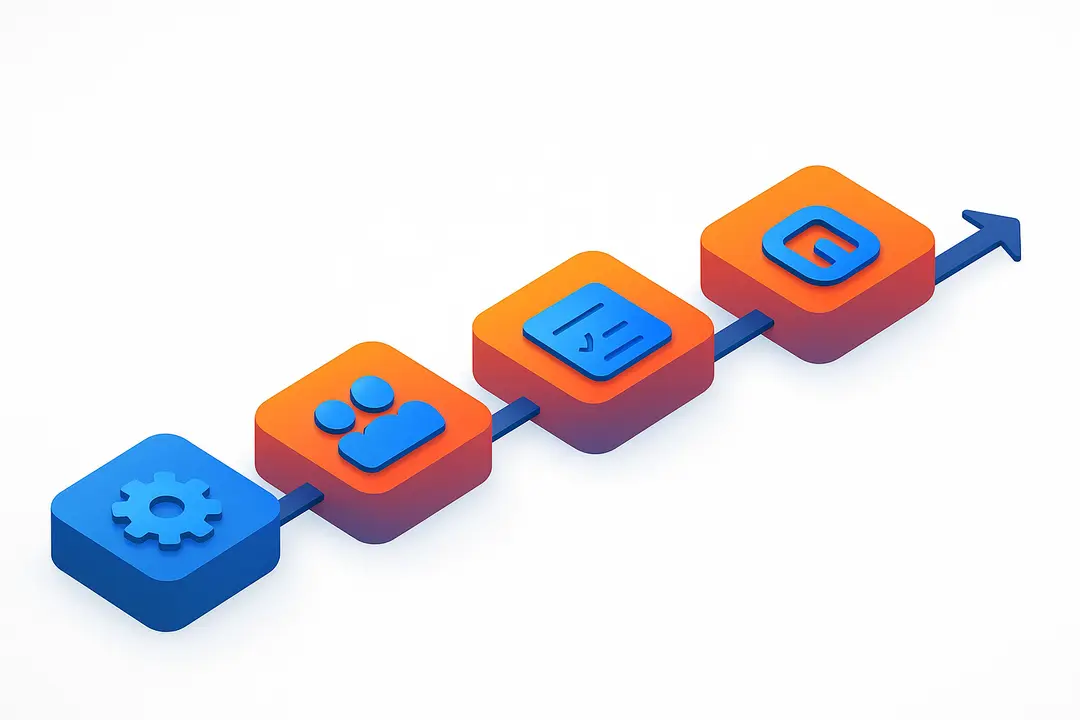
Nearshore partners offer multiple engagement models to match your project’s size, complexity, and workflow needs. Choosing the right model is critical for achieving delivery, budget, and innovation targets.
- Staff Augmentation
What: Integrate remote engineers into your existing product teams; maintains direct control.
Use When: Scaling quickly, needing niche skills, or supplementing core teams.
Pros: High flexibility, rapid ramp-up, direct oversight.
Limitations: Requires strong internal managers, onboarding investment. - Dedicated Agile Teams
What: Self-managed, cross-functional teams focused on your product roadmap.
Use When: Delivering products end-to-end, seeking agile velocity, or minimizing management overhead.
Pros: Ownership, accountability, proven agile delivery.
Limitations: Higher monthly cost, potential integration time. - Project-Based Delivery
What: Full-cycle development delivered against defined specs, timelines, and milestones.
Use When: Fixed-budget, clear project scopes, or pilot work.
Pros: Predictable costs, outcome-oriented.
Limitations: Limited flexibility, scope change risk. - Hybrid Models
What: Combine staff augmentation, dedicated teams, and/or project work for maximum flexibility.
Use When: Large-scale or evolving needs.
Engagement Models Table:
| Model | Control Level | Flexibility | Typical Use Case | Best For |
| Staff Augmentation | High | High | Scaling teams fast | Rapid capacity increase |
| Dedicated Agile Team | Medium-High | Medium | End-to-end product dev | Full agile delivery |
| Project-Based | Low-Medium | Low | Well-defined goals/timelines | Fixed-scope MVPs |
| Hybrid | Customizable | Highest | Ongoing, multi-faceted projects | Enterprise, multi-team |
Engagement Models Lifecycle Diagram:
- Plan → Ramp → Deliver → Scale/Iterate
- Staff augment for speed
- Dedicated teams for ownership
- Project-based for milestone delivery
- Combine as product needs evolve
How Do You Select a Nearshore Software Development Partner?
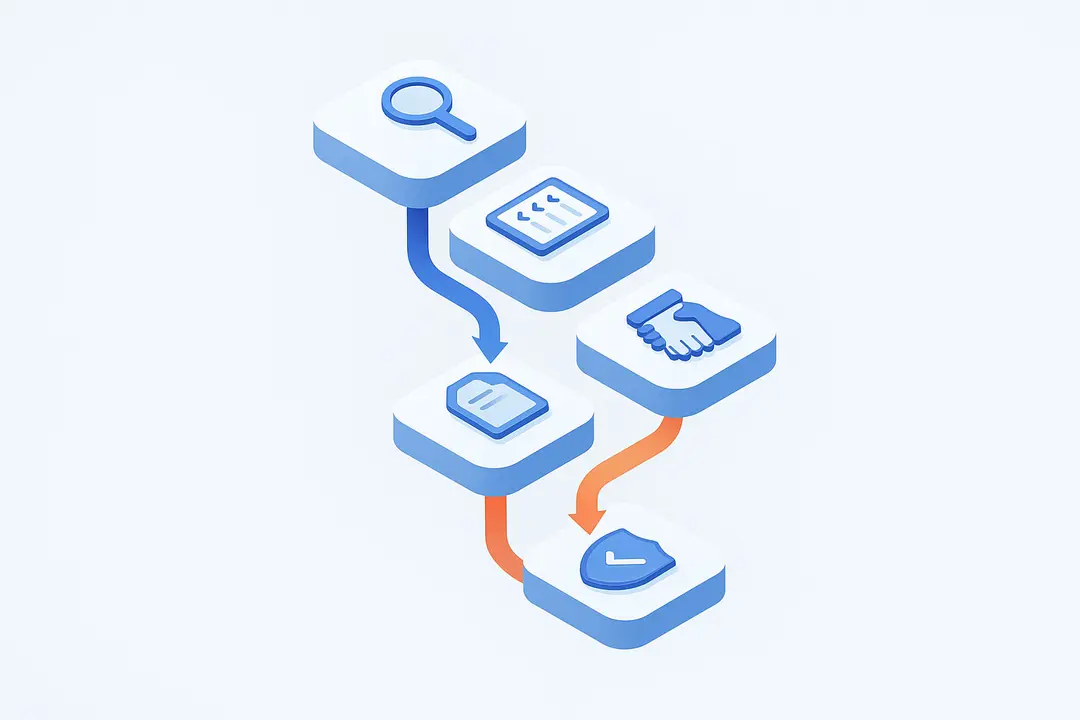
Selecting the right nearshore partner is a structured process—one misstep can result in delays, security risks, or cost overruns. Use a strategic workflow and vetting tools to ensure alignment, expertise, and long-term value.
Stepwise Partner Selection Framework:
- Define Needs & Objectives
Product type, desired skills, technical stack, security/compliance requirements. - Shortlist Vendors
Research country and company reviews (e.g., Clutch, Goodfirms). Focus on proven track records and sector expertise. - Initial Outreach
Assess responsiveness and clarity in early communication. - Deep Dive Evaluation
Request references, project portfolios, and team bios.
Review certifications and compliance practices.
Confirm English proficiency, team structure, and delivery methodology. - RFP & Due Diligence
Issue a tailored RFP using a checklist/template.
Evaluate proposals for transparency in pricing, security, ownership, and onboarding. - Pilot/Proof-of-Concept (POC)
Launch a small engagement to validate fit, collaboration, and technical capability.
Partner Vetting: Checklist
| Criteria | Why It Matters | Meets Requirement? |
| Relevant technical expertise | Ensures delivery capability | [ ] Yes [ ] No |
| Regulatory compliance | Reduces legal/IP risk | [ ] Yes [ ] No |
| Talent sourcing & retention | Drives team continuity | [ ] Yes [ ] No |
| English proficiency | Prevents communication breakdowns | [ ] Yes [ ] No |
| Data security certifications | Protects sensitive IP/customer data | [ ] Yes [ ] No |
| Project management approach | Impacts speed and transparency | [ ] Yes [ ] No |
| Transparent pricing | Prevents unexpected budget creep | [ ] Yes [ ] No |
| Cultural & time zone fit | Enables real-time collaboration | [ ] Yes [ ] No |
Red Flags & Dealbreakers:
- Unwillingness to share references or security processes
- Vague or non-transparent price structures
- Poor responsiveness, high team turnover, or unclear contracts
Where Are the Best Countries and Regions for Nearshoring?
Choosing the right nearshore location shapes your team’s quality, collaboration style, and cost. In 2025, Latin America (LATAM) and Eastern/Central Europe (EMEA) lead as nearshore hotspots due to talent pool depth, time zone alignment, and maturing ecosystems.
| Country/Region | Hourly Rate ($) | Talent Pool Size | English Proficiency | Time Overlap | Key Legal Notes | Market Focus |
| Mexico | $40–$65 | 700K+ engineers | Moderate-High | Full with US | NAFTA/USMCA compliance | SaaS, fintech, healthcare |
| Brazil | $35–$60 | ~500K+ IT grads/yr | Medium-High | 2–3 hr US | Data protection evolving | Fintech, e-commerce |
| Colombia | $35–$55 | 150K+ engineers | High | Full with US | Stable business regulation | Product engineering, banking |
| Poland (EMEA) | $45–$80 | 400K+ devs | High | Full EU, 6–8 US | EU/GDPR compliance | Mobile, enterprise |
| Romania | $40–$70 | 100K+ devs | High | EU overlap | EU/GDPR, tax incentives | AI, SaaS, fintech |
| Portugal | $45–$75 | 100K+ devs | Very High | Full EU/Partial US | EU/GDPR | Healthtech, enterprise |
Key Regional Insights
LATAM:
Growing tech hubs, competitive rates, high US/Canada time zone alignment, and strong ties to North American markets.
EMEA (Eastern/Central Europe):
Highly skilled, English-proficient developers, strong compliance with EU standards, minor time zone friction with North America.
Prioritize countries with proven IT education, regulatory maturity, and robust language skills for smooth and secure collaboration.
What Are the Real Costs, Value, and ROI of Nearshore Software Product Development?
Nearshoring strikes a powerful balance between cost and quality—offering significant savings over onshore, and higher collaboration/velocity than offshore.
Rates & Value Benchmarks (2024)
| Role | Onshore (US/EU) | Nearshore (LATAM) | Nearshore (EMEA) | Offshore (Asia) |
| Software Engineer | $100–$200/hr | $40–$65/hr | $45–$80/hr | $20–$40/hr |
| QA Engineer | $80–$160/hr | $35–$55/hr | $40–$70/hr | $18–$35/hr |
| Product Manager | $120–$220/hr | $55–$90/hr | $60–$95/hr | $30–$50/hr |
Source: Deloitte Nearshore Tech Talent Report, 2023–24
Total Cost of Ownership (TCO) Factors
- Direct costs: Hourly rates, infrastructure, tools
- Indirect costs: Overheads, project management, ramp time
- Hidden savings: Shorter onboarding, fewer handoff delays, reduced travel
Sample ROI Scenarios
For a typical 6-month MVP build, nearshoring can save 30–50% vs. onshore staffing, while accelerating deployment by 10–25% thanks to timezone alignment and agile process adoption.
Infographic: Cost Savings & Productivity
Nearshoring = 30–50% direct rate savings + up to 20% faster sprints via real-time collaboration over classic offshore models.
What Are the Legal, Regulatory & Data Security Risks—And How Do You Manage Them?
Legal and compliance risks in nearshoring include data privacy, intellectual property (IP) protection, labor law, and taxation. Proactive frameworks and tight contract terms reduce exposure.
Key Risk Types
- Data Privacy: Ensure local regulations (e.g., GDPR, LGPD) protect your customer data.
- IP Protection: Contracts must clarify code, patent, and product ownership.
- Labor Law: Varies by country, especially in LATAM; impacts contracts, hire/fire, taxes.
- Tax & Contract Structure: Cross-border invoicing and transfer pricing require clarity and local expertise.
Compliance Checklist
| Item | Action Required | Complete? |
| NDAs & IP assignment clauses | Included in partner contracts | [ ] |
| Data security certifications | SOC 2, ISO 27001 (as applicable) | [ ] |
| Country labor law onboarded | Legal review of employment/contract | [ ] |
| GDPR/LGPD/etc compliance | Location-specific data process | [ ] |
| Audit/reporting provisions | In place for transparency | [ ] |
LATAM & EU Legal Nuances
LATAM: Stay updated on evolving data privacy regimes (e.g., Brazil’s LGPD); contractually specify US/EU-style IP protection.
EU: GDPR defines strict data handling—verify that providers meet relevant European standards.
Risk Mitigation Workflow:
- Contract Audit → Regulatory Mapping → Data/IP Protection Steps → Ongoing Compliance Review
What Are Best Practices for Nearshore Software Product Delivery and Collaboration?
Successful nearshore teams mirror the best in distributed engineering—embedding agile processes, seamless onboarding, strong communication, and trust.
Core Best Practices
Agile Adoption:
Empower dedicated teams with mature Agile or Scrum frameworks. Regular stand-ups and sprint reviews keep development close to changing business needs.
Structured Onboarding:
Use standardized onboarding guides to align processes, roles, tool access, and cultural expectations early.
Communication Stack:
Combine real-time tools (Slack, Zoom, Jira, GitHub) for rapid collaboration and transparent progress tracking.
Cultural & Time Zone Alignment:
Schedule overlapping hours and leverage cultural similarity for reduced friction and miscommunication.
Infographic: Best Practices Workflow
- Toolset Ready
- Team Onboarded
- Clear Communication Cadence
- Regular Feedback & Retrospectives
- Ongoing Process Improvement
What Are the Key Trends Shaping Nearshore Product Development in 2024–2026?
Nearshore software product development is entering a new era, shaped by technology, workforce, and regulatory shifts.
Notable Trends
- AI & Automation:
Increased adoption of AI/ML in delivery workflows and code generation tools—in both providers and clients. - Hybrid & Remote Models:
Post-pandemic, most nearshore vendors enable hybrid/remote work, expanding talent availability but requiring improved digital onboarding and management. - Regulatory Change:
New regional privacy laws (GDPR, LGPD) and cross-border tax rules make compliance more complex. Nearshore teams increasingly invest in certifications and process transparency. - Talent Market Evolution:
Demand continues to outpace supply in major nearshore hubs, raising compensation slowly, but upside remains compared to onshore rates. Some regions see tech “brain gain” as local economies foster more IT graduates.
Future Factors Table:
| Trend | Impact Area | What to Watch |
| AI/ML Automation | Productivity, QA | Faster MVPs, smarter testing pipelines |
| Hybrid teams | Collaboration | Higher engagement, global talent reach |
| Regulatory shifts | Compliance | Must adopt new privacy, security frameworks |
| Talent shifts | Cost/quality | Emerging hubs (Africa, Central Europe rising) |
Case Studies & Mini-Success Stories—Real Lessons from Nearshoring Software Product Teams
Case 1: Startup SaaS Accelerates Launch with LATAM Team
A US SaaS company struggling with Bay Area talent shortages engaged a nearshore partner in Colombia for product buildout. Within weeks, agile squads scaled core features, reducing time to MVP by 30%. The CTO credited daily real-time standups and robust onboarding for smooth delivery.
Case 2: EU Healthtech Navigates Compliance with Polish Development Team
An EU-based healthcare firm selected a nearshore team in Poland to address GDPR and rapid scaling needs. Transparent contracts, English-fluent developers, and mature delivery processes enabled both compliance and continuous releases. In the client’s words:
“The true test was scaling—our Polish team managed it with speed and no legal headaches.”
Key Takeaways:
- Clear contracts and onboarding frameworks reduce launch risk.
- Time zone and language alignment drive faster, higher-quality delivery.
- Mature providers excel not just technically, but in regulatory diligence.
Quick-Reference Summary Table: Models, Costs & Benefits at a Glance
| Model | Avg. Rate ($/hr) | Key Benefits | Best Regions |
| Staff Augmentation | $35–$65 | Control, flexibility, speed | LATAM, EMEA |
| Dedicated Agile Teams | $40–$80 | Ownership, agile delivery | LATAM, Poland, Romania |
| Project-Based Delivery | $35–$75 | Fixed cost, outcome based | Brazil, Portugal |
| Hybrid Model | $40–$85 | Full customization, scalability | Larger markets |
Key Takeaways:
- Nearshoring offers the best blend of cost efficiency and close collaboration.
- Model choice depends on product lifecycle, organizational maturity, and compliance needs.
- LATAM and EMEA remain the strongest nearshore regions for 2024–2026.
Frequently Asked Questions about Nearshoring Software Product Development
What Is Nearshoring Software Product Development?
Nearshoring software product development means outsourcing software product work to teams in nearby countries. It helps businesses reduce costs, improve time zone alignment, support real-time collaboration, and work with skilled development teams.
How Does Nearshore Software Development Differ From Offshore And Onshore Models?
Nearshore software development uses teams in nearby countries with similar time zones. Offshore development usually involves distant countries, while onshore development uses local teams. Nearshoring often provides a better balance of cost, communication, and collaboration.
What Are The Cost Differences In Nearshoring Software Product Development?
The cost of nearshoring software product development is usually lower than onshore development but may be higher than offshore outsourcing. However, better communication, faster feedback, and closer collaboration can improve overall project value.
Which Countries Are Best For Nearshore Software Development?
The best countries for nearshore software development depend on your location, budget, technical needs, and communication preferences. Popular regions include Latin America, Eastern Europe, and nearby technology hubs with strong software talent.
What Legal Or Regulatory Challenges Are Common In Nearshoring Software Product Development?
Common legal challenges in nearshoring software product development include data privacy, IP ownership, contract terms, compliance rules, and labor regulations. Clear agreements and legal review help reduce risks before the project begins.
What Engagement Models Work For A Nearshore Development Team?
A nearshore development team can work through staff augmentation, dedicated teams, project-based delivery, or hybrid models. The right model depends on your project scope, timeline, budget, and level of control.
How Do I Select A Reliable Nearshore Development Team?
To choose a reliable nearshore development team, review technical expertise, industry experience, communication skills, security practices, client references, and delivery process. A small pilot project can also help test the partnership before scaling.
How Can Companies Ensure Data Security With Nearshore Software Development?
For secure nearshore software development, use NDAs, IP ownership clauses, access controls, secure repositories, regular audits, and partners with strong security practices. These steps help protect sensitive data and product assets.
What Trends Are Shaping Nearshoring Software Product Development?
Key trends in nearshoring software product development include AI-assisted development, hybrid delivery models, stronger cybersecurity requirements, growing demand for specialized talent, and increased use of agile nearshore teams.
Conclusion: Key Takeaways & Your Next Steps in Nearshore Product Development
Nearshoring software product development offers a powerful solution to tech talent shortages, budget constraints, and the need for agile innovation. By selecting the right engagement model, region, and partner, and conducting thorough due diligence, you can tap into top-tier talent, ensure seamless collaboration, and realize significant cost savings.
Take the next step in accelerating your product development and mitigating risks by connecting with a nearshore expert to discuss how this strategy can benefit your business.
Key Takeaways
- Nearshoring blends cost optimization with real-time, high-quality Agile collaboration for product teams.
- LATAM and EMEA are 2024’s prime nearshore destinations, with proven engineering talent and regulatory maturity.
- Engagement models (staff aug, dedicated teams, hybrid) suit every scaling scenario.
- Legal, regulatory, and IP risks can be mitigated with checklists, tight contracts, and certified partners.
- 2024–2026 will see AI, hybrid work, and compliance standards reshape the nearshore landscape.
This page was last edited on 9 July 2026, at 11:10 am

Start a conversation with our team to solve complex challenges and move forward with confidence.