
To make a gambling website in 2026, research laws and markets, get a gaming license, choose your casino platform, set up secure payments, launch verified games, and ensure ongoing compliance. Costs usually start at $35,000. Full process explained below.
Growth in global online gambling continues. In 2026, the global online gambling market is estimated at $97.7 billion, according to Grand View Research. But higher revenue potential also brings tougher legal, compliance, payment, and technical barriers.
I know founders face tough questions: Is it worth fighting rising regulation? What does it really cost to compete? What steps matter most for trust and long-term success?
This guide lays out the exact decisions, steps, and pitfalls I have seen most in online casino development. Readers will leave with a clear process, benchmarks, and compliance guardrails needed to succeed.
What Makes Online Casino Development in 2026 Both High-Reward and High-Risk?
Online casino development is the structured process of creating and running a digital gaming platform. This work blends complex technical builds with strict legal and business requirements.
The real issue is that, by 2026, the market holds both record potential and record scrutiny. User demand is high, but new laws and global payment limits present major risks. Fast-growing markets include casino, sports betting, live dealer, and hybrid (skill-based or crypto) products. Every operator now needs a strong compliance plan and business model.
In my experience, teams who start with clear compliance, up-to-date market research, and a well-chosen software stack stand a better chance. Getting any of these wrong risks shutdown or financial loss. The steps in this guide map out how to avoid these common pitfalls.
What Are the Essential Steps to Make a Gambling Website in 2026?
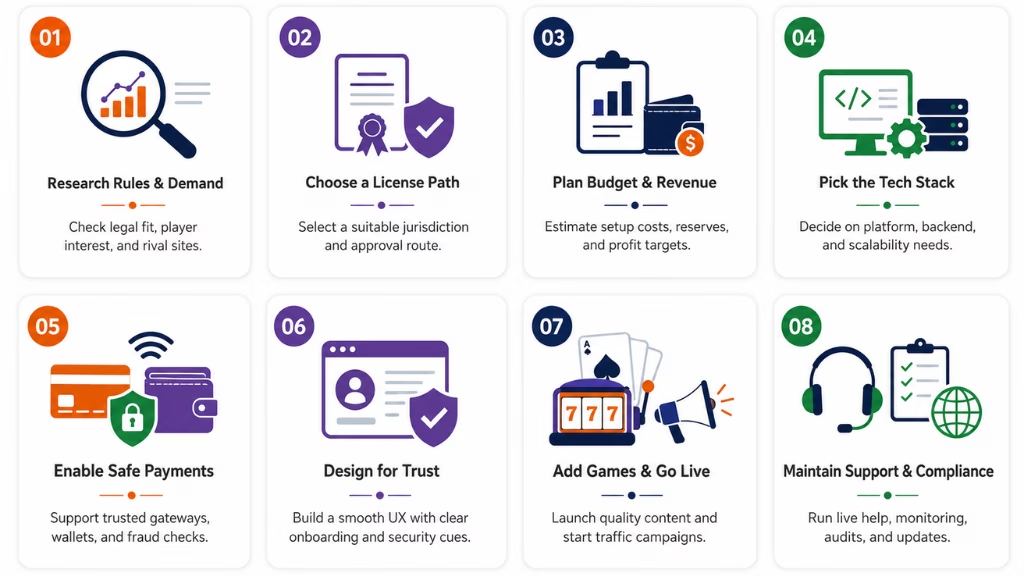
Making a gambling website in 2026 means following a strict, stepwise process to reduce risks. Each step serves a practical function in launching and sustaining a legal, profitable business.
Below is the full roadmap from planning through launch.
| Step | Key Action | Why It Matters |
|---|---|---|
| 1 | Conduct legal and market research | Avoids illegal operation and costly errors |
| 2 | Obtain a gaming license from a top jurisdiction | Enables legal operations and reliable payments |
| 3 | Build a casino business plan and realistic budget | Prevents overspending and models ROI |
| 4 | Select your technology stack/platform | Impacts speed, cost, and future flexibility |
| 5 | Integrate secure payment gateways | Boosts trust and global accessibility |
| 6 | Design for user experience and trust | Drives player retention and supports compliance |
| 7 | Launch games and start core marketing | Attracts players and builds initial traffic |
| 8 | Ensure ongoing compliance and live support | Maintains operations, trust, and legal right to run |
A better approach is to link each step to later sections for deeper guidance. In my POV, most failed casino startups skip or rush steps one and two—this is where many teams struggle.
How Do You Navigate the Legal and Licensing Maze for Gambling Websites in 2026?
Legal compliance comes first in any gambling project. Without correct licensing, payment providers, ad platforms, and players will not trust your business.
Operators must pick a jurisdiction, gather documents, and pass vetting. By 2026, regulators demand even tighter anti-money laundering (AML) and KYC processes. Markets like the UK, Malta, and Curacao have new rules for crypto and “hybrid” models.
Here’s a comparison of top licensing options:
| Jurisdiction | Cost Range | Time to Issue | Pros | Cons |
|---|---|---|---|---|
| Curacao | $18K–$36K | 1–3 months | Fast, affordable | Less reputational weight, limits |
| Malta (MGA) | $40K–$55K+ | 4–8 months | Strong EU access, trust | Stringent, costly |
| UKGC | $40K–$80K+ | 4–10 months | Top-tier credibility | Highest compliance, slow |
| Isle of Man | $45K–$75K | 3–6 months | Stable, crypto-friendly | High bar, tough documentation |
| Kahnawake | $30K–$50K | 2–5 months | NA focus, semi-flexible | Some payment restrictions |
Latest data, Gambling Compliance 2026
A step-by-step approach:
- Choose a business structure.
- Apply to your target jurisdiction.
- Prepare shareholder, director, and AML documents.
- Submit compliance, tech games, and hosting details.
- Pass KYC, AML, and fit-and-proper tests.
- Pay fees and respond to requests.
- Secure approval and maintain annual audits.
Pay attention to 2026 changes. Many “easy” licenses now have stricter renewal and monitoring. Using low-reputation paths risks payment blocks or blacklisting. Always consult the regulator’s site for the latest updates.
How Should You Build a Business Plan and Budget for an Online Casino?
Every successful online casino starts with a clear, honest business plan. The goal is to define your market, model profits, and set up funding before writing a line of code.
A one-page business model canvas should include:
- Core customer segment and target market
- Key value proposition (e.g., unique games, bonuses)
- Marketing channels (paid ads, affiliates, influencers)
- Partner network (game studios, payment processors)
- Cost structure (fixed and variable)
- Revenue models (RTP, house edge, fees)
Example cost breakdown (2026 benchmarks):
| Item | Startup Cost (USD) | Ongoing ($/mo) |
|---|---|---|
| License & Legal | $25,000–$80,000 | $500–$2,000 |
| Software/Platform | $20,000–$100,000+ | $1,000–$20,000 |
| Game Content | $10,000–$80,000 | % of profit |
| Payment Integration | $5,000–$25,000 | Transaction fees |
| Marketing | $10,000–$50,000 | $3,000–$30,000 |
| Operations & Support | $5,000–$25,000 | $2,000–$15,000 |
Total typical startup: $35,000–$180,000+
A better approach is to double-check every assumption. The mistake I see often is underestimating compliance upgrades and support costs after launch.
Modeling ROI? Many new operations take 12–24 months to break even. Factor in a lower estimate for your first-year revenue and include buffer for compliance, payment holdbacks, and tech upgrades.
Common funding options: Self-funding (bootstrapped), venture capital, or strategic partnerships.
Which Technology Stack or Platform Is Best for Your Gambling Website? (Custom vs. White-Label vs. Turnkey)
This is one of the most important decisions for new operators. Your tech choice shapes your speed, budget, and flexibility.
In my experience, the three main options are:
- Custom Build: High control, unique features, higher costs, longer timeline, heavy on compliance.
- White-Label Solution: Fast to launch, includes basic license/tech, lower control but simpler compliance.
- Turnkey Casino Platform: Balance of custom and white-label, with integrations and support, scalable.
Here’s how they stack up in a practical sense:
| Feature | Custom | White-Label | Turnkey |
|---|---|---|---|
| Time to Launch | 6–12+ months | 2–8 weeks | 2–12 weeks |
| Upfront Cost | $80K–$200K+ | $20K–$60K+ | $40K–$100K+ |
| Compliance Effort | High | Medium | Medium |
| Game Flexibility | Full | Moderate (bundled) | High |
| Payment Options | Fully customizable | Platform-limited | Broad but managed |
| Ongoing Fees | Custom support req’d | % revenue, monthly/license | Monthly/license + % |
| Scaling/Updates | Needs dev team | Vendor-provided | Vendor-provided |
Top providers in 2026 include BetConstruct, SoftSwiss, and industry-specific turnkey stacks. Check each for mobile-first UX, integration toolkit (APIs for games/payments), and proven audits.
A better approach is not to cut corners on security or compliance, even when “fast” platforms tempt you.
How Do You Ensure Fairness and Security in Your Online Casino Platform?
Fairness and security determine whether players—and regulators—trust your casino. This trust is non-negotiable.
- SSL encryption and secure hosting
- Regular KYC and AML checks during signup and cashout
- Integration with third-party RNG and fairness audit labs (e.g., iTech Labs)
- GDPR and data privacy features
- Real-time security monitoring to detect hacks or fraud
In my experience, weak security leads to audits, chargebacks, or worse—a license loss.
What’s the Role of Mobile and Responsive Design in 2026?
Players now expect to play on any device, any time. The data from 2026 shows mobile devices drive over 65% of online gambling traffic.
Progressive Web Apps (PWAs) let you reach mobile users even when app stores block casino apps. Make sure the UX is designed for touch, easy sign-up, and quick loading.
A better approach is to put mobile design at the start, not as an afterthought.
How Do You Integrate Secure and Flexible Payment Methods?
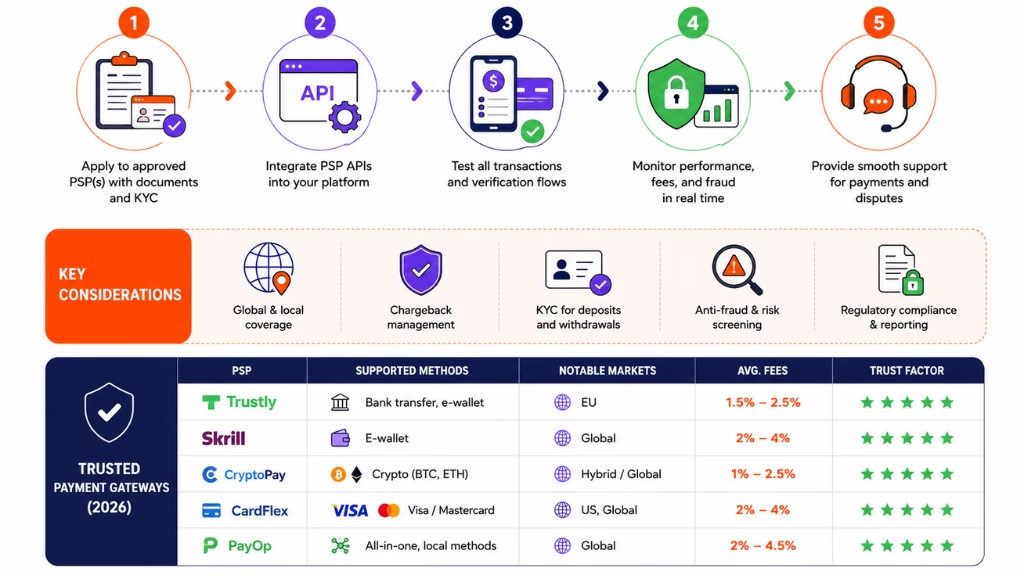
Reliable payment integration is the backbone of any gambling website. It impacts user trust, profit, and compliance.
In 2026, top Payment Service Providers (PSPs) support credit cards, e-wallets (Skrill, Neteller), and regulated crypto payments (Bitcoin, Ethereum). The real issue is that some countries now ban gambling-related crypto or apply extra checks.
Consider:
- Local and global PSPs for player coverage
- Chargeback management and anti-fraud tools
- KYC for payout and deposit flows
Common setup steps:
- Apply to your approved PSP(s) with license and KYC package
- Integrate PSP APIs into your casino backend
- Test each flow (deposit, withdrawal, refund, KYC denial)
- Monitor fees and fraud reports
Here’s a snapshot of trusted gateways as of 2026:
| PSP | Supported Methods | Notable Markets | Avg. Fees |
|---|---|---|---|
| Trustly | Bank transfer, e-wallet | EU | 1.5–2.5% |
| Skrill | E-wallet | Global | 2–4% |
| CryptoPay | Crypto (BTC, ETH) | Hybrid/Global | 1–2.5% |
| CardFlex | Visa/MasterCard | US, Global | 2–4% |
| PayOp | All-in-one, local exotics | Global | 2–4.5% |
The mistake I see often is not aligning payment flows with both user needs and new regulatory flags. Some payment processors now conduct real-time player vetting—plan for this.
What Design, UX, and Platform Features Drive Player Trust and Retention?
Trust and user experience are key to player retention. Get these right, and you win not just customers, but regulars.
- Clear site structure, fast game loading
- Trust badges (license, RNG seal, secure payment certifications)
- Wide game selection, but also curated featured games
- Round-the-clock support (live chat, multi-language help)
- Loyalty programs (VIP, points, custom bonuses)
- Accessibility for players who are vision- or mobility-impaired
Here’s a checklist of must-have features:
- Security/certification banners in header/footer
- Visible support options (chatbot, ticket, FAQ)
- Account controls (deposit limits, self-exclusion, statements)
- Responsive/mobile-first layout
- Well-categorized lobbies
I have seen design shortcuts kill user trust faster than almost any other mistake.
What Are the Most Effective Marketing Strategies for Gambling Websites in 2026?
Marketing is where most sites either sprint ahead or stall out. New restrictions on ads by Google and Meta mean old playbooks no longer work.
In 2026, you must combine:
- SEO and SEM for casino-specific searches (on-page, content, technical)
- Compliant affiliate programs with tight tracking and vetting
- Influencer/streamer partnerships for social proof
- Loyalty and retention programs (bonuses, free spins, VIP)
- Data-driven email and CRM campaigns
Affiliate programs can be high-growth but carry risk if partners cheat or spam. Set clear rules and monitor every partner.
A sample one-page plan might map each tactic to required spend, KPIs, and risk flags. The mistake I see often: launching with ads only and no backup plan for organic or affiliate traffic.
What Are the Ongoing Compliance and Customer Support Requirements?
After launch, compliance is ongoing work. Even small violations can result in license suspension or payment blocks.
- Transaction monitoring for AML/suspicious activity
- KYC for all players on first withdrawal (or as required)
- Regular regulatory audit submission (rules may change yearly)
- 24/7 help desk, with multi-language and accessible contact points
Responsible gaming tools now include deposit/time limits, self-exclusion, and automated alerts for risky play.
Update all software, payment modules, and legal content as required—this changes often, especially as laws shift.
Customer support is no longer optional. I have seen sites fail in month three for lack of live human help during outages or fraud investigations.
How Much Does It Cost to Make and Run an Online Gambling Site in 2026?
Cost controls success. Most failures I have seen come from over-optimistic budgeting.
A breakdown:
| Cost Type | Amount (USD) | Notes |
|---|---|---|
| Gaming License | $25K–$80K (setup) | Yearly renewals $2K–$10K |
| Core Platform | $20K–$100K+ (setup) | Includes white-label or custom |
| Game Content | $10K–$80K (setup) | % revenue model common |
| Payment Integration | $5K–$25K (setup) | Plus per-transaction fees |
| Marketing | $10K–$50K (setup) | $3K–$30K monthly |
| Support/Staff | $5K–$25K (setup) | $2K–$15K monthly |
| Ongoing Compliance | $1K–$5K monthly | Audits, updates, legal reviews |
Total initial: Usually $35,000–$180,000+. Ongoing: $6,000–$60,000/month depending on scale.
Profit benchmarks vary. Some established sites see positive cash flow in year one, while most need one to two years to break even.
Key Pitfalls and Critical Success Factors When Launching a Gambling Website
Launching a gambling site is as risky as it is rewarding. Here are the most common mistakes and what to watch for.
- Underestimating licensing, legal, or compliance hurdles
- Choosing a provider without proven regulatory history
- Overlooking secure payment integration—funds may get blocked
- Ignoring mobile players and UX
- Launching with no responsible gaming tools in place
- Not planning for ongoing staff and support
Critical success comes from prioritizing compliance, high-quality partners, and clear player trust features.
Why Choose a Specialist Development Partner Like Riseup Labs?
Selecting the right development partner can solve many startup headaches. In my experience, teams like Riseup Labs stand out by offering:
- Deep online casino development experience (custom, white-label, and turnkey)
- Compliance-first builds, meeting 2026 regulation from day one
- Ongoing platform support, feature upgrades
- Proven security, fairness audits, and integration with trusted PSPs
- Reduced time to launch, cutting weeks or months vs. in-house builds
A better approach is to work with an expert team who understands the cost of getting compliance wrong. The right partner means less risk, less rework, and faster market entry.
Conclusion
Building a gambling website in 2026 takes more than software. It demands sharp business planning, legal precision, trusted partners, and ongoing investment in user trust.
From what I have seen, the most successful launches follow the steps in this guide: careful market and compliance research, robust tech stack choice, correct payment systems, and live support. Teams who cut corners on licensing, security, or UX usually burn out or get closed.
Riseup Labs and similar specialist partners support your launch and beyond, helping you adapt as new legal and tech standards arrive. If you are ready, review the checklist above, plug your numbers into a real budget, and connect with experts who know this market.
Looking ahead, AI-assisted development and compliance tools are reshaping iGaming. But experience remains key. The future belongs to those who combine new tech with proven expertise.
FAQs: Creating a Gambling Website in 2026
What are the steps to create an online gambling website in 2026?
Legal research, get a gaming license, pick software, integrate payments, design UX, launch games, market, and manage compliance and support.
How much does it cost to launch a gambling website?
Startup costs start at $35,000 and can reach $180,000+, with ongoing monthly costs from $6,000 to $60,000 based on size and features.
Which gambling license is easiest for new operators?
Curacao is common for speed and lower fees, but Malta and Isle of Man offer higher trust. Easy licenses may limit payment or marketing options.
What are the requirements for casino software?
Secure hosting, RNG fairness tested games, KYC-ready signups, scalable backend, integrated payments, and compliance checks are all required.
How long does it take to start an online casino?
It takes 3 to 9 months on average, depending on licensing, tech build, and game integration speed.
What are the top payment gateways for gambling?
Top 2026 gateways are Trustly, Skrill, CryptoPay, CardFlex, and PayOp. Each supports different markets and compliance needs.
What legal risks should be considered?
Operating without a license, AML failures, missing KYC checks, or marketing in restricted regions all risk fines or site shutdown.
Can I use a white-label solution for my casino?
Yes. White-labels offer fast launch with lower control. Check vendor compliance and game variety to avoid problems.
What is AML and KYC in online gambling?
AML means anti-money laundering checks. KYC is “know your customer” verification on every player, required by law.
How do I attract players to my gambling site?
Focus on casino SEO, affiliate programs, paid search, onboarding bonuses, influencer partnerships, and strong UX with fast support.
This page was last edited on 6 July 2026, at 4:04 pm

Start a conversation with our team to solve complex challenges and move forward with confidence.