
A banking app can look great and still fail on security, integrations, or scalability. The best banking app development companies handle those risks from the start. Riseup Labs, Chetu, ScienceSoft, Nimble AppGenie, and Intellias stand out, but the right fit depends on your product scope, existing systems, and growth plans.
A banking app is no longer a secondary channel customers use when they cannot get to a branch. For many, the app is the bank.
The numbers make that clear. In 2025, 54% of U.S. consumers said mobile apps were their most-used way to manage their bank accounts, compared with just 9% who chose branches. Among Millennials, that figure climbed to 67%.
That raises the stakes when choosing a banking app development company.
You are not simply outsourcing an iOS or Android build. The team may need to connect your app with core banking systems, payments, KYC providers, card services, fraud controls, and third-party APIs without creating security gaps or frustrating customers.
In banking, even a small error can quickly become a trust problem. A failed payment, incorrect balance, or broken login flow matters far more when customers are dealing with their money.
That is why I would not choose a banking development partner based on a polished app portfolio alone. I would look for evidence that the company understands financial workflows, security, integrations, compliance, scalability, and the backend systems that keep a banking app reliable.
With those criteria in mind, here are 12 banking app development companies worth shortlisting in 2026.
Top Banking App Development Companies in 2026
| Company | Best For | Notable Strength |
|---|---|---|
| Riseup Labs | Custom banking and fintech apps | Flexible feature scope, mobile engineering, security |
| Chetu | Legacy banking modernization | Core banking and API integration |
| ScienceSoft | Security-focused banking development | Full-cycle delivery and integration |
| Nimble AppGenie | Digital banking platforms | Core modernization, compliance, AI |
| Intellias | Large banking transformation | UX, data, AI and digital banking |
| ELEKS | Enterprise banking software | Complex transformation and data engineering |
| Itransition | Core and back-office banking systems | Broad banking software expertise |
| Apptunix | Fintech and AI-enabled apps | Mobile-first fintech development |
| Brain Station 23 | Enterprise fintech and digital banking | Banking, wallets and remittance |
| WillowTree | Customer-facing digital banking | Product design and digital experience |
| FintegrationFS | Open banking projects | Financial APIs and integrations |
| Goji Labs | Fintech MVPs and new products | Product strategy and UX |
How I Selected These Companies
I did not treat every company that has a “fintech development” landing page as a banking specialist.
I looked for evidence of at least three things:
Banking depth. Does the company discuss real banking workflows such as core systems, KYC/AML, payments, account management, transaction processing, or open banking?
Technical depth. Can it handle more than the customer-facing interface? Banking apps often depend on APIs, authentication, data infrastructure, legacy systems, and third-party financial services.
Security and compliance awareness. Certifications are useful signals, but they are not enough on their own. I also looked for evidence that security is built into the architecture and development process.
I then considered what type of buyer each company makes the most sense for. That matters because the right partner for a regional bank replacing a legacy system may be completely wrong for a fintech founder validating an MVP.
1. Riseup Labs — Best for Custom Banking and Fintech App Development
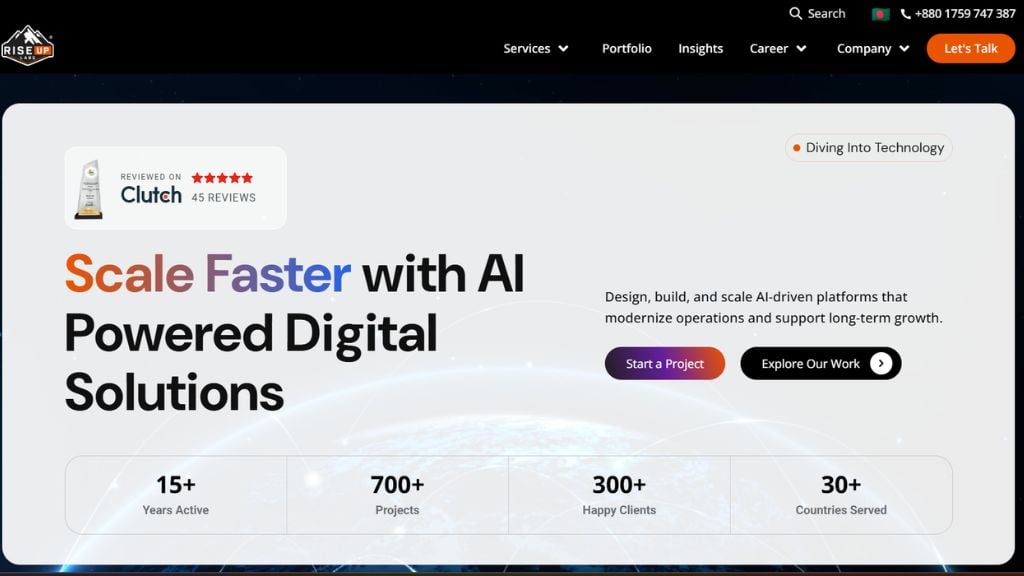
Riseup Labs is a strong option for banks, credit unions, and FinTech companies looking for a development partner that can handle both the customer-facing app and the technical requirements behind it.
One thing that sets Riseup Labs apart is how it structures its banking development offering. The company supports Basic, Advanced, and A-Class banking apps, giving businesses a clearer path to start with a focused product and expand its capabilities as their needs grow.
Its banking development capabilities also cover payment integrations, KYC and AML workflows, secure authentication, personal finance features, and connections with existing financial systems. The company works across native iOS and Android as well as Flutter and React Native, giving teams flexibility in how they build and scale their products.
Riseup Labs also brings a broader mobile development track record to these projects:

Security is another reason it stands out for financial products. The company holds ISO 9001 and ISO 27001 certifications and highlights practices such as two-factor identification, biometric authentication, device-linked transaction authorization, and secure device management.
It also provides post-launch maintenance and SLA support, which is important for banking applications that need ongoing security updates, performance monitoring, and feature improvements.
Best suited for: banks, credit unions, and FinTech companies looking for a custom banking development partner with strong mobile capabilities, security practices, and room to support the product as it grows.
2. Chetu — Best for Core Banking and Legacy Integration
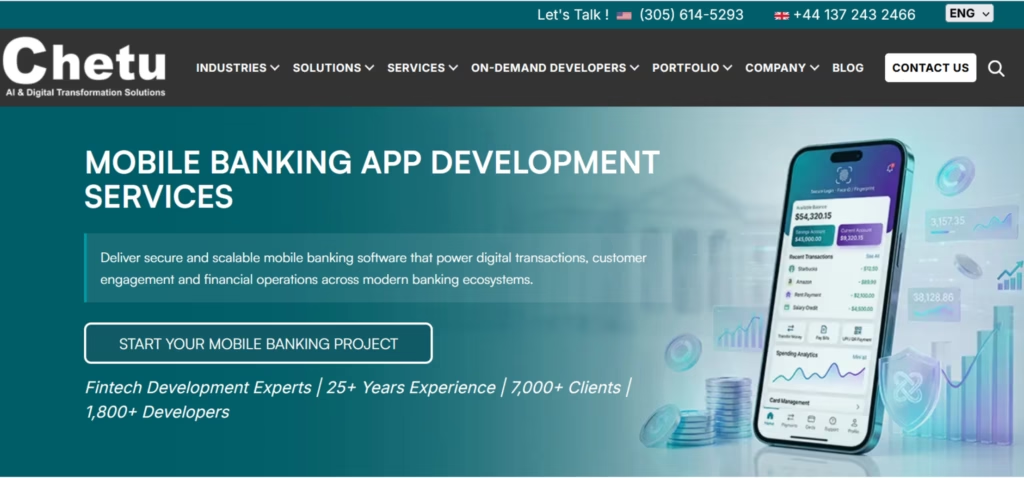
Chetu is the company I would investigate first when the hardest part of the project sits behind the mobile interface.
Its banking practice covers mobile applications, core banking systems, payment and wallet integration, cloud-native architectures, middleware, and REST/SOAP API integration. The company specifically describes connecting mobile products to existing core systems without disrupting banking operations.
That makes Chetu particularly relevant to established institutions where the project sounds something like:
“We need a modern banking experience, but it still has to work with systems we have been running for years.”
The company also has a long operating history, reporting 25+ years of experience, 7,000+ clients, and 1,800+ developers. Those numbers do not automatically make it the best choice, but they matter if you need access to a larger engineering organization rather than a small product studio.
Best suited for: established banks, credit unions, and financial institutions dealing with legacy cores, complicated integrations, or multiple banking channels.
Watch for: Make sure the proposed team has direct experience with your core banking environment. “API integration experience” is much less useful than experience with the systems you actually operate.
3. ScienceSoft — Best for Security-Conscious Full-Cycle Development
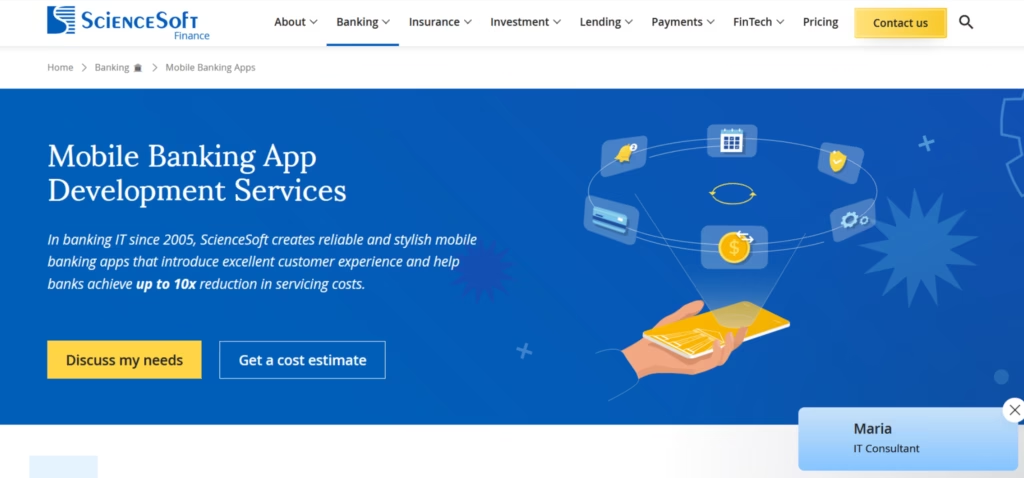
ScienceSoft is one of the easier vendors to research because it publishes unusually concrete information about its delivery process, cost, and timeline.
For mobile banking, the company covers product planning, UX/UI, development, core banking and third-party integrations, QA, deployment, and ongoing maintenance. It says a banking MVP can be delivered in 3–5 months, followed by iterative releases.
ScienceSoft is particularly worth considering when security architecture is one of your first procurement questions rather than something you plan to review before launch. Its wider mobile practice explicitly references security-sensitive BFSI development and the OWASP Mobile Application Security methodology.
It is also refreshingly specific about price. ScienceSoft currently estimates an average-complexity custom mobile banking app at around $150,000–$180,000+, with the final figure depending on functionality, UX/UI, security mechanisms, and integrations.
That figure is useful even if you hire someone else because it gives you a credible benchmark against suspiciously low quotes.
Best suited for: banks and fintech companies that want a structured full-cycle vendor and place heavy emphasis on architecture, QA, and security.
4. Nimble AppGenie — Best for Core Modernization and Digital Banking Platforms
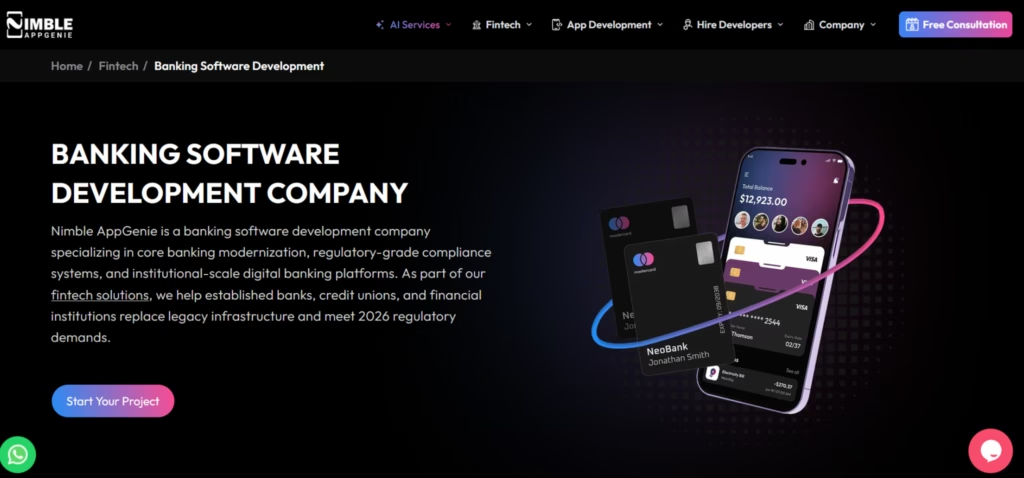
Nimble AppGenie goes deeper into banking infrastructure than its name might suggest.
Its services include digital and mobile banking, core banking systems, regulatory onboarding, open-banking APIs, AI-enabled risk tools, and migration from platforms such as Finacle, Temenos, and FIS Profile to API-first architectures.
That makes it more relevant to a modernization project than a company whose portfolio consists mainly of consumer fintech interfaces.
The company also discusses specific controls such as field-level encryption, zero-trust architecture, OAuth 2.0, CDD/EDD workflows, KYC/AML, and standards including PCI DSS, SOC 2, ISO 27001, GDPR, and ISO 20022. These are company-described capabilities rather than independent validation of every implementation, but the level of specificity is a useful sign during initial vendor research.
Best suited for: banks modernizing core infrastructure, fintechs building digital banking platforms, and organizations with significant compliance and integration requirements.
5. FINANTEQ — Best for Mobile Banking Development
FINANTEQ is one of the more specialized companies on this list. Rather than covering every type of software development, it focuses heavily on mobile finance and digital banking.
The company provides end-to-end mobile banking development, covering UX/UI, native app development, testing, deployment, and post-launch support. It also offers ready-to-integrate banking components, which can help banks add new functionality without rebuilding everything from scratch.
Its experience is another strong point. FINANTEQ reports 20+ years in banking and has worked on mobile banking projects for institutions including mBank, National Bank of Kuwait, Arab Bank, and BNP Paribas.
That makes it particularly relevant for banks that want a development partner with deep mobile banking experience rather than a general-purpose app agency.
Best suited for: banks and financial institutions building, redesigning, or expanding mobile banking applications.
6. ELEKS — Best for Enterprise Banking Transformation
ELEKS is another company I would place in the enterprise-transformation category.
Its banking practice combines application engineering with data science, DevOps, QA, cybersecurity, analytics, AI, and infrastructure work. ELEKS also publishes banking and financial-services case studies rather than relying only on generic industry claims.
The distinction matters. At a large bank, the difficult problem is often not creating another customer dashboard. It is getting new software, data, security requirements, internal processes, and old infrastructure to coexist without turning the project into a multi-year mess.
Best suited for: banks and financial enterprises with large modernization programs, complicated internal systems, or substantial data-engineering requirements.
7. Itransition — Best for Broad Banking Software Modernization
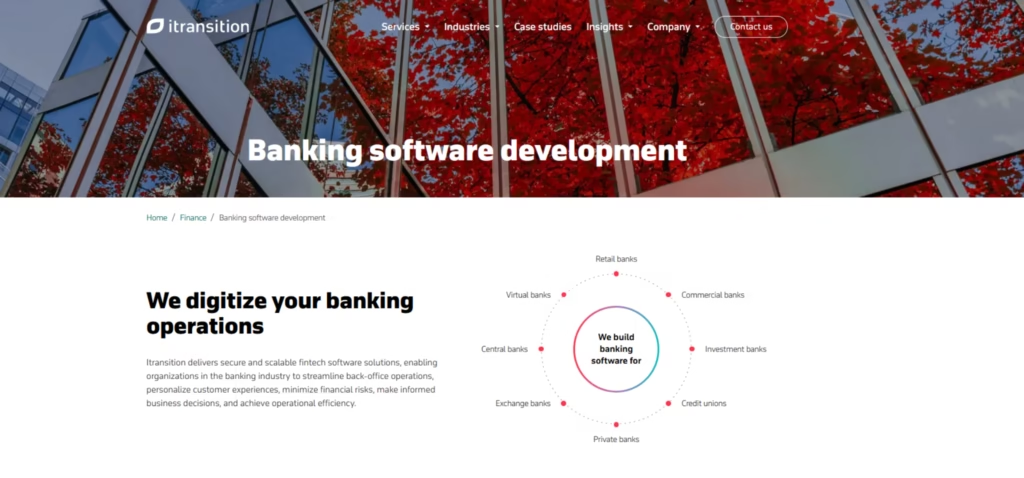
Itransition has one of the broadest banking software portfolios in this comparison.
It develops core banking systems, digital banking portals, mobile applications, banking CRMs, loyalty platforms, ATM software, investment systems, analytics tools, and other financial software. Its mobile banking work includes account and card management, online-banking synchronization, biometrics, digital wallets, and wearable integration.
That breadth is useful when your mobile app is only one piece of a larger modernization program.
Itransition also publishes examples involving banking portals and business-intelligence work for banks, which gives prospective buyers more to investigate during due diligence.
Best suited for: established financial institutions that need customer-facing applications connected to a broader banking technology environment.
8. Apptunix — Best for Mobile-First Fintech Products
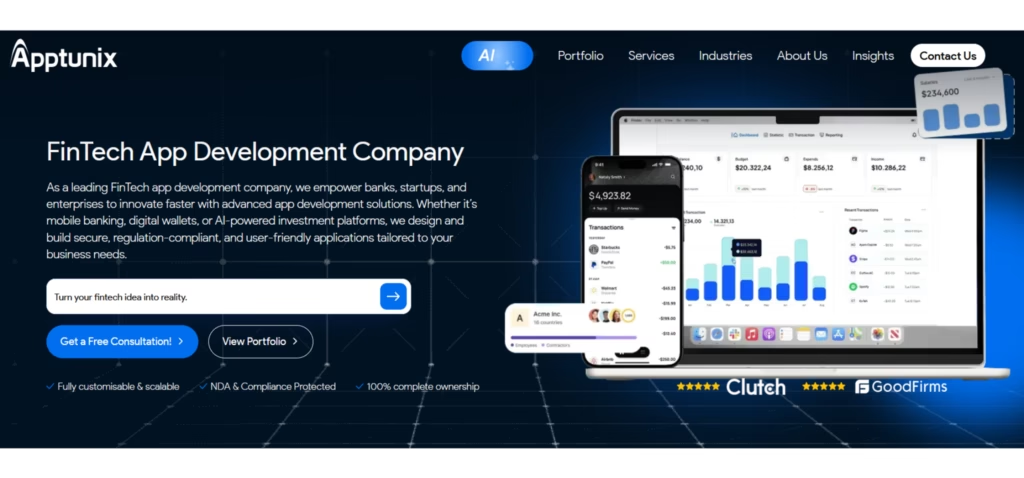
Apptunix focuses heavily on fintech application development across digital banking, wallets, payments, investment products, lending, and related financial services.
Its process includes discovery, compliance analysis, UI/UX, custom development, payment and API integration, security testing, deployment, and maintenance. The company also reports ISO 27001 and ISO 9001 certification.
Apptunix is more interesting for a startup or digital product team than for a bank looking primarily for deep core replacement. Its strength is the customer-facing fintech product layer and the technologies around it.
Best suited for: fintech startups and digital-first businesses developing mobile banking, wallet, payment, lending, or AI-enabled financial applications.
9. Brain Station 23 — Best for Banking, Wallet, and Remittance Products
Brain Station 23 deserves more attention in this list than the original draft gave it.
The company publishes concrete fintech capabilities across banking, payments, remittance, digital wallets, core banking integration, KYC/AML, fraud detection, and mobile banking.
More importantly, it publishes relevant project examples. Its site describes a cross-border remittance platform for City Bank, a digital banking project for AB Bank, and a wallet platform reported to have reached two million users.
Those examples make the company easier to evaluate than a vendor whose banking credentials stop at a services page.
Best suited for: banks and fintech companies building digital banking, payment, remittance, or wallet products, particularly where offshore development is being considered.
10. WillowTree — Best for Digital Banking Experience and Product Design
WillowTree has a different profile from many companies here.
Its strength is the intersection of product strategy, customer experience, design, and engineering. Its financial-services practice covers native banking apps, online banking portals, payment platforms, middleware/APIs, AI readiness, and digital-experience work.
That makes it compelling when adoption and experience are major competitive concerns—not just whether a transaction technically works.
There is one current detail procurement teams should know: WillowTree has rebranded under TELUS Digital, so evaluate the current organizational structure and delivery model rather than relying on older descriptions of the standalone WillowTree business.
Best suited for: consumer-facing financial institutions where UX, product strategy, and digital engagement are major priorities.
11. FintegrationFS — Best for Open Banking and Financial API Projects
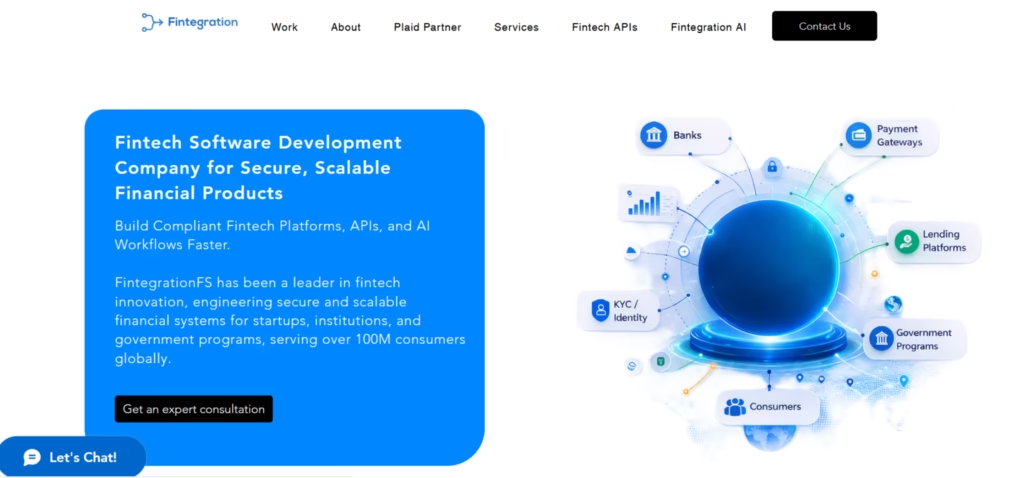
FintegrationFS is more specialized than most names on this list.
Its public material focuses heavily on financial integrations, data APIs, open banking, and the infrastructure that allows fintech applications to connect with banks and other financial-data providers.
That makes it worth considering when connectivity is the central problem rather than when you simply need a conventional mobile banking front end. Its 2026 analysis of open-banking providers, for example, evaluates providers by geography, data availability, payment capabilities, consent flows, reconnection, and production behavior rather than treating API integration as a checkbox.
Best suited for: open-banking products, API-heavy fintech platforms, and teams whose product depends on external financial-data connectivity.
12. Goji Labs — Best for Fintech MVPs and Product Strategy
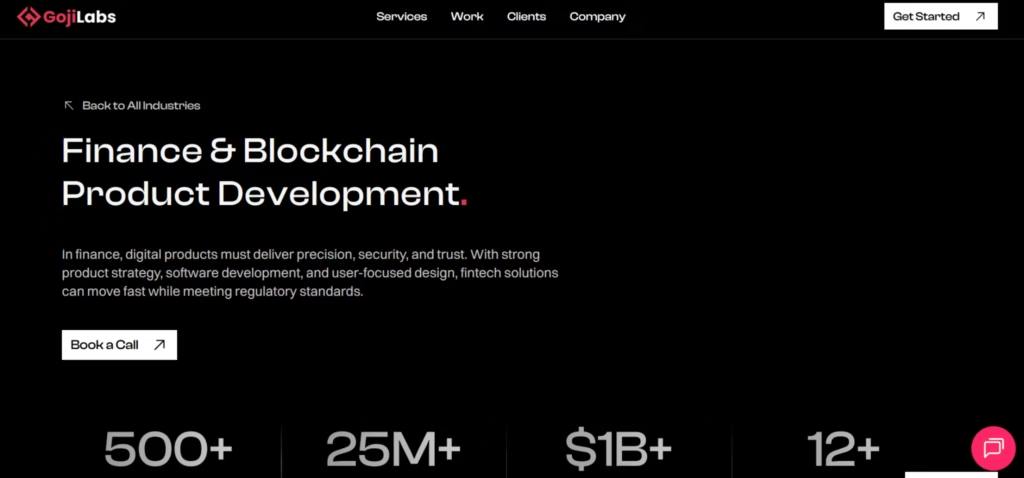
Goji Labs sits closer to a product-development consultancy than a traditional banking systems integrator.
Its finance practice combines product strategy, UX/UI, app development, payment and compliance integrations, and fintech SaaS development. The company reports 500+ products launched, 25 million+ users supported, and 12+ years in business.
Its published thinking also reflects an important point that early-stage fintech founders sometimes miss: financial software risk does not live only in the interface. Reconciliation, ledger behavior, fraud decisions, records, and regulatory obligations need to influence product decisions before development begins.
That product-first perspective makes Goji Labs particularly relevant to teams still shaping what they should build.
Best suited for: early-stage fintechs, MVPs, and teams that need product strategy and UX alongside engineering.
Which Banking App Development Company Is Best for Your Project?
The best company depends less on ranking position and more on the problem you need it to solve.
A fintech startup validating a product has very different needs from a bank modernizing legacy systems. So instead of comparing vendors only by size or service lists, match them to the hardest part of your project.
| If Your Main Priority Is… | Companies to Consider | Why |
|---|---|---|
| Custom banking app development | Riseup Labs, ScienceSoft | Good fits for scalable custom banking products and full-cycle development. |
| Legacy and core banking integration | Chetu, Itransition | Stronger for APIs, middleware, legacy systems, and complex integrations. |
| Security-focused development | ScienceSoft, Riseup Labs | Both emphasize secure development, authentication, and banking-grade controls. |
| Core modernization and open banking | Nimble AppGenie, Chetu | Relevant for migrations, APIs, compliance workflows, and connected banking systems. |
| Large-scale digital transformation | Intellias, ELEKS | Better suited to broader cloud, data, infrastructure, and enterprise programs. |
| UX and digital banking experience | WillowTree, Intellias | Strong choices when customer experience and product design are major priorities. |
| FinTech MVP development | Goji Labs, Riseup Labs | Useful for launching a focused product and expanding it as the business grows. |
| Payments, wallets, and remittance | Brain Station 23, Apptunix | Relevant experience across payments and customer-facing FinTech products. |
| Open banking and API-heavy products | FintegrationFS, Nimble AppGenie | Better suited to financial APIs, external connectivity, and integration-heavy platforms. |
If I were shortlisting vendors, I would choose three companies whose strengths match the biggest technical risks in the project, then compare their case studies, security approach, integrations, team structure, and post-launch support.
For example, Riseup Labs is a stronger fit when you want a banking product that can grow in stages, Chetu when legacy integration is the main challenge, and ScienceSoft when security and structured delivery matter most.
What Should a Banking App Development Company Actually Be Able to Build?
A modern banking app usually needs far more than balances and transfers.
At minimum, I would expect a capable development partner to be comfortable with five areas.
Account and Card Management
Customers should be able to check balances, view transaction history, manage cards, download statements, update relevant settings, and understand what is happening with their money without contacting support.
The challenge is not putting these functions on a screen. It is making sure the app is accurately synchronized with the underlying banking systems.
Payments and Money Movement
Depending on the product, this may include account-to-account transfers, peer-to-peer payments, bill payment, scheduled transfers, international payments, QR payments, and card controls.
Ask vendors how they handle failed, duplicated, delayed, or reversed transactions. Their answer is more revealing than a demo of a successful transfer.
Authentication and Fraud Controls
Biometrics and MFA are now baseline capabilities, not premium features.
The deeper questions involve session management, device recognition, transaction authorization, fraud monitoring, suspicious-behavior detection, encryption, auditability, and account recovery.
The FTC’s fraud figures make the reason obvious: consumers reported $12.5 billion in fraud losses during 2024, including $2.95 billion from imposter scams.
Core Banking and Third-Party Integration
This is where many apparently simple projects become difficult.
Your application may need to communicate with a core banking system, payment processor, identity provider, KYC vendor, credit bureau, card processor, CRM, fraud platform, analytics stack, or open-banking provider.
Before choosing a vendor, map those dependencies.
Then ask which ones the company has integrated before.
Scalability and Operational Reliability
A banking application does not only need to survive growth. It needs to survive traffic spikes, delayed third-party services, failed integrations, unusual transaction patterns, and software releases without disrupting customers.
Ask prospective vendors about observability, disaster recovery, incident response, performance testing, deployment strategy, and SLAs—not just cloud hosting.
For a deeper look at mobile banking app development, read Mobile Banking App Development: Cost, Features, And Process.
How Much Does It Cost to Develop a Banking App?
The cost to develop a mobile banking app typically ranges from $60,000 to $300,000+, depending on the complexity of the product, platform choice, security requirements, integrations, and development team location.
A simple MVP sits at the lower end of the range, while a full-scale banking platform with AI, investment tools, or complex integrations can cost significantly more.
| Banking App Type | Estimated Cost | Typical Scope |
|---|---|---|
| Simple / MVP | $60,000–$100,000 | Registration, account overview, basic transfers, essential security |
| Medium Complexity | $100,000–$200,000 | QR payments, loan applications, biometrics, notifications, chatbot |
| Advanced Platform | $200,000–$300,000+ | AI insights, investment tracking, multi-currency support, complex integrations |
These are planning estimates rather than fixed prices. The final budget can change considerably depending on what the app needs to connect with and how much infrastructure already exists.
Factors That Affect Banking App Development Cost
Feature Complexity
The more advanced the product becomes, the more development and testing it requires. Features such as AI-powered insights, investment tools, digital wallets, and multi-currency support can quickly increase the budget.
Security and Compliance
Banking apps require stronger security than most consumer applications. Encryption, MFA, secure APIs, fraud controls, and compliance with standards such as PCI DSS, GDPR, or PSD2 all add development effort.
Development Team Location
Developer rates vary significantly by region. Teams in North America and Western Europe generally cost more than those in Eastern Europe or South Asia, which can have a major impact on the overall budget.
Platform and Maintenance
Building separate native iOS and Android apps usually costs more than using a cross-platform framework such as Flutter or React Native. Ongoing maintenance also matters, with post-launch costs often adding around 15%–20% of the initial development budget each year.
A lower upfront quote does not always mean better value. For banking software, it is more useful to compare what is included in the proposal, especially security, integrations, maintenance, and post-launch support.
How Long Does It Take to Build a Banking App?
For a focused MVP, three to six months is a reasonable planning range.
ScienceSoft estimates 3–5 months for a mobile banking MVP. Riseup Labs states 3–6 months for its basic banking app. Apptunix gives a wider range of 3–9+ months depending on complexity.
But the interface is rarely what determines the final date.
Projects tend to stretch because of integration dependencies, security reviews, compliance decisions, changing requirements, data migration, vendor approvals, and testing.
If a company promises a sophisticated banking platform unusually quickly, ask what assumptions its timeline depends on.
How to Choose the Right Banking App Development Company

Choosing a banking app development company takes more than comparing portfolios, pricing, or technology stacks. The right partner should understand financial workflows, security, integrations, and how the product may need to grow after launch.
Before making a decision, look at these factors:
Check Their FinTech Experience
A company with relevant banking or FinTech experience is more likely to understand issues such as secure transactions, KYC, banking APIs, and regulatory requirements.
Look for experience with:
- Mobile banking apps
- Digital payments
- Banking APIs
- Wallets and financial platforms
- Security-focused development
Riseup Labs, for example, works across basic, advanced, and more feature-rich banking apps, which makes it relevant for both focused products and larger FinTech projects.
Review Similar Projects
A portfolio is more useful when the projects are close to what you want to build.
Look at:
- Similar banking or FinTech products
- Integrations used
- UX quality
- Technical complexity
- Measurable results
Ask what the company actually handled in each project rather than relying only on screenshots.
Evaluate Security Practices
Security should be discussed early.
Ask how the company approaches:
- Authentication
- Encryption
- API security
- Transaction protection
- Secure coding
- Compliance requirements
Certifications can also help during evaluation. Riseup Labs, for instance, lists ISO 27001 and ISO 9001 certifications alongside banking-specific authentication and security controls.
Check Their Integration Capabilities
Banking apps often need to connect with core banking systems, payment providers, KYC services, card processors, and other third-party platforms.
Ask which systems the company has integrated before and how it handles failed transactions, API errors, and service downtime.
Consider Scalability and Support
Your first release may be relatively simple, but the product can become more complex as users, transactions, and integrations increase.
Choose a company that can support new features, higher traffic, additional integrations, and ongoing maintenance after launch.
Riseup Labs may be worth considering here because its banking offering is structured around different levels of product complexity, allowing businesses to start with a focused app and add more advanced functionality later.
Compare Cost With Long-Term Value
The cheapest proposal is not always the best option for financial software.
Compare what each quote actually includes, especially development, integrations, security testing, maintenance, and post-launch support.
The better choice is usually the company that offers the strongest balance of FinTech experience, security, scalability, and long-term support.
Final Thoughts
The best banking app development company is not simply the one with the biggest team or the longest service list. It is the one that fits the technical and business challenges of your project.
For some companies, that may mean strong legacy-system integration. For others, security, scalability, product strategy, or long-term support will matter more.
If you are looking for a custom banking product that can start with essential features and expand over time, Riseup Labs is a strong option to consider. Its banking-focused development approach, security credentials, and range of app capabilities make it relevant for both growing FinTech products and more established financial institutions.
Whichever company you shortlist, compare its relevant experience, security practices, integration capabilities, and post-launch support before making the final decision.
Frequently Asked Questions
What Is the Best Banking App Development Company?
The best banking app development company depends on your project needs. Riseup Labs is a strong option for custom mobile banking and FinTech development, Chetu for legacy and core banking integration, and ScienceSoft for security-focused full-cycle development. Larger transformation projects may also suit Intellias or ELEKS.
How Much Does It Cost to Develop a Banking App?
A mobile banking app typically costs around $60,000 to $300,000+, depending on its complexity, security requirements, integrations, platform choice, and development team location. A simple MVP may fall near the lower end, while advanced banking platforms with AI, analytics, or complex integrations can cost significantly more.
How Long Does Banking App Development Take?
A banking app MVP typically takes around 3–6 months to develop. Projects involving complex integrations, data migration, compliance requirements, or advanced features can take considerably longer.
What Should I Look for in a Banking App Development Company?
Look for FinTech experience, strong security practices, banking API and core-system integration skills, compliance knowledge, scalability, and post-launch support. Relevant banking case studies are more valuable than a large general mobile-app portfolio.
Can a New Banking App Work With an Existing Core Banking System?
Yes. A new banking app can connect with an existing core banking system through APIs, middleware, or custom integration layers. The complexity depends on the core system, available APIs, data architecture, and third-party services involved.
Should a FinTech Startup Build an MVP First?
Usually, yes. A FinTech MVP helps validate the product with a smaller feature set before investing in a full platform. However, security, transaction integrity, and required compliance controls should never be treated as optional MVP features.
This page was last edited on 8 October 2026, at 11:49 am

Start a conversation with our team to solve complex challenges and move forward with confidence.