- What is AI App Development
- AI App Development Process
- What are the Popular AI App Development Platforms & Tools
- What Are The Use Cases Of AI Apps
- How Long Can It Take to Develop an AI App
- How Much Does It Cost to Build an AI App
- What Are The Challenges in AI App Development
- What is The Best Practices for Successful AI App Development
- Future Trends in AI App Development
- Conclusion
- Frequently Asked Questions (FAQs)
Apps today have to do more than simply function. Users expect fast responses, relevant suggestions, and experiences that feel increasingly personal over time. This shift in expectations is driving the rapid adoption of AI App Development across industries.
By using modern AI technologies, businesses are building applications that learn from user behavior, identify patterns, and improve interactions with every use. Instead of relying on fixed logic, AI powered apps adapt in real time, helping companies deliver smarter customer experiences while improving efficiency behind the scenes.
And it’s not just hype, according to PR Newswire over 70% of companies are racing to add AI features to their apps, boosting engagement, retention, and customer satisfaction.
Whether it’s a mobile app or a web platform, combining cutting-edge AI with clever app design opens up endless possibilities, making AI app development not just a trend, but a game-changing strategy for anyone looking to stay ahead in today’s digital world.
What is AI App Development?
AI app development is all about creating applications with fusion of machine learning, deep learning, and intelligent algorithms with mobile and web apps to deliver experiences that feel personal, intuitive, and highly efficient.
AI Apps don’t just run, they think, learn, and adapt. Unlike any other apps that follow fixed instructions, AI-powered apps can analyze data, recognize patterns, and make decisions in real-time.
Whether it’s helping a user find the perfect product, automating repetitive tasks, or making sense of complex data, AI app development turns ordinary apps into intelligent tools that anticipate needs before users even ask. For businesses, this isn’t just innovation, it’s a competitive edge in a world where every interaction counts.
Key Technologies Behind AI Apps
AI applications rely on a combination of advanced technologies working together to deliver intelligence, adaptability, and personalization. Each technology serves a specific role in how an AI-powered app understands data and interacts with users.
Machine Learning (ML)
Machine learning enables apps to learn from historical and real-time data without being explicitly programmed. ML algorithms improve predictions, recommendations, and automation by continuously refining their models as new data becomes available. This is the foundation of personalization, fraud detection, and predictive analytics.
Deep Learning
Deep learning is a subset of machine learning that uses neural networks to process complex and unstructured data such as images, audio, and video. It powers advanced use cases like facial recognition, voice assistants, and medical image analysis.
Natural Language Processing (NLP)
NLP allows apps to understand, interpret, and generate human language. It enables chatbots, voice assistants, sentiment analysis, and language translation features, making interactions more natural and conversational.
Computer Vision
Computer vision allows AI apps to interpret visual data from images and videos. This technology is used for facial recognition, object detection, augmented reality, visual search, and quality inspection in industrial applications.
Recommendation Engines
Recommendation systems analyze user behavior, preferences, and interactions to suggest relevant content, products, or services. They play a critical role in e-commerce, streaming platforms, and social media applications.
Predictive Analytics
Predictive analytics uses historical data and ML models to forecast future outcomes. Businesses use it to anticipate customer needs, optimize operations, and reduce risk through data-driven insights.
Together, these technologies enable AI-powered apps to deliver experiences that are not only intelligent but also context-aware and highly personalized.
AI App Development Process
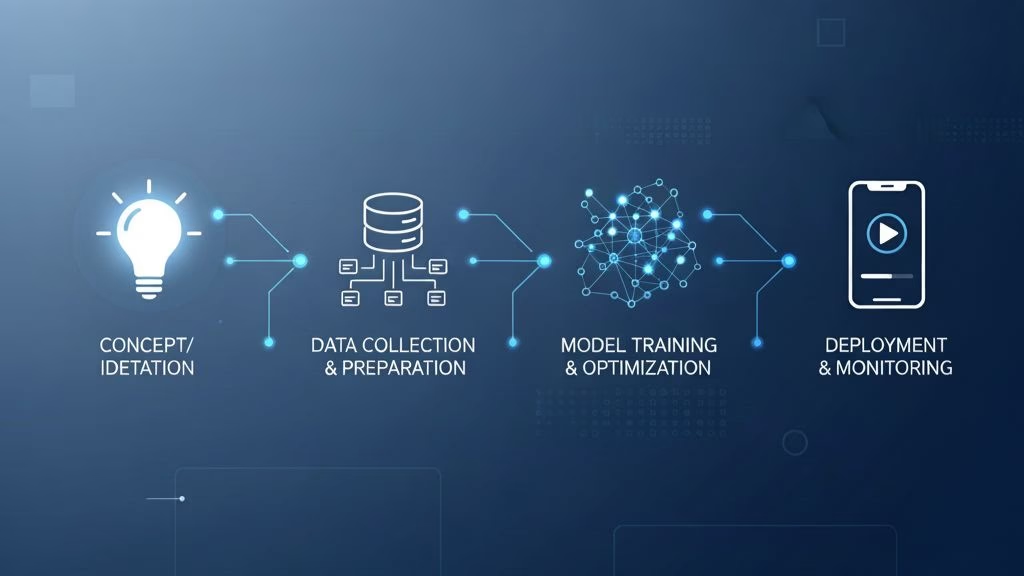
Building an AI-powered app is not just about adding a model and hoping it works. It’s a step-by-step process where product thinking, data, and engineering come together.
Step 1: Idea & Conceptualization:
Everything starts with a clear use case. The first question is not what AI model to use, but what problem needs solving. Teams define what the app should do, who it is for, and where AI can actually make a difference.
At this stage, decisions are made around the type of intelligence needed. This could be personalization, prediction, text understanding, or image processing. The team also looks at data availability early on, because without the right data, even the best idea will struggle later.
Step 2: Data Collection & Preparation
Once the direction is clear, the focus shifts to data. This usually involves pulling data from databases, user activity logs, third-party tools, or external datasets.
Raw data is rarely usable as it is. It needs to be cleaned, organized, and sometimes labeled so the model can learn from it properly. In many projects, this step takes more time than expected, but it is also where the quality of the final AI system is decided.
Step 3: AI Model Selection & Training
With data ready, developers choose a model that fits the problem. Some use cases need simple machine learning models, while others require more advanced approaches for text, images, or recommendations.
The model is trained on the prepared data and tested repeatedly. The goal here is not perfection, but consistency. Teams adjust the model until it performs reliably across different scenarios and does not break when faced with new inputs.
Choose the right algorithms for your app’s needs. For example, use machine learning for predictions, NLP for text and voice understanding, or computer vision for image processing. Train your models on the prepared data, test them rigorously, and refine them until they achieve the desired accuracy.
Step 4: Integration with App
After training, the model is connected to the actual app. This is where AI meets real users. The model is usually exposed through an API and plugged into the app’s backend and interface.
Performance matters a lot at this stage. If responses are slow or unreliable, users will notice immediately. Engineers focus on keeping the AI features fast, stable, and well integrated with existing systems.
Step 5: Testing & Optimization:
Testing goes beyond checking if the app works. Teams look at how the AI behaves with real data, unexpected inputs, and edge cases.
Based on test results and early user feedback, the model is fine-tuned to improve accuracy and reduce errors. This step often continues even after launch, as real-world usage reveals things that testing environments cannot.
Step 6: Deployment & Monitoring:
Once the app is live, the work continues. AI models need regular monitoring because user behavior changes over time. What worked well at launch may slowly become less accurate.
Teams track performance, update data, and retrain models when needed. This ongoing process helps keep the app reliable and useful, rather than letting the AI become outdated.
What are the Popular AI App Development Platforms & Tools
Choosing the right AI platform directly impacts how quickly an app is built, how well it scales, and how it performs over time. Since each platform serves different use cases, understanding their strengths helps teams make better decisions from the start.
TensorFlow
A widely adopted open-source framework for building and deploying machine learning and deep learning models. TensorFlow supports mobile, web, cloud, and edge environments, making it ideal for scalable, production-grade AI applications.
PyTorch
Known for its flexibility and ease of experimentation, PyTorch is popular among researchers and developers working on complex or custom AI models. It enables rapid prototyping and faster innovation cycles.
IBM Watson
A cloud-based AI platform offering pre-built services for NLP, speech recognition, visual analysis, and conversational AI. It allows businesses to integrate AI features quickly without extensive model development.
Microsoft Azure AI
A comprehensive enterprise AI ecosystem providing machine learning tools, cognitive services, and bot frameworks with built-in security and global scalability.
Google ML Kit
A lightweight SDK designed specifically for mobile applications, enabling easy integration of AI features such as text recognition, image labeling, and translation.
Low-code/No-code AI Platforms: Tools like Bubble, Appgyver, or Lobe allow developers and non-developers to create AI-powered apps quickly, reducing development time while still incorporating machine learning and automation features.
Using the right platform not only speeds up development but also ensures your AI-powered app is reliable, scalable, and capable of delivering a truly intelligent user experience.
What Are The Use Cases Of AI Apps
AI app development is revolutionizing how businesses operate and how users interact with technology. Here are some key applications across different sectors:
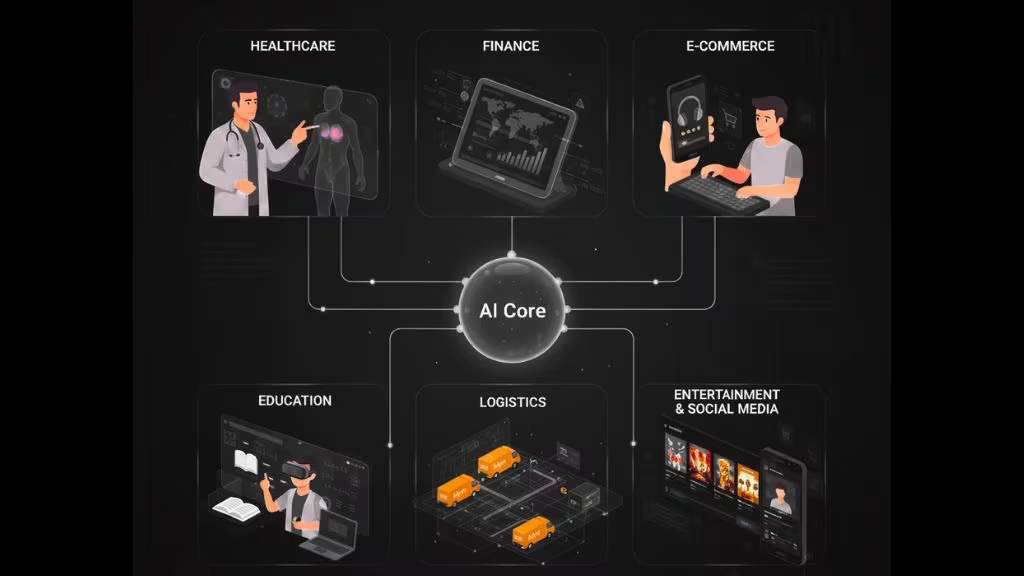
- Healthcare: AI apps can assist with diagnostics, analyze medical images, predict patient outcomes, and provide virtual health assistants. For example, apps can flag potential health issues from scans or monitor chronic conditions in real-time.
- Finance: AI-powered apps detect fraud, provide personalized banking recommendations, and automate trading or investment decisions. Chatbots also enhance customer support by answering queries instantly.
- E-commerce: Recommendation engines analyze user behavior to suggest products, optimize inventory, and personalize shopping experiences. AI chatbots handle customer service efficiently.
- Education: AI apps offer personalized learning paths, automated grading, and intelligent tutoring, adapting to students’ strengths and weaknesses.
- Entertainment & Social Media: AI powers content recommendations, smart filters, voice assistants, and even automated content creation, keeping users engaged longer.
- Logistics & Transportation: AI apps optimize routes, predict delivery times, and monitor fleet performance, improving efficiency and reducing costs.
By integrating AI, these apps go beyond simple functionality, creating smarter, more intuitive, and highly personalized experiences for users across industries.
How Long Can It Take to Develop an AI App
The development timeline for an AI app varies based on its complexity, features, and data requirements. Here’s a breakdown:
Basic AI Apps (3–6 months):
Simple applications like chatbots, virtual assistants, or basic recommendation systems can usually be built within a few months.
Moderately Complex Apps (6–9 months):
Apps with multiple AI features, such as predictive analytics, natural language processing, or smart automation, take longer due to data preparation and model training.
Advanced AI Apps (9–18 months or more):
Complex solutions involving deep learning, computer vision, or large-scale data integration require extensive development, testing, and optimization.
How Much Does It Cost to Build an AI App
The cost of developing an AI app can vary significantly depending on its complexity, the AI models used, and the overall project scope. Here’s a breakdown:
Basic AI Apps ($30,000–$50,000):
Simple apps like chatbots, virtual assistants, or basic recommendation engines. These often use pre-trained models and require minimal customization.
Moderately Complex AI Apps ($60,000–$120,000):
Apps with multiple AI features, such as predictive analytics, NLP, or image recognition. These require custom data preparation and model training.
Advanced AI Apps ($150,000–$250,000+):
Enterprise-level solutions using deep learning, real-time processing, or complex automation. These projects involve large datasets, continuous learning, and extensive testing.
What Are The Challenges in AI App Development
While AI app development offers endless opportunities, it also comes with unique challenges that can impact time, cost, and performance. Here are the most common ones:
Data Quality and Availability:
AI models are only as good as the data they’re trained on. Incomplete, biased, or poor-quality data can lead to inaccurate predictions and unreliable app performance.
High Development Costs:
Building and training AI models, purchasing cloud resources, and hiring skilled developers or data scientists can be expensive, especially for startups.
Model Accuracy and Bias:
Ensuring your AI produces fair and accurate results is crucial. Biased data or unoptimized models can lead to poor user experiences and ethical concerns.
Scalability and Performance:
As your user base grows, AI models must handle more data and requests in real-time. This requires strong infrastructure and efficient optimization.
Integration Complexity:
Combining AI with existing mobile or web app architectures can be technically challenging. It requires seamless coordination between data pipelines, APIs, and user interfaces.
Privacy and Security Concerns:
AI apps often handle sensitive user data, so ensuring robust data protection and compliance with regulations like GDPR is essential.
What is The Best Practices for Successful AI App Development
To build a high-performing, scalable, and user-friendly AI app, following the right practices from the start is key. Here are some proven strategies to ensure success:
Start with a Clear Goal:
Define the problem your AI app will solve and how AI will enhance user experience. A well-defined purpose guides your data collection, model selection, and overall design.
Develop a Minimum Viable Product (MVP):
Begin with essential AI features to validate your concept. Test user feedback early, then expand functionality based on data-driven insights rather than assumptions.
Collect and Clean Quality Data:
Data is the backbone of AI. Invest time in gathering accurate, diverse, and well-labeled datasets, this ensures your AI model learns effectively and performs reliably.
Choose the Right Tools and Frameworks:
Select trusted AI platforms like TensorFlow, PyTorch, or Google ML Kit. These tools provide pre-built models, libraries, and community support to speed up development.
Prioritize User Experience (UX):
AI should enhance, not complicate, the app experience. Focus on smooth interactions, intuitive interfaces, and transparent AI behavior that builds user trust.
Ensure Transparency and Ethics:
Avoid “black box” AI. Explain how your app uses data and makes decisions to increase user confidence and comply with ethical standards.
Continuously Test and Optimize:
AI models evolve. Regularly monitor accuracy, update models with new data, and fine-tune performance to keep the app adaptive and efficient.
Plan for Scalability:
Design your architecture to handle more users, data, and AI computations as your app grows, especially important for cloud-based AI systems.
AI App Development Companies
As AI becomes a core part of modern digital products, many businesses choose to work with specialized AI app development companies to bring their ideas to life. These teams combine technical expertise, data science, and product strategy to build applications that are intelligent, scalable, and ready for real-world use.
Among these providers, Riseup Labs has emerged as a trusted partner for organizations looking to build impactful AI-powered applications.
Riseup Labs
Riseup Labs is a leading AI app development company that helps startups and enterprises design and develop intelligent mobile and web applications aligned with real business goals. With expertise in machine learning, natural language processing, computer vision, and predictive analytics, Riseup Labs focuses on building AI solutions that are scalable, secure, and user-focused. From rapid MVP development to complex enterprise-grade AI systems, the company emphasizes practical innovation, seamless integration, and continuous optimization to ensure long-term success.
Alongside Riseup Labs, several global technology companies are also shaping the AI app development ecosystem:
Accenture
Accenture delivers enterprise-scale AI applications by combining advanced analytics, AI models, and digital strategy to support large-scale transformation initiatives across industries.
IBM
IBM enables AI app development through its Watson platform, offering solutions for NLP, automation, and data-driven decision-making with a strong focus on security and compliance.
Tata Consultancy Services (TCS)
TCS supports businesses in building AI-driven applications using cloud-native architectures, machine learning models, and global delivery capabilities.
Infosys
Infosys provides AI app development services centered on intelligent automation, predictive analytics, and enhanced digital experiences for enterprise clients.
Choosing the right AI app development company depends on your product vision, data maturity, and scalability needs. The right partner goes beyond implementation—helping align AI capabilities with business value to ensure your application continues to evolve and perform in a fast-changing digital landscape.
Future Trends in AI App Development
The world of AI app development is evolving rapidly, and the future looks more exciting than ever. Here are some key trends shaping the next generation of intelligent applications:
Generative AI Integration:
AI models like ChatGPT, Gemini, and Claude are enabling apps to create content, text, images, videos, and even code, making personalization and creativity limitless.
AI-Powered IoT (Internet of Things):
The combination of AI and IoT will make devices smarter and more autonomous, from home automation systems that predict user needs to smart wearables that monitor health in real time.
Voice and Gesture Control:
Natural and hands-free interactions are becoming the norm. Apps will increasingly rely on AI-driven speech recognition and gesture-based navigation for smoother user experiences.
Hyper-Personalization:
AI will go beyond basic recommendations, analyzing deeper behavioral patterns to offer tailored products, content, and experiences unique to each user.
Edge AI:
Instead of relying solely on the cloud, more AI processing will happen directly on devices, enabling faster responses, better security, and offline functionality.
AI Ethics and Transparency:
As AI becomes more pervasive, users and regulators will demand more transparency, fairness, and accountability in how AI-driven apps make decisions.
Augmented Reality (AR) + AI Fusion:
The blending of AR and AI will create immersive experiences, from virtual try-ons in e-commerce to real-time object detection in navigation and gaming.
Conclusion
AI app development is revolutionizing how we interact with technology. From chatbots that understand context to predictive apps that anticipate user needs, AI-powered applications are driving the future of innovation. As machine learning, NLP, and computer vision advance, the opportunities for creating intelligent, personalized experiences are endless.
For businesses, adopting AI integration is no longer optional, it’s essential for staying competitive, improving user engagement, and unlocking new growth potential. Whether you start small with an MVP or scale a complex AI ecosystem, the key is to keep innovating and refining your approach.
Key Takeaways
- AI app development empowers apps to learn, adapt, and personalize user experiences.
- Development can take 3–18 months, depending on complexity.
- Major challenges: data quality, scalability, bias, and security.
- Trends: Generative AI, Edge AI, and hyper-personalization lead the future.
- Early AI adopters gain a lasting competitive edge in the digital era.
Frequently Asked Questions (FAQs)
Got questions? We’ve got answers! Explore our FAQs to learn how AI app development works, what to expect during the process, and how we can help you bring your smart app idea to life.
What types of AI apps can be developed?
AI apps span a wide range of real-world categories, including virtual assistants and chatbots, recommendation systems, computer vision apps (e.g., image or face recognition), predictive analytics and automation tools, speech and language translation apps, fraud detection and security, and generative AI apps for creating text, images, or other content.
Which technologies are used in AI app development?
AI app development typically uses:
– Machine Learning (ML) and Deep Learning frameworks like TensorFlow, PyTorch, or Scikit-learn
– Natural Language Processing (NLP) tools such as OpenAI GPT, BERT, or spaCy
– Computer Vision libraries like OpenCV or YOLO
– Cloud AI services from AWS, Google Cloud, or Azure
– App frameworks like Flutter, React Native, or Swift for frontend integration
How long does it take to develop an AI app?
Development time depends on the complexity of the AI model and app features.
– Basic AI app: 4–8 weeks
– Moderate complexity: 2–4 months
– Advanced custom AI solution: 6+ months
How much does AI app development cost?
Costs vary depending on project scope, model complexity, data requirements, and integration needs. A simple AI-powered app may start from $10,000–$25,000, while enterprise-grade or highly customized AI systems can exceed $100,000+.
Do I need my own data to build an AI app?
Not always. While having proprietary data can improve accuracy, pre-trained AI models or synthetic datasets can also be used to build and train your AI app efficiently.
Can AI apps integrate with my existing systems?
Yes. AI apps can be integrated with CRMs, ERPs, APIs, cloud platforms, or existing mobile/web applications to ensure smooth data flow and automation.
How do you ensure data privacy and security?
We follow industry best practices, including data encryption, anonymization, GDPR compliance, and secure API design to protect user and business data.
Do you offer post-launch support or maintenance?
Yes, we provide full-cycle support, model retraining, bug fixes, updates, and performance optimization, to keep your AI app running at peak efficiency.
Can I scale my AI app as my user base grows?
Absolutely. We design scalable architectures and deploy AI models using cloud-native technologies, allowing your app to handle increasing users and data seamlessly.
What makes your AI app development services different?
Our approach combines custom AI modeling, robust engineering, and user-centric design. We don’t just build apps, we create intelligent solutions that deliver measurable business impact.
This page was last edited on 4 January 2026, at 4:30 pm
Contact Us Now

Contact Us Now
Start a conversation with our team to solve complex challenges and move forward with confidence.


