
AI models need structured and labeled data because they make AI training accurate, efficient, and fair. Structure enables clear patterns and scalability. Labels help supervised learning, support compliance, and reduce model bias or errors.
The quality and structure of your data will decide if your AI project succeeds or fails. I have seen teams waste months on a “promising” machine learning model, only for it to deliver poor results due to messy inputs.
A project with unstructured or unlabeled data often faces bias, compliance trouble, or low user trust. Your data pipeline matters as much as your algorithms.
In this guide, I will show you why structured and labeled data is non-negotiable in 2026, and give you clear steps, tables, and checklists to help your team deliver reliable AI.
What Are Structured, Unstructured, and Labeled Data?
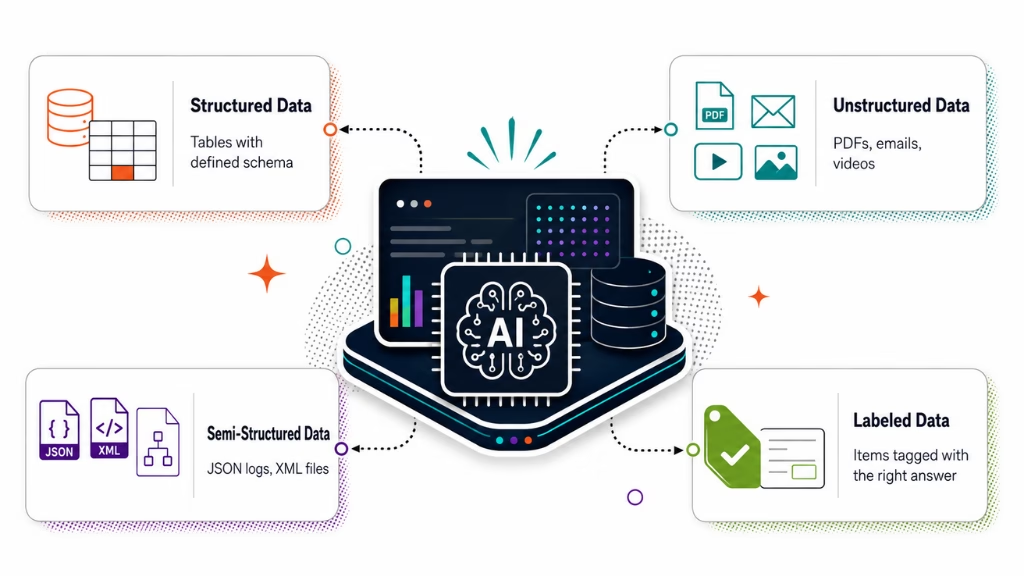
To build good AI, you must know your data types. Each form comes with strengths and challenges for machine learning and affects how easily or reliably a model can learn.
If you do not choose the right data structure or labeling, your algorithm will struggle and may never reach production.
Data Type Definitions
- Structured Data:
Data stored in tables with defined schema—think rows and columns in databases. - Unstructured Data:
Content without a clear format—like PDFs, emails, or videos. - Semi-Structured Data:
Data with some structure but not a rigid table—like JSON logs or XML files. - Labeled Data:
Any dataset where each item is tagged with the right answer (label)—such as “spam” or “not spam” in emails.
Why This Matters for AI
Structured and labeled data allows algorithms to learn patterns, make accurate predictions, and scale across many tasks. Unstructured or unlabeled data increases the chance of mistakes, bias, and failed deployments.
A clear structure gives fast access, easy validation, and better results. Labeled data is the bedrock for training classifiers to “know” what’s right or wrong.
Comparison Table: Data Types for AI
| Property | Structured | Semi-Structured | Unstructured | Labeled Data |
| Storage | Database tables | JSON, XML, logs | Text blobs, images, audio | Any format, plus labels |
| Schema | Rigid, enforced | Flexible, partial | None | Varies; adds annotation layer |
| Example | Sales records in SQL | Log files, emails | Social posts, videos | Image with “dog/cat” label |
| Machine Readability | High | Moderate | Low | High with the right labels |
| Pros for AI | Easy to clean/analyze | Adapts to variety | Rich information | Enables training and testing |
| Cons for AI | Can miss nuance | Needs extra parsing | Slow, error-prone for ML | Costly, needs regular QC |
Why Do AI Models Need Structured and Labeled Data? (Core Benefits & Risks)
AI models perform best with clearly structured and labeled data. I have seen models fail due to poor structure or missed labels. The real issue is, a model trained on messy or raw data cannot learn the correct rules.
Structured data lets AI extract features fast and with fewer mistakes. Labeled data teaches models what outcomes to predict, like diagnosing disease or sorting customer emails.
Unstructured or unlabeled data makes errors, bias, and compliance problems more likely. Bad data can damage trust, waste budget, or even put users at risk.
Core Benefits
- Speeds up feature extraction and cleaning
- Increases accuracy and fairness
- Enables true model explainability
- Reduces bias by ensuring all classes are covered
- Supports audit and regulatory needs
Key Risks Without Proper Data
- Higher error rates and unpredictable model behavior
- Biases that cause unfair treatment of users
- Inability to trace how decisions are made
- Model failure under real-world conditions
Table: Impact of Data Quality on AI Model Outcomes
| Data Quality Level | Model Accuracy | Bias Risk | Auditability | Cost to Fix |
| High (Structured/Labeled) | High | Low | High | Low |
| Medium (Partial structure/labels) | Medium | Medium | Medium | Medium |
| Low (Unstructured/Unlabeled) | Low | High | Low | High |
How Does Data Labeling Work? (Step-by-Step Workflow for Modern AI)
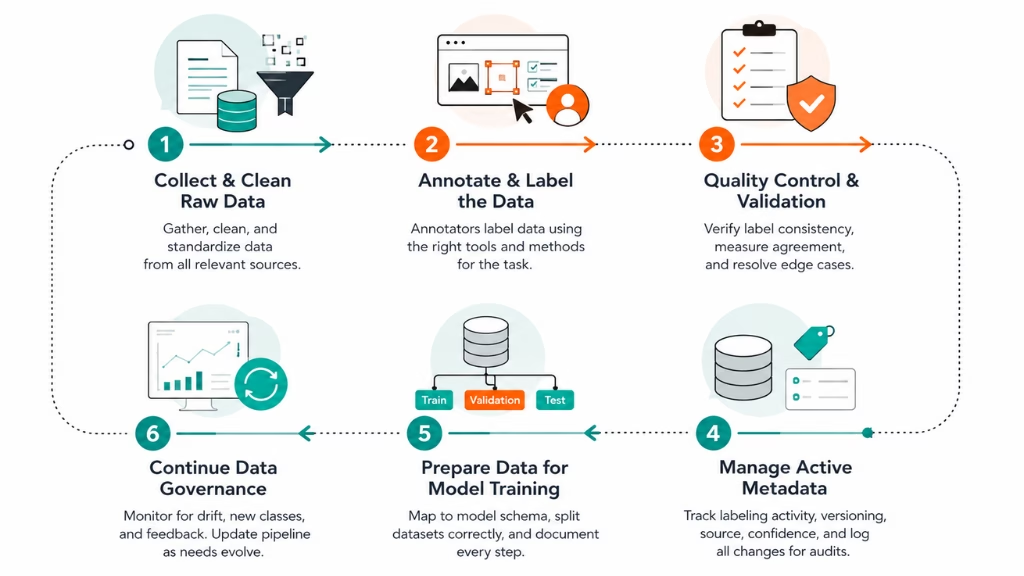
A well-run data labeling process is the backbone of accurate AI. In my experience, clarity and control at every step matter more than speed.
Here’s how to get it right in 2026. Follow this process to build, audit, or fix your AI data pipeline.
Stepwise Data Labeling Process
The workflow starts with collection and ends with ongoing governance. Skipping quality checks or metadata at any stage leads to model issues.
1. Collect and Clean Raw Data
- Gather all relevant data sources (CRM, sensors, logs, documents).
- Clean by removing errors, duplicates, offensive content, or unneeded fields.
- Standardize formats (dates, currencies, categories).
2. Annotate and Label the Data
- Assign human annotators (domain experts or crowdsourcing).
- Use tools like Labelbox, Scale AI, or open-source options.
- Choose between manual (best for complex items) and automated (for high-volume, clear cases) methods.
3. Perform Quality Control and Validation
- Double-check label consistency (use a second annotator or review team).
- Monitor inter-annotator agreement to spot confusion.
- Resolve edge cases or disagreements through escalation or expert input.
4. Manage Active Metadata
- Track who labeled what, when, and any versioning.
- Add metadata for source, label confidence, and validation results.
- Use platforms that log all changes for future audits.
5. Prepare Data for Model Training
- Map labeled features to model schema and requirements.
- Split datasets into training, validation, and test groups (avoid leakage).
- Document every step for transparency.
6. Continue Data Governance
- Regularly check for label drift, new classes, or feedback from production.
- Update pipeline as your model or compliance needs change.
Below is a simple diagram of the data readiness flow:
Supervised vs. Unsupervised Learning—Where Structure and Labels Matter
Choosing what to label, and how much to structure, depends on your learning method. Every team should make this choice first.
If you skip labels for a classification task, you set yourself up for a failed project. But for some AI types, labels are not required.
Key Differences in AI Approaches
Supervised learning uses labeled data. Unsupervised learning learns from patterns in unlabeled data. Each comes with benefits and specific requirements.
Where Labels and Structure Are Needed
- Supervised Learning: Needs labeled data. Used for tasks like image classification or spam detection.
- Unsupervised Learning: Explores structure in raw data. Used for clustering customer behavior or topic modeling.
Table: Data Needs by Learning Approach
| Approach | Data Structure Needed | Labels Required | Typical Uses |
| Supervised | High | Yes | Classification, regression |
| Unsupervised | Varies | No | Clustering, anomaly detection |
Example Scenarios
- Image recognition: Needs thousands of labeled images (“cat” or “dog”). Supervised learning only works with labels.
- Text clustering: Sorts news articles by topic without labels. Unsupervised learning discovers groups from the data itself.
In my experience, mismatching your data prep to your model type is a common but avoidable mistake.
What Are the Enterprise Data Architecture Best Practices in 2026?
Enterprise AI needs scalable data pipelines that support both speed and control. The mistake I see often is companies trying to force all data into rigid structures or ignoring unstructured data.
A better approach is a hybrid architecture that blends structured and unstructured storage, active metadata, and real-time processing.
Key Components of Enterprise AI Architecture
- Lakehouse and RAG (Retrieval-Augmented Generation):
Combine data warehouse structure with lake flexibility. Lakehouse lets you store all data types for AI. RAG systems support blending structured and unstructured knowledge for GenAI. - Metadata-First Governance:
Track lineage, changes, and access at all times. Metadata platforms help manage risk and gain audit trails. - Observability and Change Data Capture:
Monitor data quality, freshness, and drift. Tools report errors and trigger fixes right away. - Real-Time and Batch Pipelines:
Support both fast online inference and bulk offline analysis as business needs change.
According to recent Gartner research (2026), over 80% of enterprise AI failures stem from gaps in data governance or lack of observability.
Quick Enterprise Caselet
Last year our dev team helped a global logistics firm overhaul their AI for delivery route prediction. Their models failed due to missing traceability and poor label quality. With a hybrid lakehouse pipeline and improved labeling checks, their prediction accuracy improved by 22%, and audit time dropped to hours.
What Are Common Pitfalls and Best Practices in AI Data Preparation?
Without strong practices, AI projects get stuck, run over budget, or deliver wrong results. In my POV, most failures come from overlooking simple data basics.
Here are the top mistakes I have seen buyers and teams make, and what works instead.
Common Pitfalls
- Missing or incomplete labels
- Poor metadata and version control
- Lack of regular data validation or auditing
- Privacy issues and weak compliance controls
- Unclear cost estimates or scalability problems
Best Practices and Checklist
- Validate all labels with double review and clear guidelines
- Track all data changes and provenance
- Set up data quality checks before every model update
- Involve privacy and legal teams early
- Build for scaling from day one
Table: Top 5 Mistakes and How to Avoid Them
| Mistake | Impact | Fix/Best Practice |
| Incomplete labeling | Missed predictions, bias | Double review, clear criteria |
| Weak metadata | Lost traceability, compliance | Use metadata management platforms |
| Sparse validation | Errors go live | Add routine data validation steps |
| Privacy neglect | Fines, user distrust | Involve compliance at start |
| Ignoring data drift | Model failure | Set up monitoring, alerting |
How Riseup Labs Can Help You Build Reliable AI Data Pipelines
Choosing the right process and tools for structured and labeled data isn’t simple, especially at scale. Many teams struggle to balance accuracy and speed, and to build lasting governance.
Riseup Labs has a proven record in enterprise data labeling, active metadata, and data governance. If your company needs a full data audit or wants guidance upgrading your pipeline, our team can help—at any maturity level.
From workflow design to label quality control, we partner with your data science or IT teams for results you can trust. To start a discovery call, visit the Riseup Labs website or reach out for a tailored pilot.
Conclusion
Good AI starts and ends with structured and labeled data. In my experience, this step makes or breaks model accuracy, fairness, and trust. You cannot fix bad data with better code.
Keep your pipeline strong by reviewing raw input, labeling with care, checking for drift, and tracking every change. Remember, ongoing governance turns data into a long-term asset, not a one-time task.
If you want AI that delivers results, now is the time to check your data readiness. For teams needing extra support or expert validation, the right partner—like Riseup Labs—can help you de-risk every step of your AI journey.
AI will only be as reliable as the data it learns from. Prepare your data, strengthen your process, and put the future of trustworthy AI in your hands.
Frequently Asked Questions (FAQ) About Structured and Labeled Data for AI
Why do AI models need structured data?
AI models need structured data because it provides a clear format, making it easier for algorithms to detect patterns, learn, and deliver accurate results.
What does labeled data mean in AI?
Labeled data in AI means each data item is tagged with the correct answer or category, which allows models to learn and predict outcomes.
How does data labeling impact model accuracy?
Accurate data labeling improves model accuracy by giving clear examples to learn from, reducing errors, and enabling reliable performance in production.
What is the difference between structured and unstructured data in AI?
Structured data is organized in defined tables; unstructured data lacks a set format and can include text, images, or audio files.
What are the risks of using unlabeled or unstructured data?
Using unlabeled or unstructured data increases error rates, model bias, and makes it hard to audit or explain AI decisions.
What are best practices for data labeling in machine learning?
Best practices include double-checking labels, using expert annotators, clear guidelines, and automated tools to ensure consistency and quality.
How can enterprises prepare their data for AI projects?
Enterprises should clean up datasets, label critical items, track metadata, set up governance, and review data quality before AI model training.
What role does metadata play in AI data governance?
Metadata records details about data sources, changes, and access, ensuring traceability, compliance, and better AI audits.
How do hybrid data architectures support AI models?
Hybrid data architectures combine structured and unstructured data storage, making it easier to support both traditional analytics and modern AI.
What are common pitfalls in data preparation for AI?
Common pitfalls include missing labels, poor validation, weak version control, privacy issues, and failing to plan for scale or drift.
This page was last edited on 4 August 2026, at 4:08 pm

Start a conversation with our team to solve complex challenges and move forward with confidence.