
Building a future-ready healthcare website is now a critical business requirement, not just a digital upgrade.
In 2026, healthcare organizations face unprecedented demands—patients expect seamless digital access, while regulatory compliance grows more complex. Most generic web guides overlook strict healthcare requirements, leaving teams exposed to costly risks or missed opportunities.
This actionable healthcare website development guide empowers you to navigate every step: from compliance and core features to budgeting and future trends.
By the end, you’ll have a clear, strategic blueprint to create a patient-centric, secure, and fully compliant website for 2026—and beyond.
What Is Healthcare Website Development—and What Makes It Unique?
Healthcare website development is the process of planning, designing, and building secure web platforms specifically for medical organizations, prioritizing compliance, data privacy, and patient trust.
Unlike standard websites, healthcare platforms must meet strict regulations (such as HIPAA, GDPR), provide accessible portals for diverse patient needs, and integrate complex health systems.
Key distinctions of healthcare website development:
- Regulatory compliance—Websites must conform to HIPAA, GDPR, ADA, and healthcare-specific privacy rules.
- User trust and privacy—Medical data handling demands far higher security and privacy than most industries.
- Complex stakeholder needs—Platform must serve patients, clinicians, administrators, and insurers.
- Types of sites—Includes clinic and hospital websites, telemedicine portals, health SaaS platforms, and more.
Definition Table: What Sets Healthcare Website Development Apart
| Aspect | Healthcare Website | Standard Website |
| Compliance | HIPAA, GDPR, ADA, HITECH required | Basic data/privacy policy |
| Feature Set | Patient portals, EHR/EMR, telemedicine | Contact forms, blog, static |
| Security | End-to-end encryption, disaster recovery | SSL/TLS typically |
| User Groups | Providers, patients, admins, payers | Mostly end-users/customers |
| Accessibility | WCAG/ADA compliance essential | Often optional |
Why Build—or Redesign—a Healthcare Website in 2026?
Modernizing your healthcare website in 2026 is mission-critical to meet evolving patient expectations, comply with new regulations, and maintain competitive edge.
Healthcare’s digital transformation, accelerated by the pandemic, has made robust online engagement and accessibility non-negotiable.
Key drivers for healthcare website development in 2026:
- Digital-first patients: Most patients research, schedule, and manage care online.
- Telemedicine normalization: Remote care, video visits, and digital forms are now standard.
- New regulatory updates: HIPAA, GDPR, and ADA standards are stricter and actively enforced.
- Competitive threat: Outdated sites erode trust, reduce patient retention, and risk data breaches.
- Tech innovation: Integration with wearables, AI, and advanced analytics is rapidly emerging.
2026 Healthcare Digital Trends (source: Statista, Deloitte):
- 70%+ of patients expect online appointment booking.
- 85% of US healthcare organizations cite digital health as their top investment.
- Over 60% of new web projects will include AI-enabled features or telemedicine modules.
Must-Have Features of a Modern Healthcare Website
A high-performing healthcare website in 2026 must deliver essential features that enable seamless patient care, compliance, and operational efficiency.
Building a robust feature set takes planning, with compliance and user experience at its core.
Feature Checklist for Healthcare Websites:
| Feature | 2026 Expectation | Compliance Tie-In |
| Patient Portal | Secure PHR, results, messaging | HIPAA, GDPR |
| Telemedicine | Video visits, scheduling, digital consents | HIPAA |
| EHR/EMR Integration | Real-time data sharing (HL7/FHIR APIs) | HIPAA, HITECH |
| Appointment Booking | Online, real-time availability, reminders | ADA, UX |
| Secure Payments & Insurance | CC/ACH, verification, encrypted | PCI-DSS, HIPAA |
| AI Tools | Chatbots, triage, recommendations | Best practice |
| Analytics Dashboards | Outcomes tracking, UX/ROI metrics | HIPAA (de-identified) |
| Accessibility (WCAG/ADA) | Screen reader support, color contrast | ADA, Section 508 |
| Mobile-First & Responsive | Seamless across devices | WCAG |
How to Develop a Healthcare Website: Step-by-Step Framework
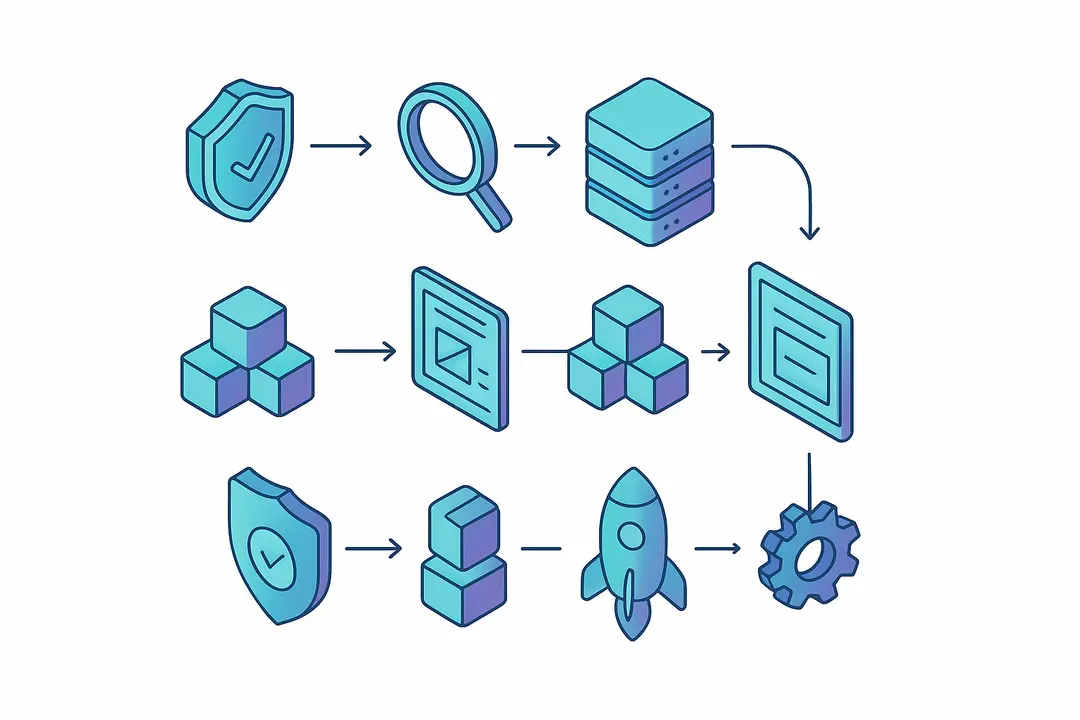
Developing a healthcare website in 2026 requires a structured, actionable process covering compliance, user needs, design, technology, and ongoing governance.
Below is a proven, step-by-step framework for healthcare website development:
Healthcare Website Development Process:
- Define goals, compliance requirements, and stakeholders
Map organizational objectives against user needs. Identify all stakeholders—clinicians, patients, admins—and clarify HIPAA, GDPR, and ADA obligations. - Conduct market & user research
Survey patient personas, benchmark competitors, and analyze industry trends to identify feature gaps. - Choose your technology stack
Select between robust frameworks (React, Node.js, Django, AWS) and CMS options, prioritizing interoperability, security, and vendor support. - Design for UX/UI and accessibility
Apply mobile-first strategies, ensure WCAG/ADA standards, and embed inclusive navigation with regular patient/user feedback. - Develop core site features
Build modular components—secure patient portal, telemedicine modules, appointment schedulers, and payment systems. - Integrate essential systems & security layers
Connect EHR/EMR (e.g., Epic, Cerner) using HL7/FHIR or similar APIs. Implement SSO, data encryption, audit trails, and backup plans. - Test for compliance and quality assurance
Run security audits for HIPAA/GDPR, perform accessibility checks, and undertake user acceptance testing. - Plan and execute launch
Use a staged rollout with staff/internal training, phased go-lives, and fallback planning for critical phases. - Establish a post-launch review & maintenance plan
Continuously monitor site performance, gather user feedback, schedule compliance/security audits, and iterate regularly.
What Are the Compliance and Security Requirements for Healthcare Websites?

Healthcare websites must meet strict compliance and security standards to protect patient data and avoid costly penalties.
The core frameworks include HIPAA, GDPR (for global practices), ADA/WCAG, and sector-specific security best practices.
Key Compliance and Security Steps:
- HIPAA—Protects health information through access controls, encryption, and detailed audit logs. Requirements: role-based access, secure transmission (TLS), breach notifications.
2026 note: HHS and OCR updates have increased scrutiny for third-party service providers. - GDPR—Sets standards for consent, cross-border data transfer, and the right to data erasure for any site handling EU citizens’ information.
- Accessibility (ADA, WCAG 2.1+):
Legal and ethical requirement in the US. Must ensure users with disabilities can navigate and use all digital services. - Security best practices:
End-to-end encryption, regular backups, disaster recovery planning, intrusion detection, and annual third-party security audits.
Healthcare Website Compliance Checklist Table
| Area | Requirements |
| HIPAA | Encryption, access control, audit logs, breach response |
| GDPR | Explicit consent, data portability, right to be forgotten |
| ADA/WCAG | Keyboard navigation, alt text, appropriate contrast, mobile accessibility |
| Data Security | SSL/TLS, frequent backups, multi-factor authentication, business continuity plan (BCP) |
| Regular Audits | Security scans, compliance review, documentation |
How Much Does It Cost to Develop and Maintain a Healthcare Website?

Healthcare website development costs vary based on scope, features, compliance requirements, and vendor/regional differences.
Most projects fall within a wide range—budget transparency and planning are essential for decision makers.
Key Healthcare Website Cost Drivers:
- Project Scope: Number of integrations, types of patient portals, telemedicine setup
- Compliance Investments: Security, legal, and documentation costs
- Technology Stack/Customization: Custom vs. off-the-shelf solutions
- Geographic Region: Labor and regulatory differences
Typical Cost Ranges (2026 Estimates):
| Scope/Region | Basic Website (USD) | Advanced/Custom Portal (USD) | Annual Maintenance (USD) |
| US / Canada | $25,000–$60,000 | $75,000–$250,000+ | $8,000–$30,000 |
| Europe (EU) | $20,000–$50,000 | $60,000–$200,000+ | $7,000–$25,000 |
| Asia-Pacific | $15,000–$40,000 | $40,000–$150,000+ | $5,000–$18,000 |
According to industry surveys, advanced features like telemedicine or AI tools significantly increase both upfront and ongoing costs.
Hidden/Recurring Costs:
- Software licensing and security updates
- Compliance re-audits/monitoring
- Hosting, support, and regular feature updates
What Are the Biggest Challenges—and How Do You Solve Them?
Developing and maintaining a healthcare website presents unique challenges, from technical integration hurdles to patient adoption and data security.
Understanding these obstacles—and proven solutions—reduces risk and accelerates success.
Common Healthcare Website Challenges & Solutions:
| Challenge | Solution/Best Practice |
| EHR/EMR Integration | Use certified HL7/FHIR APIs; engage experienced partners |
| Balancing Compliance with UX | Involve clinicians/patients in user testing; simplify workflows |
| Staff/Patient Adoption | Offer onsite and video training; phased rollouts |
| Disaster Recovery & Continuity | Implement redundant backups; annual plan rehearsal |
| Change Management | Start early communication; gather feedback pre/post-launch |
“Our hospital’s biggest issue was integrating our old EHR with a new portal—pre-launch dry runs with real patient data scenarios were essential.”
—CIO, Regional Healthcare Group
How to Future-Proof Your Healthcare Website: 2026 Trends
To remain relevant and compliant, healthcare websites must anticipate and adopt emerging technology and design trends.
Building with adaptability in mind extends site value and reduces rework.
Healthcare Website Trends to Watch (2026):
- AI/Chatbots: Smart triage, conversational UI, predictive personalization
- Blockchain: Immutable patient records, audit trails, heightened data security
- IoMT/Wearables Integration: Real-time data from patient devices, remote monitoring
- Interoperability: Standards like FHIR, seamless data exchange with other health IT systems
- Advanced Analytics: Predictive health insights, custom UX, and improved patient outcomes
Trend Adoption Matrix
| Trend | Business Value | Implementation Priority (2026) |
| AI/Chatbots | Improved triage, 24/7 support | High |
| Blockchain | Stronger data security | Medium |
| IoMT Integration | Better patient engagement | Medium |
| Interoperability APIs | Enhanced data flow/compliance | High |
| Personalization/Analytics | Higher patient retention | High |
Best Practices for Ongoing Improvement & Maintenance
After launch, ongoing website improvement is vital for security, performance, and patient satisfaction.
Establishing structured review and iteration keeps your healthcare website compliant and ahead of competitor offerings.
Ongoing Improvement Checklist:
- Regular Security/Compliance Audits: Quarterly security scans, annual HIPAA/ADA reviews.
- Patient Feedback Channels: Use surveys, NPS scores, and analytics.
- Feature & Content Updates: Stay current with clinical best practices and regulations.
- Technology Monitoring: Schedule updates (CMS, plugins), monitor performance, uptime alerts.
- Vendor Management: Review SLAs, escalation plans, and support quality.
Review Calendar Example
| Task | Frequency |
| Security Scan | Quarterly |
| Compliance Review | Annually |
| Patient Feedback Collection | Monthly |
| Content/Feature Update | As needed |
| Vendor SLA Review | Semi-Annually |
Frequently Asked Questions About Healthcare Website Development
What makes healthcare website development different from other industries?
Healthcare website development is distinct due to stringent compliance requirements (like HIPAA, GDPR), the need for secure data handling, and the complexity of integrating medical systems such as EHRs and patient portals.
How much does it cost to build a healthcare website?
Depending on features, compliance needs, and region, a basic healthcare website can cost $15,000–$60,000, while advanced patient portals or telemedicine sites can exceed $250,000.
What are the must-have features for a healthcare website in 2026?
Essential features include secure patient portals, telemedicine, EHR/EMR integration, online appointment booking, accessibility (WCAG/ADA), analytics dashboards, and robust security.
What are the steps to achieve HIPAA compliance?
Develop clear data privacy policies, ensure end-to-end encryption, restrict access to protected health information (PHI), implement audit logging, and conduct regular compliance audits.
Which technology stack should I use for a healthcare website?
Popular choices include React, Node.js, Django, and AWS for scalability and security. Choose a stack that aligns with clinical system integrations and regulatory needs.
How do I ensure accessibility for all users?
Design with WCAG 2.1/ADA in mind: use readable fonts, sufficient color contrast, alt text, keyboard navigation, and test with assistive technologies.
How to integrate EHR/EMR with my website?
Leverage industry-standard APIs (HL7, FHIR) and partner with experienced vendors. Prioritize interoperability and data security throughout development.
What are the 2026 web development trends?
Healthcare web trends include AI-powered chatbots, blockchain for data integrity, integration with wearables (IoMT), predictive analytics, and advanced personalization.
How can AI improve patient experience on my website?
AI chatbots offer 24/7 support, streamline triage, personalize patient journeys, and provide instant answers to common questions, enhancing engagement and satisfaction.
How do I keep my healthcare website secure after launch?
Ongoing security best practices include regular patching, encrypted backups, user activity monitoring, multi-factor authentication, and scheduled compliance audits.
Conclusion
Modern healthcare website development goes far beyond standard web builds. By adopting this step-by-step guide, your organization gains a proven framework for achieving legal compliance, operational excellence, and exceptional patient engagement. Whether you’re starting from scratch or planning a redesign, use the downloadable templates and checklists to streamline your next web project.
Ready to accelerate your digital health transformation? Download our project checklist, schedule a consult, or subscribe for periodic trends and resource updates—your path to a fully compliant, future-proof healthcare website starts now.
Key Takeaways
- Map project goals to regulatory requirements (HIPAA, GDPR, ADA) from day one.
- Build with core patient-centric features: secure portals, telemedicine, online booking, integrated payments.
- Choose a technology stack with support for security, scalability, and EHR integration.
- Test thoroughly for compliance, accessibility, and real-world user feedback before launch.
- Budget for both upfront development and ongoing maintenance, security, and updates.
- Embrace emerging trends (AI, IoMT, blockchain) to future-proof your investment.
- Establish continuous improvement cycles using analytics and structured feedback.
This page was last edited on 6 May 2026, at 4:14 pm

Start a conversation with our team to solve complex challenges and move forward with confidence.