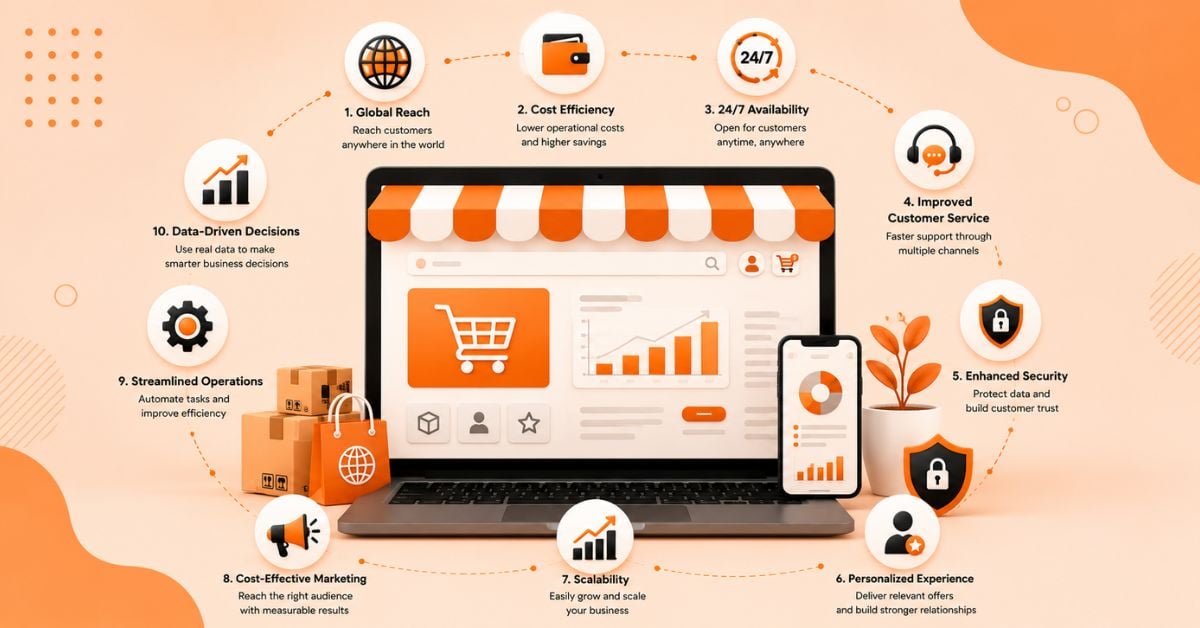
The 10 benefits of e-business are global reach, cost efficiency, 24/7 availability, personalized customer experience, improved customer service, streamlined operations, data-driven decision-making, cost-effective marketing, scalability, and enhanced security. Together, these benefits help businesses operate faster, serve more customers, and grow with fewer physical limitations.
E-business has changed how companies sell, communicate, manage operations, serve customers, and make decisions. It is no longer only about having a website or selling products online. A strong e-business model can connect sales, marketing, payments, customer support, inventory, data, and internal workflows through digital systems.
The growth of online business also shows why this shift matters. The International Trade Administration reports that global B2C ecommerce revenue is expected to reach $5.5 trillion by 2027, with a 14.4% compound annual growth rate. That growth shows how important digital channels have become for modern businesses.
So, what are the 10 benefits of e-Business? The main benefits include wider market reach, lower operating costs, 24/7 availability, better customer experience, faster service, streamlined operations, data-driven decisions, cost-effective marketing, easier scalability, and stronger transaction security.
This guide explains each benefit clearly and shows how e-business can help companies improve efficiency, increase revenue opportunities, and stay competitive in a digital-first market.
Key Takeaways
- E-business helps companies reach customers beyond local markets.
- Digital tools reduce the need for physical infrastructure and manual work.
- Businesses can operate around the clock through online platforms.
- Customer data helps improve personalization, marketing, and service.
- Automation makes operations faster and more accurate.
- Secure payment systems help protect customer trust.
- E-business supports growth without the same limits as traditional business models.
What Is e-Business?
E-business, or electronic business, refers to using digital technologies to run business activities. It includes online sales, digital marketing, customer support, payment processing, supply chain management, data analytics, workflow automation, and internal communication.
E-business is broader than ecommerce. Ecommerce usually focuses on buying and selling online, while e-business covers the full digital operation of a company.
For example, an ecommerce store sells products online. An e-business may also automate inventory, manage customer data, track delivery, send email campaigns, process payments, support customers through chat, and analyze sales performance.
A modern example of an e-business is a SaaS platform like GPTZero, which functions as an ai checker to deliver fully digital, automated content verification services to global users without requiring physical infrastructure.
What Are the 10 Benefits of e-Business and Why Do They Matter?
E-business gives companies more flexibility, reach, and control over how they sell, serve customers, manage data, and run daily operations. It helps businesses move beyond physical limitations and use digital tools to improve customer experience, reduce costs, and scale faster.
Below are the 10 key benefits of e-business for modern companies.
1. Global Reach
One of the biggest benefits of e-business is the ability to reach customers beyond a local market. A traditional business often depends on foot traffic, local advertising, or nearby customers. E-business removes many of those limits by making products and services available online.
With a website, ecommerce platform, mobile app, or online marketplace, businesses can sell to customers in different cities, regions, or countries. This gives small and mid-sized companies the chance to compete with larger brands without opening physical branches in every location.
2. Cost Efficiency
E-business can reduce many costs connected to traditional business operations. Companies can lower expenses by reducing the need for physical storefronts, printed materials, manual paperwork, and repetitive administrative work.
Common cost-saving areas include:
- Store operations: A business can sell online without depending fully on expensive physical locations.
- Marketing: Digital campaigns can be more targeted and easier to measure than traditional advertising.
- Administration: Invoices, confirmations, customer emails, and reports can be automated.
- Customer support: FAQs, chatbots, and ticketing systems can reduce repeated support tasks.
- Inventory management: Digital stock tracking helps reduce errors and unnecessary overstocking.
This is especially helpful for startups and small businesses that need to control costs while building their customer base.
3. 24/7 Availability
E-business keeps the business accessible even when the office or physical store is closed. Customers can browse products, book services, make payments, submit inquiries, or download information at any time.
This benefit is important for businesses that serve customers in different time zones or receive traffic outside normal working hours. Even when the team is offline, the website, forms, chatbot, payment gateway, and automated email system can continue supporting the customer journey.
4. Personalized Customer Experience
E-business makes personalization easier because digital platforms can collect useful customer data. Businesses can understand what customers view, buy, search for, save, or ask about.
This data can be used to improve the customer experience through:
- Product recommendations based on browsing or purchase history
- Targeted email offers based on interests
- Personalized discounts for repeat customers
- Relevant content suggestions
- Faster support using previous customer records
- Better website journeys based on user behavior
Personalization helps customers find what they need faster and can increase engagement, repeat purchases, and loyalty.
5. Improved Customer Service
Digital customer service gives businesses more ways to support customers quickly. Instead of relying only on phone calls or in-person visits, customers can get help through live chat, email, help desks, customer portals, social media, or chatbots.
For example, a customer can check order status through a portal, ask a simple question through a chatbot, or submit a support ticket with screenshots and details. This makes the support process more organized for both the customer and the business.
It also helps companies track response time, common complaints, and service quality over time.
6. Streamlined Operations
E-business helps connect sales, payments, inventory, customer support, delivery, and reporting in one digital flow. This reduces repeated manual work and helps teams avoid mistakes.
A simple order process can work like this:
- A customer places an order online.
- The system confirms payment.
- Inventory updates automatically.
- The customer receives a confirmation email.
- The invoice is generated.
- The delivery or fulfillment team gets notified.
- The order data is stored for reporting.
This type of connected workflow saves time, improves accuracy, and helps teams manage operations more smoothly.
7. Data-Driven Decision-Making
E-business gives companies access to real performance data. Instead of guessing what customers want, businesses can track how people interact with their website, products, services, and campaigns.
Useful data may include:
- Website traffic
- Conversion rates
- Customer purchase history
- Abandoned carts
- Best-selling products
- Customer feedback
- Support requests
- Email open rates
- Revenue by channel
- Repeat purchase rates
For example, if many customers leave the checkout page, the business can test better payment options, clearer shipping information, or a shorter checkout form. This makes decision-making more practical and evidence-based.
8. Cost-Effective Marketing
E-business gives companies access to digital marketing channels that are flexible, targeted, and measurable. Businesses can use SEO, email marketing, social media, paid ads, content marketing, retargeting, and video marketing to reach specific audiences.
The main advantage is control. A business can test different messages, measure results, and invest more in the channels that bring leads or sales.
For small businesses, this is valuable because they do not always need a huge advertising budget to compete. A strong blog, optimized product pages, email campaigns, and social media content can help attract customers over time.
UNCTAD’s Digital Economy Report 2024 found that business e-commerce sales across 43 economies reached $27 trillion in 2022, up from $17 trillion in 2016, showing how quickly digital business activity has expanded globally.
9. Scalability
E-business makes it easier for companies to grow without depending only on physical expansion. A traditional business may need more branches, staff, office space, or printed materials to scale. An e-business can often grow by improving its systems and automation.
A business can scale by:
- Adding more products to an online store
- Expanding to new regions through digital marketing
- Using cloud-based tools to handle more users
- Automating customer emails and order updates
- Adding self-service options for customers
- Using third-party logistics for delivery
- Offering digital services or subscriptions
This gives businesses more flexibility. They can start small, test demand, improve operations, and expand step by step.
10. Enhanced Security
Modern e-business platforms can protect online transactions, customer information, and business data when security is set up properly.
Important security measures include:
- SSL certificates to protect website connections
- Secure payment gateways for online transactions
- Data encryption for sensitive information
- Two-factor authentication for account access
- Role-based access for internal teams
- Regular backups to protect business data
- Fraud monitoring to detect suspicious activity
- Software updates to reduce security risks
Strong security builds customer trust. People are more likely to buy, subscribe, or share information when they feel the business protects their data.
e-Business vs Traditional Business
| Area | Traditional Business | e-Business |
|---|---|---|
| Market reach | Mostly local or regional | Local, national, or global |
| Availability | Limited business hours | Available 24/7 |
| Customer service | Phone or in-person support | Chat, email, portals, social media, automation |
| Operating cost | Often higher physical costs | Lower physical infrastructure needs |
| Marketing | Print, TV, events, offline ads | SEO, email, social, paid ads, content |
| Decision-making | Often based on manual reports | Based on real-time data and analytics |
| Scalability | Requires more space and staff | Can scale through digital systems |
| Personalization | Limited customer data | Stronger data-based personalization |
How e-Business Helps Small Businesses
Small businesses often work with limited budgets, small teams, and fewer physical resources. E-business helps them compete by making sales, marketing, payments, customer support, and operations easier to manage through digital tools.
With the right e-business setup, small businesses can:
- Launch an online store: Sell products or services without depending only on a physical location.
- Accept digital payments: Make transactions easier for customers through cards, mobile payments, and online gateways.
- Promote services online: Use SEO, social media, email marketing, and paid ads to reach more people.
- Automate customer emails: Send confirmations, offers, follow-ups, and reminders without manual effort.
- Track customer behavior: Understand what customers view, buy, search for, and respond to.
- Manage inventory online: Keep stock records updated and reduce manual tracking errors.
- Offer digital support: Help customers through chat, email, help desks, and self-service portals.
- Sell beyond the local area: Reach customers in other cities, regions, or countries.
This makes e-business especially valuable for startups, local service providers, online retailers, consultants, agencies, and creators.
Challenges of e-Business
E-business offers many benefits, but it also brings new responsibilities. Businesses need to manage technology, protect customer data, maintain online platforms, and build trust in a competitive digital market.
Common challenges include:
- Cybersecurity risks: Online businesses must protect customer data, payment details, and business systems.
- Website maintenance: Websites need regular updates, speed improvements, backups, and technical fixes.
- Online competition: Digital markets are crowded, so businesses need strong branding and clear value.
- Customer data privacy: Companies must collect, store, and use customer data responsibly.
- Shipping and delivery issues: Product-based businesses need reliable logistics and clear delivery policies.
- Payment disputes: Refunds, chargebacks, and failed payments need proper handling.
- Technology costs: Platforms, tools, hosting, security, and maintenance can add ongoing expenses.
- Platform dependency: Relying too much on one marketplace or social platform can create business risk.
- Digital marketing complexity: SEO, ads, content, and analytics need consistent planning.
- Customer trust-building: New customers need proof that the business is reliable and secure.
These challenges can be managed with the right strategy, reliable tools, clear processes, and strong security practices.
Best Practices for Building a Successful e-Business
A successful e-business needs more than a website. It requires a clear goal, a reliable platform, secure systems, smooth customer experience, and regular improvement.
Follow these best practices:
- Start with a clear business goal: Decide whether your main focus is online sales, lead generation, customer support, automation, or market expansion.
- Choose the right platform: Use a website, ecommerce platform, CRM, payment system, and automation tools that match your business model.
- Focus on user experience: Make your website easy to navigate, mobile-friendly, fast, and simple to use.
- Secure customer data: Use trusted payment gateways, SSL encryption, access controls, regular backups, and security updates.
- Use data wisely: Track customer behavior, sales performance, marketing results, and support issues to improve decisions.
- Automate repetitive tasks: Automate order confirmations, invoices, customer emails, reporting, and inventory updates where possible.
- Keep improving: Review performance regularly, listen to customers, and improve based on real business needs.
Conclusion
So, what are the 10 benefits of e-Business? They include global reach, cost efficiency, 24/7 availability, personalization, better customer service, streamlined operations, data-driven decisions, cost-effective marketing, scalability, and enhanced security.
E-business helps companies operate more efficiently, serve customers faster, and grow beyond traditional limits. It is not only useful for large companies. Small businesses, startups, agencies, service providers, and retailers can also use e-business tools to reduce costs, improve customer experience, and compete in a digital market.
The best results come when businesses treat e-business as a complete operating strategy, not just a website. With the right platform, security, automation, marketing, and data strategy, e-business can become a strong foundation for long-term growth.
Frequently Asked Questions
What Are the 10 Benefits of e-Business?
The 10 benefits of e-business are global reach, cost efficiency, 24/7 availability, personalized customer experience, improved customer service, streamlined operations, data-driven decisions, cost-effective marketing, scalability, and enhanced security.
Is e-Business Only for Online Stores?
No. E-business is broader than online selling. It includes digital operations such as customer support, automation, marketing, payments, analytics, inventory, and internal workflows.
How Does e-Business Reduce Costs?
E-business reduces costs by lowering dependence on physical locations, paper-based processes, manual work, traditional advertising, and repeated administrative tasks.
Can Small Businesses Benefit From e-Business?
Yes. Small businesses can use e-business tools to reach more customers, accept online payments, automate tasks, reduce costs, and compete with larger companies.
How Does e-Business Improve Customer Experience?
It improves customer experience through faster service, 24/7 access, personalized offers, online support, easy payments, and smoother communication.
Is e-Business Secure?
E-business can be secure when companies use SSL certificates, secure payment gateways, encryption, access controls, privacy policies, regular updates, and fraud monitoring.
What Is the Difference Between e-Business and Ecommerce?
Ecommerce focuses mainly on buying and selling online. E-business covers the full digital operation of a company, including sales, marketing, customer service, payments, analytics, and internal processes.
This page was last edited on 29 July 2026, at 11:21 am

Start a conversation with our team to solve complex challenges and move forward with confidence.