
Selecting the right AI development company can be the difference between tangible ROI and costly setbacks. AI projects often face high failure rates and hidden risks, leaving organizations exposed to overruns, poor alignment, or missed objectives. According to Harvard Business Review, nearly 70% of digital transformation projects—AI included—fall short of expectations, mostly due to misaligned vendors or unclear goals.
If you’re evaluating AI partners, you can’t afford generalized advice or a checklist that fails to address your specific circumstances. In this article, you’ll find tips for choosing the right AI development company, including expert criteria, real-world evaluation tools, and pitfalls to avoid—boosting your confidence and your project’s likelihood of success.
What you’ll learn:
- How to define precise project goals and make vendors compete on your terms
- What technical skills and domain expertise matter—and how to verify them
- Critical questions for due diligence, from ethics to ongoing support and pricing
- A ready-to-use checklist and comparison matrix for decision-making
7 Expert Tips for Choosing the Right AI Development Company
Choosing the right AI development company is essential for ensuring the success of your AI project. To make an informed decision, you need to carefully assess a variety of factors, including technical capabilities, industry experience, and long-term partnership potential. Below are tips for choosing the right AI development company that will guide you through each step of the selection process, helping you make a confident and strategic choice.
Step 1: Define Clear AI Project Goals and Success Criteria
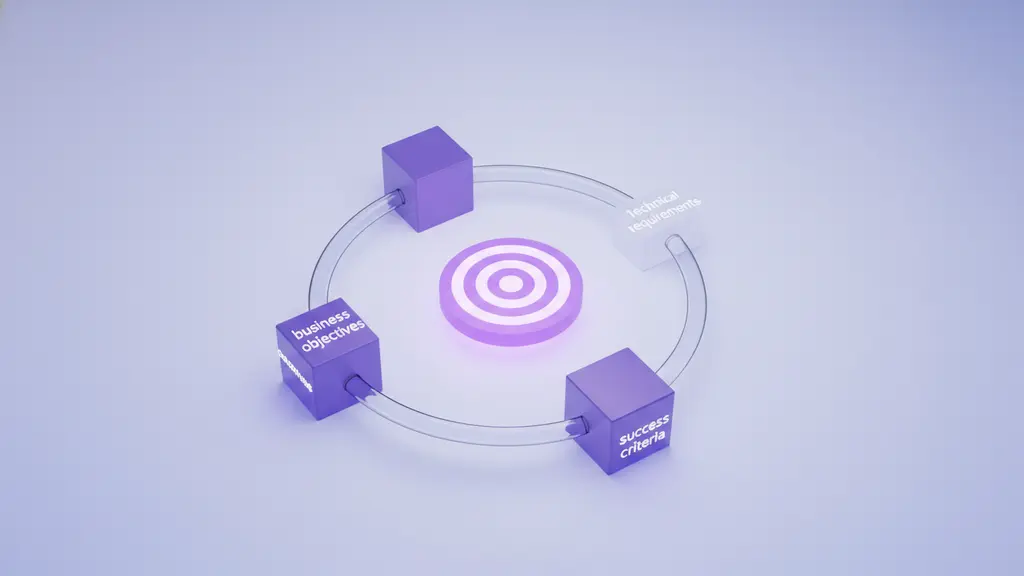
Establishing clear AI project goals and success metrics provides the foundation for vendor alignment and effective partner evaluation.
Every successful AI project starts with a well-defined objective. Before you approach any AI development company, clarify what you want to achieve—both in business and technical terms. This ensures that vendor candidates understand your vision and can offer the right solutions, making your selection process faster and more accurate.
Key actions:
- Outline business objectives: Are you looking to boost efficiency, automate tasks, improve customer experiences, or pivot with new business models?
- Define technical requirements: What types of AI (machine learning, natural language processing, generative AI) are you seeking? Outline your data types, desired integrations, and system constraints.
- Set measurable success criteria: Consider time-to-value, ROI targets, accuracy benchmarks, or user adoption.
- Adapt by industry: Project goals and requirements differ sharply by sector. For example, a healthcare AI initiative may prioritize compliance and data privacy, while a retail project focuses on personalization and scalability.
Example:
For a hospital, the AI project goal might be “reduce patient readmission rates by 10% in 12 months using predictive analytics.”
For a retailer: “Increase online conversion rates by 15% with an AI-powered recommendations engine.”
Tool tip:
Use a requirements worksheet or downloadable template to capture your needs—this not only clarifies your project scope but serves as a filter during vendor selection.
Step 2: Identify Key Technical Capabilities and Requirements
Pinpointing must-have AI capabilities and technical requirements helps ensure that your chosen partner is equipped to deliver on your precise project needs.
Not all AI development companies offer the same depth of technical expertise. Draw up a list of essential skills (must-have) and desirable skills (nice-to-have) that match your goals. This technical criteria becomes your first filter for vendor qualification.
Critical areas for consideration:
- Machine learning model development: Can the vendor create, train, and optimize models for your data?
- Generative AI and NLP: Is the team experienced with generative models (e.g., GPT, DALL-E) or advanced natural language processing for chatbots, summarization, or search?
- Computer vision: Needed for projects involving image or video analysis.
- Integration & API skills: Can solutions be embedded seamlessly into your existing tech stack? Look for knowledge in MLOps and robust API development for scalability.
- Proof of Concept (PoC): Ask vendors if they offer low-risk PoCs. This is a practical step to validate capabilities before committing further budget.
Evaluation matrix example:
| Requirement | Critical (Y/N) | Vendor 1 | Vendor 2 | Vendor 3 |
| ML development | Y | ✔️ | ✔️ | ❌ |
| NLP expertise | Y | ✔️ | ❌ | ✔️ |
| Integration APIs | N | ✔️ | ✔️ | ✔️ |
| PoC Offer | Y | ✔️ | ❌ | ✔️ |
Step 3: Assess Vendor’s Industry Experience and Domain Expertise
Choosing a vendor with relevant industry experience ensures the AI solution will meet regulatory standards and address domain-specific challenges.
AI development is not one-size-fits-all. A vendor’s ability to deliver real results often depends on familiarity with your industry’s data, processes, and compliance landscape. Industry-specific expertise reduces communication gaps and accelerates implementation.
Evaluate vendors for:
- Relevant project portfolio: Have they built solutions for your sector (healthcare, finance, logistics, retail, etc.)? Request specific examples or anonymized case studies.
- Regulatory understanding: For regulated industries (e.g., HIPAA for healthcare, PCI-DSS for finance), does the vendor demonstrate knowledge of compliance requirements?
- Domain references: Ask for client references who faced challenges similar to yours.
- Customization skills: Can the vendor adapt AI to your legacy systems, workflows, and security demands?
Red flags:
Watch for vendors who lack public domain experience, offer only generic answers, or refuse to share sector references.
Sample questions:
- Can you share results from previous projects in our industry?
- How have you handled industry-specific data privacy or regulatory hurdles?
Step 4: Examine Case Studies, Client References, and Proof of Concept Offers
Reviewing real-world case studies and seeking client references lets you verify vendor claims and minimize selection risk.
A credible AI development company will provide detailed portfolios, measurable project outcomes, and facilitate reference checks. Case studies should go beyond high-level wins—look for specifics about scope, challenge, metrics, and complexity.
Effective due diligence steps:
- Analyze case studies: Look for clear goals, solution overviews, technical challenges, and quantifiable results (e.g., “Reduced churn by 20% in 6 months”).
- Ask for references: Speak directly with 2–3 past clients to probe for honesty, communication, and delivery consistency.
- Proof of concept (PoC): A successful PoC demonstrates technical and team fit. Favor vendors who pilot solutions before contract lock-in.
- Check for transparency: Be wary of “white label” work (projects that cannot be substantiated) and testimonials lacking details.
Sample reference questions:
- Would you work with this vendor again?
- How did their team manage unexpected challenges?
- Were deadlines and budgets honored?
Step 5: Evaluate Data Security, Ethics, and Regulatory Compliance

Assessing a vendor’s approach to data security, compliance, and ethical AI is essential to protect your business and customers.
Security and compliance are non-negotiable, especially where sensitive data or regulated industries are involved. A trustworthy AI partner will be upfront about their protocols for data storage, encryption, privacy, and compliance with laws like GDPR or CCPA.
Checklist for vendor evaluation:
- What encryption and data handling policies are in place?
- Are systems designed for GDPR, HIPAA, or other relevant regulations?
- How do they prevent and mitigate bias or data drift in AI models?
- Do they provide documentation or certifications for security practices?
- How do they govern and audit agentic or ethical AI components?
Industry-specific considerations:
- Healthcare: Look for HIPAA compliance and detailed PHI (Protected Health Information) handling.
- Finance: Seek PCI-DSS adherence and evidence of secure payment data pipelines.
Red flags:
Vague or non-specific answers about compliance, lack of audit records, and unawareness of industry-specific regulations indicate elevated risk.
Symptoms of a secure AI vendor:
- Clear security policies
- Compliance documentation
- Regular audits and reporting
- Bias monitoring and mitigation plans
Step 6: Understand Support, Maintenance, and Long-Term Partnership Model
Knowing what level of post-launch support and partnership model each AI vendor offers helps ensure long-term project ROI.
AI solutions require ongoing tuning and monitoring to stay effective as business requirements and data evolve. Reliable vendors proactively offer maintenance, model retraining, system upgrades, and transparent service level agreements (SLAs).
Types of support to clarify:
- Monitoring and incident response: Is there 24/7 or business-hour monitoring? What is the turnaround for issue resolution?
- AI model retraining/updating: How often are models retrained to address data drift or new business needs?
- Upgrade and scaling policies: Are there costs or downtime for scaling or adding features?
- SLAs and guarantees: What service levels are set contractually? Are response times and escalation policies clear?
Comparison:
| Support Factor | Vendor 1 | Vendor 2 | Vendor 3 |
| 24/7 Monitoring | ✔️ | ❌ | ✔️ |
| Model Retraining | Quarterly | On-demand | Monthly |
| Upgrade Fees | Included | Extra | Included |
| Partnership Model | Strategic | Transactional | Strategic |
Partnership vs. Transactional:
Choose vendors who see themselves as ongoing partners—committed to your evolving success—not just one-off project implementers.
Step 7: Analyze Costs, Pricing Models, and Contract Terms

Comparing costs, pricing models, and contracts ensures you get value for your investment and avoid unpleasant surprises.
AI project pricing varies widely, influenced by solution complexity, data requirements, and ongoing support. Transparency is critical for budget planning and vendor comparison.
Main pricing models:
- Fixed price: Upfront-defined scope, clear costs, low flexibility.
- Hourly/Time & Materials: Pay as you go, better for agile scopes, risk of overruns.
- Milestone-based: Payment triggered by project stages or deliverables.
- Performance-based: Payment tied to agreed results (e.g., outcomes, savings).
Key contract terms to review:
- IP ownership: Who retains rights to the solution, models, and/or data?
- Exit clauses: How can you transition away from the vendor if needed?
- Payment triggers and penalties: Are terms flexible to project realities?
- Hidden fees: Clarify costs for maintenance, upgrades, or scaling in advance.
Negotiation tips:
- Don’t choose solely on price—balance technical expertise, support, and flexibility.
- Use a structured vendor comparison table for “apples-to-apples” evaluation.
Sample table:
| Vendor | Cost Model | IP Ownership | Support Included | Exit Terms |
| Vendor 1 | Fixed + Milestone | Client | 1yr maintenance | 90 days notice |
| Vendor 2 | Hourly | Shared | Paid add-on | 30 days notice |
| Vendor 3 | Performance | Client | Included | 60 days notice |
Quick Reference: AI Vendor Selection Checklist & Decision Matrix
Use this practical checklist and matrix to compare AI development companies side-by-side and make confident decisions.
| Criteria | Weight (%) | Vendor 1 | Vendor 2 | Vendor 3 |
| Project Fit & Goals | 20% | |||
| Technical Capabilities | 20% | |||
| Industry Experience | 15% | |||
| Security & Compliance | 15% | |||
| Support & Partnership | 10% | |||
| References/Case Studies | 10% | |||
| Pricing & Contract | 10% | |||
| Total (out of 100) |
How to use:
Score each vendor 1–5 per row (5 = best).
Multiply by weight and sum up for an overall comparison.
Download or create a copy of this checklist as you assess options.
Common Mistakes to Avoid When Choosing an AI Development Company
Steering clear of known pitfalls can help you avoid project delays, wasted resources, and failed outcomes.
Top 5 selection mistakes:
- Overlooking data privacy and compliance: Failing to verify vendor protocols can lead to legal and reputational risks.
- Ignoring post-launch support needs: Without clarity, you may end up unsupported when issues arise.
- Choosing based solely on price: Bargain vendors often underdeliver or hide true costs in add-ons.
- Not confirming proof of concept offers or real references: Skipping validation or reference checks increases project risk.
- Unclear project goals: Without specific criteria, vendors can’t deliver aligned solutions—leading to scope drift or failure.
According to McKinsey, poor execution and misaligned partnerships contribute to a high AI project failure rate, emphasizing the need for rigorous selection.
Frequently Asked Questions About AI Vendor Selection
What are the most important factors when choosing an AI development company?
When choosing the right AI development company, the most critical factors include clear alignment with your business goals, technical expertise specific to your needs, proven industry experience, robust data security practices, reliable support, and transparent pricing.
Which questions should I ask potential AI vendors?
To ensure you’re choosing the right AI development company, ask about prior domain projects, technical certifications, compliance processes, support models, project management approach, and access to case studies or client references.
How can I evaluate an AI company’s technical expertise?
Evaluate their technical portfolio, request a proof of concept, and assess the credentials of their team members. Look for experience with the AI technologies and integrations needed for your project, which are essential tips for choosing the right AI development company.
What are the risks of selecting the wrong AI partner?
The risks include failed deployments, budget overruns, data breaches, regulatory non-compliance, lack of ongoing support, and ultimately missed business objectives. These are all key factors to consider when choosing the right AI development company.
How do I ensure data privacy and compliance with an AI vendor?
Confirm the vendor’s certifications, compliance with regulations like GDPR, and documented security/privacy policies. Demand clear responses and audit trails as part of your due diligence in choosing the right AI development company.
Is it better to build an AI solution in-house or outsource it?
Outsourcing often provides faster access to specialized expertise and can be more cost-effective, especially for organizations lacking internal AI capabilities. Tips for choosing the right AI development company suggest outsourcing for faster results, while in-house builds offer more control but require significant investment.
What post-deployment support should I expect from an AI partner?
Expect regular monitoring, model updates, troubleshooting, user training, and clear service level agreements (SLAs) for support responsiveness. This support is crucial when choosing the right AI development company to ensure ongoing success.
What kind of contracts and pricing models are typical in AI development?
Contracts vary—fixed price for defined scopes, hourly for flexible projects, milestone or performance-based for shared risk. Review all terms around IP, support, and exit to ensure you understand what you’re agreeing to when choosing the right AI development company.
How do I check if an AI company has experience in my industry?
Ask for case studies and client references in your field. Evaluate their ability to navigate sector-specific regulations and technical challenges, which are key tips for choosing the right AI development company.
What’s the best approach to comparing multiple AI development companies?
Use a weighted decision matrix to score vendors across criteria like experience, technology, security, support, and pricing. This allows for objective, head-to-head comparisons and is one of the most effective tips for choosing the right AI development company.
Conclusion: Synthesizing Your Vendor Shortlist and Next Steps
Choosing the right AI development company is a multi-stage process that requires clarity, diligence, and structured comparison. By following this step-by-step framework—from defining success criteria to analyzing contracts—you’ll dramatically reduce risk and increase your project’s likelihood of delivering strong ROI.
Next actions:
- Download or create your AI vendor decision matrix and checklist.
- Shortlist 2–3 companies using the criteria above.
- Insist on PoC offers, transparent references, and clear support agreements before finalizing any contract.
Thoughtful vendor selection is an investment in your company’s future—take time to assess, validate, and build a partnership that positions you for AI project success.
Key Takeaways
- Defining clear project goals and success metrics is crucial for informed AI vendor selection.
- Evaluate technical and industry-specific capabilities to match your needs.
- Always verify references, case studies, and insist on a proof of concept.
- Prioritize vendors with strong data security and compliance practices.
- Use a structured checklist or decision matrix to make objective, confident choices.
This page was last edited on 2 February 2026, at 5:58 pm
Contact Us Now

Contact Us Now
Start a conversation with our team to solve complex challenges and move forward with confidence.


