Choosing between Python and JavaScript is one of the most important early steps for programmers and teams in 2025. Both languages dominate tech job boards, power leading technologies, and influence salaries worldwide—yet each serves distinct roles and learning curves.
With programming trends evolving, future-proof skills mean picking the right language for your goals. This guide provides an unbiased, up-to-date comparison: from syntax and speed to salaries, popular frameworks, and beginner roadmaps.
In this article, you’ll get:
- A side-by-side breakdown of Python vs JavaScript
- Up-to-date salary and job market data
- Core differences in syntax, speed, and ecosystem
- Expert insights and practical learning paths
Whether you’re new to programming or optimizing your tech stack, you’ll finish equipped to decide which language fits your journey.
What is Python?
Python is a high-level, general-purpose programming language known for its clean syntax and versatility. Created by Guido van Rossum and released in 1991, Python has grown from a scripting tool to a cornerstone for web backends, machine learning, automation, and beyond.
- Key strengths: Simple, readable syntax; built-in support for object-oriented programming; and a vast ecosystem of third-party libraries.
- Popular frameworks: Django (web), Flask (micro web), TensorFlow (machine learning).
Python Example: “Hello, World!”
print("Hello, World!")Python’s design prioritizes readability and rapid development, making it ideal for beginners and professionals tackling complex tasks with minimal code overhead.
What is JavaScript?
JavaScript is the world’s most widely used scripting language, initially created in 1995 to add interactivity to web pages. Today, JavaScript runs everywhere—from browsers (frontend) to servers (backend with Node.js).
- Key roles: Dominant in web frontend development, essential for building interactive user interfaces, and expanding quickly into backend and full-stack development thanks to Node.js.
- Popular frameworks: React (UI), Angular (enterprise apps), Vue (progressive web), Node.js (backend).
JavaScript Example: “Hello, World!”
console.log("Hello, World!");JavaScript’s flexibility enables modern web applications to deliver seamless experiences across browsers and devices, while its ecosystem supports everything from startups to tech giants.
What Are the Main Differences Between Python and JavaScript?

| Attribute | Python | JavaScript |
|---|---|---|
| Syntax | Readable, whitespace-based | C-style, uses braces and semicolons |
| Typing | Dynamic, strong | Dynamic, weak |
| Main Use Cases | Backend, ML, data science, scripting | Frontend, full-stack, web/apps |
| Speed | Typically slower | Faster, especially in web |
| Paradigm | Object-oriented, procedural | Prototype-based, event-driven |
| Community | Large, strong in AI/ML | Very large, web centric |
| Popular Frameworks | Django, Flask, TensorFlow | React, Node.js, Angular |
Key differences:
- Python excels in data analysis and machine learning; JavaScript rules web interactivity and full-stack applications.
- Syntax and code readability differ significantly, affecting learning curves and debugging.
- Performance and concurrency models vary, impacting suitability for real-time or scalable projects.
How Do Syntax & Readability Compare?
Python code is widely praised for its readability and simplicity, relying on indentation rather than brackets. JavaScript uses C-style braces and has more punctuation, which can be less intuitive for beginners.
Example Comparison:
Python:
def greet(name):
    print(f"Hello, {name}!")
JavaScript:
function greet(name) {
    console.log("Hello, " + name + "!");
}- Python’s syntax closely resembles natural English, minimizing boilerplate.
- JavaScript requires curly braces and explicit concatenation, which may feel more verbose at first.
What About Typing, Programming Paradigms, and Inheritance?
Both languages use dynamic typing, but they approach it in distinct ways and follow different object-oriented paradigms.
- Python: Dynamically and strongly typed, variables must not be implicitly converted between types. Follows class-based object-oriented programming.
- JavaScript: Dynamically and weakly typed, variables can change types and implicit conversions occur. Employs prototype-based inheritance, enabling flexible object structures.
Summary Table:
| Feature | Python | JavaScript |
|---|---|---|
| Typing | Dynamic, strong | Dynamic, weak |
| Inheritance | Class-based OOP | Prototype-based OOP |
| Type Safety | Stricter | Looser, more conversions |
Understanding these differences is crucial for maintaining code quality and planning large projects.
Which Is Faster, and How Does Performance Differ?
JavaScript generally outpaces Python in web and event-driven scenarios, especially due to the Node.js runtime:
- JavaScript: Optimized for non-blocking, asynchronous tasks with its event loop. Excels at handling concurrent connections and real-time applications like chats or live updates.
- Python: Typically single-threaded and interpreted, which can limit performance for I/O-bound, real-time, or highly scalable web servers, although asynchronous features like
asynciohave improved performance for some applications.
Performance varies by use case, but for browser-based and real-time backends, JavaScript tends to be faster and more scalable out of the box.
How Do the Ecosystems, Libraries, and Frameworks Compare?
The strength of each language’s ecosystem significantly influences its domain dominance.
Python:
- Machine learning/data: TensorFlow, PyTorch, pandas, NumPy, scikit-learn
- Web backend: Django, Flask, FastAPI
- Automation: Selenium, Requests
JavaScript:
- Web frontend: React, Angular, Vue
- Backend: Node.js, Express
- Full-stack: Next.js, Nuxt.js, Meteor
Community & Packages:
- Both languages have vast package repositories (PyPI for Python, npm for JavaScript).
- JavaScript’s npm is the largest software registry, but Python leads in data/ML libraries.
Choose based on your target platform: Python for AI/data, JavaScript for web and UI.
What Are the Best Use Cases for Python vs JavaScript?
| Use Case | Python | JavaScript |
|---|---|---|
| Web Frontend | Not typical (limited support) | Primary language (React, Vue, Angular) |
| Web Backend | Django, Flask, FastAPI | Node.js, Express |
| Data Science/ML | TensorFlow, pandas, scikit-learn | Limited, some JS ML libraries |
| Scripting/Automation | Strong (sysadmin, test scripts) | Browser scripting, some Node.js scripting |
| Mobile Apps | With Kivy, BeeWare (less common) | React Native, Ionic (widely adopted) |
| IoT/Embedded | MicroPython, CircuitPython | Node.js on hardware platforms |
Example Projects:
- Python: Build a recommendation engine with scikit-learn.
- JavaScript: Create a real-time chat app with React and Node.js.
Choose the language that directly matches your desired end product or industry.
Which Language Should You Learn First?
Start with Python if you value readability, data science, or a gentle learning curve. Choose JavaScript for immediate web development and interactive UIs.
Key factors to help decide:
- Career Goal: Web apps/UX? → JavaScript; Data/AI? → Python
- Background: No coding experience? → Python is often easier to grasp.
- Desired Projects: Scripting, ML, API work? → Python; Interactive sites, frontends? → JavaScript
Simple Decision Flow:
- Want to build web frontends or full-stack apps? 👉 Start with JavaScript
- Prefer data analysis, automation, or AI/ML? 👉 Start with Python
- Still unsure? Both are valuable and can be learned sequentially.
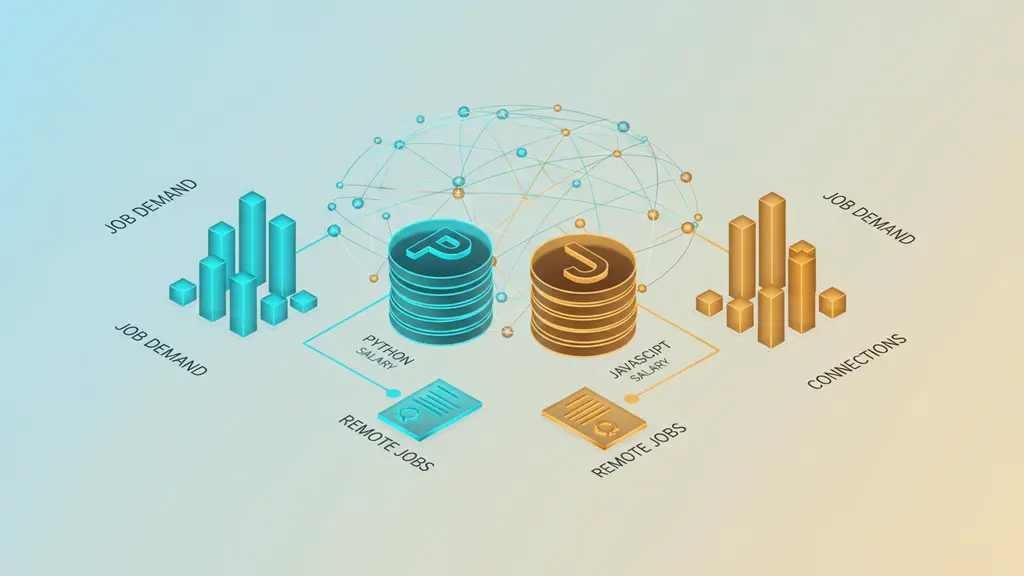
How Do Career Prospects, Salaries, & Job Demand Compare in 2025?
Both Python and JavaScript remain high-demand skills in 2025, with competitive salaries depending on specialization and region.
Average Global Salary Comparison (2025):
| Role | Average Salary (USD) ¹ |
|---|---|
| Python Developer | $95,000 – $126,000 |
| JavaScript Developer | $90,000 – $122,000 |
| Full-Stack JS Developer | $100,000 – $130,000 |
| Data Scientist (Python) | $120,000 – $160,000 |
- Market Demand: According to the 2025 TIOBE and PYPL Indexes, both languages are top 5 globally. JavaScript leads in job listings for web dev; Python leads in data science and AI roles.
- Remote Jobs: Both are prevalent in remote, freelance, and startup roles.
- Enterprise Adoption: Enterprises favor both, but Python dominates automation and analytics, while JavaScript powers most web UIs.
¹ Figures aggregated from Glassdoor, Indeed, Stack Overflow 2025. Salaries will vary by region, seniority, and industry.
What’s the Best Learning Path for Python and JavaScript Beginners?
A structured approach and targeted resources make learning either language much more effective.
Python: 5-Step Beginner Roadmap
- Master basics: data types, operators, control flow.
- Learn functions and object-oriented programming.
- Explore popular libraries (pandas, requests).
- Try beginner projects (todo app, web scraper).
- Build with frameworks (Flask, Django).
Resources:
- Official Python docs
- Real Python tutorials
- Codecademy Python track
JavaScript: 5-Step Beginner Roadmap
- Understand core syntax: variables, functions, loops.
- Grasp DOM manipulation and browser basics.
- Learn ES6+ features (let/const, arrow functions, promises).
- Build mini projects (interactive website, calculator).
- Move to frameworks (React, Node.js).
Resources:
- MDN Web Docs
- freeCodeCamp JavaScript curriculum
- JavaScript.info
Can You Learn Both at Once?
It’s possible but not recommended for absolute beginners. Master foundational concepts in one before layering in the second—this reduces confusion and builds confidence.
What Are the Strengths and Weaknesses of Python and JavaScript?
| Criteria | Python – Strengths | Python – Weaknesses | JavaScript – Strengths | JavaScript – Weaknesses |
|---|---|---|---|---|
| Syntax | Clean, easy to read | Can be slow for large apps | Highly flexible, everywhere | Less readable for some |
| Learning | Beginner-friendly | Slower for web apps | Ideal for web apps | Can be inconsistent |
| Ecosystem | Rich for ML/data/AI | Few frontend frameworks | Massive for web/frontend | Weak in ML/data/AI |
| Performance | Great for scripts/ML | Single-threaded limitations | High for real-time apps | Callback/event-driven complexity |
| Job Market | Hot in data/automation | Fewer web jobs than JS | Ubiquitous for web | Can be saturated in some areas |
Frequently Asked Questions About Python vs JavaScript
What is the main difference between Python and JavaScript?
Python excels in readability and is often used for data science, backend, scripting, and automation. JavaScript powers the web’s frontend and is now widely used for server-side development with Node.js.
Should I learn Python or JavaScript first as a beginner?
If you want to start in data, AI, or automation, Python is easier to learn first. For web development and frontend work, begin with JavaScript.
Which is better for web development: Python or JavaScript?
JavaScript is essential for frontend and often required for full-stack web development. Python is a strong choice for backend web frameworks but not used on the browser side.
Which language has more job opportunities in 2025?
Both are in high demand. JavaScript leads in web developer roles, while Python dominates data and automation positions, with high-paying jobs in both fields.
Is Python or JavaScript better for machine learning?
Python is the clear leader, with the most robust machine learning libraries and community support. JavaScript has some ML libraries but is less mature in this area.
Can you use Python instead of JavaScript for frontend or backend?
Python can handle the backend but isn’t used in browsers (frontend). JavaScript now handles both frontend and backend (with Node.js).
What are the salary differences between Python and JavaScript developers?
Average salaries for both are comparable, but Python-based roles in AI/data science may command higher pay. Regional and industry differences apply.
How does the learning curve of Python compare to JavaScript?
Python is generally seen as easier for beginners due to its simple syntax. JavaScript’s flexibility requires learning more concepts, especially for browser programming.
Which language is more popular in 2025?
Both languages are in the top five globally, but JavaScript edges ahead in sheer usage due to its role in web development.
What frameworks are available for Python and JavaScript?
Python features Django, Flask, and FastAPI for web development; TensorFlow and pandas for data. JavaScript offers React, Angular, and Vue for UI, and Node.js/Express for backend.
Conclusion
Python and JavaScript are both exceptional languages to learn in 2025, each with its own strengths and prime use cases. If your vision includes building web frontends, interactive UIs, or real-time applications, start with JavaScript. For those passionate about data, automation, or rapid prototyping, Python offers a beginner-friendly entrance with broad industry demand.
Key Takeaways
- Python vs JavaScript: Both languages dominate their domains—Python for data and automation, JavaScript for web development.
- Salary and Demand: 2025 job markets are strong for both, with competitive salaries and remote opportunities.
- Learning Path: Python offers easier entry; JavaScript is essential for web work.
- Ecosystem Fit: Choose Python for machine learning or scripting; JavaScript for interactive apps and frontends.
- Expert Advice: Both are valuable—select based on your career vision and project goals.
This page was last edited on 16 February 2026, at 9:58 am
Contact Us Now

Contact Us Now
Start a conversation with our team to solve complex challenges and move forward with confidence.


