Overview
One platform. Three pathways. A single, unified learning experience.
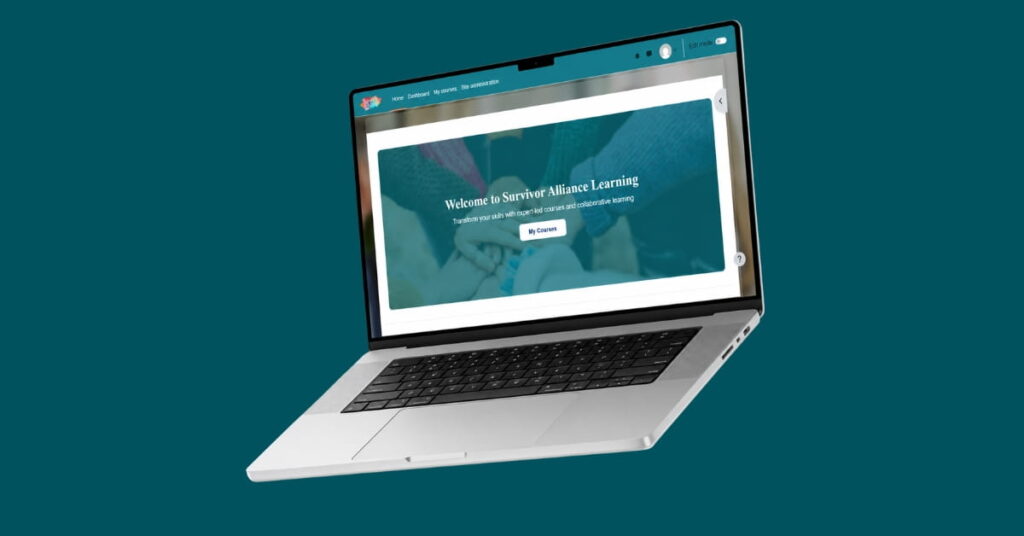
Survivor Alliance needed more than a learning management system — they needed a digital home for a complex, multi-pathway leadership curriculum that could serve self-directed learners, U.S.-based cohorts, and global cohorts simultaneously. The goal was to build a structured, branded Moodle Cloud environment from the ground up, then transfer full ownership to their internal team.
Riseup Labs architected, configured, and delivered the complete platform — covering setup, branding, course templates, access rules, completion logic, badges, multilingual readiness, and comprehensive admin training — so the client could grow the program independently without ongoing vendor dependency.
The Challenge
A curriculum too complex for a disorganized digital environment
Survivor Alliance’s leadership training program was built with depth — multiple levels, live and self-paced delivery, U.S. and global audiences, trauma-informed learning norms, and a structured orientation requirement. The challenge was giving this curriculum a digital home that was equally structured, yet simple enough for the internal team to manage without constant external support.
Complex, multi-pathway curriculum
The program combined 10 self-directed micro-courses across three skill levels, 6 U.S. live cohort modules, and 6 global cohort modules — all requiring separate logic, access controls, and progress tracking. Without a clear LMS architecture, learners had no way to navigate the right experience.
Orientation-gated access with flexible self-pacing
Learners needed to complete a formal orientation — including community agreements, a quiz, and acknowledgment — before unlocking self-directed modules. At the same time, the self-directed pathway needed to support non-linear learning, not a rigid sequence.
Reusability and internal ownership
The client’s internal team needed to upload and manage future content without relying on the vendor for every update. This demanded reusable, documented course templates — not just a one-off LMS configuration.
Separate cohort management for U.S. and global learners
The platform needed to keep U.S. and global cohort learners in distinct tracks, with separate access controls, monthly live modules, attendance tracking, and progress reports — all managed within a single Moodle environment.
Accessibility and multilingual readiness
The program serves a diverse global audience, requiring accessible design practices — captions, transcripts, alt-text guidance, readable contrast — and multilingual settings readiness from the start, not retrofitted later.
Learning Architecture
Three pathways. One platform. Zero confusion.
We structured the Moodle environment around three clearly defined learning pathways, each with its own navigation category, course shells, access logic, and activity format. This gave learners an immediate, intuitive sense of where they belonged and what came next.
Self-Directed Pathway
- Orientation unlock flow
- Level 100 Essentials
- Level 200 Deepening
- Level 300 Advanced
- Non-linear progression
- Badges per course
U.S. Live Cohort
- 6 monthly modules
- Pre & post-work
- Zoom session setup
- Attendance tracking
- Cohort-restricted access
- Resources & recordings
Global Live Cohort
- 6 monthly modules
- Pre & post-work
- Multilingual readiness
- Separate cohort controls
- Completion tracking
- Progress by cohort
The Solution
Built for the long run — not just the launch
We approached this as a full-stack LMS delivery: from initial Moodle Cloud configuration through reusable template design, sample course builds, accessibility review, admin training, and a structured handover. Every decision was made with the client’s long-term independence in mind.
Moodle Cloud setup & branding
Configured a clean Moodle Cloud environment with client-aligned branding — logo, colors, typography, and accessible contrast. Site defaults, navigation structure, and Xerte integration support were established before any course content was added.
Role & cohort configuration
Set up five user roles (Admin, Manager, Instructor, Non-editing Teacher, Learner) with appropriate permissions, plus distinct U.S. and Global cohorts — enabling separate access control and reporting for each learner group without duplicating infrastructure.
Orientation unlock flow
Built a mandatory orientation micro-course covering community agreements, trauma-informed norms, privacy basics, navigation guidance, a quiz, and an acknowledgment. Upon completion, Moodle’s Restrict Access rules automatically unlocked the self-directed pathway — no manual intervention required.
Self-directed micro-course framework
Designed a consistent five-activity structure across all 10 micro-courses: Learn, Practice, Check, Discuss, and Complete. Each course included a lesson, applied assignment, short quiz, discussion forum, and a badge awarded on completion — giving learners clear milestones at every step.
Live cohort course structure
Created 12 live cohort course shells (6 U.S. + 6 global), each structured with pre-work, a live Zoom session activity, attendance tracking, post-work, resource materials, and recording slots — delivering structured live learning entirely inside Moodle.
Reusable course templates
Developed four documented Moodle course templates (Level 100, 200, 300, and Live Cohort Monthly) with placeholder activities, predefined completion rules, and standard activity blocks — so the internal team can build new courses without starting from scratch or consulting the vendor.
Completion tracking, badges & reporting
Enabled Moodle’s native completion tracking across all activities and courses. Badge rules were configured for micro-course completions, with optional certificate rules for selected paths. Admins gained access to enrollment, progress, completion, and cohort-level engagement reports.
Sample proof-of-concept builds
Delivered two fully configured sample courses — one self-directed micro-course and one live cohort monthly course — demonstrating the complete activity flow, completion logic, and visual structure to serve as a reference for all future content uploads.
Course Design
Consistent structure across every micro-course
Each of the 10 self-directed micro-courses follows the same five-step learning flow — giving learners a predictable experience regardless of which course they access, and making it easy for the content team to build new courses using the templates.
Technology Stack
Purpose-built with Moodle's native capabilities
The entire solution was built on Moodle Cloud’s native LMS capabilities — no custom plugins or third-party workarounds. This kept the platform maintainable, stable, and fully supported by Moodle’s update cycle.
Handover & Training
Built to be handed over completely
A well-configured LMS is only valuable if the team running it can actually use it. We designed the entire engagement with handover as the end goal — delivering training, documentation, and 30 days of post-launch support so the client’s internal team could take full ownership from day one.
Admin training covering user management, enrollment, reporting, and cohort controls
Instructor & content operations training for uploading and managing course content
Content upload playbook with step-by-step guidance for using each course template
Annotated screenshots and short instructional clips for common admin workflows
Admin checklist for platform maintenance and course launch readiness
Accessibility QA report with captions workflow, alt-text, and contrast review
Testing with sample learner and instructor accounts before final sign-off
30-day post-launch support for questions, fixes, and configuration adjustments
Impact
A scalable learning environment — ready for what comes next
The Moodle Cloud platform transformed a complex, multi-audience leadership curriculum into a structured, accessible, and fully manageable digital learning environment. Learners get a cleaner experience. Instructors get reusable tools. Administrators get real visibility. And the client gets a platform they own completely.
Conclusion
This project is a clear example of how to transform a multifaceted leadership curriculum into a structured, interactive, and highly scalable Moodle e-learning experience. By combining a pathway-based architecture with robust access controls, reusable course templates, and a thorough operational handover, we delivered more than just a Learning Management System. We provided a long-term, maintainable learning framework that confidently supports flexible self-directed exploration, strict cohort delivery, and future curriculum expansion—all managed independently by the client team.