- IoT Production Downtime Tracker System
- How Does the System Works?
- Scenario 1
- Scenario 2
- Technology Behind the Project
- 1. IoT Hardware
- 2. Andon Signal Towers:
- 3. Cloud Server
- Role-Based Access Control
- Web Application Dashboard
- Mobile Application Dashboard
- Business Benefits
- Built for Real Factory Conditions
- Final Thoughts
- FAQs
In a garment factory, every minute of production matters. A machine breaks down, a quality defect goes unnoticed, or a supervisor gets pulled into another task. One small interruption can slow down an entire production line.
But the bigger problem isn’t always the downtime itself. It’s the downtime nobody accurately tracks or reports.
When factories rely on paper logs and verbal updates, production delays can go unrecorded, reports arrive late, and managers struggle to understand where valuable production time is being lost.
That’s the challenge we set out to solve.
At Riseup Labs, we built an IoT-based production downtime tracking system that uses RFID devices, Andon signal lights, and real-time monitoring to record line stoppages, alert the right people, and turn lost production minutes into actionable data.
In this article, we’ll explain how the system works on a garment factory floor, the technology we used to build it, and the engineering decisions behind its design.
What Is the Production Downtime Tracker System?
Production Downtime Tracker is an IoT-based monitoring system designed to track production line stoppages, measure lost production time, and manage quality defects in garment factories. It combines custom IoT hardware, RFID technology, Andon signal lights, a cloud-based backend, and web and mobile applications. This is a practical example of the Internet of Things (IoT) in manufacturing, where connected devices collect production data and communicate with a central system.
The system is built around two main goals:
- Accurate Downtime Tracking: Record production line stoppages and calculate lost production time in real time.
- Quality Defect Management: Identify and escalate quality issues through an RFID-based Red Tag system, helping prevent minor defects from becoming costly production problems.
To achieve these goals, we designed two workflows: one to track production stoppages and another to manage quality defects.
How Does the IoT Production Downtime Tracking System Work?
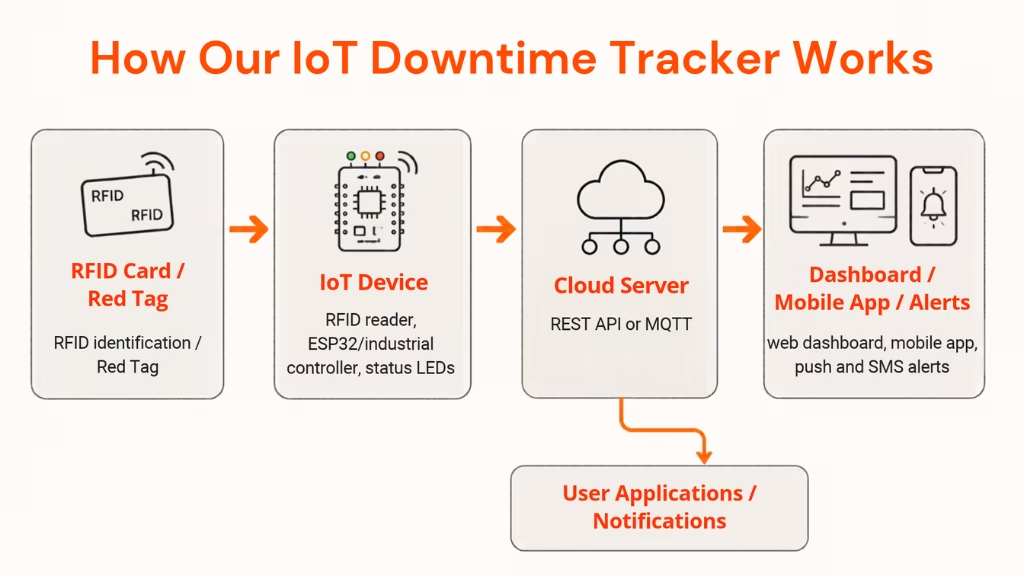
Our IoT-based Production Downtime Tracker uses RFID technology, Andon signal lights, and automated notifications to monitor production line stoppages and manage quality issues in real time.
The system operates through two main scenarios: production downtime tracking and quality defect escalation.
Scenario 1: Production Line Downtime Tracking Using an RFID Card
When a problem occurs on a production line, the supervisor inserts their RFID card into the IoT device installed on that line. This action automatically triggers a series of events:
- Andon Light Activation: The Andon signal light turns on, making the line stoppage visible to everyone on the factory floor.
- Real-Time Data Recording: The device securely sends the production line ID, supervisor ID, and stoppage start timestamp to the server.
- Instant Notification: The Floor Supervisor receives a push notification about the stoppage.
What happens when the issue is resolved?
Once the issue is fixed, the supervisor removes the RFID card. The Andon light switches off, the system records the end timestamp, and the total lost production time is calculated automatically.
Each downtime event is stored with its corresponding production line, department, supervisor, date, and time, making it easier to analyze production interruptions.
What if the production line remains stopped?
If the supervisor does not remove the RFID card within a predefined period, the system automatically escalates the issue.
In our standard configuration, a stoppage lasting 10 minutes triggers an SMS and push notification to the Production Manager, helping ensure prolonged interruptions receive management attention.
Tracking downtime is only one part of the system. We also needed a way to respond when repeated quality defects put production at risk.
Scenario 2: Quality Defect Management Through RFID Red Tags
Not every production problem starts with a machine breakdown. Sometimes, repeated quality defects can disrupt production and lead to costly rework or rejected batches.
To address this, we implemented an RFID-based Red Tag escalation system that helps factory teams track defects and take action based on predefined thresholds.
Each production line is assigned five RFID Red Tags. Whenever a tag is scanned, the system records the event against the corresponding production line and department.
As more Red Tags are scanned, the system triggers different responses based on predefined escalation levels:
| Red Tag Count | Automated System Response |
| 1st and 2nd Tags | Defects are recorded without triggering an escalation. |
| 3rd Tag | The Andon light turns on, a notification is generated, and an SMS alert is sent to executive staff. |
| 4th Tag | An SMS alert is sent to the Supervisor. |
| 5th Tag | Production is stopped through a relay that cuts power to designated machines. And critical SMS alerts are sent to the Production Manager, Quality Assurance Manager, and Factory Manager. |
Why does this escalation process matter?
Instead of treating every defect as an isolated incident, the Red Tag system creates a structured response process. Minor quality issues are recorded, repeated defects trigger management alerts, and critical thresholds initiate a production stop.
This allows factory teams to address quality problems before they escalate into larger production losses.
IoT Solutions for Garment Factories
Make Every Production Minute Count
Track production downtime, manage quality alerts, and gain real-time visibility with a custom IoT system built for your factory.
Discover IoT SolutionsInside the Technology Behind Our IoT Downtime Tracker
We built the system using three main components: IoT hardware, Andon signal lights, and a cloud server. Each component has a specific role. Together, they track production downtime, manage alerts, and provide real-time updates.
1. IoT Hardware: Capturing Production Events
We installed a custom IoT device on each production line to capture RFID interactions and communicate with the central server.
The device includes:
- RFID Reader: Identifies supervisors and records Red Tag interactions.
- ESP32 or Industrial IoT Controller: Processes RFID inputs and controls connected devices.
- WiFi or Ethernet Connectivity: Establishes communication between the IoT device and the server.
- Relay Outputs: Control Andon signal lights and send machine-stop signals when predefined conditions are met.
- Status LEDs: Indicate power, network connectivity, and device activity.
If the network connection drops, the device automatically retries communication with the server to help maintain reliable event tracking.
2. Andon Signal Towers: Making Production Status Visible
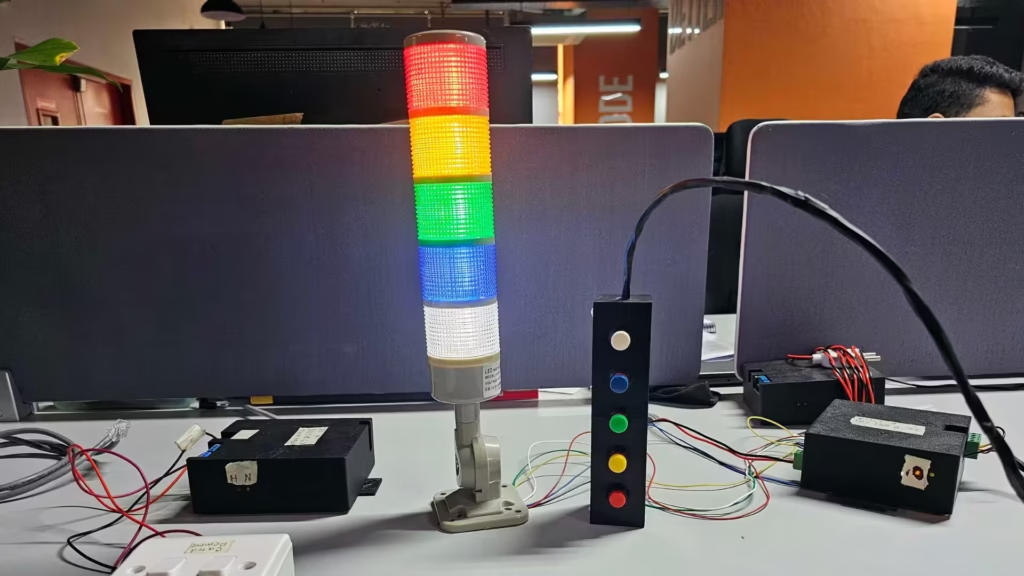
On a busy garment factory floor, production issues need to be visible without requiring supervisors to check a dashboard constantly.
That’s where the three-color industrial Andon signal towers come in.
These towers can be installed at the beginning, middle, and end of each production line, making the line’s operational status visible from different areas of the factory floor.
When a supervisor reports a stoppage using their RFID card, the system activates the Andon light. Once the issue is resolved and the card is removed, the light switches off.
The Andon towers also support the Red Tag escalation process, providing a visual warning when the predefined defect threshold is reached.
3. Cloud Server: Processing Events and Powering Real-Time Monitoring
The cloud server acts as the central processing layer of the IoT Production Downtime Tracking System. It receives data from connected devices through HTTPS REST APIs or MQTT, stores event logs, executes escalation rules, and powers the web and mobile applications.
For this implementation, we combined device connectivity, backend development, and real-time data processing. These are also core parts of our IoT development services. We used the following technologies:
| Technology | Role in the System |
| Django | Handles backend operations, business logic, and API functionality. |
| PostgreSQL | Stores production downtime records, RFID events, and other system logs. |
| Redis | Supports real-time event tracking and active production status management. |
| WebSockets | Delivers live production status updates to dashboards. |
| Firebase Cloud Messaging (FCM) | Sends push notifications about stoppages and escalation events. |
| Third-Party SMS Gateway | Delivers SMS alerts to supervisors and management based on escalation rules. |
Together, these technologies connect physical production events with digital monitoring and automated responses. This is where IoT software development plays a critical role, connecting devices, backend systems, and user applications. This is where IoT software development plays a critical role, connecting devices, backend systems, and user applications.
When an RFID event reaches the server, the backend processes the information, updates the relevant records, and triggers notifications or escalation actions according to the configured rules.
WebSockets keep the dashboards updated without waiting for manual reports. We designed these dashboards around the information each factory role needs to monitor production and respond to issues.
Role-Based Access and Dashboard Views
Factory managers, supervisors, and administrators need different levels of information. That’s why our team implemented role-based access across the platform.
- Admins manage departments, production lines, devices, and users.
- Managers access reports and analytics.
- Supervisors view data specific to their own production lines.
These role-specific interfaces are an important part of IoT app development, where device data must be presented in a way that users can understand and act on.
Web Application Dashboard
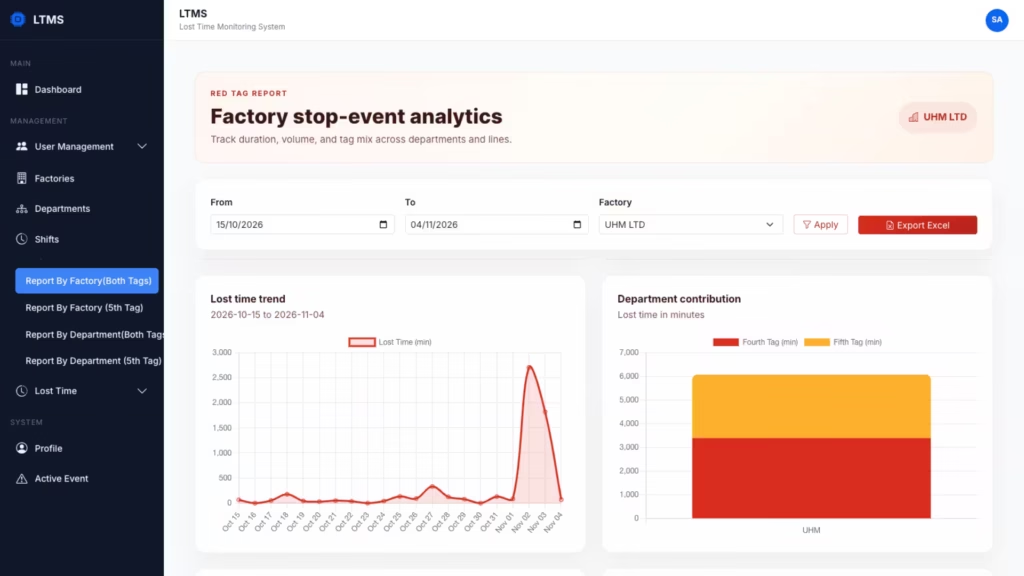
The web application provides a real-time production line status dashboard. It includes department-wise lost time reports, line-wise history, and Red Tag tracking.
Users can filter reports by date, including daily, weekly, monthly, and yearly views. Any report can be exported to Excel in one click.
Mobile Application Dashboard
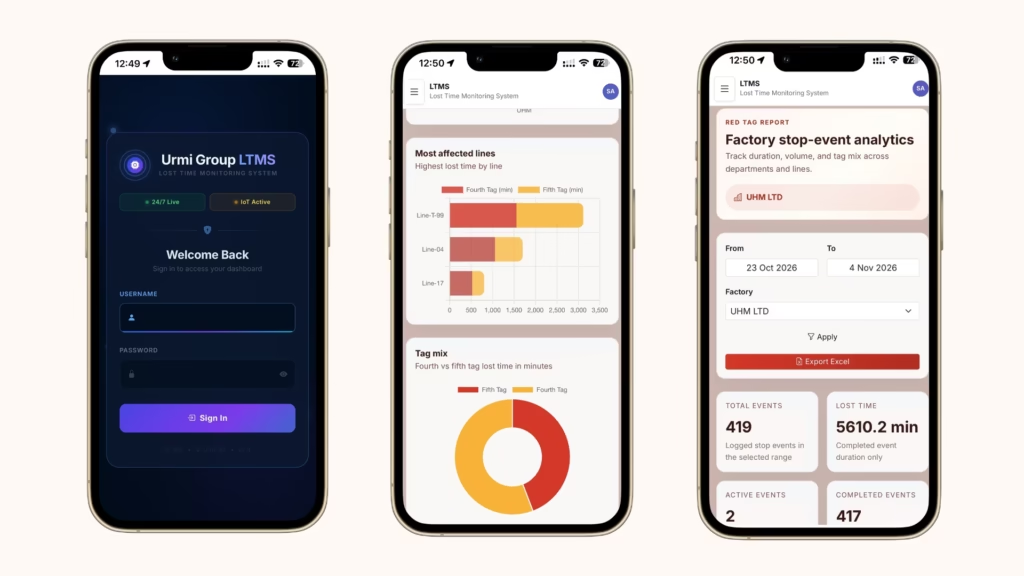
The mobile app keeps managers and floor supervisors informed wherever they are. This is a practical use of IoT mobile app development, bringing production data and alerts directly to users’ phones. It provides live production line status (running or stopped), lost time summaries, and department performance views.
Users also receive push notifications for line stoppages, 3rd Red Tag warnings, and 5th Red Tag machine stops.
Business Benefits of the IoT Production Downtime Tracker
By bringing downtime records, quality alerts, and production reports into one system, we made it easier for factory teams to monitor operations and respond to problems. The main operational benefits include:
- Real-Time Visibility: See which production lines are running and which are stopped, directly from a computer or mobile phone.
- Accurate Downtime Data: Replace estimates and paper logs with precise, timestamped records for each production line, department, and supervisor.
- Faster Response: A built-in escalation process automatically notifies the right manager when a stoppage remains unresolved.
- Stronger Quality Control: The Red Tag system turns defect counts into clear, step-by-step actions, including an automatic production stop when the critical threshold is reached.
- Better Decision-Making: Daily, weekly, monthly, and custom reports reveal which lines stop most often, which departments lose the most time, and how frequently critical stoppages occur.
- Accountability Without Paperwork: Every recorded action is linked to a supervisor ID and logged automatically, reducing the need for manual reporting.
These capabilities also play an important role in modern manufacturing software solutions, where production visibility and timely responses help teams manage daily operations.
Built for Real Factory Conditions
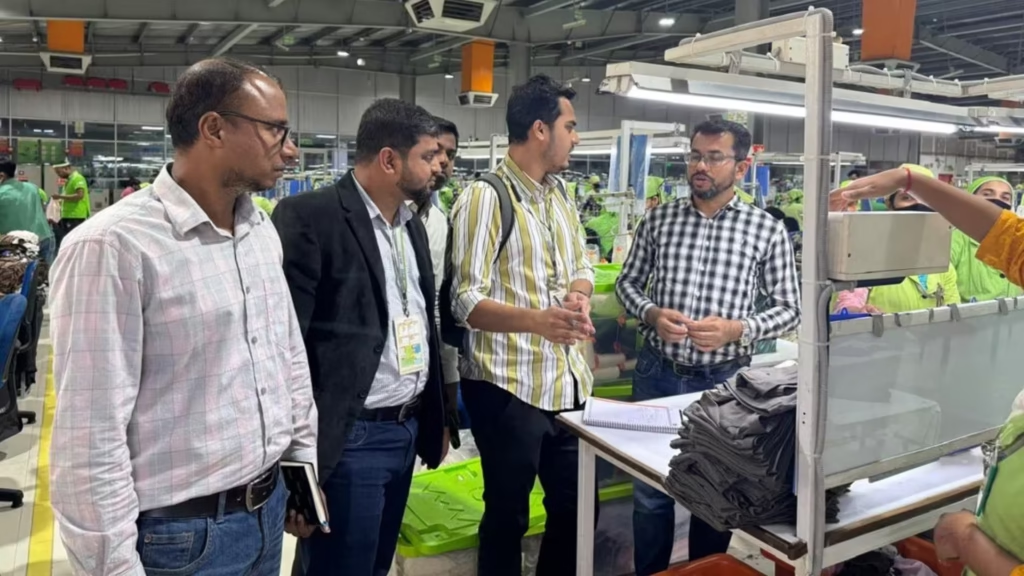
These benefits depend on how reliably the system works during daily production. Factory floors are demanding environments. That’s why we designed the system around simple, physical interactions, such as inserting and removing an RFID card, instead of complicated interfaces.
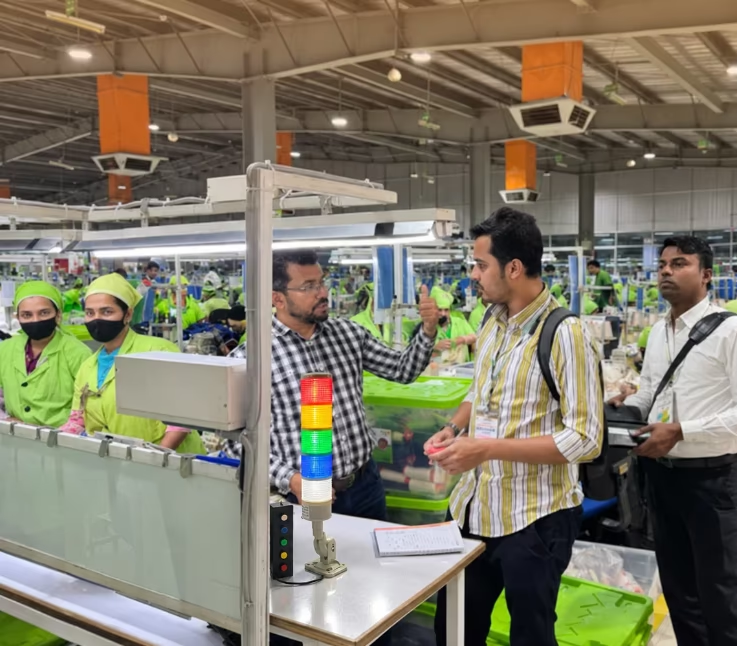
Our garment factory visit at Adamjee EPZ also highlighted the importance of reviewing IoT and automation systems in real production environments.
The device also retries communication automatically if the network connection fails. The system architecture supports both cloud and on-premises deployment.
Supervisors don’t need to learn new software to record a production stoppage. This makes the system easier to adopt and use in daily factory operations.
For us, the priority was to make downtime recording part of the existing factory workflow, rather than introduce another complicated reporting process.
Systems like this require expertise across hardware, networking, backend development, and applications. Our guide to building an IoT development team explains the technical roles involved.
IoT Solutions for Garment Factories
Still Losing Track of Production Downtime?
Track line stoppages, manage quality alerts, and gain real-time visibility with a custom IoT system built for your factory.
Explore IoT SolutionsFinal Thoughts
Building this system reinforced an important lesson: reliable production monitoring starts with accurate data collection on the factory floor. Without that foundation, even the most advanced dashboards have limited value.
With our IoT-based Production Downtime Tracking System, we aimed to make downtime tracking simpler and more reliable. By combining RFID technology, Andon signal lights, automated escalation, and real-time dashboards, we built a system that connects factory-floor activities with actionable production data.
More importantly, this project showed us how practical IoT technology can solve everyday manufacturing challenges. The goal wasn’t just to build another monitoring tool. It was to give factory teams reliable production data, clear escalation workflows, and the information they need to respond to problems as they happen.
FAQs
1. What is an IoT-Based Production Downtime Tracking System?
An IoT-based production downtime tracking system helps factories record production line stoppages, calculate lost production time, and monitor interruptions in real time. Our system uses RFID devices, Andon signal lights, and web and mobile dashboards to track downtime and automate alerts.
2. How Does RFID Help Track Production Downtime?
When a production line stops, the supervisor inserts an RFID card into the IoT device. The system records the stoppage time and activates an Andon light. Once the issue is resolved, the supervisor removes the card. The system then calculates the total lost production time automatically.
3. What is the Role of Andon Lights in the System?
Andon lights provide visual signals about production line status. When a stoppage is reported, the light turns on to alert factory staff. The lights also indicate quality issues when the Red Tag escalation threshold is reached.
4. How Does the Red Tag Escalation System Work?
Each production line has five RFID Red Tags. The first two tags record defects without escalation. The third and fourth tags trigger notifications and alerts. The fifth tag initiates a production stop through a relay and sends critical SMS alerts to management.
5. Can Managers Monitor Production Downtime Remotely?
Yes. The system provides web and mobile dashboards that display live production line status, downtime records, Red Tag events, and department performance. Managers can access reports and receive notifications without being physically present on the factory floor.
This page was last edited on 5 November 2026, at 3:49 pm

Start a conversation with our team to solve complex challenges and move forward with confidence.