
Enterprises face an unprecedented explosion of information, yet many struggle to find and use knowledge effectively. In the debate around Generative AI vs Traditional Knowledge Management Systems, it’s clear that traditional KM tools are falling behind as business complexity grows and digital expectations rise.
This guide delivers a comprehensive, enterprise-ready framework for evaluating and transitioning from legacy KM systems to generative AI-powered solutions. Inside, you’ll find feature comparisons, actionable migration steps, cost and compliance insights, and expert perspectives—empowering leaders to make confident, future-proof decisions about their organization’s knowledge strategy.
What Are Traditional Knowledge Management Systems (KMS)?
Traditional knowledge management systems (KMS) are enterprise platforms designed to store, organize, and facilitate secure access to organizational knowledge and documents.
They typically combine document repositories, structured taxonomies, enterprise search, and collaboration tools. Legacy systems like SharePoint, Confluence, and Documentum focus on indexing and storing information in a controlled, rule-based manner, supporting regulatory compliance and organizational memory.
Key features of traditional KMS:
- Centralized document databases and repositories
- Taxonomy and metadata tagging for organization
- Enterprise search functionality (keyword/rule-based)
- Collaborative workspaces (e.g., wikis, forums)
- Audit, access, and compliance controls
Common vendors include: Microsoft SharePoint, Atlassian Confluence, OpenText Documentum.
What Are the Main Limitations of Traditional KMS?
While foundational for years, legacy KM systems now struggle to meet modern enterprise needs.
The main pain points of traditional KMS include:
- Manual content entry and retrieval slow down workflows
- Information is often siloed across departments or platforms
- Search is limited to keywords rather than context or meaning
- Heavy maintenance and administration burdens IT teams
- Personalization and adaptive recommendations are lacking
These issues often lead to wasted time, duplicated effort, and missed business opportunities.
What Is Generative AI in Knowledge Management?
Generative AI in knowledge management refers to the use of advanced artificial intelligence—particularly large language models (LLMs) like GPT-4—to automate, synthesize, and deliver enterprise knowledge in contextually relevant ways.
Unlike rule-based systems, generative AI can interpret language, generate new content, and understand relationships across vast collections of unstructured data. Platforms such as GPT-4, BERT, and T5 power these capabilities, enabling AI-driven knowledge workflows that go beyond storage and retrieval to deliver context-aware answers, summaries, and recommendations.
AI-driven KM workflows typically include:
- Automated content generation or summaries
- Natural language Q&A over enterprise data
- Cognitive (semantic) search that understands user intent
- Personalized and multimodal (text, image, audio) knowledge delivery
How Does Generative AI Enhance Enterprise Knowledge Management?
Generative AI transforms knowledge management by introducing new levels of automation, personalization, and intelligence.
Key benefits include:
- Automated content synthesis and summarization, saving time and reducing manual effort
- Context-aware question answering on internal documents and data
- Semantic and cognitive enterprise search that surfaces relevant information—even across silos
- Personalized knowledge delivery tailored to individual, role, or team
- Support for multiple modalities—text, images, audio/video—for richer knowledge experiences
These capabilities increase efficiency, foster collaboration, and help organizations unlock the full value of their information assets.
Generative AI vs Traditional Knowledge Management Systems: A Detailed Comparison
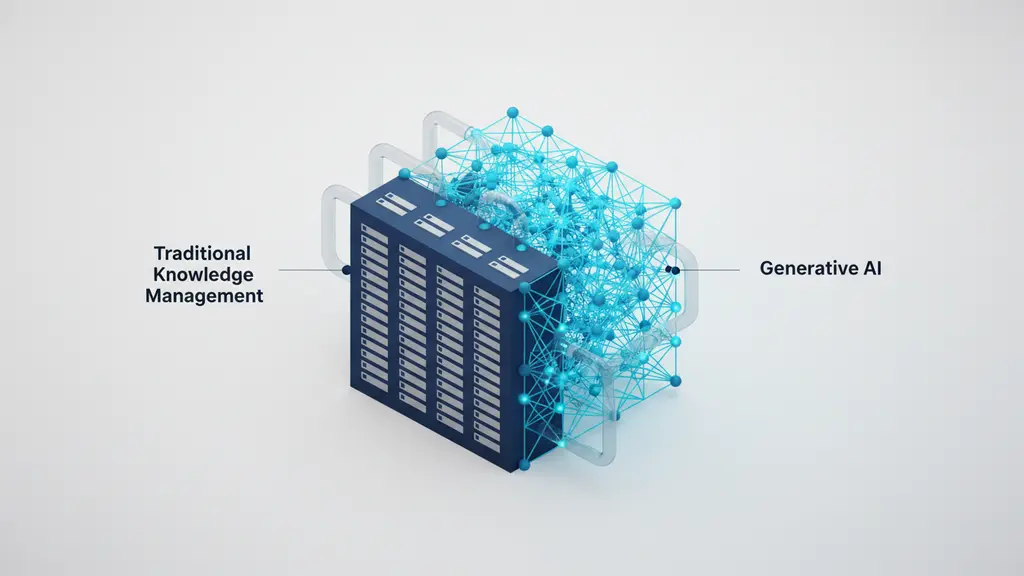
Generative AI-powered KM systems and traditional systems take fundamentally different approaches to storing, surfacing, and leveraging enterprise knowledge. The table below provides a concise feature-by-feature comparison:
| Capability | Traditional KMS | Generative AI-Powered KMS |
| Data Modeling | Rule-based, document-centric | Context-aware, semantic, adaptive |
| Search | Keyword, taxonomy, manual filters | Semantic, natural language, cognitive |
| Automation | Limited, manual workflows | Automated synthesis, recommendations |
| Collaboration | Document sharing, comments | AI-driven insights, dynamic collaboration |
| Personalization | Minimal, group-based | Individualized, adaptive |
| Scalability | Manual scaling, complex setup | Dynamic scaling with AI-driven learning |
| Compliance/Security | Robust, well-understood | Evolving, needs new privacy/governance |
| Cost Structure | License + IT maintenance | License, compute, training, integration |
Key differences: Traditional KMS rely on static organization and manual processes, while generative AI enables dynamic, context-rich knowledge delivery at scale.
Visual Timeline: The Evolution of Knowledge Management Systems
Tracing the evolution of KM illustrates how enterprise needs and technology have changed:
- 1990s–2000s: Rule-based, document-centric KM (e.g., file servers, document repositories)
- 2010s: Enterprise search, collaboration platforms (e.g., SharePoint, Confluence)
- 2020s: AI-driven, LLM-based, multimodal KM (e.g., GPT-4-powered assistants, Microsoft Viva)
Organizations now move toward dynamic, intelligent systems that adapt to changing content, user needs, and regulations.
What Are the Key Benefits of Generative AI for Knowledge Management?
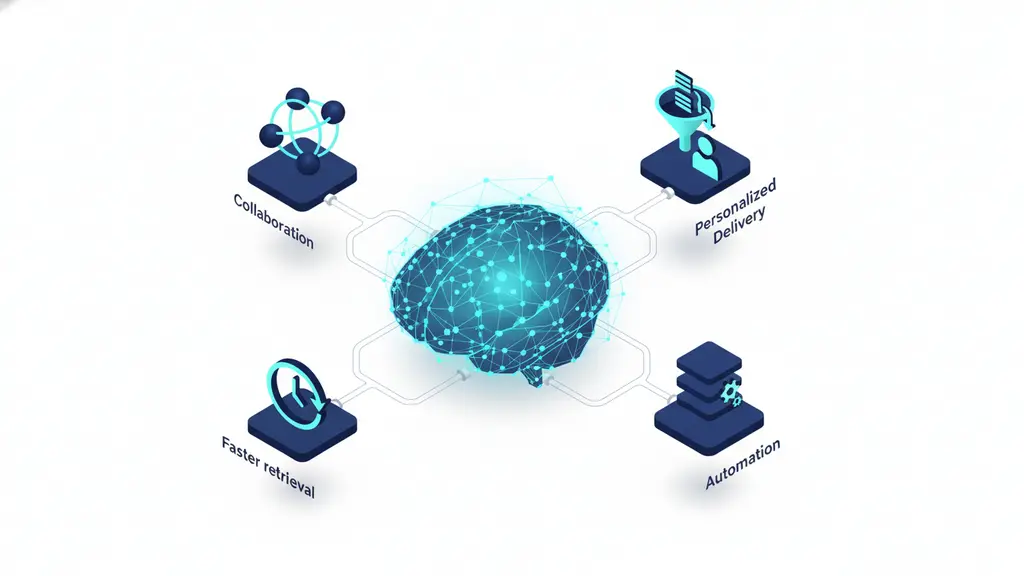
Generative AI delivers substantial business value by making knowledge more discoverable, actionable, and personalized.
Top benefits of generative AI in KM:
- Drastically faster knowledge retrieval through natural language interfaces
- Contextual recommendations tailored to users’ roles and needs
- Improved collaboration with real-time content synthesis and insights
- Reduced manual effort in organizing, updating, and maintaining repositories
- Systems that learn and adapt from user interactions, improving over time
- Delivering measurable ROI through operational efficiencies and cost savings
Organizations deploying AI-driven KM often report significant reductions in search times and increases in productivity.
Real-World Use Cases: Generative AI in Action
Across industries, generative AI is already transforming knowledge management.
Leading enterprise use cases include:
- Customer Service: AI-powered self-service portals and virtual support agents answer questions instantly, reducing ticket volume. For example, IBM Watson’s deployment in major banks shows up to 60% faster case resolution times.
- Healthcare: Clinical staff can query patient records, clinical trials, or compliance guidelines using natural language. AI summarizes case notes and regulatory changes, boosting accuracy and compliance.
- Finance: Automated risk analysis and compliance workflows cut down on manual research. Case in point: global finance firms using Microsoft Viva or custom LLMs streamline documentation and fulfill audit requirements more efficiently.
- Business Intelligence: Teams use AI to synthesize market research, generate executive summaries, and surface actionable insights from diverse data sources.
These examples demonstrate both measurable ROI and improved knowledge access for large organizations.
How Do You Integrate Generative AI Into Existing KM Systems?

Integrating generative AI with traditional KM requires a structured, phased approach to ensure value and minimize disruption.
A step-by-step framework for transitioning to AI-powered KM:
- Assess readiness: Evaluate your current KMS, data quality, security posture, and user needs.
- Plan integration: Identify high-impact workflows, map relevant data sources, and select pilot use cases.
- Deploy APIs or connectors: Use vendor-supported integration points (APIs, plugins) to connect AI models to your KMS.
- Conduct a pilot: Run a limited rollout with clear success metrics (e.g., reduction in retrieval times).
- Train and support users: Provide change management, onboarding sessions, and training to build trust and ensure adoption.
- Monitor and iterate: Track usage, gather feedback, and refine AI responses and integrations over time.
Migration checklist:
- Data mapping & cleansing completed
- Integration approach documented
- Compliance review passed
- User onboarding scheduled
- Success metrics defined
What Are the Costs and Considerations When Upgrading to AI-Driven KM?
Upgrading to generative AI-enhanced knowledge management involves both direct and indirect costs.
Key cost considerations:
- Licensing and subscription fees for AI services (LLMs, platform access)
- Integration and development costs to connect AI with legacy systems
- Data migration, cleansing, and ongoing data management expenses
- Training, change management, and user adoption programs
- Ongoing compute and maintenance costs for AI workloads
Cost-benefit analysis:
| Cost | Traditional KMS | AI-Driven KM |
| License | Moderate | Moderate–high |
| Integration | Low–moderate | Moderate–high |
| Training | Moderate | High (initial), reduces over time |
| Maintenance | Ongoing IT overhead | Lower manual, higher automation |
| ROI | Gradual | High with successful uptake |
Organizations should forecast payback periods, considering not just upfront costs, but expected efficiency and productivity gains.
Ensuring Security, Compliance, and Data Governance in AI-Powered KMS
Adopting generative AI in KM brings new security and data governance challenges.
Best practices to ensure security and compliance:
- Review AI vendors’ approaches to data privacy, including GDPR and CCPA compliance
- Enforce role-based access controls and audit trails for sensitive data
- Ensure data lineage and model explainability to support internal and regulatory audits
- Perform vendor due diligence, including security certifications and incident response protocols
- Train users on responsible use and reporting of AI outputs
Integrating these safeguards helps maintain trust, meet regulatory requirements, and avoid costly breaches or penalties.
What Are the Main Risks and Challenges of Using Generative AI for Knowledge Management?
While the potential is high, adopting AI-driven KM involves real risks that must be mitigated.
Common risks and mitigation strategies:
- Data quality and AI hallucination: Poor source data or lack of oversight can lead to inaccurate or fabricated responses. Mitigation: Use human-in-the-loop validation and rigorous testing.
- Regulatory hurdles and auditability: AI “black box” outputs pose challenges for audit and compliance. Mitigation: Document model decisions and maintain logs.
- Model bias and fairness: LLMs can inherit biases from training data. Mitigation: Regular bias audits and diverse testing.
- Resistance to change: Users may distrust or underuse new AI features. Mitigation: Robust training, clear communication of benefits, and leadership support.
Proactive management and transparent policies are key to avoiding setbacks.
What Is the Future of Knowledge Management with Generative AI?
The next wave of knowledge management will be powered by autonomous, multimodal, and adaptive AI systems.
Future trends include:
- Emergence of agentic AI that autonomously organizes, curates, and optimizes knowledge bases
- Widespread adoption of conversational enterprise search, integrating voice and chat interfaces
- Multimodal KM that incorporates text, audio, images, and video for holistic knowledge access
- Self-organizing repositories that adapt structure based on usage and feedback
- Adaptive compliance frameworks to manage evolving regulations
According to Gartner and McKinsey, organizations investing in KM modernization are expected to see significant competitive advantages and improved business resilience in the next 3–5 years.
FAQ: Generative AI vs Traditional Knowledge Management Systems
What is the main difference between generative AI and traditional knowledge management systems?
The main difference is that generative AI can understand context, generate new content, and deliver personalized insights, while traditional KMS focus on storing and retrieving static documents using predefined rules.
How does generative AI improve efficiency in knowledge management?
Generative AI automates content synthesis, enables natural language search, and personalizes knowledge delivery—reducing manual tasks and speeding up access to relevant information.
What are the risks or challenges of AI-driven KMS?
Key risks include inaccurate or biased AI outputs, regulatory compliance challenges, and the need for strong data governance and user training.
Can generative AI be integrated into existing knowledge management systems?
Yes, many LLMs and AI services offer APIs and connectors for integration with legacy KMS. A phased approach—including data mapping, pilot programs, and user training—is recommended.
What industries benefit most from generative AI-powered KM?
Industries like healthcare, finance, customer service, and business intelligence see significant gains from AI-driven KM due to large volumes of complex, regulated, and fast-changing information.
What does it cost to upgrade from traditional to AI-driven KMS?
Costs typically include AI licensing, integration and development, data migration, and user training. While upfront investment may be higher, efficiency savings often yield favorable ROI within one to three years.
How secure is generative AI in handling sensitive company knowledge?
Enterprise-grade AI solutions can be secure when paired with best practices such as role-based access control, encryption, and compliance audits—though continuous risk assessment is essential.
Are there any case studies of successful AI-KMS implementation?
Yes. Enterprises deploying IBM Watson, Microsoft Viva, or custom AI platforms report faster knowledge access, reduced manual effort, and improved compliance outcomes.
What future trends are expected in knowledge management with AI?
Autonomous agentic AI, multimodal knowledge interfaces, adaptive compliance, and real-time collaborative tools are expected to become standard features by 2025 and beyond.
How do I choose between traditional and AI-driven KM for my business?
Assess your current system’s limitations, knowledge complexity, compliance needs, and user expectations. Consider piloting AI where faster access, automation, or personalization would drive clear business value.
Conclusion and Next Steps: Choosing the Right KM Approach
As enterprise data continues to grow, the limitations of legacy knowledge management systems become more apparent. In the context of Generative AI vs Traditional Knowledge Management Systems, generative AI offers a powerful shift by enabling faster access to insights, improved personalization, and more intelligent knowledge discovery.
That said, adopting generative AI is not just a technology decision. It requires a thoughtful evaluation of organizational goals, existing systems, data readiness, and governance requirements. Enterprises that move forward successfully typically take a measured approach by testing solutions in controlled environments, aligning stakeholders, and ensuring strong oversight around data security and compliance.
Ultimately, the right knowledge management strategy is one that supports long term scalability, informed decision making, and user adoption. By understanding both traditional and AI driven approaches, organizations can make confident choices that prepare them for the future of enterprise knowledge management.
Key Takeaways
- Generative AI delivers context-aware, automated knowledge management far beyond traditional, rule-based systems.
- Integration is achievable through stepwise planning, pilot projects, and strong governance.
- AI-powered KM offers faster retrieval, personalized delivery, and measurable ROI.
- Key risks include data quality, compliance, and user adoption—but are manageable with best practices.
- Future trends will further multiply business value through autonomous, multimodal, and adaptive enterprise KM systems.
This page was last edited on 8 February 2026, at 1:39 pm
Contact Us Now

Contact Us Now
Start a conversation with our team to solve complex challenges and move forward with confidence.


