Machine learning holds the promise of game-changing business impact—but only if developed and deployed correctly. Too many organizations waste time and money on ML projects that fail to deliver results, often due to strategic missteps or unnecessary complexity.
This article provides a practical playbook packed with expert tips to make machine learning development work for you, whether you’re a technical lead, product owner, or business decision-maker. You’ll learn how to align ML with your business goals, choose the right tools, avoid common pitfalls, and set your team up for sustained success.
What Are the Expert Tips to Make Machine Learning Development Work for You?

To ensure machine learning project success, experts recommend five foundational tips:
- Align ML projects with business goals
- Choose the right models, tools, and frameworks
- Prioritize data preparation and quality
- Choose wisely between building custom ML vs. using APIs
- Assemble specialized teams for production and scale

Below is a summary table detailing each tip, why it matters, and corresponding action steps.
| Expert Tip | Why It Matters | Action Steps |
|---|---|---|
| Align ML with business goals | Ensures ROI and high-impact outcomes | Define KPIs, involve stakeholders, set project scope |
| Choose the right models, tools, frameworks | Optimizes performance, scalability, and resource efficiency | Map business needs to model type, vet frameworks, plan for growth |
| Prioritize data preparation and quality | Solid data enables accurate, robust models | Clean data, validate sources, engineer relevant features |
| Build custom vs use APIs judiciously | Balances speed vs flexibility for production needs | Analyze requirements, assess resources, review examples |
| Assemble specialized production and ops teams (MLOps) | Enables seamless deployment, scaling, and maintenance | Fill key roles, foster cross-functional collaboration, monitor models |
1. Align Machine Learning Projects with Business Goals
Start with a clear business objective for every ML initiative to ensure projects generate measurable ROI.
Effective machine learning development always begins with a business problem or opportunity, not with the technology itself. Define what success looks like—choose KPIs and metrics that tie directly to organizational goals. Early involvement from business stakeholders helps shape realistic timelines and priorities, and ensures buy-in across departments.
Key actions:
- Pinpoint the specific business challenge or KPI the ML project will address.
- Translate business needs into technical requirements with stakeholders.
- Define measurable success criteria before writing code.
Example:
A retailer aiming to reduce inventory costs should target relevant KPIs like stock-out rate or turnover—then work with both business analysts and ML engineers to build models that directly impact those numbers.
2. Choose the Right Models, Tools, and Frameworks for Your Needs
Selecting appropriate models and frameworks ensures your ML solution matches the unique demands of your project and organization.
Machine learning success depends on matching business requirements, data characteristics, and team expertise to the right algorithms and development frameworks. For example, choosing supervised vs. unsupervised learning depends on labeled data availability, while tool selection (Python, TensorFlow, PyTorch, Spark) should consider scalability, interoperability, and talent.
Key considerations:
- Map business case to ML model type: supervised, unsupervised, reinforcement learning, etc.
- Vet frameworks for mature libraries, community support, and scalability (e.g., Python and TensorFlow for deep learning; Spark for distributed data processing).
- Ensure toolchain compatibility with deployment environment and team skills.
Tip Table Example:
| Project Requirement | Recommended Model/Framework |
|---|---|
| Predicting continuous values | Regression, Scikit-learn, XGBoost |
| Image recognition | CNNs, TensorFlow, PyTorch |
| Large-scale data | Spark MLlib, Apache Beam |
| Text classification | NLP, Hugging Face Transformers |
Action steps:
- Assess current and future data volumes, types, and infrastructure.
- Test drive frameworks with proof-of-concept before large-scale commitment.
- Plan for maintainability and handoff by aligning tool choice with team skills.

3. Prioritize Data Preparation and Quality from the Start
Ensuring high-quality, well-structured data is the foundation of every successful ML project.
Research and industry experience consistently show that poor data preparation is a leading cause of ML project failure. Clean, validated, and well-engineered data directly drives model accuracy and robustness. Establishing scalable data pipelines early helps mitigate bias, missing values, and drift.
Checklist for data readiness:
- Conduct thorough data cleaning: remove duplicates, handle missing values.
- Validate sources for consistency, accuracy, and freshness.
- Engineer features that capture domain-relevant signals (e.g., aggregate trends, transformed variables).
- Implement a repeatable pipeline for ongoing ingestion and processing.
Example:
A financial institution lays out a data pipeline using data validation tools such as Great Expectations and automates feature engineering to ensure regulatory compliance and data reliability across all model training cycles.
4. Choose Wisely Between Building Custom ML Pipelines vs. Using APIs
Deciding whether to build custom ML solutions or leverage pre-built APIs can significantly affect project speed, flexibility, and long-term value.
Custom ML pipelines offer the ultimate in flexibility and differentiation for unique needs but demand more resources and time. APIs—for vision, speech, text analytics, etc.—accelerate deployment but may limit customization, IP ownership, or long-term integration.
Pros & Cons Table:
| Option | Pros | Cons | Best Use Cases |
|---|---|---|---|
| Off-the-shelf APIs | Fast, easier integration, less engineering required | Less flexibility, potential data lock-in, ongoing costs | Rapid prototyping, common functionalities (e.g., sentiment analysis) |
| Custom ML development | Tailored, high flexibility, potential proprietary IP | Resource intensive, slower to market, complex maintenance | Proprietary algorithms, strategic differentiation |
Decision steps:
- Evaluate whether available APIs meet performance and compliance needs.
- Weigh costs and time-to-market versus the need for innovation and control.
- Leverage APIs for non-core functions; invest in custom builds for core differentiators.
Real-world example:
A healthcare startup uses Google Vision API for basic image tagging but develops proprietary deep learning for diagnostic modeling, ensuring both speed and competitive advantage.
5. Assemble Specialized Teams for Production, Deployment, and Scale
Bringing together cross-functional, domain-specialized teams is critical for ML projects to move beyond prototypes and scale into reliable production systems.
Failure to invest in team structure is a leading cause of stalled deployments and unmaintained models. Key roles like MLOps engineer, data steward, DevOps, and business analyst create a bridge between technical talent and organizational needs, while enabling model monitoring, scaling, and ongoing retraining.
Essential ML team roles:
- Data Scientist: Researches, models, and evaluates solutions.
- ML Engineer: Operationalizes and packages models for production.
- MLOps Engineer: Maintains deployment, monitoring, and automation pipelines.
- Data Steward: Ensures data quality, lineage, and compliance.
- DevOps: Integrates deployment infrastructure and CI/CD workflows.
- Business Analyst/Product Owner: Translates strategy and tracks impact.
Best practices for collaboration:
- Foster a culture of continuous learning—cross-train roles where possible.
- Assign responsibility for post-launch monitoring, maintenance, and retraining.
- Regularly review project success against business KPIs with all stakeholders.
How Can You Avoid Common Pitfalls in Machine Learning Development?

Avoiding common ML development failures requires proactive focus on data quality, business alignment, monitoring, and compliance.
Many machine learning initiatives falter due to predictable but preventable missteps. To maximize project success and ROI, teams should be aware of and address these issues from the outset:
Top pitfalls and solutions:
- Undervaluing Data Preparation:
Failing to clean, validate, and engineer meaningful features undermines all downstream work. - Insufficient Business Buy-in:
Projects built in technical silos can yield solutions that don’t matter—or are never adopted. - Neglecting Model Monitoring and Retraining:
Even world-class models degrade over time (model drift); plan for ongoing validation and retraining schedules. - Security and Compliance Gaps:
Overlooking privacy, fairness, or regulatory issues can expose your business to fines and reputational damage.
“Don’t Do This If…” Laydown:
- Don’t start modeling before confirming data and KPIs.
- Don’t ignore stakeholder input in requirements gathering.
- Don’t deploy without a monitoring and alert system.
- Don’t shortcut privacy or compliance documentation.
Anticipate these areas early—successful teams build fail-safes into both process and technology.
Actionable Checklist to Make Your ML Project Work
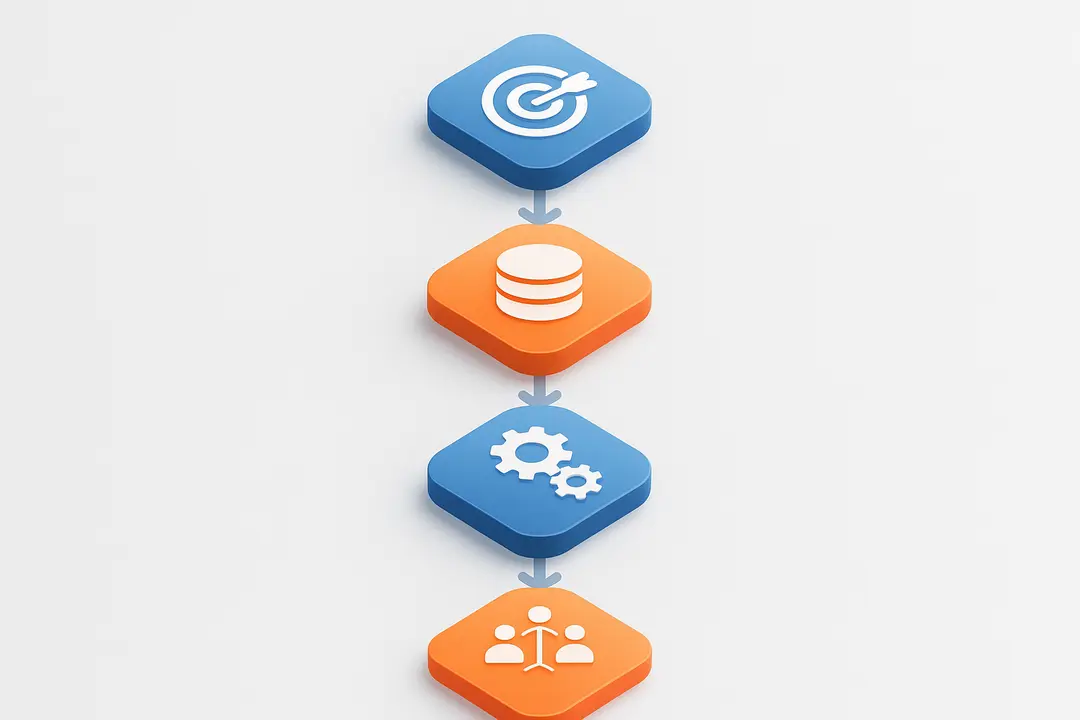
Here’s a step-by-step checklist to increase your chances of machine learning project success. Use it as a project scorecard or share it with your team:
Project Kickoff
- Confirm business problem, KPIs, and success metrics.
- Identify stakeholders across tech and business.
- Define clear project scope and timeline.
Data Preparation
- Inventory and profile all data sources.
- Clean, validate, and document datasets.
- Engineer domain-relevant features.
- Establish a scalable data pipeline.
Modeling & Framework Selection
- Map requirements to model types and select suitable frameworks.
- Evaluate toolchain compatibility and scalability.
- Prototype and benchmark initial models.
Build vs. Buy Decision
- Compare available APIs to custom development needs.
- Analyze cost vs. time-to-market tradeoffs.
- Decide and document rationale for chosen approach.
Team & Ops Readiness
- Assign key roles: Data Scientist, ML Engineer, MLOps, etc.
- Set up DevOps infrastructure and CI/CD.
- Plan for deployment, model monitoring, and retraining.
Deployment and Monitoring
- Deploy models to production or staging environments.
- Implement real-time monitoring and automated alerts.
- Schedule regular retraining and performance review cadences.
FAQs on Expert Tips to Make Machine Learning Development Work for You
What are the most important factors for successful machine learning development?
Clear business alignment, high-quality data, use of the right frameworks, cross-functional teams, and continuous model monitoring are the pillars of successful ML development.
How do I align my ML project with business goals?
Begin by identifying a quantifiable business challenge or KPI. Collaborate with stakeholders to define requirements and measure outcomes, ensuring the ML project supports strategic objectives.
What roles are essential in a machine learning development team?
Core team members often include data scientists, ML engineers, MLOps specialists, data stewards, DevOps, and business analysts. Larger projects may include domain experts and compliance officers.
Should I build a custom ML solution or use an existing API?
If speed to market is critical and requirements are standard, APIs are efficient. For bespoke, proprietary needs or long-term scalability, custom solutions are usually justified despite higher initial effort.
How much of ML success depends on data preprocessing?
Industry practitioners estimate that up to 80% of ML model accuracy stems from rigorous data preparation and feature engineering, underlining its importance.
What are common pitfalls in ML deployment?
Skipping data validation, ignoring business alignment, failing to plan for monitoring/retraining, and neglecting compliance/security are all frequent—and costly—failure points.
How do I maintain and monitor an ML model in production?
Set up automated monitoring for data and prediction drift, automate periodic retraining, and use MLOps tools to catch and respond to operational issues quickly.
What is MLOps, and why does it matter?
MLOps (Machine Learning Operations) is a set of practices and tools for automating, monitoring, and maintaining ML systems in production. It’s vital for scaling reliably and minimizing technical debt.
How can businesses scale machine learning effectively?
Standardize pipelines, use modular frameworks, invest in MLOps talent, and automate monitoring and retraining to ensure high uptime and scalability.
How do I keep my ML model up to date as data changes?
Implement regular retraining cycles, monitor for drift, and maintain data pipelines that continuously feed fresh, validated data to your models.
Conclusion
Strategic, expert-driven machine learning development transforms business outcomes when teams align projects with real goals, invest in data and processes, and foster cross-functional collaboration.
Apply the tips, frameworks, and checklists from this guide to maximize your ML investment, reduce costly failures, and cultivate a culture of innovation and accountability.
Key Takeaways
- Always align ML projects to specific business goals for maximum impact.
- Invest early in data preparation—it’s foundational to model success.
- Choose models and frameworks that balance current needs and future scalability.
- Make informed build vs. buy decisions to optimize time and resources.
- Success depends on cross-functional teams with clear roles and responsibilities.
- Proactive monitoring and retraining protect your models from performance drift.
This page was last edited on 2 April 2026, at 11:32 am
Contact Us Now

Contact Us Now
Start a conversation with our team to solve complex challenges and move forward with confidence.


