Quick Answer:
In-house ecommerce is best when you need full control, custom workflows, and strict data ownership, while outsourcing works better when you want to launch faster, scale easier, reduce compliance risks, and keep your internal team focused on growth.
You’ve built the product. You’ve got the audience. Now comes the big question: do you run your ecommerce store yourself, or do you hand it off to someone else?
This is one of those decisions that looks simple on the surface but can seriously affect your revenue, your team’s bandwidth, and your customer experience.
We’ve seen businesses thrive with both models, and we’ve also seen businesses get it badly wrong. That is why the Ecommerce Store In-House vs Outsourced decision deserves an honest look before you commit.
What Does “In-House Ecommerce” Actually Mean?
When we say in-house ecommerce management, we mean your own team handles everything from building and maintaining your online store to managing payment gateway integration, handling customer data security, running order fulfillment management, and dealing with tax compliance.
You own the tech. You own the operations. You own the headaches, too.
Some businesses love this. They want full control over ecommerce operations, they have the developers, and they don’t want a third party touching their data or their brand. That’s completely valid.
But it’s not for everyone.
What Is Outsourced Ecommerce?
Outsourced ecommerce operations means you bring in an external partner, whether that’s an agency, a platform, or a third-party ecommerce provider, to handle some or all of your online selling process.
This could mean:
- Using a full-service ecommerce platform that handles checkout, payments, and compliance
- Hiring an agency to build and manage your store
- Partnering with a merchant of record who takes on tax and legal responsibilities
The level of outsourcing varies. Some businesses outsource everything. Others outsource just the parts they’re weakest at, like international tax compliance or fraud prevention.
The Real Pros of Running an In-House Ecommerce Store
Let’s start with why businesses choose to keep things internal.
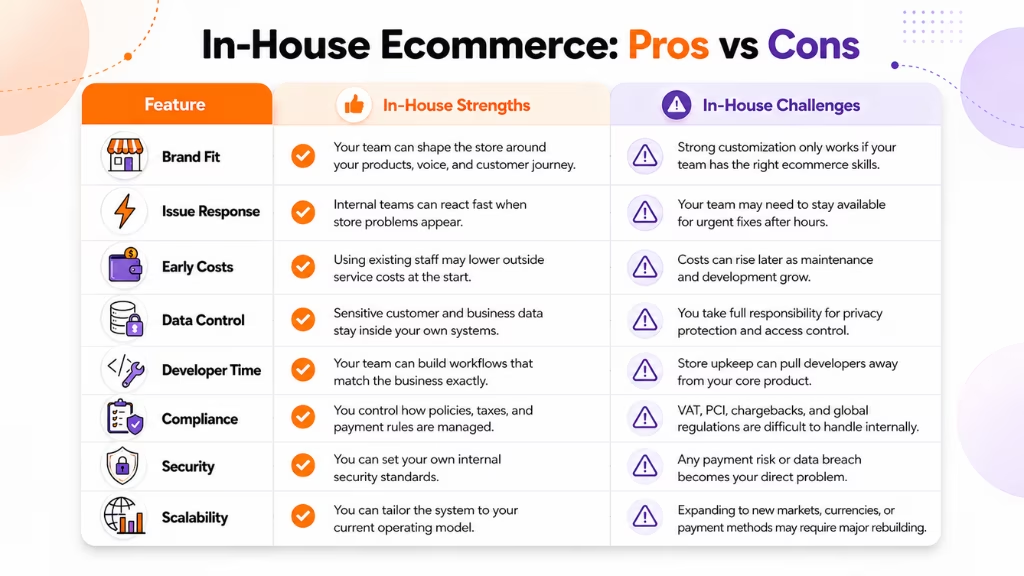
1. You Know Your Business Best
Nobody understands your products, your customers, and your brand voice better than your own team. When you run an in-house ecommerce solution, you can build something that fits your exact workflow no compromises, no features you don’t need cluttering things up.
We’ve worked with brands that had very specific checkout flows that no off-the-shelf tool could replicate. Going in-house was the only way.
2. Faster Internal Response Time
When something breaks at 11 PM on a Friday, your in-house team can jump on it immediately. There’s no waiting on a support ticket, no time zone confusion, no “we’ll get back to you in 24 hours.” Ecommerce platform control means faster troubleshooting and quicker fixes.
3. Cost Control in the Early Stages
If you’re early-stage and not doing significant volume yet, building in-house can actually be cheaper in the short run. You avoid ecommerce outsourcing costs like agency retainers, platform fees, and service contracts. Your developers are already on payroll, why not use them?
4. Data Privacy and Security
Some industries, such as healthcare, finance, and enterprise software, are extremely sensitive about where their customer data lives. Keeping ecommerce in-house means customer data security stays within your walls. You control who sees what.
The Real Cons of In-House Ecommerce
Here’s where we get honest.
1. It Eats Developer Time
This is the one people underestimate the most. Managing an ecommerce store even a relatively simple one takes serious developer hours. Time spent on ecommerce platform management is time not spent on your actual product.
We’ve seen startups delay core product features by months because their team was buried in ecommerce maintenance. That’s a painful trade-off.
2. Compliance Is a Nightmare
Tax compliance for ecommerce, VAT management, PCI DSS compliance, chargeback handling, international payment regulations this stuff is genuinely complicated. And it changes constantly.
If you’re selling globally, you need to comply with rules in dozens of jurisdictions. Miss one, and you’re looking at fines, account suspensions, or worse. Very few in-house teams have this expertise natively.
3. Security Vulnerabilities
You’re now responsible for your customers’ payment data. A breach doesn’t just cost money it destroys trust. Meeting PCI DSS compliance requires ongoing investment and attention. If you don’t have a dedicated security engineer, this is a real risk.
4. Scaling Gets Expensive Fast
When you want to expand to new markets, add currencies, or support new payment methods, an in-house system needs to be rebuilt or heavily modified. Ecommerce scalability becomes a serious bottleneck.
The Real Pros of Outsourcing Your Ecommerce Store
Now let’s flip it.
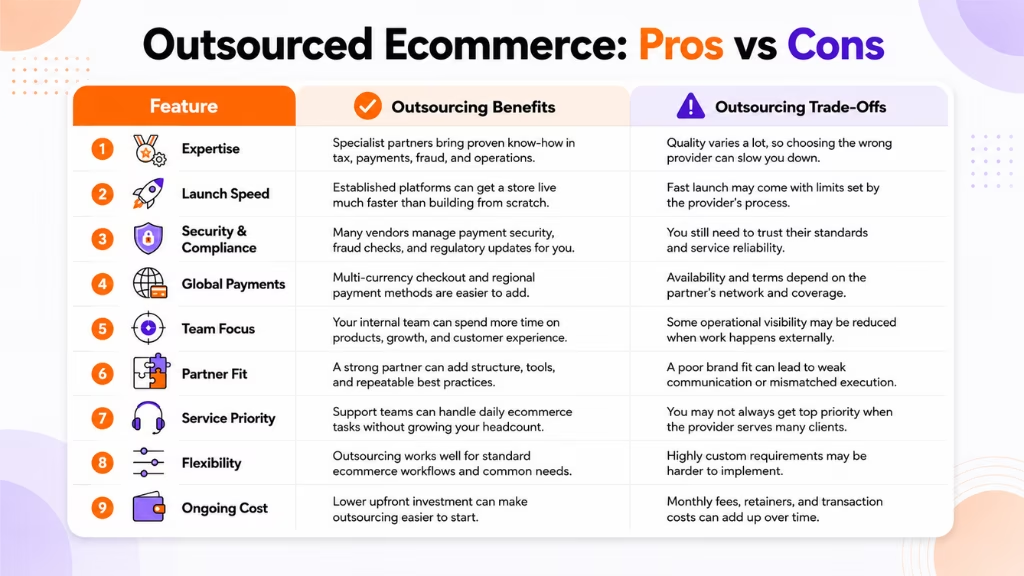
1. You Get Instant Expertise
A good outsourced ecommerce partner has already solved the problems you’re about to face. They’ve handled international tax, multi-currency payments, fraud prevention, and compliance for hundreds of businesses before yours.
You’re not starting from zero. You’re borrowing years of experience from day one.
2. Faster Time to Market
This is huge. With a mature ecommerce SaaS platform or agency partner, you can go from zero to a fully functioning store in days or weeks not months. That speed is a real competitive advantage, especially in fast-moving markets.
3. Built-In Security and Compliance
Third-party ecommerce providers handle PCI compliance, fraud detection, and payment security on your behalf. They also stay current with changing tax laws and international regulations. You don’t have to think about it it’s just handled.
4. Access to Global Payment Infrastructure
Want to accept payments in 20+ currencies? Support local payment methods in Southeast Asia or Europe? An outsourced solution can turn that on almost immediately. Building that infrastructure yourself would take years and millions of dollars.
5. Focus on What You’re Actually Good At
The biggest benefit of ecommerce outsourcing is this: it frees your team to focus on building great products and growing your business. That’s where your energy belongs.
The Real Cons of Outsourcing
1. Picking the Wrong Partner is Costly
Not all outsourced ecommerce solutions are created equal. If you choose the wrong agency or platform, you could end up with a store that doesn’t match your brand, a partner that’s slow to respond, or a contract that’s hard to exit.
Do your research. Ask for references. Read reviews on G2, Capterra, Reddit, and Trustpilot. Look at their track record with businesses similar to yours.
2. You’re One of Many Clients
A well-known ecommerce outsourcing agency might have dozens or hundreds of clients. When you have an urgent issue, you might not get the priority you’d like. Make sure you understand their SLAs before signing anything.
3. Less Flexibility for Custom Needs
If your business has highly unique ecommerce requirements, an outsourced platform might not accommodate them. You’re working within their system, not building your own.
4. Ongoing Costs Add Up
Monthly platform fees, transaction fees, agency retainers, and ecommerce outsourcing costs can stack up. It’s important to model out what you’ll spend at different revenue levels before committing.
In-House vs Outsourced Ecommerce: A Side-by-Side Look
| Factor | In-House | Outsourced |
| Setup Cost | Higher upfront | Lower upfront |
| Time to Launch | Weeks to months | Days to weeks |
| Customization | Full control | Limited by platform |
| Compliance | Your responsibility | Handled by a partner |
| Scalability | Requires rebuilding | Built-in |
| Security | Your responsibility | Managed externally |
| Team Bandwidth | High drain | Low drain |
| Ongoing Cost | Dev salaries + maintenance | Platform/agency fees |
When In-House Makes Sense
You should lean toward in-house ecommerce management if:
- You have a large, experienced dev team with ecommerce expertise
- Your business has very unique operational or compliance requirements
- You’re in a data-sensitive industry where keeping everything internal is non-negotiable
- You’re doing massive volume, and the economics of in-house make sense at scale
- You have dedicated resources for security, compliance, and ongoing maintenance
When Outsourcing Makes Sense
Outsourcing ecommerce operations is probably the right call if:
- You’re a small to mid-size team without dedicated ecommerce developers
- You want to launch fast and start generating revenue
- You’re expanding globally and need multi-currency and tax support
- Your dev team should be focused on your core product
- You want compliance and security handled without building internal expertise
A Hybrid Approach: The Middle Ground Most Businesses Miss
Here’s something a lot of articles don’t mention: you don’t have to choose one or the other completely.
Many businesses run a hybrid ecommerce model: they use an outsourced platform for payments, compliance, and checkout while keeping creative control and customer experience in-house. They outsource the technical and regulatory complexity, but they own the brand.
This is often the smartest move for mid-size businesses. You get the speed and expertise of outsourcing without giving up control of your customer relationships.
Our Take After Working With Both Models
We’ve seen both sides. Businesses that went all-in-house and thrived because they had the team for it. Businesses that went in-house and got crushed by compliance issues and developer burnout. Businesses that outsourced and scaled to global markets in months. Businesses that picked the wrong outsourcing partner lost six months of momentum.
The honest truth? There’s no universally right answer. But there is a right answer for your specific situation, and it comes down to your team’s capabilities, your growth ambitions, and how much of your bandwidth you can genuinely dedicate to running an ecommerce operation versus building your actual product.
If you’re not sure, start outsourced. It’s faster and cheaper to get started, and you can always bring things in-house later when you have the resources and the volume to justify it. Going the other way, starting in-house and switching to outsourced, is a lot more painful.
FAQs
Is it cheaper to build your own ecommerce store or use a platform?
It depends on scale. Early on, using a platform like Shopify, WooCommerce, or a full-service provider is almost always cheaper when you factor in developer time. At high volume, some businesses find it cost-effective to go in-house, but that’s a minority.
What are the risks of outsourcing ecommerce?
The main risks are choosing the wrong partner, losing some control over your brand experience, and ongoing costs. These are manageable if you vet partners carefully and negotiate clear SLAs.
Can a small business manage ecommerce in-house?
Yes, but it depends on your team. If you have a developer who understands ecommerce, payment integrations, and security, you can manage a basic store in-house. As you grow, you’ll likely need to either hire more people or bring in outside help.
What is the difference between in-house and outsourced ecommerce?
In-house means your own team builds and runs your store. Outsourced means an external partner agency, platform, or merchant of record handles some or all of it.
How do I choose an ecommerce outsourcing partner?
Look for: proven experience in your industry, strong security and compliance credentials, transparent pricing, responsive support, and positive reviews from similar businesses. Always ask for case studies.
What does a merchant of record do in outsourced ecommerce?
A merchant of record takes on the legal responsibility for your transactions including tax collection, VAT remittance, chargebacks, and payment compliance. This is a major burden lifted from your team.
Final Thoughts
The in-house vs outsourced debate doesn’t have a one-size-fits-all answer. But it does have an answer for your business; you just need to be honest about where you are right now.
Ask yourself: Do we have the team, the expertise, and the bandwidth to do this well in-house? If the answer is yes, go for it. If there’s any doubt, outsourcing is probably the smarter starting point.
The goal isn’t to control every piece of your ecommerce stack. The goal is to sell more, grow faster, and build something your customers love.
This page was last edited on 9 July 2026, at 11:10 am

Start a conversation with our team to solve complex challenges and move forward with confidence.