Executive Summary
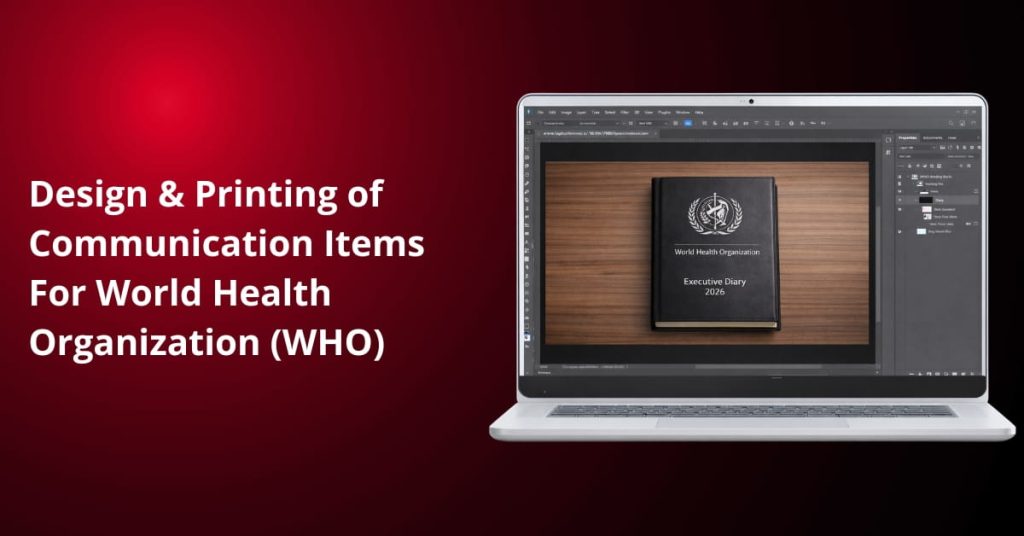
This project involved the end-to-end execution of branded materials for WHO Bangladesh. It required tight coordination across design, client communication, vendor management, and production to ensure timely and quality delivery despite earlier delays.
Primary Objectives:
- Deliver high-quality branded diaries and folders aligned with WHO Bangladesh’s branding standards.
- Ensure client satisfaction through iterative design validation.
- Complete production and delivery within the agreed timeline.
Secondary Objectives:
- Establish a repeatable production workflow for future orders.
- Minimize rework during production through structured approvals.
- Build a strong working relationship with the client for future engagements.
The Challenge
During the project lifecycle, the team had to navigate several constraints and risks to meet the objective on time:
- Design Ambiguity: Client requirements were not clearly defined initially. Frequent design changes led to multiple iteration cycles.
- Delayed Approvals: The sample approval process was slowed due to bureaucratic procedures. Extended decision-making timelines heavily impacted the overall schedule.
- Compressed Production Timeline: Significant time spent in the design and approval phases reduced the actual production window. This increased the dependency on vendor efficiency.
- Vendor Dependency Risks: Production timelines were tightly coupled with vendor capacity and responsiveness.
The Solution & Mitigation Strategies
To counter these challenges, we implemented a proactive and structured execution plan:
- Structured Communication: Established clear and continuous communication channels with the client. All feedback was meticulously documented to avoid misinterpretation.
- Iterative Alignment: Frequent checkpoints were introduced to ensure progressive alignment with client expectations, which significantly reduced the risk of major rework in later stages.
- Parallel Coordination: Production planning was prepared in parallel with the approval cycles to save time. We pre-aligned with vendors so that mass execution could begin immediately post-approval.
- Vendor Collaboration: Maintained close coordination with production vendors, ensuring quick turnaround times despite the highly reduced timelines.
Process & Execution Flow
The project was executed methodically across five distinct phases:
Phase 1: Design & Approval
- Created initial design concepts based on client requirements.
- Conducted multiple iterations due to evolving and initially unclear feedback.
- Secured final design approvals after several revision cycles.
Phase 2: Sample Production & Validation
- Produced physical samples of diaries and folders and shared them with the client for evaluation.
- Incorporated feedback iteratively.
- Obtained final sample approval after multiple evaluation cycles.
Phase 3: Mass Production
- Initiated production immediately upon final sample approval under a compressed timeline.
- Maintained close coordination with vendors to ensure strict adherence to quality standards.
Phase 4: Delivery
- Successfully delivered products within the agreed timeline, successfully mitigating earlier delays.
- Maintained the quality and specifications exactly as per the approved physical samples.
Phase 5: Reorder Execution
- Received a direct reorder of 1,095 diaries due to high client satisfaction.
- Reused the existing approved design, allowing for a direct transition to mass production and ensuring an even faster turnaround.
Business Impact & Results
By proactively managing risks and parallel-planning the production workflow, the team hit every core objective.
Key Outcomes:
- Successfully Delivered: 1,000 Diaries and 500 Folders.
- Timeline: Completed within the agreed timeline despite heavy initial delays.
- Workflow: Established a highly scalable workflow for future production cycles.
Success Metrics:
- On-Time Delivery – Achieved
- Design Approval Cycles – Multiple iterations (managed successfully)
- Client Satisfaction – High (evidenced by the reorder)
- Production Quality – Met approved sample standards
- Reorder Conversion – Successful
Key Learnings
- Importance of Requirement Clarity: Early-stage ambiguity significantly impacts timelines. Structured requirement documentation from day one is critical.
- Approval Process Planning: External approval dependencies must be accounted for in timeline planning. Building in buffer time is essential for navigating bureaucratic processes.
- Communication as a Risk Mitigator: Clear and consistent communication reduces both delays and rework. Consistent documentation of decisions ensures alignment.
- Production Readiness: Preparing vendors in advance helps mitigate compressed timelines, and parallel planning massively improves execution efficiency.
Conclusion
This project demonstrates strong execution across design, client management, and production under tight constraints. Despite real challenges related to unclear initial requirements and delayed approvals, proactive communication and structured workflows enabled successful delivery and repeat business.
The experience ultimately highlights the vital importance of early alignment, stakeholder management, and operational agility in delivering physical product projects efficiently.