The best AI video annotation service providers in 2026 offer scalable video labeling, strong quality control, secure workflows, and support for complex computer vision projects. When choosing a provider, compare annotation accuracy, compliance standards, integration options, turnaround time, scalability, and pricing.
AI and machine learning need vast amounts of video data. But raw video is useless to algorithms without high-quality annotation. Teams face hard choices: which provider will keep data secure, meet deadlines, and ensure reliable labels? One mistake and your whole model may fail in production.
I have seen technical teams delay for months just choosing the wrong vendor or tool. The real issue is, not all providers match the accuracy, speed, or compliance you need.
This guide will help you compare the leading AI video annotation service providers, understand what matters most, and pick the right path for your project. Let’s make your shortlist smarter.
What Is AI Video Annotation, and Why Does Choosing the Right Provider Matter?
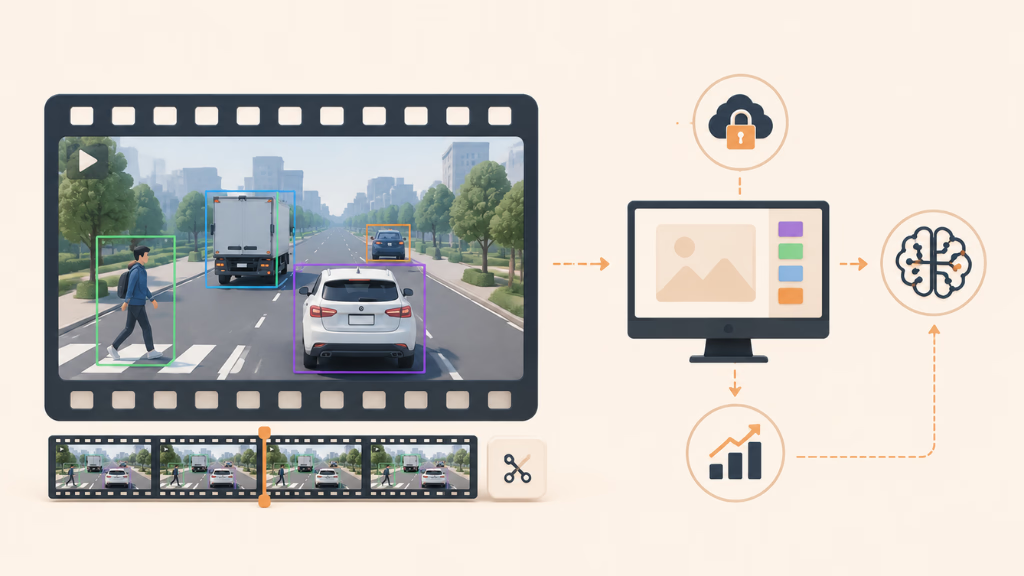
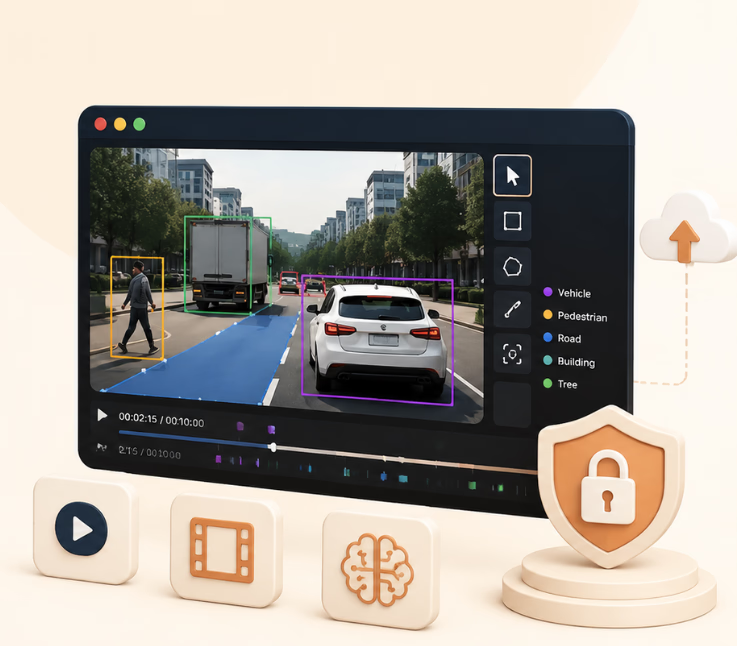
AI video annotation is a process where platforms or data experts label video frames. This creates “training data” so machine learning algorithms can detect objects, track movements, or understand scenes. In my experience, quality annotation is what turns raw video into valuable business assets.
While image annotation involves a single frame, video annotation tracks objects through thousands—or millions—of frames. This adds complexity. Common use cases span autonomous vehicles, medical imaging, and robotics. Poor annotation quality leads to bad predictions, security risks, and wasted budget.
Selecting the right provider impacts more than just cost. It determines model accuracy, data privacy, speed of deployment, and whether your AI project succeeds or fails.
What Types of Video Annotation Services Do Providers Offer?
Video annotation is not one-size-fits-all. Each method addresses unique project needs. Here’s a quick overview of main technique types and where they’re used:
| Annotation Type | Description | Typical Applications |
|---|---|---|
| Bounding Boxes | Boxes around objects | Object detection, autonomous driving |
| Polygons | Outlines for complex shapes | Medical imaging, retail analytics |
| Semantic Segmentation | Pixel-level classification | Scene understanding, smart cities |
| Keypoints / Landmarks | Track joints or features | Pose estimation, sports analytics |
| Object Tracking | ID and follow objects over time | Security, robotics, logistics |
| Activity/Action Labeling | Tag specific actions/events | Video moderation, compliance, sports |
From what I’ve seen, accuracy requirements change by project. Example: healthcare demands pixel-based detail; autonomous vehicles need precise, real-time object tracking. Quality assurance is more complex as annotation gets more technical.
2026 Side-by-Side Comparison: Top AI Video Annotation Service Providers
Choosing the right AI video annotation provider depends on annotation capabilities, industry experience, quality standards, and integration support. This comparison highlights the key differences between leading providers.
| Provider | Annotation Types Supported | Industry Focus | Key Strengths | Best Use Case |
|---|---|---|---|---|
| Riseup Labs | Image, video, text, and AI data annotation | AI, computer vision, machine learning, enterprise applications | Data annotation expertise, scalable workflows, quality-focused labeling support | Businesses needing professional data annotation services |
| GigaBPO | Bounding boxes, polygons, segmentation, tracking, video labeling | Automotive, healthcare, retail, AI/ML | Skilled annotation teams, human-in-the-loop QA, scalable workflows | Businesses needing reliable outsourced video annotation |
| AI People Agency | Image, video, text, AI training data annotation | AI startups, enterprises, ML teams | Flexible AI workforce support, scalable resources, customized solutions | Companies needing AI project support and annotation resources |
| Aya Data | Boxes, polygons, segmentation, tracking | Healthcare, automotive, robotics | Strong QA workflows, audit trails, compliance support | Regulated industries requiring high accuracy |
| Labellerr | Boxes, polygons, automation-based annotation | Healthcare, mobility | Automation, collaboration tools, efficient workflows | Teams needing faster AI-assisted annotation |
| Voxel51 | Boxes, tracking, segmentation, activity labeling | Robotics, computer vision | Deep MLOps integration and developer-focused tools | Technical teams building advanced vision systems |
| Labelbox | Image, video, text annotation | Technology, healthcare | Custom workflows, collaboration, API support | Enterprise AI teams managing annotation pipelines |
| Scale AI | Image, video, 3D, sensor annotation | Automotive, robotics, enterprise AI | Large-scale workforce and automation support | Large organizations with high-volume projects |
| SuperAnnotate | Boxes, polygons, keypoints | Research, startups, enterprises | User-friendly platform and collaboration features | Teams needing flexible annotation management |
| CloudFactory | Standard image and video annotation | Technology, logistics, enterprise | Managed annotation teams and quality control | Businesses needing outsourced labeling operations |
| iMerit | Image, video, text, specialized annotation | Healthcare, finance, automotive | Domain expertise and expert QA processes | Complex industry-specific AI projects |
Who Are the Best AI Video Annotation Service Providers? Detailed Profiles & Platform Strengths
Riseup Labs
Riseup Labs provides data annotation services to help businesses prepare high-quality datasets for AI and machine learning applications. Their services support different annotation requirements, helping organizations create labeled data for computer vision and AI model development.
With experience in handling structured annotation workflows, Riseup Labs helps businesses improve training data quality while reducing the challenges of managing annotation operations internally.
- Best for: Businesses looking for professional data annotation support for AI and machine learning projects.
- Key Strengths: Data labeling expertise, scalable annotation workflows, and support for AI training data preparation.
- Quick Verdict: A suitable choice for organizations needing reliable annotation services to support AI model development.
GigaBPO
GigaBPO provides scalable AI video annotation services designed to help businesses create high-quality training datasets for machine learning and computer vision applications. Its annotation workflows combine skilled human annotators with structured quality assurance processes to support complex video labeling requirements.
The company helps businesses handle tasks such as object detection, segmentation, tracking, and video data preparation without requiring them to build large internal annotation teams.
- Best for: Businesses needing reliable video annotation support, scalable labeling teams, and quality-focused workflows.
- Key Strengths: Human-in-the-loop review, flexible workflows, scalable annotation capacity, and support for different AI use cases.
- Quick Verdict: A strong choice for organizations looking for managed annotation support rather than managing labeling operations internally.
AI People Agency
AI People Agency supports businesses with AI talent and data-related solutions required for machine learning development. Their expertise helps organizations build AI workflows, including support for data preparation and annotation requirements.
They are suitable for companies looking for flexible AI workforce support and scalable resources for AI projects.
- Best for: AI companies, startups, and businesses needing flexible AI expertise.
- Key Strengths: AI talent support, scalable resources, and customized project assistance.
- Quick Verdict: A good option for companies seeking broader AI support alongside data preparation needs.
Aya Data
Aya Data stands out for technical accuracy, compliance support, and detailed quality workflows.
Aya Data supports bounding boxes, polygons, segmentation, and object tracking with human-in-the-loop review processes. Their focus on audit trails and quality checks makes them suitable for industries where accuracy and compliance are critical.
- Best for: Regulated industries requiring strong QA and data governance.
- Known weaknesses: May not be the lowest-cost option for simple annotation projects.
- Quick Verdict: Strong choice for accuracy-focused AI projects.
Labellerr
Labellerr focuses on automation, collaboration, and efficient annotation workflows.
The platform supports multiple annotation types while helping teams manage large projects through automation features and integrations.
- Best for: Teams looking for faster workflows and AI-assisted annotation.
- Known weaknesses: Some highly specialized workflows may require customization.
- Quick Verdict: Suitable for teams prioritizing speed and automation.
Voxel51
Voxel51 is designed for technical teams working with advanced computer vision workflows.
Its strength comes from deep ML pipeline integration, SDK support, and tools designed for researchers and AI engineers.
- Best for: Computer vision teams requiring advanced workflow control.
- Known weaknesses: Less suitable for non-technical users.
- Quick Verdict: Ideal for research-focused and engineering-heavy AI projects.
Labelbox
Labelbox is a widely used data annotation platform offering flexible workflows for image, video, and text labeling.
It provides collaboration tools, API integrations, and customization options for teams building AI models.
- Best for: Enterprise AI teams needing customizable annotation workflows.
- Quick Verdict: Strong platform for teams managing annotation internally.
Scale AI
Scale AI combines automation with a large annotation workforce to support high-volume AI projects.
It is commonly used for automotive, robotics, and enterprise AI applications requiring large-scale data processing.
- Best for: Large organizations handling massive datasets.
- Quick Verdict: Strong option for enterprise-scale annotation requirements.
SuperAnnotate
SuperAnnotate provides annotation tools designed for teams managing computer vision and AI datasets.
Its collaboration features and flexible workflows make it useful for startups, researchers, and AI teams.
- Best for: Teams needing an easy-to-use annotation platform.
- Quick Verdict: Good choice for flexible annotation management.
CloudFactory
CloudFactory focuses on managed annotation services supported by trained human teams.
It helps businesses handle large-scale labeling projects while maintaining quality through structured workflows.
- Best for: Companies needing outsourced annotation teams.
- Quick Verdict: Suitable for businesses prioritizing human-led annotation operations.
iMerit
iMerit provides specialized annotation services for industries requiring domain expertise and high-quality labeling.
The company supports complex AI projects in areas such as healthcare, finance, and automotive.
- Best for: Industry-specific AI projects requiring expert annotation.
- Quick Verdict: Strong option for specialized annotation requirements.
How Do You Choose the Right AI Video Annotation Provider? Expert Framework
Choosing the right AI video annotation provider requires more than comparing prices. The right partner should match your data requirements, maintain strong quality standards, and support your project as it scales.
Use this checklist before selecting a provider:
- Annotation capabilities: Do they support the annotation types your project needs, such as bounding boxes, segmentation, tracking, or 3D labeling?
- Quality assurance: Do they have clear review processes, accuracy checks, and quality control workflows?
- Data security: Can they meet your required compliance and security standards?
- Integration support: Do they offer smooth API or workflow integration with your existing ML pipeline?
- Scalability: Can they handle your data volume and project timeline without reducing quality?
- Industry experience: Have they worked on similar AI or computer vision projects?
A common mistake is choosing the lowest-cost provider without evaluating quality, scalability, or workflow compatibility. A better approach is to first define your annotation requirements, quality expectations, and project goals—then select a provider that can consistently deliver reliable training data.
How Do Leading Providers Ensure Security, Compliance, and Quality Assurance?
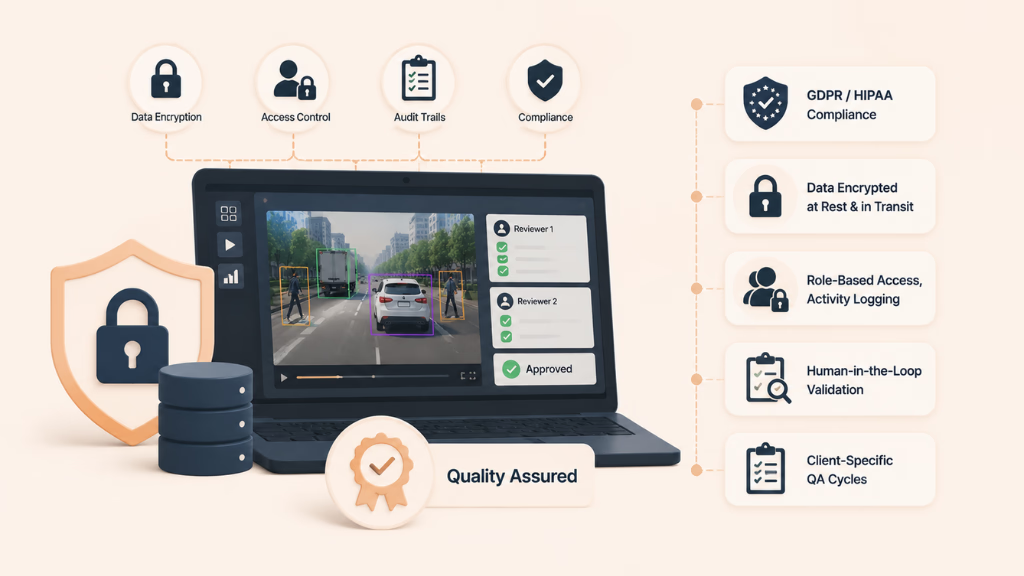
Security, privacy, and accurate results are non-negotiable, especially in regulated sectors. Providers invest in both technology and process controls.
Most top platforms support GDPR and HIPAA. This includes data encryption, anonymization, and limiting workforce access. Annotation usually involves “human-in-the-loop” QA where samples are checked by a second reviewer. Sampling, cross-checking, and audit logs further reduce risk. For regulated industries, clear SLAs and certifications are critical.
Summary:
- GDPR/HIPAA compliance and frequent audits
- Data encrypted at rest and in transit
- Role-based access, activity logging, audit trails
- Human-in-the-loop validation, not just automated QA
- Client-specific QA cycles for sensitive sectors
Teams need to see detailed policy documents during procurement. Last year when our dev team ran a healthcare project, compliance checks saved us from weeks of legal back-and-forth.
What Integration and API Options Enable Smooth Machine Learning Workflows?
A provider’s integration capabilities determine how data moves between your systems and theirs. Smooth APIs and SDKs save hours every week.
Most advanced vendors offer REST APIs, SDKs for popular languages, and ready-to-use connections to ML frameworks like TensorFlow and PyTorch. Annotation export formats often include JSON, COCO, or custom CSV. Version control and batch processing are key for ML automation.
Top Integration Features:
- REST and Python SDKs
- Native support for TensorFlow, PyTorch
- Batch upload/download, job queuing
- Export in common ML formats (JSON, COCO)
- CLI tools or open-source plugins for workflow customization
The mistake I often see: buying for “best accuracy” but missing tight ML pipeline integration, causing handoffs to fail at deployment.
What Are the Common Pricing Models and How Much Does Video Annotation Cost in 2026?
Pricing in 2026 is more transparent, but complexity remains.
Main Models:
- Per frame: Ideal for small, fixed-scope jobs. Cost can be $0.02–$0.10 per frame.
- Per hour or per label: Good for bulk, repetitive work.
- Project-based: Custom, often used in enterprise or regulated sectors.
- Subscription: Platform access for ongoing needs, common for teams scaling up.
Cost Factors:
- Annotation type and complexity (e.g., pixel-level costs more)
- Project size and data volume
- Turnaround speed requirements
- Level of automation vs. manual review
- Industry domain (regulated industries often pay more)
According to public benchmarks, large enterprise video annotation often averages between $5,000–$25,000 per 100 hours of video in 2026, but exact quotes depend on specifics. Ask for itemized pricing and pilot project costs up front.
What Are the Top Industry Applications and Case Studies for AI Video Annotation?
Different industries use video annotation in unique ways. In my experience, the best providers highlight proven outcomes, not just features.
Sector Use Cases:
- Autonomous Vehicles: Object tracking, scene segmentation, and lane boundary marking for self-driving research.
- Healthcare: Tumor detection, surgical activity tracking, pixel-level organ labeling in medical videos.
- Robotics: Movement tracking, part identification, real-time reaction labels.
- Security & Surveillance: Suspicious activity recognition, facial obscuration, multi-object tracking.
- Retail & Agtech: Shopper movement, shelf analysis, livestock monitoring.
Example Mini-Case Studies:
- Healthcare: A US hospital used Aya Data to annotate 50,000 hours of endoscopy footage, improving model recall for polyp detection by 12%.
- Automotive: Labellerr supported a self-driving startup in India, reducing data annotation cycles by 30% via automation.
- Retail: Hive’s video platform tracked in-store movement, enabling a 15% reduction in lost items by targeted staff deployment.
A better approach is to match vendor case studies with your use case. Quality is more than accuracy stats—it is proven workflow and ROI.
Conclusion: Choosing the Right AI Video Annotation Partner
Selecting the best AI video annotation service provider in 2026 goes beyond comparing features or pricing. The right partner should align with your project requirements, data complexity, quality expectations, security needs, and long-term AI goals.
A reliable annotation provider helps you build accurate training datasets through strong quality control, scalable workflows, and expertise in handling complex video data. Before making a decision, evaluate providers based on their annotation capabilities, industry experience, integration support, and ability to deliver consistent results at scale.
Whether you are developing computer vision models, autonomous systems, or AI-powered applications, investing in the right annotation partner can directly impact model performance and project success. Start by defining your requirements, comparing suitable providers, and choosing a partner that can support your AI journey from data preparation to deployment.
Frequently Asked Questions
Below are direct answers to common questions about AI video annotation. These are concise and updated for 2026.
What is AI video annotation and why is it important for machine learning?
AI video annotation means tagging video data so machine learning models can detect, track, or analyze objects and events. Reliable annotation boosts accuracy and safety for AI applications.
Which are the best AI video annotation service providers in 2026?
Aya Data, Labellerr, Voxel51, AnnotationBox, and Labelbox top the list for reliable, secure, and scalable AI video annotation in 2026.
How do providers ensure data accuracy and security?
Top providers use multi-layer QA reviews, role-based access, data encryption, and comply with standards like GDPR and HIPAA.
What annotation techniques do top companies support?
Leading companies support bounding boxes, polygons, semantic segmentation, keypoints, object tracking, and activity/action labeling.
How does video annotation pricing work and what factors impact cost?
Most use per-frame, per-label, or project pricing. Costs depend on volume, annotation detail, speed, and QA requirements.
How long does it usually take to annotate large video datasets?
Turnaround varies, but annotating 100 hours of video can take several days to weeks, depending on project complexity and provider scale.
Should I use automated, human-in-the-loop, or hybrid services?
Hybrid (automation plus human QA) is best for most projects, combining speed with needed accuracy and fewer errors.
Which providers offer ML pipeline/API integration?
Aya Data, Voxel51, Labellerr, AnnotationBox, Labelbox, and SuperAnnotate all offer strong API and SDK integration for ML workflows.
What certifications or compliance should I look for in a provider?
Look for GDPR, HIPAA, SOC 2, and industry-specific certifications according to your data privacy needs.
How do I evaluate the quality of annotation work?
Check for clear QA processes, sample reviews, case studies, references, and confirm the provider supports audits and error correction.
This page was last edited on 24 August 2026, at 12:44 pm

Start a conversation with our team to solve complex challenges and move forward with confidence.