
- The New Era of Software Development
- Enterprise Adoption and Usage Patterns
- How AI Is Used in Software Development
- How Organizations Use AI in Software Development
- How AI Enhances Every Stage of the Software Development Life Cycle (SDLC)
- Benefits of AI in Software Development
- Challenges and Risks in AI Software Development
- Future Trends: What’s Next for AI in Software Development
- Strategic Recommendations for Tech Leaders
Artificial Intelligence is no longer an experimental technology in software development it has become the foundation of modern digital innovation. What began as a set of tools to automate coding or detect bugs has evolved into an intelligent ecosystem that accelerates every phase of the software lifecycle. Today, AI doesn’t just assist developers; it transforms how software is planned, built, and maintained.
AI enables teams to shorten release cycles, enhance code quality, predict risks, and optimize operations. For developers, it’s a new paradigm where creativity and efficiency coexist, powered by data-driven insight and intelligent collaboration.
In this new era, the question is no longer whether to use AI in software development, but how strategically and responsibly it can be implemented to unlock competitive advantage.
The New Era of Software Development
Software development is undergoing its most profound transformation since the advent of cloud computing. Traditional development relied on manual coding, rigid workflows, and human-driven testing. Today, AI integrates intelligence into every layer of this process, enabling what can best be described as an AI-augmented development lifecycle.
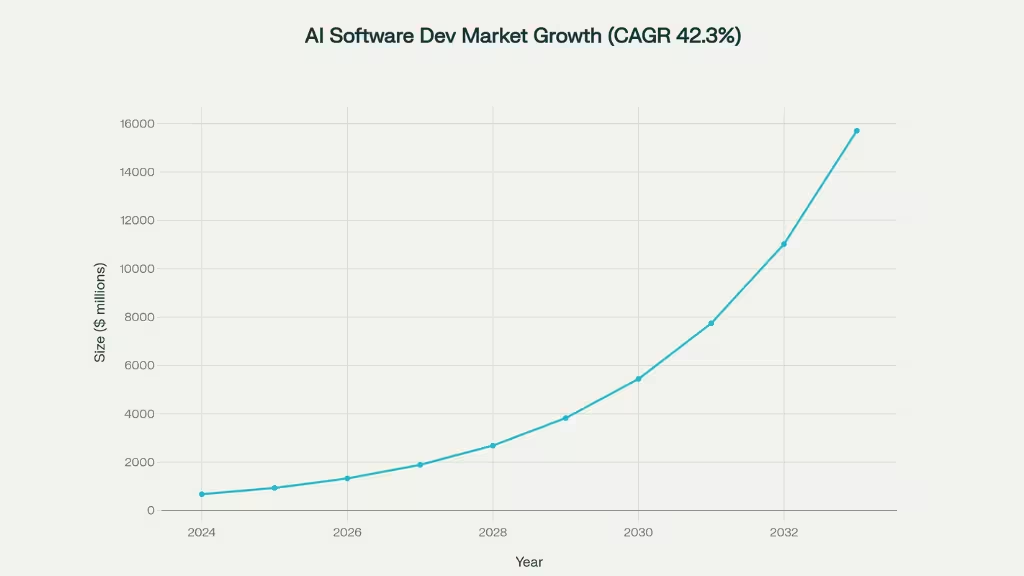
In this new model, AI acts as both co-creator and analyst. It reads and understands existing codebases, predicts errors before they occur, and generates optimized solutions in real time. Developers are no longer bound to repetitive syntax and debugging; they collaborate with AI systems that learn from billions of code examples and contextual data.
The result is a shift from development as construction to development as orchestration. Teams now design intelligent workflows that connect tools like GitHub Copilot, Tabnine, Cursor, and Amazon Q Developer into unified ecosystems. These tools suggest code, generate tests, document automatically, and even predict deployment outcomes.
This transformation is also cultural. In a recent survey, 84% of developers reported using or planning to use AI-powered tools, and more than half do so daily. Enterprises view AI not as a plugin but as a strategic capability, a driver of innovation, speed, and resilience. The organizations leading this shift are those that see AI not as automation, but as augmentation.
In essence, we’ve entered a new age of development, one where human creativity meets machine precision, and where software evolves as intelligently as the people who build it.
Enterprise Adoption and Usage Patterns
AI has become a standard part of software engineering workflows. 84% of developers now use or plan to use AI tools, and over half use them daily. GitHub alone reports 1.3 million paid Copilot accounts across 50,000+ companies, reflecting the technology’s deep integration into modern development.
Adoption scales with enterprise size: 87% of large enterprises use AI, compared to 74% of mid-sized and 34% of smaller firms. Bigger organizations gain the most from automation across complex operations.
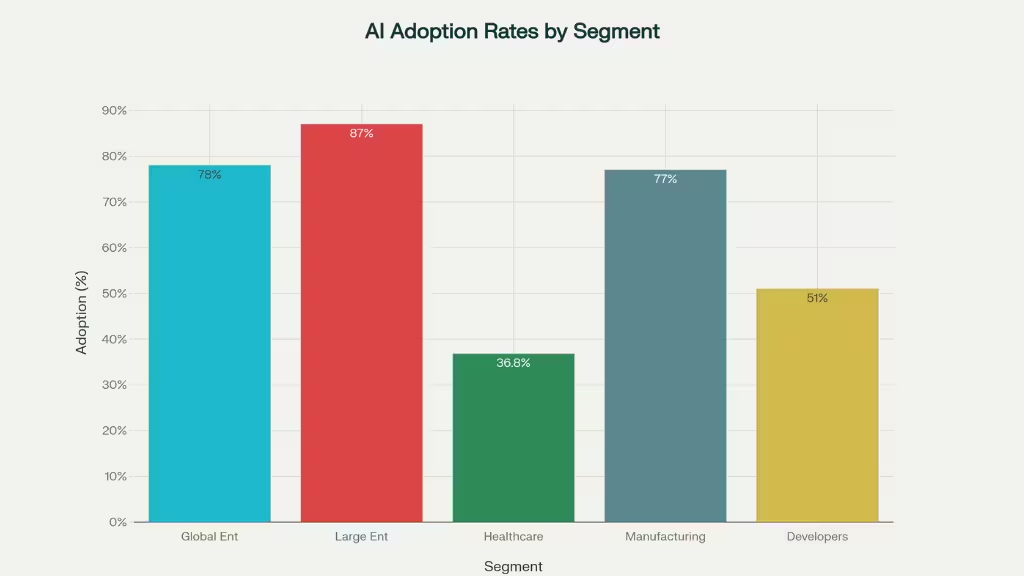
On average, enterprises spend USD 6.5 million annually on AI—split between software (USD 2.4M), talent (USD 1.8M), infrastructure (USD 1.2M), and training (USD 650K). Notably, training budgets have risen 61% year-over-year, showing that companies understand AI success depends as much on people as on technology.
How AI Is Used in Software Development
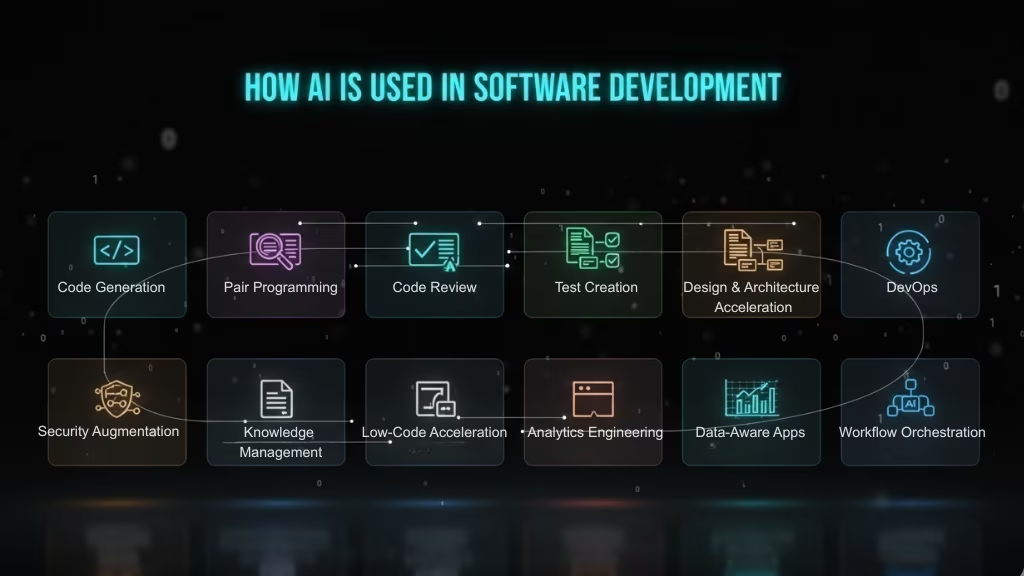
1) Code Generation & Pair Programming
What it does: Predicts the next lines of code, scaffolds functions, translates between languages (e.g., Python ⇄ Java), and proposes idiomatic patterns.
How teams implement it:
- Inline copilots in IDEs for day-to-day flow (e.g., autocomplete, diff-aware suggestions).
- Chat copilots for multi-file reasoning: “Explain this module,” “Refactor to repository pattern,” “Migrate to async I/O.”
2) Code Review & Quality Gates
What it does: Reviews pull requests for logic errors, security smells, style drift, and maintainability. Generates human-readable explanations and suggested fixes.
Deployment pattern:
- AI as a PR bot that posts structured comments: risk score, vulnerable patterns, complexity hotspots, and suggested patches.
- Policy bridge: AI aligns comments with standards (OWASP, internal secure coding rules, style guides).
3) Test Creation, Prioritization & Coverage Expansion
What it does: Generates unit/integration tests from specs, diffs, and production logs. Learns risk to prioritize test execution (e.g., path coverage over trivial getters).
Tactics:
- Diff-aware test generation on each PR.
- Failure triage assistant: Groups flaky tests, proposes stabilizing changes.
- Prod-to-test loop: Mine real user journeys and error traces to generate realistic scenarios.
4) Requirements, Design & Architecture Acceleration
What it does: Converts conversations, emails, and tickets into clean user stories, acceptance criteria, and lightweight design artifacts (sequence diagrams, context maps).
Workflow:
- Feed call transcripts + support chat logs → AI clusters pain points → drafts stories with “Definition of Done.”
- Turn non-functional goals (throughput, RTO/RPO) into architectural options with trade-offs (cost, latency, failure domains).
5) DevOps, Release Management & SRE
What it does: Predicts pipeline failures, recommends parallelization, and auto-tunes runners; in prod, detects anomalies and suggests rollbacks/remediations.
Patterns that work:
- Change-risk scoring: Use features like diff size, touched services, and historical incident correlation to gate prod deploys.
- Runbook copilots: Given an alert, the assistant fetches dashboards, correlates recent changes, and proposes the next command with copy-safe snippets.
- Self-healing hooks: For trivial, reversible issues (disk fill, stuck pods), pre-approved automated actions with a tight blast radius.
6) Security Augmentation (AppSec + AI Security)
What it does: Detects vulnerabilities, secrets, dependency drift, and misconfigurations; hardens prompts and model interfaces.
Two layers:
- Secure the software: SCA+SAST in PR; IaC policy checks; inference-time secret scanning in logs; exploit path reasoning in CI.
- Secure the AI: Prompt injection filters, data exfiltration guards, output validation, model abuse detection, red-team simulations.
Deployment tip: Treat AI as a new attack surface, add it to your threat modeling and residual risk register.
7) Documentation, Knowledge Management & Developer Experience
What it does: Keeps docs synced to code, explains complex modules, answers “how do I…?” based on private repos, tickets, and runbooks.
Winning approach:
- Build an internal RAG (retrieval-augmented generation) over your repos, ADRs, design docs, RFCs, and wikis with access control.
- Add context windows that include code, tests, and recent PRs so answers reference the current truth.
Governance: Doc changes ride the same PR path; expired snippets are flagged automatically.
8) Low-Code Acceleration & Integration Stitching
What it does: Lets product teams draft UIs while AI writes connectors, validations, and schema transforms; speeds up MVPs and internal tools.
Guardrails:
- Enforce integration contracts (OpenAPI/GraphQL schemas) and policy-as-code for data access.
- Maintain a service catalog (ownership, SLAs, data classifications) that AI references
9) Analytics Engineering & Data-Aware Apps
What it does: Generates SQL and pipelines, flags data quality regressions, and powers product features (recommendations, personalization, semantic search).
Good practice:
- Couple feature stores with data contracts; let the AI surface drift and schema breaks before they hit prod.
- Use eval datasets for LLM features (factuality, latency, satisfaction) the same way you test APIs.
10) Multi-Agent & Workflow Orchestration (Emerging)
What it does: Specialized agents (requirements, code, tests, infra) collaborate via a planner to deliver increments under human oversight.
When to try it: Well-instrumented monorepos, strong CI, reliable mocks/sandboxes, and clear guardrails.
Safety rails: Capability-scoped agents, ephemeral branches, mandatory human approval on merge/deploy, cost/latency budgets.
How Organizations Use AI in Software Development
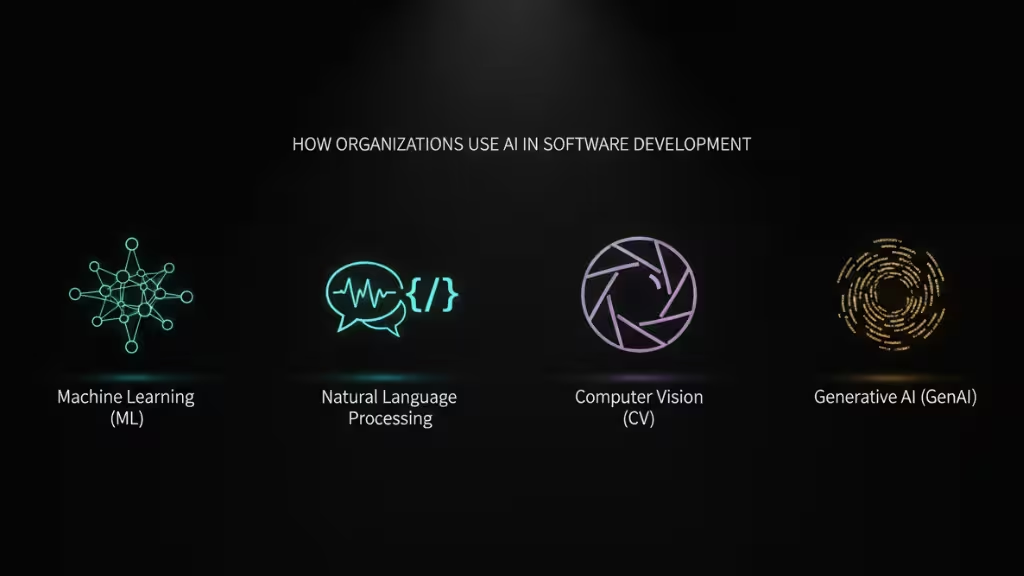
AI now works as an embedded capability across the software development life cycle, analyzing context, generating code and tests, automating workflows, and continuously learning from production signals. The result: faster delivery, higher quality, and reduced risk.
Machine Learning (ML)
Learns from code bases, commits, and incident history to spot anomalies, predict defects, flag risky changes, and recommend refactors. Teams use ML to prioritize hotspots, reduce regressions, and guide reviewers to areas that matter.
Natural Language Processing (NLP)
Enables “describe → build” workflows. Developers and product owners write requirements or intents in plain language; AI proposes code, acceptance criteria, and documentation. NLP also powers PR summaries, ticket triage, and knowledge search.
Understands visual artifacts, screens, diagrams, and layouts. CV automates UI testing (pixel diffs, visual regressions), checks design consistency against style guides, and validates accessibility and responsive behavior across devices.
Creates net-new code, tests, data fixtures, and docs from patterns in your repo and architecture. It accelerates scaffolding, translates between languages/frameworks, and drafts integration glue, freeing engineers for architecture and product logic.
How AI Enhances Every Stage of the Software Development Life Cycle (SDLC)

AI now touches every phase of the software development life cycle from the first line of requirements to post-deployment monitoring. What makes this transformation powerful isn’t just automation; it’s how AI learns from context and adapts across iterations, turning the SDLC into a continuously improving ecosystem.
Planning and Requirements Analysis
At the start of a project, AI helps teams understand scope, estimate effort, and predict risks. Using natural language processing, tools can extract functional requirements from documents, customer feedback, and chat discussions. Predictive models then compare upcoming projects with past performance to forecast timelines, resource needs, and likely roadblocks.
For project managers, this means data-driven decision-making replaces gut instinct, reducing delays and improving accuracy in early planning.
Design and Architecture
During design, AI analyzes historical architectures and performance data to recommend best-fit patterns or system topologies. For instance, AI tools can identify the most efficient API structures or suggest modular breakdowns for scalability. This helps architects focus on innovation instead of revisiting repetitive design challenges.
Development and Code Generation
The development phase has seen the most dramatic transformation. AI-powered assistants such as GitHub Copilot, Tabnine, and Cursor generate code snippets, translate between languages, and offer real-time debugging suggestions. Studies show developers working with AI tools complete coding tasks up to 55% faster, with 25–35% improvements in code quality.
By reducing mechanical coding effort, developers spend more time on logic, performance tuning, and creative problem-solving tasks where human judgment still matters most.
Testing and Quality Assurance
In testing, AI automates the most time-consuming tasks. Machine learning models analyze past defects to predict which areas of code are most vulnerable. They automatically generate and prioritize test cases for higher coverage while cutting total testing time by 50–70%.
Neural-assisted pathfinding models can even simulate thousands of execution paths to detect bugs that manual testing might overlook, achieving bug detection rates above 90%. The result is more reliable releases and faster iterations.
Deployment and Maintenance
AI-driven DevOps systems monitor continuous integration and deployment pipelines, predicting failures before they occur. They automate rollback triggers, optimize build scheduling, and maintain uptime through predictive maintenance.
Once software is deployed, AI-powered observability platforms detect performance anomalies, security threats, and user experience issues in real time, reducing mean time to resolution (MTTR) and preventing small issues from escalating into outages.
Across all stages, AI transforms the SDLC from a linear process into a living feedback loop, where every build, test, and deployment improves the next one. It’s not just faster, it’s smarter, safer, and increasingly self-correcting.
Benefits of AI in Software Development
The integration of Artificial Intelligence into software development delivers measurable advantages, enhancing productivity, efficiency, and innovation while improving the quality and speed of software delivery. For organizations aiming to stay competitive, AI is not just a convenience it’s a strategic multiplier.
1. Automation of Repetitive Tasks
AI-powered development assistants can automatically generate boilerplate code, write documentation, and even identify syntax or logic errors in real time. This automation can reduce development time by up to 50%, freeing developers to focus on creative, higher-value work such as system design, architecture, and optimization.
2. Improved Software Quality and Reliability
AI detects bugs and vulnerabilities early in the software development life cycle (SDLC), using predictive analytics to pinpoint risky areas before deployment. AI-driven testing tools can achieve 90–95% bug detection rates while cutting total testing time by up to 70%. The result is more stable releases and significantly lower maintenance costs.
3. Faster Decision-Making and Project Planning
AI enhances project management by analyzing historical performance data, estimating delivery timelines, and optimizing resource allocation. These insights allow teams to make faster, data-driven decisions, improving planning accuracy and reducing delays caused by human estimation errors.
4. Democratization of Software Development
AI is making software creation accessible to a wider range of professionals through no-code and low-code platforms. Business users and product managers can now design and deploy applications without deep programming expertise, enabling faster innovation and tighter alignment between business goals and technical execution.
5. Enhanced User Experience and Personalization
AI helps developers design smarter, more adaptive applications. By continuously analyzing user behavior, preferences, and feedback, AI can personalize interfaces and recommendations in real time. This leads to higher user engagement, improved satisfaction, and applications that evolve alongside user needs.
6. Continuous Optimization and Learning
Unlike static systems, AI-enabled software improves over time. Feedback loops embedded within development pipelines allow models to learn from errors, usage patterns, and production data, turning every iteration into an opportunity for performance enhancement and self-optimization.
Challenges and Risks in AI Software Development
As transformative as AI is, its adoption in software development introduces new layers of complexity and risk. Organizations that rush implementation without proper governance often find themselves confronting issues that can offset the very efficiencies AI promises.
1. Security Vulnerabilities in AI-Generated Code
AI-assisted coding tools are powerful but not infallible. Studies show that 45% of AI-generated code contains security flaws, including SQL injections, cross-site scripting (XSS), and improper data sanitization.
The reason lies in how AI learns: models are trained on vast amounts of public code, some of which include insecure or outdated practices. Without human oversight and continuous code review, these vulnerabilities can slip into production unnoticed.
2. Integration Complexity with Legacy Systems
More than 90% of organizations report difficulty integrating AI tools with existing infrastructure. Legacy systems often lack APIs, data pipelines, or version control structures compatible with AI platforms. This creates friction, slows deployment, and raises maintenance costs.
True success with AI requires not only the right tools but also architectural readiness, clean data, modular systems, and well-defined integration layers.
3. Ethical and Compliance Concerns
AI systems can unintentionally replicate bias from their training data. In software that affects users, such as hiring platforms, financial scoring, or healthcare diagnostics, these biases can lead to unfair or discriminatory outcomes.
Transparency is another challenge: few organizations can explain how their AI models reach decisions. As regulations like GDPR and ISO 42001 tighten, accountability and explainability are becoming legal as well as ethical imperatives.
4. Overreliance and Skill Degradation
When AI tools handle too much of the development process, human expertise can atrophy. Developers risk losing a deep understanding of system architecture, algorithmic reasoning, or secure coding practices.
Sustainable AI adoption demands balance AI should augment, not replace human capability. Teams must continue manual review, mentorship, and training to retain long-term technical resilience.
5. Governance and Change Management
Finally, many organizations underestimate the cultural and structural change required for successful AI integration. Without a clear governance defining tool usage, data access, and validation protocols, AI adoption can lead to inconsistent practices or “shadow AI” deployments that operate outside corporate oversight.
In short, the challenge isn’t whether AI works; it’s whether the organization is prepared to use it securely, ethically, and strategically. Success depends on aligning technology innovation with human judgment, process maturity, and responsible governance.
Future Trends: What’s Next for AI in Software Development
The rapid evolution of AI is reshaping not just how software is built, but what software itself can become. The next wave of innovation will see AI move beyond assistance into autonomy, where intelligent systems don’t just support developers but collaborate, adapt, and self-optimize.
1. Agentic AI
The next generation of AI tools is evolving into agentic AI systems that can act independently toward defined goals. Instead of waiting for prompts, these agents plan tasks, write and test code, review pull requests, and deploy updates autonomously.
By 2026, analysts predict that autonomous agents will handle up to 30% of routine digital operations in large enterprises, reducing development cycles by as much as 60%. This will redefine developer roles, shifting humans toward strategy, design, and complex problem-solving while AI handles execution.
2. Multimodal AI
The next frontier goes beyond text-based coding. Multimodal AI merges natural language, code, and visual understanding, allowing developers to generate functional software from wireframes, screenshots, or even voice commands.
Imagine designing a user interface simply by sketching it or describing it aloud, and watching AI instantly generate responsive, production-ready code. This convergence will blur the line between design and development, accelerating innovation dramatically.
3. Privacy-Centric and On-Device AI
As organizations grow more concerned about data privacy, a new generation of privacy-centric AI models is emerging. These systems process data locally on the user’s device or within secure enterprise environments rather than sending it to the cloud.
For industries such as healthcare, finance, and government, this approach ensures compliance with strict data protection laws while maintaining the power of intelligent automation.
4. Low-Code Platforms Reinvented by AI
AI is also supercharging low-code and no-code platforms. By 2026, analysts expect 70% of new enterprise apps to incorporate low-code or AI-assisted development, enabling faster innovation and democratizing software creation across business units.
In this model, professional developers focus on architecture and integration, while AI empowers non-technical teams to build operational tools within safe, governed environments.
5. The Rise of the AI-First Enterprise
Ultimately, these trends point to a future where successful organizations are AI-first by design. They integrate intelligence into their core workflows, decision-making, and products. In this environment, software development becomes not just a technical function but a continuous cycle of learning and optimization powered by data and collaboration between humans and machines.
The pace of change is accelerating, but the winners will not be those who adopt AI first; they’ll be those who adopt it wisely, building resilient systems that learn, adapt, and evolve alongside human creativity.
Strategic Recommendations for Tech Leaders
AI in software development is no longer a technology decision; it’s a strategic imperative. Yet, success depends on how deliberately organizations integrate intelligence into their operations. The following recommendations help leaders move from experimentation to enterprise-wide transformation.
1. Prioritize Data Readiness and Governance
Every successful AI initiative begins with high-quality, well-governed data. Before scaling AI adoption, organizations should invest in data pipelines, labeling standards, and lifecycle management. Companies that establish robust data governance frameworks see up to 3x better outcomes from AI deployment.
Clean, contextual data doesn’t just improve model accuracy; it enables AI systems to make smarter, more secure decisions throughout the development process.
2. Start with High-ROI Use Cases
Rather than deploying AI everywhere at once, focus first on the areas where it will have a measurable, near-term impact, such as code generation, testing automation, or predictive DevOps.
Successful organizations often begin with a single, high-value pilot project, measure the ROI, and then scale horizontally across teams and departments.
3. Invest in Skills and Culture, Not Just Tools
Technology is only as powerful as the people using it. AI-driven development requires teams fluent in machine learning concepts, prompt engineering, and data ethics.
Leaders should allocate training budgets and create a culture of continuous learning, where developers evolve alongside their tools. Investing in skills ensures teams remain confident and creative rather than dependent on automation.
4. Balance Human Oversight with Automation
AI excels at pattern recognition, but it lacks contextual judgment. Human oversight must remain central, especially for security reviews, architectural design, and ethical decisions.
Organizations should establish AI governance boards that define how tools are used, audited, and improved over time. The goal is not to replace developers, but to augment human expertise with machine precision.
5. Build Strategic Partnerships
Finally, no company needs to navigate this transformation alone. Partnering with experts in AI integration, MLOps, and automation frameworks accelerates maturity and reduces implementation risk.
Collaborations with experienced technology partners like Riseup Labs help organizations align AI capabilities with business goals, ensuring sustainable success rather than fragmented experimentation.
Conclusion
AI has redefined what it means to build software. Once viewed as a support tool, it is now the backbone of modern development, fueling innovation, accelerating delivery, and raising the standard of quality across industries. What was once experimental has become essential.
The most successful companies recognize a key truth: AI’s greatest power lies not in automation, but in collaboration. Human creativity remains the catalyst; AI simply amplifies it. The future will belong to teams that combine technical mastery with ethical responsibility, balancing automation with human insight and governance.
By embracing AI as a strategic partner, not just a tool, enterprises can transform software development into a cycle of continuous innovation. The question for leaders is no longer if AI should be part of their development strategy, but how intelligently and responsibly they will make it the foundation of their digital future.
Frequently Asked Questions (FAQs)
What is AI in software development?
AI in software development refers to the use of artificial intelligence technologies such as machine learning, natural language processing, and generative AI to automate, optimize, and enhance different stages of the software development life cycle (SDLC).
How does AI improve the software development process?
AI increases developer productivity, improves code quality, and speeds up delivery by automating coding, testing, debugging, and deployment tasks. It also provides intelligent insights for planning and risk management.
Which tools are most popular for AI-assisted coding?
Leading AI coding assistants include GitHub Copilot, Tabnine, Cursor, Windsurf, and Amazon Q Developer, all designed to integrate seamlessly with popular IDEs and DevOps pipelines.
What are the biggest challenges of using AI in software development?
Key challenges include security vulnerabilities in AI-generated code, integration complexity with legacy systems, and ethical issues such as bias and transparency. Governance and human oversight are essential to mitigate these risks.
Will AI replace software developers?
No. AI is a powerful augmentation tool, but not a replacement for human creativity and problem-solving. Developers will evolve into AI orchestrators, focusing more on strategy, design, and innovation while AI handles repetitive tasks.
How can organizations start adopting AI in software development?
Start with data readiness and governance, choose high-ROI pilot projects, invest in AI training, and partner with AI integration experts to ensure smooth implementation and long-term scalability.
What is the future of AI in software development?
The future lies in agentic AI (autonomous development agents), multimodal AI that merges text, image, and code, and privacy-centric AI for secure, on-device processing, transforming how software is designed and delivered.
This page was last edited on 5 February 2026, at 5:42 pm
Contact Us Now

Contact Us Now
Start a conversation with our team to solve complex challenges and move forward with confidence.


