

If you’re planning to build an AI agent from a smart assistant to a fully autonomous system you’ve probably asked the obvious question:
What’s this going to cost us?
This guide lays it out clearly. No vague ranges. No overhyped promises. Just a breakdown of what drives cost: model choices, infrastructure, integrations, team structure, and where the hidden expenses tend to creep in.
Whether you’re budgeting for an internal build or talking to vendors, this will help you set expectations and avoid surprises.
Costs Based on the Types of AI Agents
Not all AI agents are built the same and neither are their price tags. What you’ll spend depends heavily on the type of agent you’re developing and the complexity it brings to the table. Here’s a breakdown to help you align features with budget:
| AI Agent Type | Example | What You’re Paying For |
|---|---|---|
| Simple Reflex Agent | Basic chatbot, FAQ bot | Pre-trained LLMs with rule-based logic, prompt tuning, basic CRM or chat integrations, fast response handling. Ideal for static flows and low-risk automation. |
| Learning / Utility-Based Agent | LLM-powered task agent | Instruction-following capabilities, context retention, API/plugin usage, smart error handling, testing pipelines, and potentially light model fine-tuning. |
| Goal-Based Agent | Retrieval-Augmented Agent (RAG) | Embedding pipelines, vector DB setup, real-time data fetching, LLM orchestration, and memory management. Costs rise with data scale and retrieval complexity. |
| Multi-Agent System | AI systems with collaboration | Multiple agents coordinating tasks, workflow decomposition, communication protocols, and fallback systems. High infrastructure and engineering overhead. |
Why it matters: The jump from a basic chatbot to a multi-agent system isn’t just technical it’s budgetary. A simple reflex agent might cost under $10K to build and deploy. A robust multi-agent setup could run you into six figures, depending on scope.
Use this table as a starting point to frame internal conversations or vendor discussions. If your agent needs to reason, retrieve data, or coordinate with other agents, you’re no longer in prototype territory you’re building infrastructure.
Factors Affecting AI Agent Development Cost
The cost of building an AI agent isn’t just about the code it’s about everything around it: planning, integration, infrastructure, and long-term scaling. Here’s what actually drives the numbers:
Discovery & System Design: Before a single line of code is written, teams need to align on goals, architecture, and risks. This includes use case mapping, technical feasibility, and stakeholder consensus.
Model Development & Training: This phase involves selecting the right foundation model (like GPT-4 or Claude), preparing quality training data, and fine-tuning it to your domain. Costs rise with model complexity and performance demands.
Agent Core Architecture: Under the hood, smart agents require orchestration logic, memory modules, fallback handling, and multi-step reasoning capabilities all of which add engineering weight.
Integration with Tools: No agent operates in a vacuum. Expect added effort to connect your agent to CRMs (like Salesforce), ERPs, internal databases, APIs, or messaging platforms like Slack or Teams.
Knowledge Infrastructure: If your agent uses retrieval-augmented generation (RAG), you’ll need to invest in embedding pipelines, vector databases like Pinecone or FAISS, and semantic search frameworks.
Admin Interface: Enterprise deployments often require dashboards, override controls, and real-time observability tools especially for operations or compliance oversight.
DevOps & MLOps: CI/CD pipelines, cloud infrastructure, version control, and rollback features are critical for stable releases and continuous iteration. Some MVPs skip this enterprise agents can’t.
QA & Testing: Rigorous testing ensures reliability and safety. This includes unit testing, regression sweeps, stress tests, rate-limiting simulations, and ethical guardrails.
Data Collection & Processing: Clean, labeled data is a hidden cost that’s often underestimated. Depending on your domain, data prep can be as expensive as the modeling itself.
Real-Time Interaction: For agents that support voice, NLP, or multilingual inputs, you’ll need specialized handling for latency, translation, and context switching.
Feature Customizations: Every industry has its own logic and workflows. Custom APIs, complex decision trees, and security layers all add to development time and cost.
Maintenance & Scaling: Post-launch, you’ll be investing in model updates, bug fixes, infrastructure scaling, and ongoing monitoring this is a continuous operational line item.
Your AI agent’s cost depends on how far you go in each of these areas. A basic deployment might skip MLOps or advanced memory systems an enterprise-grade agent can’t. Be clear about your must-haves early; it’s the difference between a $15K MVP and a $250K production system.
Investment Breakdown
AI Agent Development Cost Based on Project Complexity
The cost of building an AI agent scales with complexity both technically and strategically. Here’s how that typically breaks down:
1. Entry-Level AI Agents ($20,000–$30,000+)
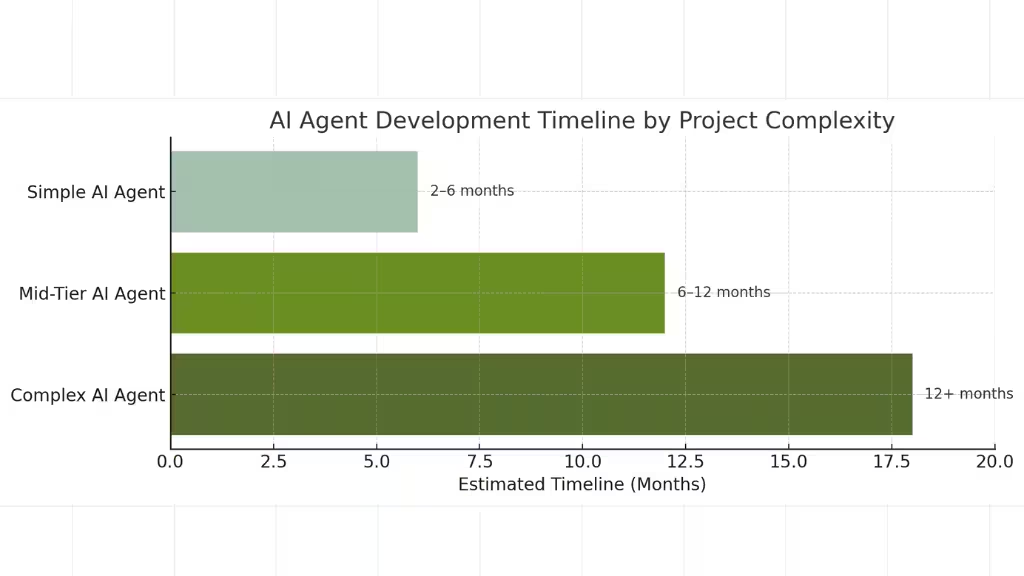
These are lightweight systems: customer service bots, FAQ responders, or basic automation assistants. They rely on rule-based or pre-trained LLM logic, with minimal personalization or context awareness. If your use case is straightforward and timelines are tight (2–6 months), this tier gets you to production with a solid MVP.
2. Mid-Tier AI Agents ($30,000–$60,000+)
Here you’re looking at smarter agents ones that handle nuanced inputs, detect sentiment, personalize responses, or support use cases like sales scoring and fraud detection. This level often includes light model tuning, third-party API orchestration, and deeper QA cycles. Expect timelines of 6–12 months and cross-functional involvement from product, data, and ops.
3. Complex AI Agent Systems ($60,000–$100,000+ and up)
This is where the real engineering begins. These agents exhibit near-human conversation, multi-turn reasoning, autonomous task execution, or domain-specific intelligence (e.g., biotech, finance, logistics). They often involve multi-agent architectures, RAG pipelines, fine-tuned or custom LLMs, and advanced DevOps/MLOps infrastructure. Build time often exceeds 12 months, with long-term support baked in.
Quick reality check: Even a “simple” AI agent becomes complex fast if you need integrations, compliance, or multilingual support. Use this breakdown as a rough guide, but expect variance based on your industry, internal team maturity, and ambition.
AI Agent Development Cost Based on Phase
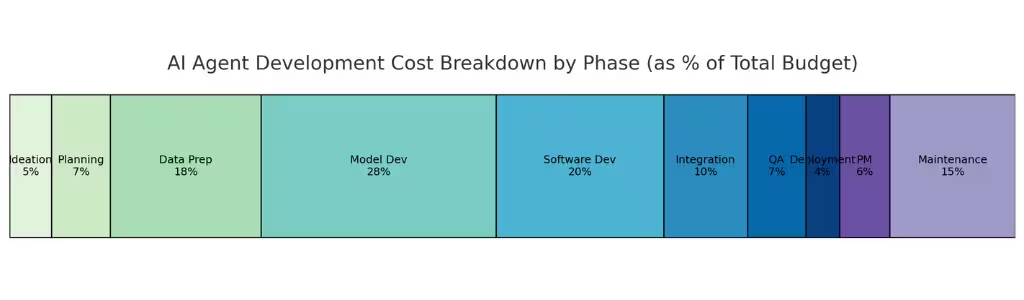
To budget effectively, it’s not enough to ask how much you need to know where the money goes. Here’s how AI agent development costs typically break down across key phases:
| Development Phase | Cost Range (USD) | Approximate Cost % | Key Activities and Deliverables |
|---|---|---|---|
| 0. Problem Definition & Ideation | Part of planning or $3,000 – $7,000 | 3% – 7% | – Deep problem analysis – Goal setting – Stakeholder alignment |
| 1. Research & Planning | $5,000 – $15,000 | 5% – 10% | – Feasibility study – Tech stack research – Architecture planning |
| 2. Data Acquisition & Preparation | $10,000 – $70,000 | 10% – 25% | – Data sourcing, cleaning, labeling – Augmentation – Data pipelines setup |
| 3. AI Model Development & Training | $15,000 – $100,000+ | 20% – 35% | – Model selection – Fine-tuning – Validation & performance testing |
| 4. Core Software Development | $10,000 – $80,000 | 15% – 25% | – Backend/frontend builds – API logic – Database and UI layer |
| 5. Integration & API Development | $5,000 – $40,000 | 5% – 15% | – CRM, ERP, messaging platform integrations – Custom API development |
| 6. Testing & Quality Assurance | $5,000 – $30,000 | 5% – 10% | – Unit & stress testing – Regression checks – Safety & ethical validation |
| 7. Deployment & Infrastructure | $2,000 – $15,000 | 2% – 5% | – Infrastructure provisioning – CI/CD setup – Cloud/on-prem deployment |
| 8. Project Management | $5,000 – $20,000 | 5% – 10% | – Resource planning – Sprint reviews – Stakeholder communication |
| 9. Real-Time Monitoring & Maintenance | Ongoing & variable | Variable | – Monitoring & logging – Retraining – Updates, patches, long-term support |
Additional Ongoing AI Agent Development Cost
AI agent development doesn’t stop at launch. To keep systems reliable, compliant, and effective over time, organizations must budget for continuous operations. These recurring costs span infrastructure, user support, model maintenance, and ethical AI oversight.
| Cost Type | Estimated Range | Notes and Considerations |
|---|---|---|
| API Usage (OpenAI, Claude, etc.) | $100 – $10,000/month | Usage-based billing; costs scale with token volume, model tier (e.g., GPT-4 vs GPT-3.5), and frequency. |
| Cloud Hosting (AWS, Azure, etc.) | $200 – $5,000/month | Costs are driven by compute type (CPU/GPU), memory, storage, and data transfer. |
| Monitoring & Maintenance | $2,000+/month | Covers performance monitoring, logs, bug fixes, model health checks, and SLA fulfillment. |
| Model Re-training & Updates | Varies | Retraining may be needed every 3–6 months as goals, data, or user behavior evolve. |
| User Support & Training | $1,000 – $5,000+/month | Internal/external support, onboarding new users, and training material updates. |
| Security & Compliance Audits | $1,000 – $10,000+/year | Essential in healthcare, finance, and legal to ensure continued adherence to regulations. |
| Data Privacy & Governance | $500 – $3,000+/month | Costs for anonymization, access control, audit trails, and policy frameworks. |
| Scaling & Load Management | Scales with adoption | Elastic infrastructure, load balancing, and global delivery architecture as the user base grows. |
| Explainability & Fairness Updates | $1,000 – $5,000+/year | Ensures transparency, bias mitigation, and responsible AI practices are kept current. |
| User Analytics & Feedback Loops | $500 – $2,000+/month | Tracks usage behavior, intent accuracy, and drop-offs; feeds insights back to improve agents. |
| Backup & Disaster Recovery | $500 – $3,000+/month | Critical for business continuity includes offsite backups, failover systems, and recovery plans. |
Ongoing operational costs for AI agents extend well beyond infrastructure and API usage. They include continuous model improvement, user experience optimization, regulatory upkeep, and long-term resilience planning.
Most organizations should expect annual maintenance costs to fall between 15% and 30% of their initial development investment. Failing to plan for these recurring expenses risks performance degradation, compliance lapses, or user attrition.
Post-Launch AI Agent Costs Most Teams Underestimate
The agent is live. It works. And then… the real work begins.
This is the phase most teams don’t budget for and where AI projects start bleeding time, tokens, and trust. Below are the hidden costs that almost always surface post-launch:
| Cost Area | Estimated Range | What Drives the Cost |
|---|---|---|
| Prompt Tuning & QA | $1,000 – $2,500/month | Continuous behavior refinement, edge-case testing, and updating multi-turn reasoning logic. |
| Observability & Debugging | $200 – $1,000/month | Conversation tracing, logs, and replay tooling (LangSmith, Helicone, OpenPipe) to diagnose agent behavior. |
AI Agent Development & Ownership Cost Summary
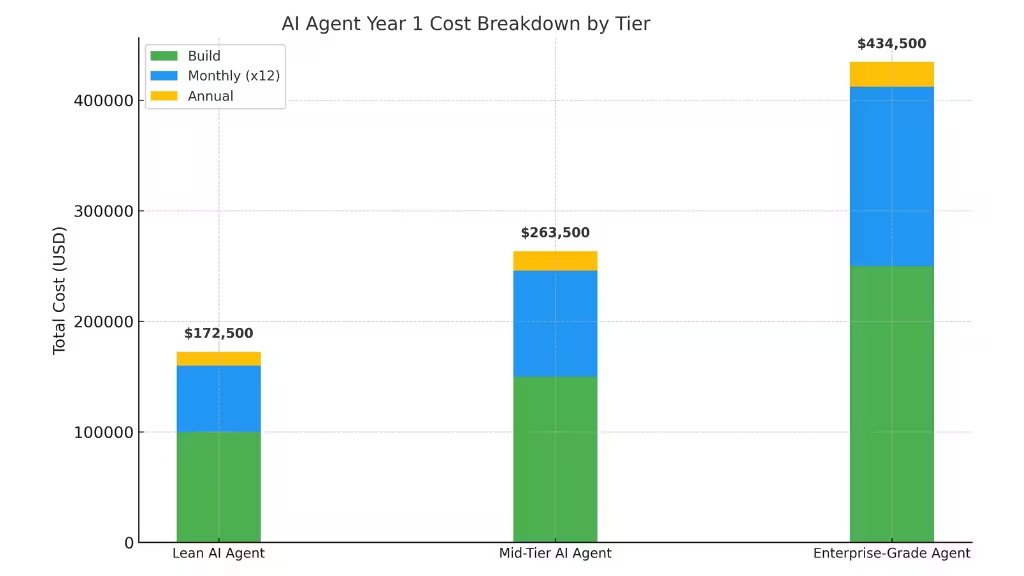
| Category / Deployment Scope | Cost Type | Estimated Range |
|---|---|---|
| Initial Development | One-time | $100,000 – $250,000+ |
| Monthly Ongoing Costs | Monthly | $5,000 – $15,000+ |
| Annual Ongoing Costs | Annual | $10,000 – $25,000+ |
| Lean AI Agent (MVP Build) | Year 1 Total | ~$160,000/year |
| Mid-Tier AI Agent | Year 1 Total | ~$246,000/year |
| Enterprise-Grade AI Agent | Year 1 Total | ~$400,000 – $450,000/year |
AI Agent Development Cost Across Different Industries
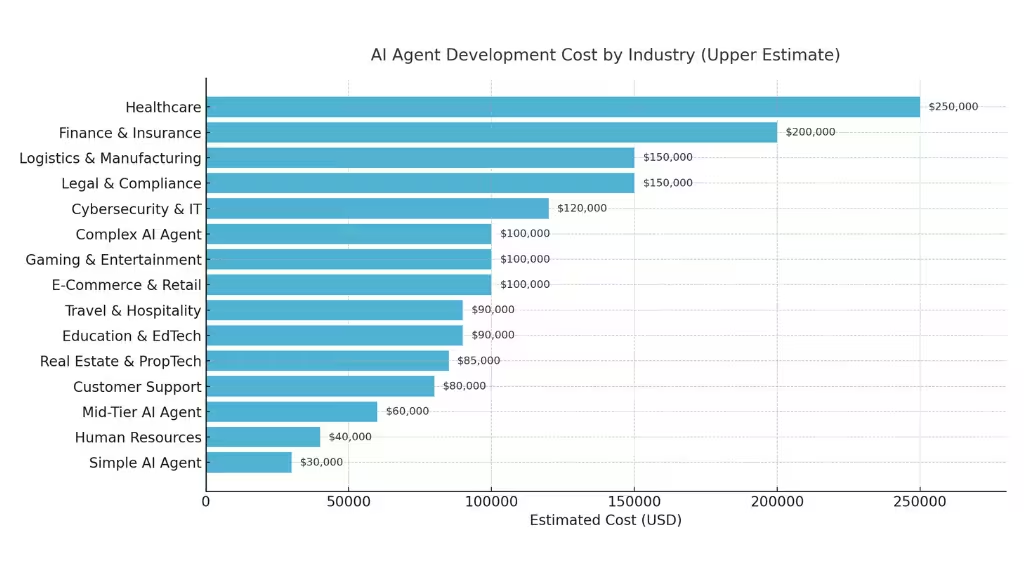
AI agent development costs are highly industry-dependent. Factors like data sensitivity, regulatory requirements, infrastructure needs, and functional complexity can dramatically shift your budget. Here’s how it plays out across sectors:
| Industry / Complexity | Estimated Cost Range (USD) | Key Use Cases / Functions | Major Cost Drivers and Factors |
|---|---|---|---|
| Healthcare | $80,000 – $250,000+ | Clinical chatbots, diagnostic assistants, drug discovery AI | HIPAA/GDPR compliance, audit trails, domain-specific model tuning, risk mitigation |
| Finance & Insurance | $70,000 – $200,000+ | Fraud detection, underwriting bots, investment advisors, and claims | Regulatory compliance (SOX, PCI DSS), large structured data, and real-time validation |
| Legal & Compliance | $60,000 – $150,000+ | Legal research bots, compliance checkers, and document review | Auditability, zero hallucinations, sensitive data handling |
| Logistics & Manufacturing | $50,000 – $150,000+ | Production workflows, fleet coordination, and inventory forecasting | IoT data integration, task scheduling, and simulation modeling |
| Cybersecurity & IT | $50,000 – $120,000+ | Anomaly detection, incident triage, vulnerability scanning | Validation, simulation, security platform integration |
| E-Commerce & Retail | $30,000 – $100,000+ | Product discovery, upselling, returns automation | Personalization logic, multilingual UX, and omni-channel integrations |
| Gaming & Entertainment | $30,000 – $100,000+ | NPC behavior, content generation, player support | Real-time interaction, emotional intelligence, multimodal capabilities |
| Education & EdTech | $25,000 – $90,000+ | Virtual tutors, personalized curriculum | Adaptive learning, structured content delivery, and feedback loops |
| Travel & Hospitality | $30,000 – $90,000+ | Bookings, itinerary changes, and real-time notifications | Personalized recommendations, voice capabilities, and booking engine integrations |
| Real Estate & PropTech | $25,000 – $85,000+ | Virtual leasing, mortgage pre-qualification, and property recommendations | Complex filtering, document parsing, and lead qualification logic |
| Customer Support (All Sectors) | $20,000 – $80,000+ | FAQs, ticket routing, escalation | CRM integrations, multilingual NLP |
| Human Resources | ~$20,000 – $40,000 | Resume screening, onboarding, and employee support | Simpler workflows, less sensitive data |
The more regulated, personalized, or real-time your industry is, the more you’ll need to invest in robust architecture, data governance, and model performance. Use this table as a benchmarking tool when defining scope, setting expectations with leadership, or comparing vendor proposals.
Cost Saving Measures for AI Agent Development
Building an AI agent doesn’t have to demand a massive budget. These proven strategies can help you reduce development costs without compromising on functionality or scalability:
1. Start with an MVP (Minimum Viable Product): Begin with just the essential features that demonstrate core value. This reduces initial scope, speeds up development, and helps validate market fit early.
2. Utilize Pre-Trained Models: Avoid building models from scratch. Instead, use large language models like GPT-4 or Claude, and fine-tune them only where necessary to suit your domain.
3. Hire Developers in Inexpensive Regions: Global hiring gives you access to skilled AI developers at a fraction of the cost, especially in regions with lower engineering labor rates.
4. Use Open Source Frameworks: Adopt frameworks like LangChain, Haystack, or LlamaIndex to accelerate development and avoid the overhead of building orchestration systems from zero.
5. Determine Early What Systems You Want Integrated: Clearly define which CRMs, APIs, or databases need to be connected. Scope creep from late-stage integrations can dramatically inflate time and cost.
6. Automate Testing and Feedback Loops: Implement automated testing for models and prompts. It reduces manual QA cycles and supports faster, safer iterations post-launch.
7. Use Cloud Services Wisely: Leverage auto-scaling and reserved instances. Monitor token usage and traffic patterns to avoid surprise costs from cloud or LLM overuse.
These cost-saving practices can reduce your total build and operational spend by 20–40%, especially when applied early in the AI agent lifecycle.
Calculating ROI for AI Agents
Demonstrating a clear return on investment (ROI) is essential for securing funding and validating the strategic value of AI agent initiatives. Unlike traditional software, AI agent ROI combines both measurable cost savings and more nuanced qualitative benefits, making it important to adopt a holistic, structured framework for calculation.
A widely accepted ROI formula remains:
ROI=Total Cost(Total Benefits (Monetary)−Total Cost)×100%
where total benefits encompass not only direct monetary savings but also quantified value from improvements in decision-making speed, customer loyalty, and innovation advantage.
Key elements to consider when building your AI ROI framework:
- Baseline Current Metrics: To measure impact reliably, capture pre-implementation baseline data on labor costs, technology expenses, error rates, and opportunity costs. This provides a benchmark for quantifying savings and efficiency gains post-deployment.
- Cost Savings and Efficiency Gains:
- Labor Cost Reduction: Automating repetitive tasks saves hours and reduces reliance on costly human labor. Track time saved per task, frequency, and average wage rates to calculate this component.
- Error Reduction: Improved accuracy lowers costly mistakes such as fraud, misclassification, or rework.
- Optimized Resource Allocation: AI-driven improvements in logistics, energy use, or supply chains increase operational efficiency.
- Revenue Generation:
- Increased Sales and Conversions: AI-powered personalization, intelligent lead nurturing, and recommendation systems boost revenue.
- New Business Models: Enabling AI-based products or automated services that open revenue streams.
- Productivity Enhancements:
- Time Savings and Faster Processing: Accelerating data analysis or workflows frees staff for strategic activities.
- Improved Throughput: AI agents handle higher task volumes or complexity without proportional cost increases.
- Customer Experience & Satisfaction: Faster, personalized responsiveness improves Net Promoter Scores (NPS) and Customer Satisfaction Scores (CSAT), driving retention and advocacy that indirectly affect revenues.
- Risk Mitigation: AI’s role in fraud detection and compliance reduces financial losses and protects brand reputation, an often overlooked but critical ROI factor.
- Innovation and Agility Benefits: While challenging to quantify, first-mover advantages, faster product development, and adaptive business models contribute significantly to long-term competitive positioning.
Additional Considerations:
- Time Horizon: ROI calculations should define a clear period (e.g., 1-3 years) reflecting realistic benefit realization timelines.
- Opportunity Costs: Factor in costs avoided by adopting AI early versus business-as-usual scenarios.
- Risk Assessment: Account for implementation risks, integration challenges, and potential delays which can affect ROI outcomes.
- Iterative Measurement: Use staged KPIs and ongoing tracking to refine ROI estimates and adjust investments dynamically.
By applying a multidimensional ROI framework grounded in data and aligned with business goals, organizations can better quantify AI agents’ transformational value and communicate compelling business cases to stakeholders.
This approach moves beyond simplistic cost-benefit ratios toward capturing AI’s full strategic impact, essential for driving sustained investment and adoption.
Final Thought
AI agents are no longer experimental; they’re becoming infrastructure. But costs vary wildly not because AI is inherently expensive, but because scope, clarity, and execution vary even more.
Whether you’re building a lean chatbot or a multi-agent enterprise system, the real key is knowing what you need and what you don’t. From architecture choices to long-term maintenance, every decision is a cost lever.
If you define success early, align tech with goals, and stay disciplined about scope, AI agents can be a high-return investment without spiraling spend. Treat cost as a design constraint, not a blocker.
The smartest teams aren’t just spending more they’re spending smarter.
FAQs
How much does AI agent development typically cost?
Estimates vary widely, but most enterprise‐grade AI agents cost from tens of thousands to several hundred thousand dollars. Simple rule-based chatbots or FAQ bots often start around $5k–$15k. More capable agents with NLP and learning (for example, lead scorers or support assistants) generally fall in the $20k–$100k range. Advanced, autonomous multi-agent systems or agents requiring specialized models can climb into the $150k–$300k+ range. Overall, current guides suggest $10k–$300k as a typical bracket for mid-market projects.
What pricing models do AI development vendors use?
Common models include hourly/time-and-materials, fixed-price contracts, dedicated team engagements, and platform/SaaS subscriptions. Hourly (or “time and materials”) offers flexibility but shifts most cost risk to the client. Fixed-price quotes give budget certainty and clear deliverables at the expense of flexibility. Dedicated team models (hiring a full-time outsourced team) balance scalability and continuity. Some solutions use SaaS or platform pricing (paying monthly for a pre-built AI service), which lowers upfront costs but may limit customization. Enterprises often blend approaches (for example, a fixed-fee pilot followed by a flexible engagement) to manage risk and scope.
What factors drive AI agent development cost?
Complexity is the biggest driver. An AI agent’s intelligence level (e.g. simple rule-based vs. ML-powered vs. autonomous decision-maker) dictates the engineering needed. Other major factors include data needs (more or higher-quality data means more preprocessing and training expense), integration requirements (connecting to CRMs, databases or multiple APIs adds custom work), and security/compliance (handling sensitive data or regulated industries (HIPAA, GDPR, SOC2) can add 20–30% to budgets). Team makeup is also key: more specialists (AI engineers, data scientists, prompt engineers, DevOps, QA) and longer timelines push costs higher. In short, anything that increases the agent’s scope, integration, or required expertise will raise the price.
How do agent types affect cost?
AI agents range from simple chatbots to advanced multi-agent systems. Rule-based chatbots or “reactive” agents (no learning, only if-then logic) are cheapest – often just $5k–$25k for basic builds. NLP-driven assistants that learn from interactions (e.g. helpdesk bots that improve over time) cost more – typically in the $10k–$100k range for moderate complexity. Autonomous or “agentic” systems (capable of planning, using tools, and learning continuously) are most expensive – prototypes often require $50k–$300k+ depending on capability. Highly specialized agents (like industrial robots or self-driving systems) can start around $500k–$1M due to safety, hardware, and compliance demands.
How can organizations control or reduce development costs?
Leading strategies include:
(a) Prioritize core features. Focus on the essential use-case first; avoid gold-plating (more features mean more dev time).
(b) Start with an MVP. Build a minimum viable agent to validate the idea quickly and then iterate – this breaks cost into stages and reduces wasted effort.
(c) Leverage pre-trained models and open frameworks. Reusing existing LLMs (e.g. GPT, BERT) and tools cuts down time and data needs. For many tasks, fine-tuning a pre-built model is far cheaper than training from scratch.
(d) Choose cloud-native architectures. Using managed cloud services (PaaS) avoids upfront hardware costs.
(e) Outsource to specialists when lacking in-house AI talent – specialized firms can deliver faster (often 30–50% cheaper than hiring new staff).
(f) Define and protect the scope – avoid scope creep. Each change can add hefty expenses, so clear requirements and tight project management are essential. Implementing these tactics can save 30–50% compared to a “build-everything” custom approach.
What hidden or long-term costs should we watch for?
Beyond development, AI agents incur ongoing and unexpected costs. Token/API usage for LLMs can be surprisingly high – enterprise usage can easily burn millions of tokens per month, costing $1k–$5k+ per month just for GPT-4 API calls. Cloud infrastructure (hosting, databases, vector stores) scales with usage – plan for hundreds to thousands of dollars per month. Maintenance and monitoring (bug fixes, retraining models, performance tuning, security patches) often run 15–30% of development costs annually. Other hidden costs include data labeling and cleaning, third-party licensing fees, and change management (training staff on new AI workflows). Enterprises should factor these into the total cost of ownership so the ROI outlook isn’t overly optimistic.
How do we measure ROI for an AI agent?
ROI is typically calculated by comparing the business value gained vs the total investment. Quantify the current cost of tasks the agent will take over (e.g., labor hours × rate). Then subtract all AI costs (development + maintenance + operation). For example, if an AI sales agent saves 150 hours/week of salesperson time at ~$100/hr, that’s ~$15,000 weekly value – over $780k per year. If developing that agent costs $150k, the ROI is roughly 10× in less than a year. Key metrics include labor cost savings, error reduction, customer satisfaction gains, and revenue lift. Many reports note that effective AI agents can pay for themselves within 3–12 months when well-targeted to high-impact workflows.
Are AI agents worth the investment?
Decision-makers look at ROI, not just price tags. For the right use case, an AI agent can yield substantial returns. Case examples show 10× ROI by freeing valuable labor time. Even deflecting 30% of support tickets might save $20k–$50k per month in support costs. When costing the project, think in terms of outcomes: e.g., “$150k to gain $15k/week in productivity”. Also consider soft benefits: faster service, 24/7 availability, and competitive differentiation. In sum, AI agents are best viewed as business investments that can automate costly manual work; when they offload real work and speed decisions, the ROI can be clear.
Do AI agent costs vary by industry?
Yes. Some industries inherently face higher costs due to complexity or regulation. For example, healthcare and finance agents often need strict compliance (HIPAA, GDPR, SOC2) and enhanced security, which can add 20–30% extra to budgets. Similarly, legal, manufacturing, and pharma use-cases (which may involve safety and precision) tend to be on the higher end. By contrast, e-commerce, retail, and general customer service solutions typically see moderate development costs since they rely on more standard models and integrations. Industry also affects scale: a large enterprise with millions of users will pay more (in hosting and scaling) than a small business with a few hundred users. It’s wise to benchmark against peers in your sector – e.g. an AI support bot in retail might cost $20k–$50k, whereas a clinical diagnosis agent in healthcare might start at $100k+.
Are AI agents feasible for smaller businesses?
Yes, SMEs can afford AI agents if they start small. A focused basic agent ($5k–$20k) aimed at a high-impact task (like FAQs or lead capture) can pay back quickly. Use cloud services and pre-trained models to minimize infrastructure and development overhead. Many small firms achieve ROI in under a year by automating routine work. The key is to scope tightly (solve one problem well) and scale up as the business grows.
What ongoing costs come after deployment?
AI agents require continuous investment. Plan for roughly 15–30% of the initial development cost per year to maintain performance. Major drivers include LLM API fees (which grow as usage and contexts grow), cloud hosting (servers, databases, vector search), and monitoring/observability tools. Regular model retraining (to adapt to new data) also adds expense. For example, an agent deflecting support tickets may need retraining monthly or quarterly, and each training run consumes data engineers’ time and compute costs. Security updates (patching dependencies, logging) are another continuing cost. In practice, a moderate AI agent might incur $500–$5,000+ per month in combined cloud and API fees, plus the ongoing labor to tune and monitor it.
What hidden expenses should we anticipate?
Hidden costs often trip up enterprises. Aside from APIs and servers, watch for:
(a) Excessive API calls. Inefficient prompts or no memory caching can blow your token budget.
(b) Third-party services. Your agent may rely on external NLP libraries, voice/text APIs, or analytics tools that charge usage fees.
(c) Employee training & change management. Adopting AI may require retraining staff or hiring new specialists, which adds HR costs.
(d) Upgrades and refactoring. As technology evolves, you might rebuild parts of the agent or migrate to new models (think of GPT-4→GPT-5 upgrades). These platform changes can be expensive if not planned for.
(e) Unexpected scale needs. A sudden surge in users (e.g. viral success) can spike cloud costs overnight. To avoid surprises, include a buffer in your budget (at least 20% extra) and require transparency from vendors about all component costs.
Should we build in-house or hire a development partner?
For many enterprises, hiring specialized AI developers is more cost-effective and faster than assembling an in-house team from scratch. Outsourcing to firms with AI expertise often yields savings (roughly 30–50% less than building internally). External teams bring proven processes and can deliver pilots quickly. Building in-house may only make sense if AI is your core business or you already have ML talent. Hybrid models also work: keep strategic vision and data in-house, outsource execution. In any case, ensure strong collaboration: the best outcomes come when internal and external teams share clear goals and metrics.
How long does AI Agent development take?
Timelines depend on complexity. A basic chatbot or FAQ assistant can be built in 4–8 weeks. More advanced NLP/ML agents typically require 2–3 months. Complex multi-agent or enterprise-grade systems may take 6+ months. These estimates assume a focused scope; expanding features or integrations will push schedules longer. Adopting an agile, phased approach helps: you can launch an initial version in a couple of months and then add features over time. Note that each extra month of development often adds roughly $20k–$40k in cost (per team size), so efficient planning is key.
This page was last edited on 8 December 2025, at 4:59 pm
Contact Us Now

Contact Us Now
Start a conversation with our team to solve complex challenges and move forward with confidence.


