Python is easy to start with but harder to scale well. The best Python development companies combine strong backend engineering with AI, data, cloud, and architecture expertise. Riseup Labs, STX Next, Brain Station 23, Itransition, and Instinctools are among the strongest options to shortlist in 2026.
Python has a reputation for being simple.
That is useful when you are prototyping an API or automating a workflow. It becomes less useful when the same codebase needs to serve thousands of users, process large datasets, support AI features, connect with several systems, and stay maintainable for years.
That is where the development company matters.
Python is still gaining ground, especially in AI, data science, and backend engineering. Stack Overflow reported a 7 percentage-point increase in Python adoption from 2024 to 2025, while GitHub said Python usage grew 49% year over year in 2025 and remained a default language for AI, science, and education.
But popularity creates its own problem: there are a lot of companies that can write Python. Far fewer can make good decisions about architecture, framework choice, APIs, data, testing, cloud infrastructure, and what happens after version one.
If I were hiring a Python development company in 2026, I would look beyond the language itself.
I would want evidence that the team can take Python from an idea to a production system that is secure, scalable, testable, and maintainable.
With that in mind, here are 10 Python development companies worth considering.
Top Python Development Companies in 2026
| Company | Best For | Core Python Strength |
| Riseup Labs | SaaS, APIs, web apps, AI integration | Django, Flask, FastAPI, automation |
| STX Next | Deep Python engineering | Python-first development, AI, data |
| Brain Station 23 | Enterprise Python and AI | Django, FastAPI, SaaS, ML |
| Itransition | Enterprise apps and modernization | Django, Flask, FastAPI, APIs |
| Instinctools | AI, analytics, and Python modernization | Django, Flask, FastAPI, data |
| ELEKS | Enterprise data and AI projects | Python-heavy AI, ML, data engineering |
| Empat | Startups and product development | Python teams, Django, Flask, FastAPI |
| Unico Connect | Backend, AI, and data engineering | Django, FastAPI, Flask, ML |
| Clarion Technologies | Python web and data engineering | Django, Flask, FastAPI, microservices |
| Sthenos Technologies | SMBs and custom Python systems | Python backends, AI, automation |
How I Selected These Companies
I would not include a company here simply because it has “Python development” in a service menu.
I looked for evidence of three things:
Python depth. The company should show real expertise in frameworks such as Django, Flask, or FastAPI, or in Python-heavy areas such as AI, data, APIs, and automation.
Delivery depth. A production system needs architecture, QA, DevOps, cloud infrastructure, security, and post-launch support, not just Python developers.
Project fit. Some companies are better for a startup MVP. Others make more sense for enterprise modernization, data engineering, or large AI systems.
That distinction matters more than ranking companies from one to ten as if they were interchangeable.
1. Riseup Labs — Best for Python Web Apps, SaaS, APIs, and AI Integration
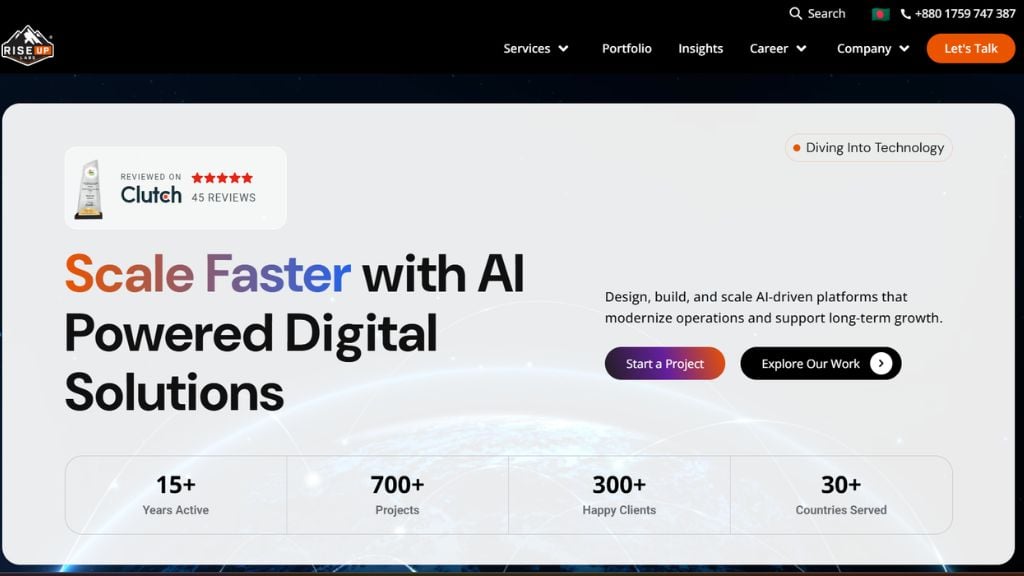
Riseup Labs is a strong option for businesses that need more than basic Python development. Its team works across backend engineering, APIs, SaaS products, AI integration, automation, QA, cloud infrastructure, and ongoing support.
Its Python services include Django, Flask, and FastAPI development, along with REST APIs, SaaS platforms, dashboards, data pipelines, workflow automation, and migration to Python-based systems. The company also works with PostgreSQL, MySQL, MongoDB, Redis, and other technologies commonly used in modern Python applications.
That mix of skills is useful because Python projects often grow beyond the original backend. A SaaS platform may start with Django, then need APIs, analytics, automation, AI features, or more advanced infrastructure as usage increases.
Riseup Labs reports 15+ years of experience, 700+ completed projects, 300+ global clients, and delivery across 30+ countries. It also offers project-based development, dedicated teams, and flexible engagement models.
Why Choose Riseup Labs?
- Strong experience with Django, Flask, and FastAPI
- End-to-end support across SaaS, APIs, AI, and automation
- Flexible options for dedicated teams or full-project delivery
- Support for QA, cloud, maintenance, and long-term scaling
Best suited for: SaaS companies, startups, growing businesses, and enterprises that want a flexible Python development partner for both launch and long-term growth.
2. STX Next — Best for Deep Python Engineering
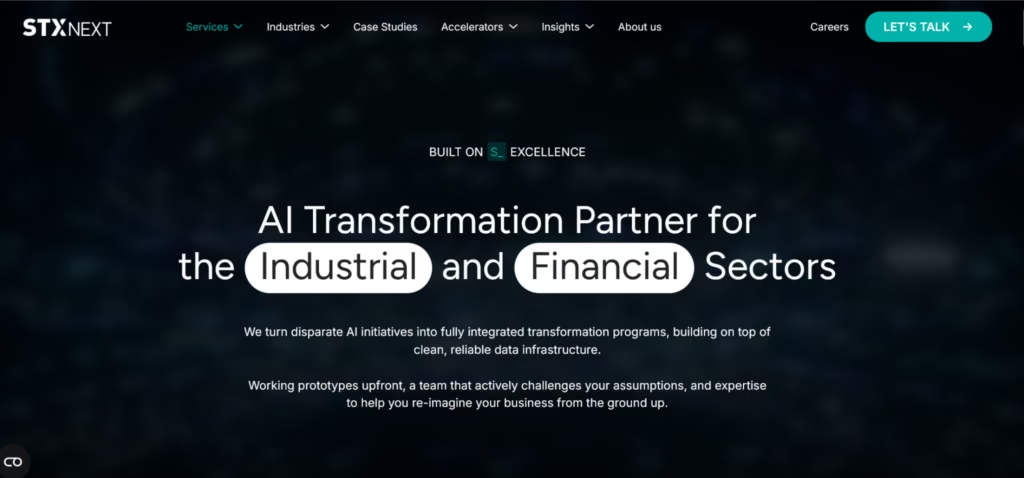
STX Next deserves a place near the top because Python is not simply one technology in a long service catalog. It has been central to the company’s engineering practice for roughly two decades.
Founded in 2005, STX Next reports 20 years of experience, around 500 professionals, and more than 1,000 delivered projects. Its current focus combines Python engineering with AI, data, cloud, and product design.
That makes it particularly attractive when Python itself is a major part of the technical challenge.
For example, a business building a data-heavy backend, AI application, or complex Python platform may benefit more from a Python-first engineering company than from a general software agency with a handful of Python developers.
Best suited for: Python-heavy products, AI applications, data platforms, backend systems, and businesses that want deep language specialization.
3. Brain Station 23 — Best for Enterprise Python, SaaS, and AI
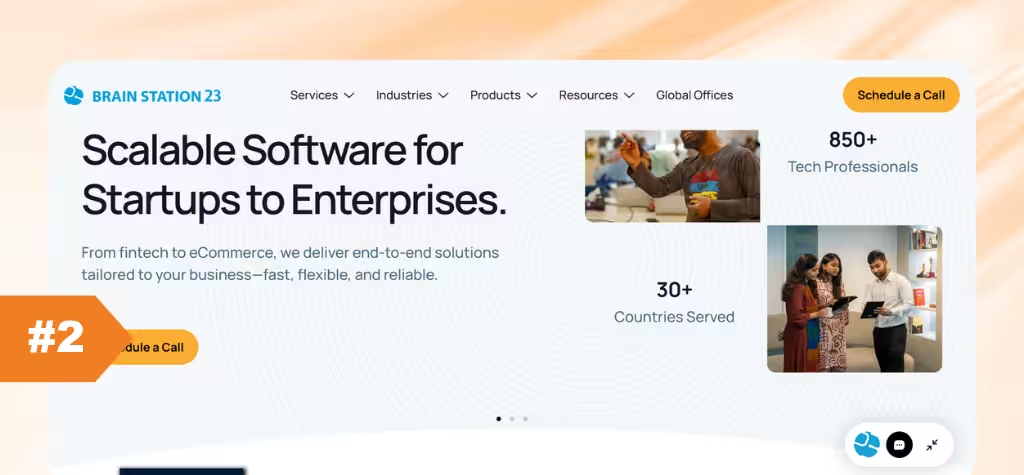
Brain Station 23 is another company I would include because it is already visible in the Python-development SERP and has substantial engineering scale.
The company was founded in 2006 and reports 900+ technology professionals, operations across 36+ countries, and 20+ years of experience. Python is part of a broader stack that also includes AI, cloud, enterprise software, fintech, ecommerce, and digital transformation.
Its own 2026 Python-company research describes its Python work across Django applications, SaaS backends, FastAPI and REST APIs, microservices, AI/ML, data engineering, and workflow automation. It also lists CMMI Level 3 and ISO 27001 among its credentials.
That breadth makes Brain Station 23 more relevant when a Python backend sits inside a larger system rather than being a standalone application.
Best suited for: enterprises, SaaS companies, fintech businesses, and organizations that need Python alongside AI, cloud, or larger engineering teams.
4. Itransition — Best for Enterprise Python Development and Modernization
Itransition has one of the more detailed Python service offerings in this comparison.
It reports 15+ years of Python application development experience and covers web applications, enterprise systems, APIs, prototyping, migration to Python, and 24/7 application support. Its toolkit includes Django, Flask, FastAPI, TensorFlow, scikit-learn, NumPy, pandas, PostgreSQL, MongoDB, Docker, AWS, Azure, and Google Cloud.
What makes Itransition particularly useful for larger organizations is its modernization capability.
If you already have an application written in another language, the company specifically offers migration to Python and integration with existing enterprise environments rather than requiring a clean-sheet rebuild.
It also supports several engagement models, from individual Python developers to dedicated teams and complete project outsourcing.
Best suited for: enterprise applications, legacy modernization, API-heavy systems, and companies that need long-term Python support.
5. Instinctools — Best for AI, Data, and Python Modernization
Instinctools combines Python development with a broader AI and data-engineering practice.
Its Python services cover custom development, APIs, application modernization, platform development, data analytics, machine learning, QA, and long-term maintenance. The company’s toolkit includes Django, Flask, FastAPI, PyTorch, TensorFlow, pandas, NumPy, scikit-learn, Celery, Docker, and several database technologies.
Instinctools reports 25+ years in technology, 400+ professionals, and 650+ completed projects. It also holds ISO 9001 and ISO 27001 certifications, among others.
I would shortlist it when the Python work is closely tied to analytics, AI, APIs, or an existing system that needs to be re-architected rather than simply rebuilt.
Best suited for: AI and analytics products, Python modernization, API development, and businesses that need a cross-functional engineering team.
6. ELEKS — Best for Python-Heavy Data and AI Projects
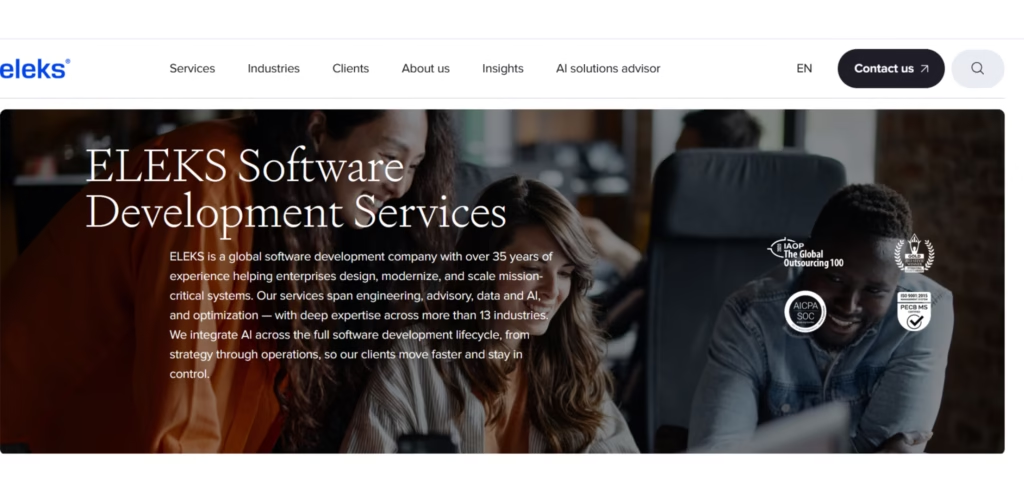
ELEKS is not a Python-only company, and that is exactly why it can make sense for certain projects.
Its stronger position is in enterprise software, data engineering, AI, machine learning, cloud, and modernization. The company reports more than 35 years of software-development experience, while its machine-learning practice cites over 1,000 delivered data-driven projects.
Python is commonly part of those workloads, particularly in machine learning, data pipelines, analytics, and AI systems.
I would consider ELEKS when your Python requirement is one component of a broader technical problem involving data platforms, ML models, cloud infrastructure, governance, or complex enterprise integration.
Best suited for: large enterprises, data platforms, machine learning, AI systems, and complex modernization programs.
7. Empat — Best for Startups and Product-Focused Python Teams
Empat is more product-oriented than many traditional outsourcing companies.
The company reports 10+ years in the market and 300+ delivered projects, with a growing focus on AI-driven development. Its Python offering covers web backends, Django, Flask, FastAPI, automation, and developers for industries including FinTech and healthcare.
That makes Empat particularly relevant for startups and product teams that need more than code.
A younger company may need help understanding requirements, selecting the right specialists, iterating quickly, and supporting the application immediately after launch. Empat says it provides one month of post-launch support and bug fixes with its Python developer engagements.
Best suited for: startups, product companies, MVPs, and teams that want Python developers within a broader product-development engagement.
8. Unico Connect — Best for Backend Systems, AI, and Data Engineering
Unico Connect has a practical Python offering built around backend systems, AI, and data.
Its developers work with Django, Flask, and FastAPI for REST and GraphQL APIs, alongside TensorFlow, PyTorch, and scikit-learn for machine learning. The company also covers data pipelines, ETL, automation, web scraping, middleware, and LLM or AI-agent development.
One area that stands out is its explicit use of AI-assisted engineering for code analysis, testing, and performance optimization.
That may be attractive if development speed matters, but I would still ask how AI-generated or AI-reviewed code is validated before production. Faster delivery only helps if testing and architecture remain strong.
Best suited for: API-first applications, AI products, data engineering, automation, and modern Python backends.
9. Clarion Technologies — Best for Python Web and Data Engineering
Clarion Technologies has a broad Python practice covering web development, APIs, AI, data engineering, IoT, microservices, migration, and application support.
Its web stack includes Django, Flask, and FastAPI, while its data-engineering services extend into ETL pipelines, cloud platforms, observability, and AI-ready data systems.
Clarion reports 25+ years of experience and positions its Python developers around cloud and AI as well as conventional web applications.
I would consider it when Python needs to support both an application layer and significant data-processing work behind it.
Best suited for: Python web applications, data engineering, microservices, cloud migration, and businesses that need extended development teams.
10. Sthenos Technologies — Best for SMBs and Custom Python Systems
Sthenos Technologies is smaller than several companies above, but that can be useful for businesses looking for a more focused engagement.
Its current services cover custom software, AI, cloud, legacy modernization, cybersecurity, and staff augmentation. Python is positioned particularly around data, machine learning, service backends, and automation.
The company also publishes its rates, currently stating 150–250 per hour, which is unusual and useful when comparing vendors.
Its positioning is strongest for small and mid-sized organizations that need custom development without hiring a very large enterprise consultancy.
Best suited for: SMBs, custom backend systems, Python automation, AI projects, and companies that prefer a smaller development partner.
Which Python Development Company Is Best for Your Project?
The best company depends on what Python is actually doing in your system.
| If Your Main Priority Is… | Companies to Consider |
| SaaS, APIs, and scalable web applications | Riseup Labs, Itransition |
| Deep Python specialization | STX Next, Instinctools |
| Enterprise Python development | Brain Station 23, Itransition |
| AI and machine learning | Riseup Labs, ELEKS, STX Next, |
| Startup or MVP development | Riseup Labs, Empat |
| Data engineering and pipelines | Clarion Technologies, Riseup Labs, Unico Connect |
| Modernizing an existing platform | Itransition, Instinctools |
| Smaller custom development engagements | Sthenos Technologies, Empat |
If I were building a shortlist, I would choose three companies whose strengths overlap with the hardest part of the project, not simply the first three in a ranking.
For example, Riseup Labs makes more sense when you need Python web development plus APIs, SaaS, automation, or AI integration. STX Next is more compelling when deep Python specialization is the priority. Itransition becomes stronger when modernization and enterprise integration are likely to dominate the work.
What Should a Python Development Company Be Able to Do?
A good Python development company should do more than assign developers who know the syntax.
The team should be able to help you make decisions around:
- Framework choice: Django, Flask, FastAPI, or another approach
- Backend architecture: APIs, microservices, databases, caching, and asynchronous workloads
- Cloud and DevOps: AWS, Azure, GCP, containers, CI/CD, and monitoring
- Data and AI: pipelines, analytics, machine learning, LLM integrations, and automation
- Security and QA: testing, permissions, secure APIs, code reviews, and deployment controls
- Long-term maintenance: version upgrades, performance optimization, bug fixes, and scaling
The important point is that these pieces affect each other.
A framework that works perfectly for an MVP may become awkward if the architecture was never designed for the traffic, data, or integrations you eventually need.
How Much Does Python Development Cost in 2026?
Python development costs vary considerably by geography, team seniority, and project scope.
As a broad planning range, offshore development teams may charge around 25–50 per hour, while experienced North American or Western European teams can reach 60–120+ per hour. More specialized firms may charge considerably more. Sthenos Technologies, for example, currently publishes a rate of 150–250 per hour.
For complete projects, a rough planning range could look like this:
| Python Project | Typical Planning Range |
| Small API or automation | 5,000–20,000+ |
| MVP or basic web application | 15,000–50,000+ |
| Custom SaaS platform | 40,000–150,000+ |
| AI or data-heavy application | 50,000–200,000+ |
| Enterprise Python platform | 100,000–500,000+ |
These should be treated as budgeting ranges, not market-standard prices.
The biggest cost drivers are usually team seniority, architecture, integrations, AI or data requirements, security, cloud infrastructure, QA, and the amount of post-launch support required.
How to Choose the Right Python Development Company
Choosing a Python company should start with your project, not the vendor list.
Check Relevant Python Experience
Ask which Python frameworks the team uses regularly and where it has used them in production.
If you are building a large web platform, Django experience may matter most. If your project is API-heavy, FastAPI may be more relevant. For AI or analytics, you need people who understand the Python data ecosystem rather than only web frameworks.
Review Similar Projects
A long portfolio is less useful than one or two genuinely comparable projects.
Look for similarities in:
- Architecture
- Integrations
- Data volume
- User scale
- Security requirements
- Industry
Then ask what the company was actually responsible for.
Evaluate the Actual Team
Do not evaluate only the agency.
Ask who will work on the project, how senior they are, and whether architects, QA engineers, DevOps specialists, and project managers are included.
The quality of the team assigned to you matters more than the size of the company.
Check the Development Process
Ask how code moves from development into production.
A healthy process should include code reviews, automated testing, CI/CD, monitoring, documentation, and a clear release process.
Discuss Security Early
If your application handles financial, healthcare, customer, or proprietary data, security should be discussed before development begins.
Ask about authentication, authorization, encryption, infrastructure, backups, secure coding, vulnerability testing, and any relevant compliance requirements.
Think Beyond Version One
Python applications often grow quickly because the language makes it easy to add APIs, automation, AI, and data features.
Ask how the proposed architecture will handle that growth and what post-launch support is available.
A company that can launch the first version but cannot maintain or scale it is only solving half the problem.
Common Mistakes When Hiring a Python Development Company
The cheapest hourly rate can be expensive if it produces poor architecture, constant rework, or a system that needs to be rebuilt a year later.
Other common mistakes include:
- Hiring based only on ratings
- Skipping technical interviews
- Not checking similar projects
- Choosing a framework before understanding the problem
- Ignoring QA and DevOps
- Failing to clarify code and IP ownership
- Underestimating security
- Not planning for maintenance
One useful approach is to start with a short discovery phase or technical assessment before committing to a large build.
That gives you a chance to evaluate how the company thinks, not just how well it sells.
Why Consider Riseup Labs for Python Development?
Riseup Labs is particularly relevant when Python is only one part of what the final product needs.
Its offering extends from Django, Flask, and FastAPI development into SaaS, APIs, automation, data dashboards, pipelines, AI integration, security hardening, migration, QA, and ongoing maintenance.
That makes it easier to keep architecture, development, QA, infrastructure, and future product work within one engineering relationship instead of coordinating several vendors.
For businesses expecting the application to evolve after launch, that broader capability is one reason Riseup Labs deserves a place near the top of the shortlist.
Final Thoughts
The best Python development company is not necessarily the one with the most developers or the lowest hourly rate.
It is the one that understands what your application needs to become, not just what needs to be coded today.
For deep Python specialization, STX Next is an obvious company to investigate. Brain Station 23 and Itransition are stronger fits for larger enterprise environments, while ELEKS makes sense for demanding AI and data programs.
For businesses that want Python development together with SaaS, API, automation, AI, and long-term product support, Riseup Labs is one of the stronger all-around options to shortlist.
Start with two or three companies that match your biggest technical risks, then compare their architecture, relevant projects, team, security practices, communication, and what happens after launch.
Frequently Asked Questions
What Are the Best Python Development Companies in 2026?
Some of the best Python development companies to consider in 2026 include Riseup Labs, STX Next, Brain Station 23, Itransition, Instinctools, ELEKS, Empat, Unico Connect, Clarion Technologies, and Sthenos Technologies. The best fit depends on whether you need web development, AI, data, SaaS, modernization, or extended engineering teams.
How Much Does It Cost to Hire a Python Development Company?
Python development rates can range from roughly $25 per hour to well above $100 per hour, depending on region, seniority, and specialization. Complete projects may cost from several thousand dollars for simple automation to hundreds of thousands for complex enterprise systems.
Which Python Framework Is Best?
There is no single best Python framework. Django works well for feature-rich web applications, Flask is useful when you want a lightweight and flexible framework, and FastAPI is a strong choice for high-performance APIs and modern backend services.
Is Python Good for AI Development?
Yes. Python is widely used for SaaS backends, APIs, authentication, billing workflows, analytics, automation, integrations, and AI functionality. Django and FastAPI are particularly common choices for SaaS products.
Can Python Be Used for SaaS Development?
Yes. Python is widely used for SaaS backends, APIs, authentication, billing workflows, analytics, automation, integrations, and AI functionality. Django and FastAPI are particularly common choices for SaaS products.
Should I Hire Python Developers or a Python Development Company?
Hire individual developers when you already have strong internal technical leadership. A Python development company is usually more suitable when you also need architecture, QA, DevOps, project management, design, or end-to-end responsibility for delivery.
This page was last edited on 8 October 2026, at 5:06 pm

Start a conversation with our team to solve complex challenges and move forward with confidence.